Microsoft MAI Models Beyond Code: Pricing and Performance
Microsoft AI used Ignite 2026 to widen its first party MAI family well past coding. On November 17, 2026 it announced seven MAI models in total. The two coding models, covered in the companion piece on MAI Code 2, are only one axis. The rest of the family is MAI Cyber 2 Flash for security work, MAI Image 2.7 and 2.7 Flash for image editing, MAI Realtime 1 for speech to speech, MAI Transcribe 2 running inside Dragon Copilot, and the Decision 1.1 routing model.
The shared argument is price per task, not a single headline score. Security scanning, image editing and realtime voice all run continuously and at high volume, so a small model that matches a frontier model on one narrow job can undercut it on total cost even when the frontier model is stronger overall. Every performance and cost figure in this launch comes from Microsoft itself, and that caveat applies to each section below.
MAI Cyber 2 Flash Pricing and Benchmark Conditions
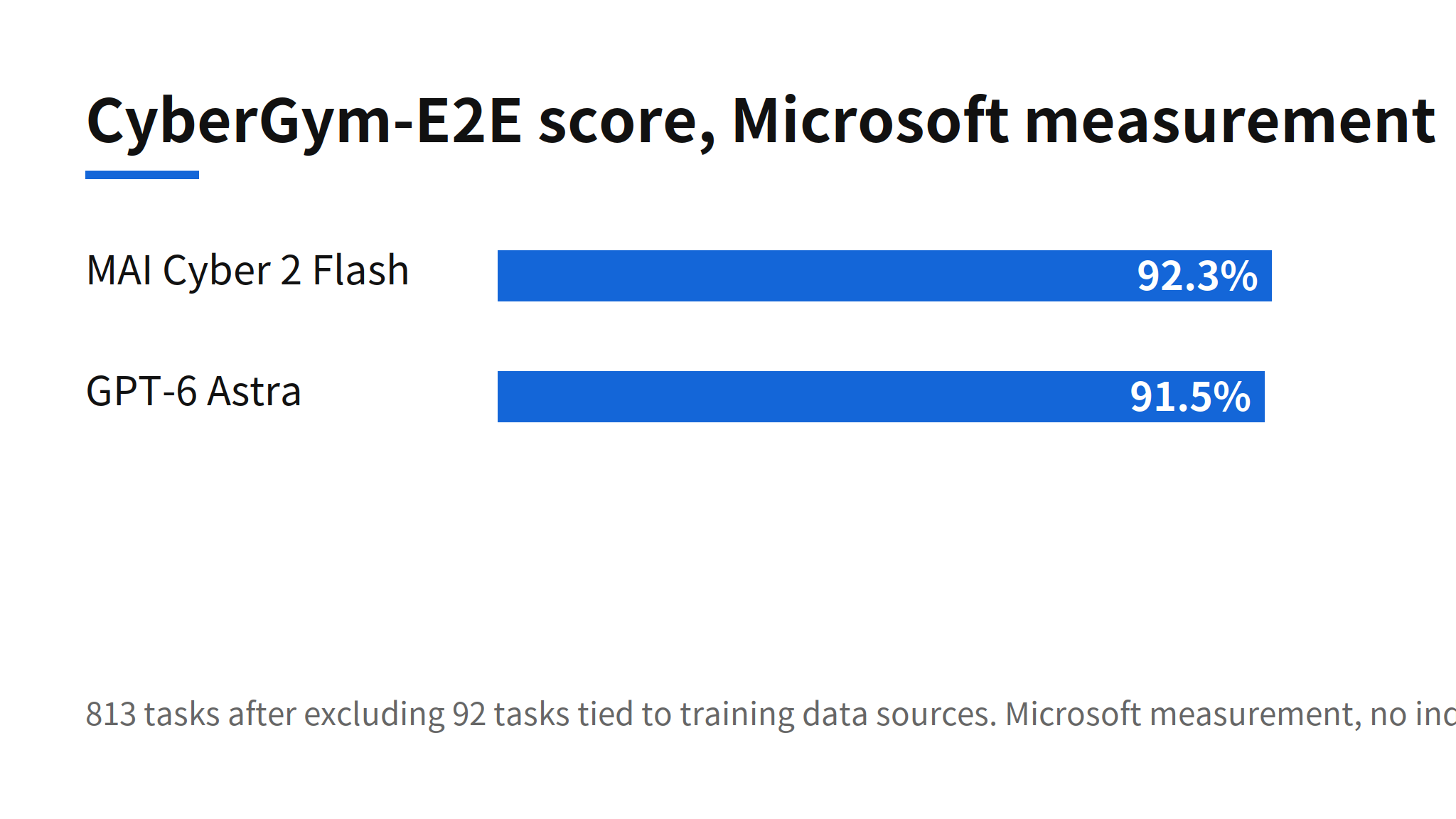
Cyber 2 Flash scored 92.3% on CyberGym-E2E, close to GPT-6 Astra at 91.5%, while Microsoft puts its cost at under 2% per task. The context window is 1 million tokens, four times MAI Cyber 1.1 Flash. Pricing is $0.10 per million input tokens, $0.01 cached input and $0.50 output, and the output price is 86% lower than Cyber 1.1 Flash. For a scanner that reads whole repositories, the larger window and the cheaper output side matter more than a small benchmark lead.
The benchmark carries an integrity note that deserves attention. Of 905 CyberGym-E2E tasks, 92 were built from the same open source projects and vulnerability reports present in training data, so Microsoft excluded those 92 for every model and scored the remaining 813 tasks. That is a cleaner methodology than reporting the raw total, and it is still a vendor run benchmark with no independent verification published yet.
Distribution is narrow by design. Cyber 2 Flash ships only inside Microsoft security products, and from mid December it will automatically replace the existing models in the MAI profile of eligible customers in Codename MDASH. Microsoft says existing MAI Cyber models already handle almost 40% of MDASH scans, so the replacement changes the cost base of a running service rather than launching a new one.
MAI Image 2.7 Ranking, Foundry Pricing and Canvas
Image 2.7 took first place on the Artificial Analysis AA-Image-Editing v2.1 leaderboard with 1,215 Elo from 5,478 votes, ahead of GPT Image 2.6 Sunburst (max) by only 4 Elo, at about one fifth of the cost. The ranking is dated November 16, 2026, and a 4 Elo gap is within the range where a leaderboard can move quickly, so the durable claim is the price ratio rather than the rank itself.
In Microsoft Foundry public preview, Image 2.7 costs about $35 per 1,000 images and Image 2.7 Flash about $10 per 1,000 images. The Flash model also powers Canvas, a conversational image workspace released in MAI Labs at the same time. MAI Image is already the default model family in Bing Image Creator, and Microsoft says usage has grown at a compound rate of about 14.7% per week since June, which gives the cheaper Flash tier a large existing surface to absorb.
My read: the pattern across this family is consistent. Microsoft is not trying to win every general benchmark. It is placing a specialised, much cheaper model inside each high volume surface it already owns, from MDASH scans to Bing image creation to clinical transcription, and letting cost per task do the persuading.
MAI Realtime 1, Transcribe 2 and Decision 1.1
Realtime 1 is Microsoft's first realtime speech to speech model, priced from $0.01 per minute of audio, and Microsoft says its own evaluation put it ahead of GPT-Realtime 2.1 on quality, speed and price. It is compatible with the OpenAI Realtime API, which lowers the switching cost for teams already built on that interface. One costing detail stays unresolved: inference billing is separate from the voice charge, and the footnote in the overview post is incomplete, so the true combined cost per minute is unconfirmed.
Transcribe 2 reaches users through a product rather than an API launch. As Dragon Copilot Transcribe, it is live inside Dragon Copilot and handles transcription of clinician and patient conversations, which Microsoft puts at 10 million patient encounters per month, with multilingual error rates cut in half. Clinical transcription is a workload where accuracy, latency and audit requirements are all strict, so a dedicated model has a clearer case than a general speech model retuned for the job.
Decision 1.1 is the least visible and possibly the most structural piece. Microsoft says 4,000 customers use the routing model, and that it is 50 times faster and 79 times cheaper than GPT-6.1 Sol on its own measurements. A cheap router decides which model handles each request, so its economics shape the cost of everything behind it.
Licensed Weights and Maia 200
Alongside the models, Microsoft announced MAI Licensed Weights, a way for customers to deploy and customise frontier MAI models inside their own Azure environment, offered soon through Frontier Company contracts. The contract terms are not public and the timing is only described as soon, so this is an option to watch rather than a purchasable product today. If it ships as described, it widens the choice between renting a model through an API and holding the weights under your own controls.
The hardware note underneath the launch is Maia 200, Microsoft's second generation AI accelerator. Microsoft says it is now in production running its largest models, at 1.7 times the tokens per watt. Owning the silicon is part of how the price claims above become plausible, since inference cost is where these specialised models have to win.
Limits and Unconfirmed Points
- All figures are Microsoft measurements: the Cyber, Image, Realtime and Decision numbers have no independent verification published yet.
- The Image 2.7 lead is small: 4 Elo on a leaderboard dated November 16, 2026, so rank can change while the price gap remains the stronger claim.
- Realtime 1 total cost is unconfirmed: inference is billed separately from the $0.01 per minute voice charge, and the combined figure is not stated cleanly.
- Licensed Weights terms are unpublished: availability is described as soon, through Frontier Company contracts with no public conditions.
- Cyber 2 Flash is not a general API product: it is limited to Microsoft security products and the MDASH replacement path from mid December.
FAQ
What did Microsoft launch besides the MAI coding models?
On November 17, 2026 Microsoft AI announced MAI Cyber 2 Flash for security, MAI Image 2.7 and 2.7 Flash for image editing, MAI Realtime 1 for speech to speech, MAI Transcribe 2 inside Dragon Copilot, and the Decision 1.1 routing model. The two coding models were covered separately.
How much does MAI Cyber 2 Flash cost?
Microsoft lists $0.10 per million input tokens, $0.01 per million cached input tokens and $0.50 per million output tokens. The output price is 86% lower than MAI Cyber 1.1 Flash, and the context window is 1 million tokens.
How did MAI Image 2.7 rank on image editing?
MAI Image 2.7 ranked first on the Artificial Analysis AA-Image-Editing v2.1 leaderboard as of November 16, 2026, with 1,215 Elo from 5,478 votes, 4 Elo ahead of GPT Image 2.6 Sunburst (max), at about one fifth of the cost according to Microsoft.
What is MAI Licensed Weights?
MAI Licensed Weights lets customers deploy and customise frontier MAI models inside their own Azure environment. Microsoft says it will be offered soon through Frontier Company contracts, and the contract terms have not been published.
Related Reading
- MAI Code 2 in GitHub Copilot: Pricing and Performance, the coding half of the same November 17 MAI family launch
- GPT-6 Cyber Release: ExploitGym 48.5% and Critical Rating, the competing security model Cyber 2 Flash is priced against
- Seedream 5.5 Release: 100-Round Editing, Pricing and Scores, another image editing model competing on editing quality and price