MAI Code 2 in GitHub Copilot: Pricing and Performance
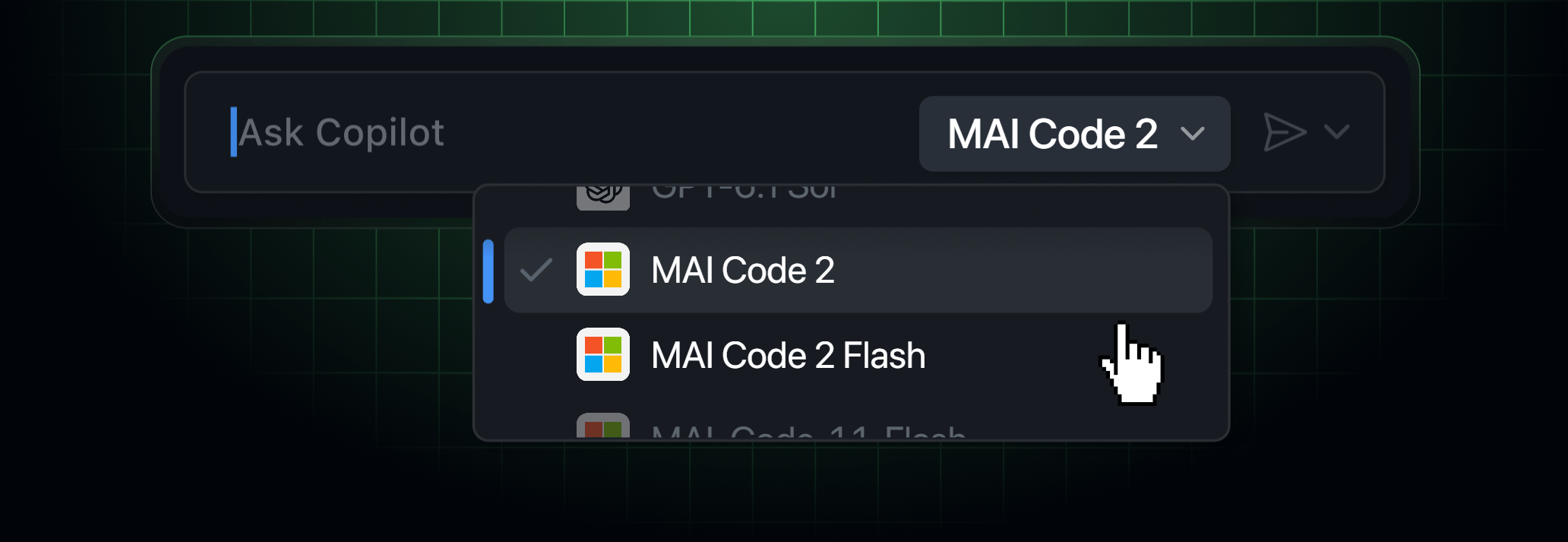
Microsoft launched its own coding models inside GitHub Copilot on November 17, 2026. MAI Code 2 is the general purpose model, built for deep debugging, multi-file implementation, refactoring and repository-wide reasoning. MAI Code 2 Flash is the lightweight model for code explanations, targeted edits, routine fixes and rapid iteration. Both are billed on a usage basis, and both sit in the same model picker as the OpenAI and Anthropic models Copilot already offers.
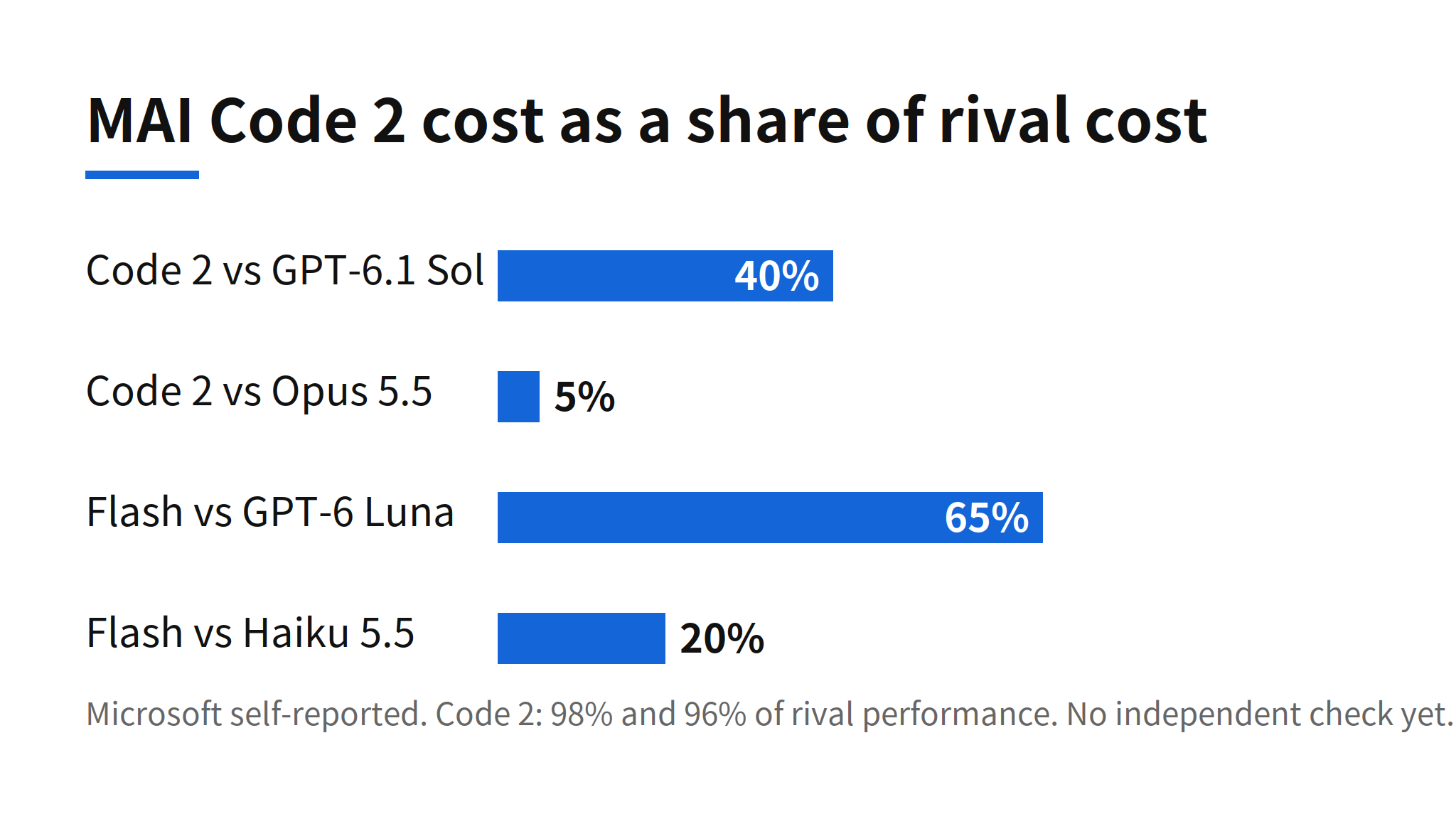
The headline claim is about price, not raw score. Averaged over four benchmarks, Microsoft says MAI Code 2 delivers 98% of GPT-6.1 Sol performance at 40% of the cost, and 96% of Claude Opus 5.5 performance at 5% of the cost. If those ratios hold on real repositories, the practical effect is simple: a team can route everyday coding work to a much cheaper model and reserve frontier models for the tasks that actually need them. The catch is that every number in this launch comes from Microsoft itself, a point this article returns to below.
Performance Claims and Measurement Conditions
The four benchmarks behind the MAI Code 2 average are DeepSWE 1.1, Terminal Bench 2.1, SWE-Atlas and FrontierCode v1.1. Microsoft chose them because they target the everyday enterprise coding work it sees in Copilot, which is a reasonable framing and also a favourable one: a vendor average over benchmarks the vendor selected tells you how the model performs on the vendor's definition of everyday work. The Flash figures rest on three benchmarks for high-volume routine tasks, and Microsoft does not name all of the underlying per-benchmark scores in the announcement summary.
The one human evaluation in the launch points the same way. In blind frontend app evaluations, reviewers preferred MAI Code 2 output over GPT-6 Sol 64% of the time, and Microsoft says the model is tuned for dashboards and visual coding. Frontend work is where cheap models often fail in visible ways, so a blind preference win is more informative than another synthetic score. It is still a Microsoft-run evaluation, with the task set and reviewer pool undisclosed.
My read: the interesting move is strategic, not technical. Copilot was a distribution channel for other labs' models. With MAI Code 2, Microsoft now competes inside its own picker on price, and it sets the default enablement rules for that picker. Even if the 98% figure softens under independent testing, a credible in-house option at 40% of the cost changes the pricing conversation for every other model listed there.
Plans, Surfaces and Model Selection
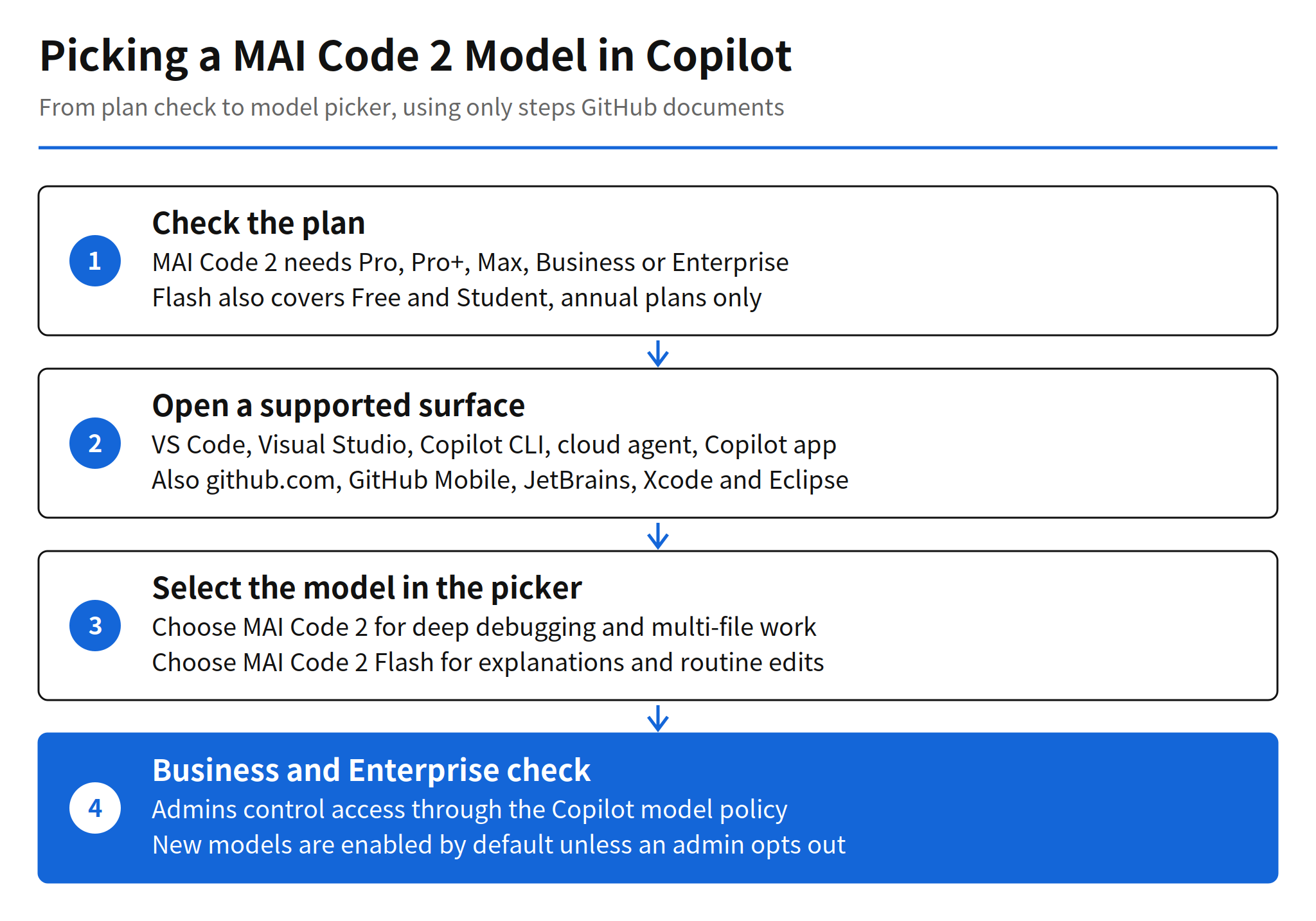
Access splits by tier. MAI Code 2 is available on Copilot Pro, Pro+, Max, Business and Enterprise. MAI Code 2 Flash reaches further down, covering Free, Student, Pro, Pro+, Max, Business and Enterprise. Both models are limited to eligible subscribers on annual plans, and both are billed under usage-based billing rather than a flat included allowance, so the cost ratios above are the numbers that decide real bills.
The picker is available in Visual Studio Code, Visual Studio, Copilot CLI, the Copilot cloud agent, the Copilot app, github.com, GitHub Mobile, JetBrains, Xcode and Eclipse. For Business and Enterprise, administrators manage access through the model policy in Copilot settings. Under default model enablement, new models turn on automatically unless an administrator has disabled the global default or the specific model, which means many organisations will get MAI Code 2 without anyone making an explicit decision. That default is worth checking before a usage-billed model starts absorbing traffic.
From MAI Code 1 Flash to Agentic Work
The MAI-Code family started in June 2026 with MAI Code 1 Flash, a lightweight assistance model. GitHub describes the second generation as the step from that lightweight assistance to complex, agentic software engineering: focused responses, practical code changes and less back and forth on multi-step tasks. The launch also lands inside Microsoft's Ignite 2026 wave of in-house models, with coding as one axis of a broader first-party model push that Reuters covered the same day as a direct challenge to Anthropic and OpenAI.
That context explains the benchmark selection. A model aimed at everyday enterprise tasks does not need to win long-horizon research problems, and Microsoft says so openly: the models are explicitly not yet tuned for fundamental science research or very long horizon agentic work. The honest scope makes the price claim easier to judge, because the comparison is confined to the routine work most Copilot seats actually do.
Limits and Unconfirmed Points
- All performance and cost figures are Microsoft measurements: no independent verification of the 98%, 96%, 64% or Flash figures has been published yet.
- Scope limits are stated by Microsoft itself: the models are not yet tuned for fundamental science research or very long horizon agentic work.
- Foundry availability is unconfirmed: reporting by SiliconANGLE describes MAI Code 2 Flash on Microsoft Foundry as a limited preview, so availability outside Copilot is not settled.
- Usage billing decides the real saving: the models are billed by usage and limited to annual plan subscribers, so the headline cost ratios apply only within that billing structure.
FAQ
What are MAI Code 2 and MAI Code 2 Flash?
They are Microsoft AI coding models launched in GitHub Copilot on November 17, 2026. MAI Code 2 is the general purpose model for deep debugging, multi-file implementation, refactoring and repository-wide reasoning. MAI Code 2 Flash is the lightweight model for code explanations, targeted edits and routine fixes.
How fast and cheap does Microsoft claim MAI Code 2 is?
Averaged over DeepSWE 1.1, Terminal Bench 2.1, SWE-Atlas and FrontierCode v1.1, Microsoft says MAI Code 2 delivers 98% of GPT-6.1 Sol performance at 40% of the cost, and 96% of Claude Opus 5.5 performance at 5% of the cost. These are Microsoft measurements with no independent verification yet.
Which Copilot plans include the new models?
MAI Code 2 is available on Copilot Pro, Pro+, Max, Business and Enterprise. MAI Code 2 Flash is available on Copilot Free, Student, Pro, Pro+, Max, Business and Enterprise. Both are limited to eligible subscribers on annual plans and are billed on a usage basis.
Where can the models be selected?
GitHub lists Visual Studio Code, Visual Studio, Copilot CLI, the Copilot cloud agent, the Copilot app, github.com, GitHub Mobile, JetBrains, Xcode and Eclipse. Business and Enterprise administrators control access through the Copilot model policy.
Related Reading
- GitHub Copilot in Slack and Teams: Generally Available, Copilot expanding into the collaboration surfaces teams already use
- Copilot Code Review API Management: Settings and Models, the admin and model controls behind Copilot code review
- Claude Code 2.1.326 Release: Code Mode and Teams, the competing coding agent stack MAI Code 2 now prices itself against