Copilot Code Review API Management: Settings and Models
GitHub announced on November 6, 2026 that Copilot code review settings can now be managed through the REST and GraphQL APIs, at every level from enterprise policy down to an individual repository. The update applies to the Copilot Pro, Pro+, Max, Business and Enterprise plans. Until now these settings lived only in settings screens. Requesting a review and assigning an effort level were already possible through the API, but the policy itself had no code path, so an organization could automate reviews while still clicking through screens to configure them.
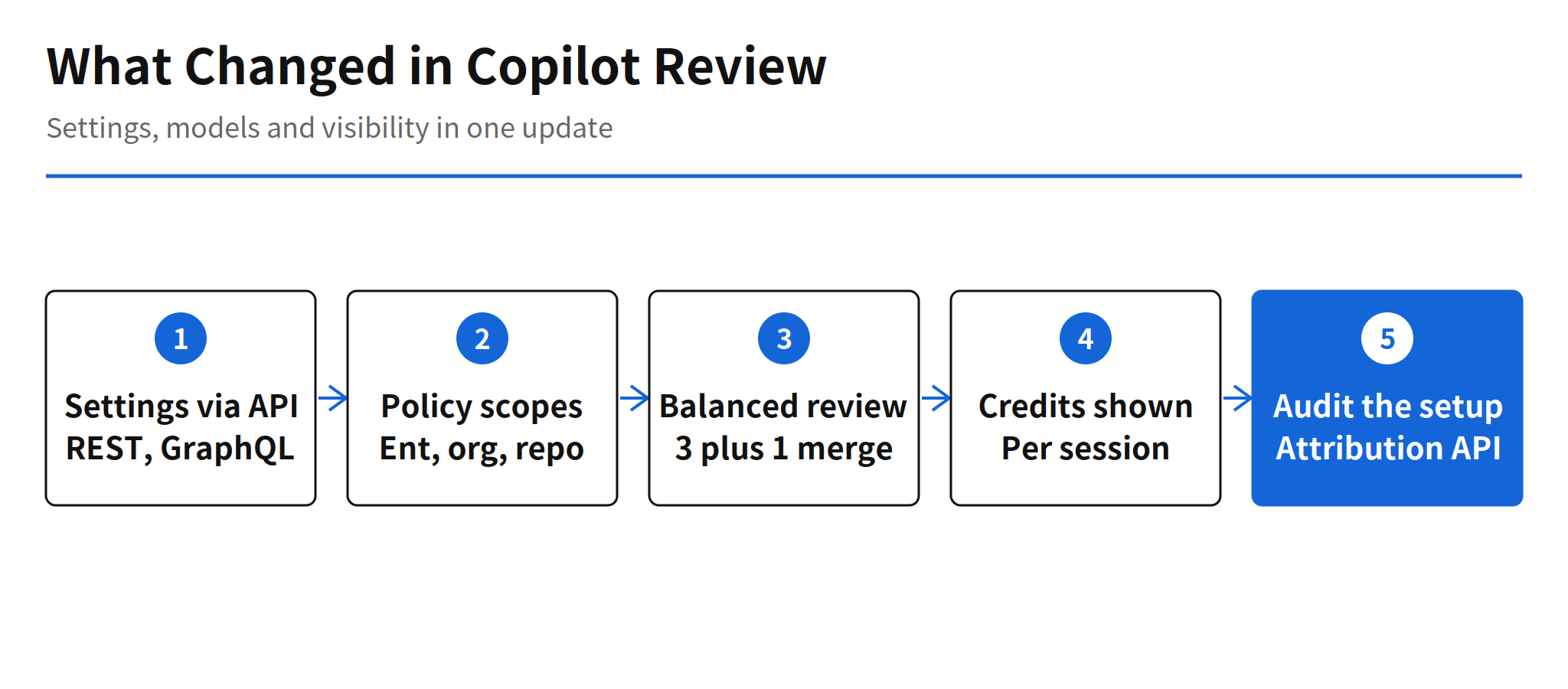
That gap is the real subject of this release. A review agent becomes a team standard only when its configuration is code: the default effort, which tools it may use, and where it is switched on at all. GitHub also changed how the balanced effort tier runs, splitting each review across three models, and added the attribution and credit data that automation pipelines need in order to trust and budget the output.
Settings as Code at Three Scopes
The API mirrors the existing admin hierarchy. Enterprise admins can turn code review on or off across the whole enterprise. Organization admins manage the default review effort and the runner configuration. Repository admins manage review effort for their repos, along with custom instructions and whether MCP tools may be used. Because the same settings now have an API form, an enterprise review policy can be deployed by script and audited the same way, instead of being reconstructed from screenshots whenever someone asks what is actually enforced.
One limit shapes how far that automation goes today. The enterprise and organization settings endpoints do not support GitHub Apps or fine-grained personal access tokens. Only the repository settings endpoints support both. Teams that run their platform automation through a GitHub App will hit that boundary at exactly the two scopes where central policy lives, so the top-level rollout still needs a supported credential path that the changelog post defines.
Balanced Reviews Split Across Three Models
A review at balanced effort is no longer one model's pass. Three reviewer models now divide the review between them, and a separate model merges their results into the final review. Splitting the work is a sensible response to a known weakness of single model review, where one model's blind spots become the review's blind spots. A merger model can drop duplicates and reconcile conflicting comments, although GitHub has not disclosed the names of the three reviewer models or the criteria the merger applies, so the quality of that reconciliation cannot be judged from outside yet.
Reliability handling changed in the same release. A review that fails or times out is retried automatically once, and if the preferred model is unavailable the review switches to another eligible model instead of failing outright. For teams that gate merges on Copilot review, that fallback matters more than the model split, because a review that silently never arrives blocks a pipeline in a way a mediocre review never does.
Attribution, Credits and the Compact Overview
API responses now carry explicit attribution fields that identify which reviews and comments came from Copilot. The API also exposes the review effort a review used and which skills, MCP servers and custom instructions grounded a given comment. That is the data an automation pipeline needs before it can act on review output: provenance for each comment, and a way to tell a Copilot comment from a human one without scraping the UI.
Cost visibility arrived alongside provenance. Code review agent sessions now show the AI credits a review consumed, which gives teams the per-session numbers required to decide whether raising the default effort is worth it. On the reading side, the review overview comment is more compact, with the review effort and the survey moved into the footer. In follow-up reviews on the same pull request, comments unrelated to the recent changes are collapsed and then hidden, although the detailed criteria for that hiding are unconfirmed.
Related Reading
For another coding agent update built around MCP plumbing, see the report on Claude Code 2.1.319 and background MCP tasks. For cloud-hosted coding sessions, see Antigravity remote agents.
FAQ
Which Copilot plans include the code review API management update?
The update is available on Copilot Pro, Pro+, Max, Business and Enterprise plans, according to the GitHub Changelog post of November 6, 2026.
What can admins control at each settings level?
Enterprise admins can turn code review on or off across the enterprise. Organization admins manage the default review effort and runner configuration. Repository admins manage review effort, custom instructions and whether MCP tools are used.
How does a balanced Copilot review work now?
A balanced effort review is now split among three reviewer models, and a fourth model merges their results. GitHub has not disclosed the names of the three reviewer models or the criteria the merging model uses.
Do the new settings endpoints support GitHub Apps and fine-grained tokens?
Only at the repository level. The enterprise and organization settings endpoints do not support GitHub Apps or fine-grained personal access tokens, while the repository settings endpoints support both.