Seedream 5.5 Release: 100-Round Editing, Pricing and Scores
ByteDance Seed released Seedream 5.5 on November 9, 2026, a new image generation model built around editing sessions instead of single generations. The model can edit the same image up to 100 times in a row while keeping unedited areas intact at pixel level, it generates transparent RGBA assets natively, and it improves realism and small text rendering over Seedream 5.0 Pro.
The pricing moves with the capability. Generation runs about 40% faster than the previous generation, and BigGo Finance reports that one 2K square image edit through the API costs about 0.28 yuan, less than half the previous price. The competitive question in image models is shifting from how good the first output looks to how much correction work a model can absorb before the image falls apart, and Seedream 5.5 is aimed directly at that shift.
Three Upgrades in Seedream 5.5
The first upgrade is multi-round editing. In the workflow Seedream targets, a generated image becomes the input for the next edit, and small color shifts and detail losses normally compound with every round. Seedream 5.5 is designed to hold unedited regions stable while the requested change is applied, so a long session does not quietly rewrite the parts nobody touched.
The second upgrade is native transparent output. The model produces assets with an RGBA transparency channel from the start, which removes the background removal and edge cleanup steps that usually sit between generation and layout. For design work, that turns a generated object into a compositing ready asset in one step instead of three.
The third upgrade is rendering quality, with realism and small text as the named targets. Text inside images has been a persistent failure point for image models, and ByteDance Seed reports severe text corruption down to 0.4% in its evaluation. The sample outputs below show the photorealistic range the release is built on, across portrait, interior, still life and transit scenes.

Editing Stability Across 100 Rounds
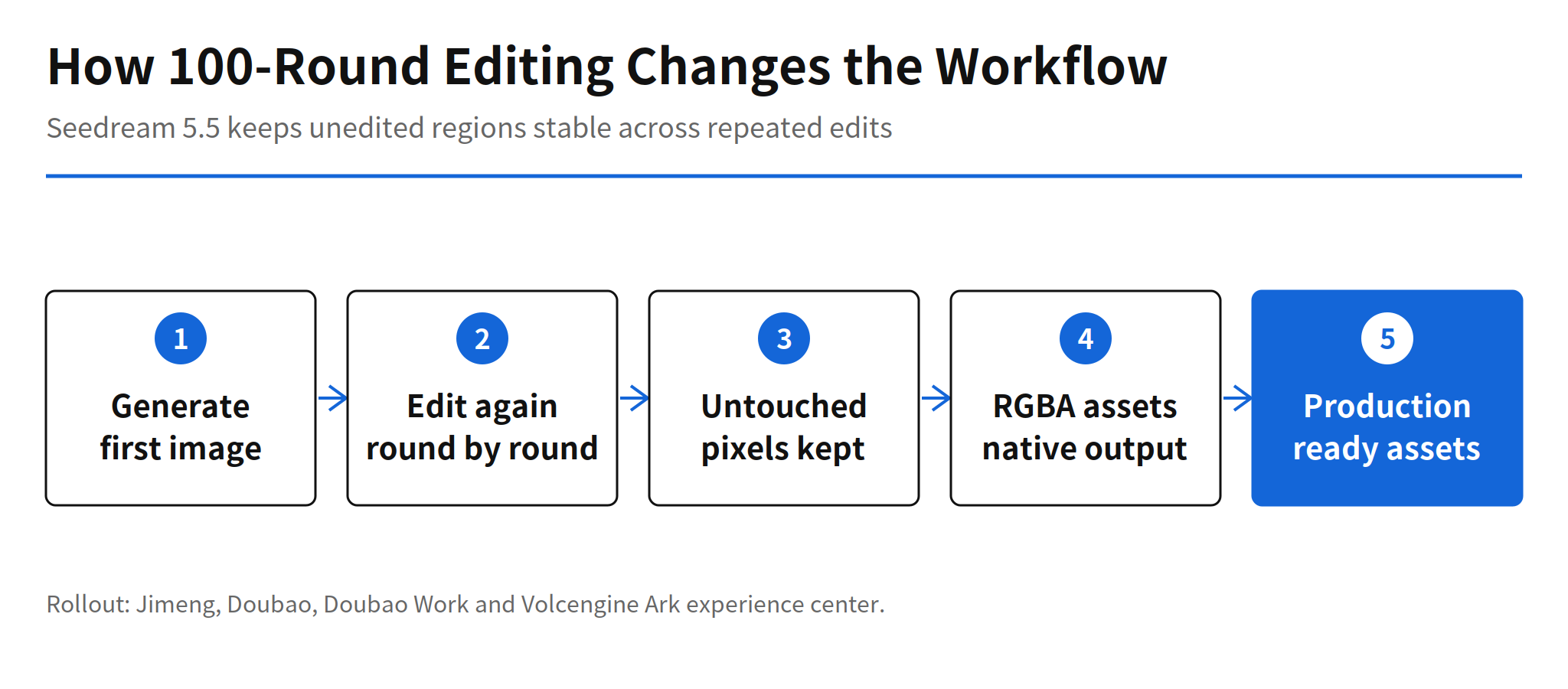
In the 100-round demonstration ByteDance Seed published, clothing, accessories and objects on a table were changed again and again, and small items such as a ring and glasses frames were still edited accurately at the end of the run. Pose, occlusion and lighting stayed consistent across the session. A single vendor demonstration is not proof of field performance, and the issue record is explicit that the preservation level on user images has to be checked by direct use. The direction of the claim still matters, because it defines what the model is for.
If edits stop degrading the untouched parts of an image, the model stops being a one-shot generator and becomes a revision tool. That is the role production teams actually need filled. Commerce and marketing work rarely ends at the first acceptable image; it continues through dozens of small corrections, swaps and local fixes. A model that survives that process at a low per-edit price competes with manual retouching time, not just with other generators.
Benchmark Scores and Text Rendering
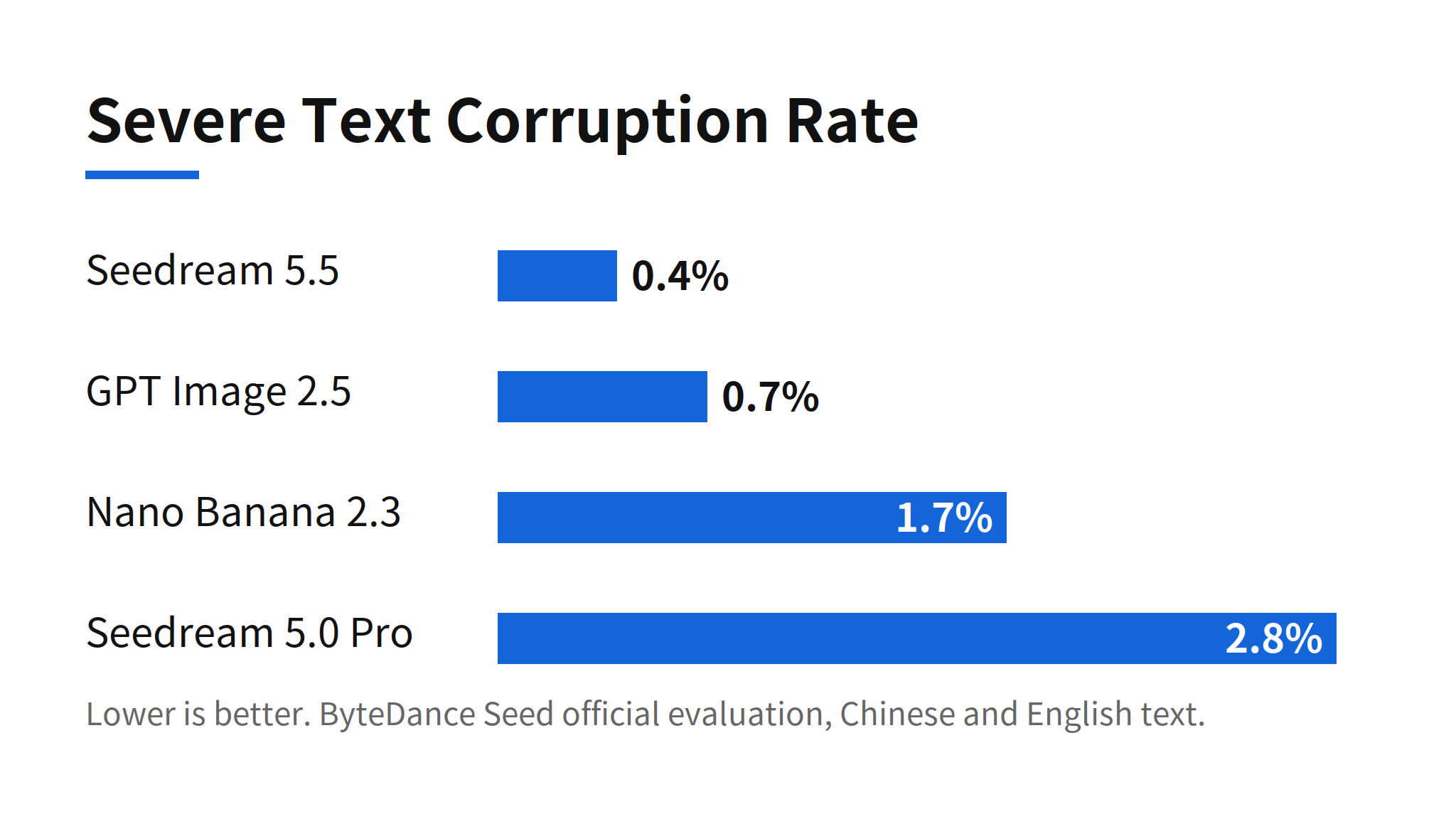
In expert pairwise GSB evaluation, Seedream 5.5 scored positive on all four comparisons against Seedream 5.0 Pro, with image-to-image realism at +55.62%. Against GPT Image 2.5 Sunburst and Nano Banana 2.1, it placed ahead on text structure in both tasks ByteDance Seed reported. Reported text corruption across Chinese and English evaluation was 0.4% severe and 1.7% minor.
In the MagicArena evaluation, quality scores and usable rates rose across all six use cases: e-commerce, marketing, film and television, gaming, office productivity and fashion design. In film and television and in office productivity, the usable rate more than doubled against the previous version. A doubling of usable rate is the kind of figure production teams feel directly, since it halves the number of generations discarded before one can ship.
Every one of these numbers is a ByteDance figure. The prompt composition and blind procedure behind MagicArena are not public, and no independent benchmark has tested the model yet. The scores are best read as a vendor claim with a specific shape, strong on editing stability and text, rather than as settled rankings. Independent testing, especially on the 100-round claim with user supplied images, is the missing piece.
Rollout, Speed and Pricing
The rollout is sequential across ByteDance surfaces: the Jimeng web creation tool and canvas, the Doubao app and web image generator, a Doubao Work skill, and the Volcengine Ark visual model experience center. That spread puts the model in front of casual creators and API evaluators at the same time, which fits a release whose headline features are workflow features rather than a single quality jump.
Two practical limits are already visible. The timing of a United States market release and the scope of third-party API access are not confirmed, per Crypto Briefing reporting. ByteDance Seed has also not disclosed the model architecture or parameter count. A Pro version of Seedream 5.5 is planned to follow, so the current release is the base of a series rather than its top end.
Open Questions and Limits
- All performance figures are vendor figures. The MagicArena prompt set and blind procedure are undisclosed, and independent benchmarks do not exist yet.
- The 100-round claim rests on one demonstration. How well unedited areas hold up on user images needs direct testing.
- United States availability is unconfirmed. Release timing and the range of third-party API access are not settled.
- Model internals are undisclosed. Architecture and parameter scale were not published with the release.
Related Reading
Multimodal generation models keep absorbing production workflow features. See the report on Gemini Omni 1.2 Flash GA for a generation model release priced around short video output, and the report on rea-video for a tool that breaks video down shot by shot for reverse engineering.
FAQ
What did ByteDance Seed release on November 9, 2026?
ByteDance Seed released Seedream 5.5, a new image generation model. Its three headline upgrades are multi-round editing that holds up across 100 rounds, native generation of transparent RGBA assets, and improved realism and small text rendering.
How many times can Seedream 5.5 edit the same image?
ByteDance Seed says the same image can be edited up to 100 times in a row while unedited areas stay preserved at pixel level. The claim rests on one official demonstration, so the level of preservation on user images still needs hands-on checks.
What does Seedream 5.5 cost and how fast is it?
Generation is about 40% faster than Seedream 5.0 Pro. BigGo Finance reports that one 2K square image edit through the API costs about 0.28 yuan, less than half the previous generation price.
Are the Seedream 5.5 benchmark results independently verified?
No. Every performance figure in the announcement comes from ByteDance evaluations. The prompt composition and blind procedure behind the MagicArena evaluation are not public, and no independent benchmark results are available yet.
Sources
- ByteDance Seed official blog: More realistic images, more stable editing across 100 rounds, introducing Seedream 5.5 (November 9, 2026)
- Unite.AI: ByteDance Seed Introduces Seedream 5.5 for Multi-Round Image Editing (November 9, 2026)
- Crypto Briefing: ByteDance rolls out Seedream 5.5 image model across Dreamina, CapCut and BytePlus (November 9, 2026)
- Original issue: ax-trend issue #3895