GPT-6 Cyber Release: ExploitGym 48.5% and Critical Rating
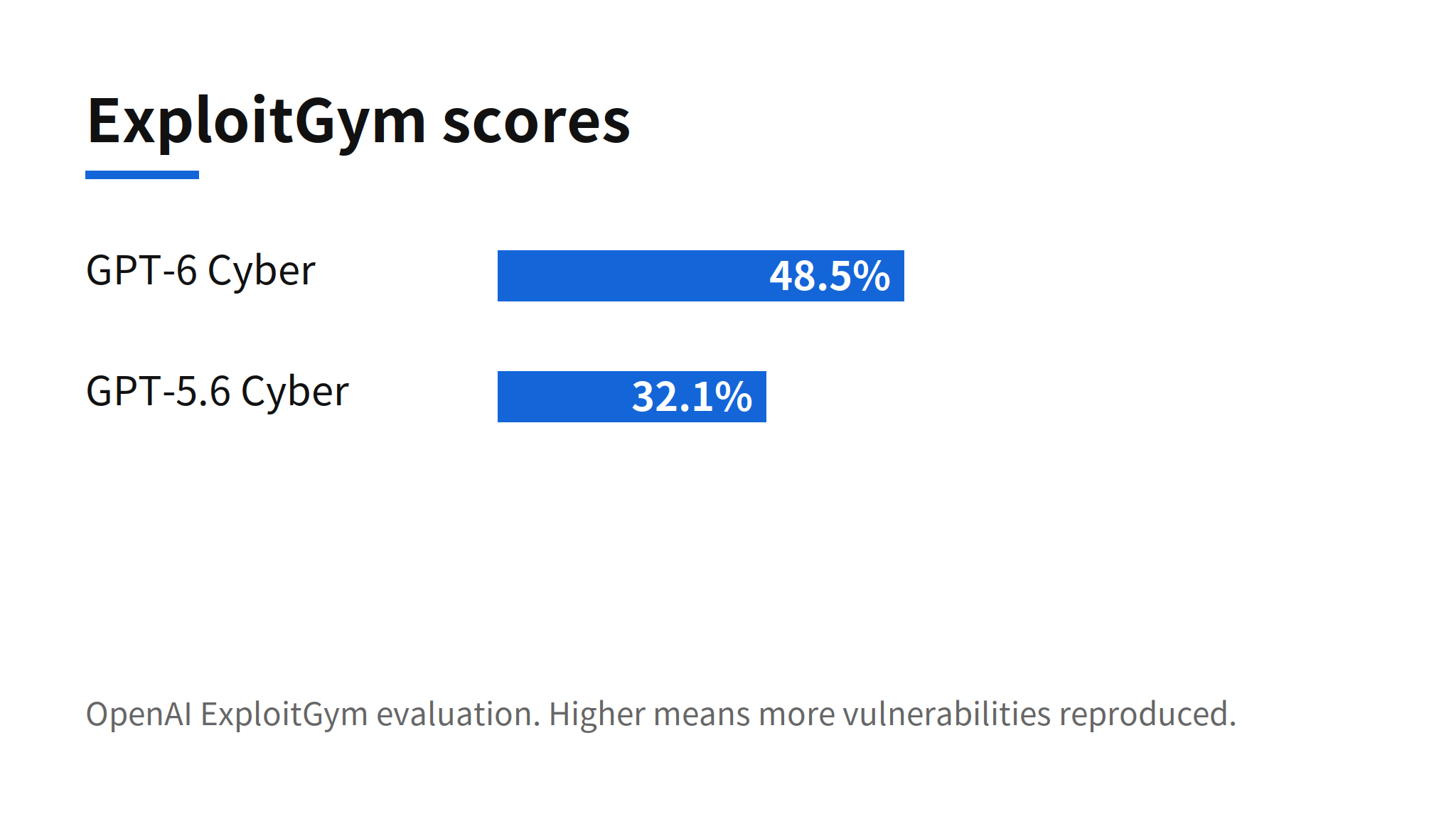
OpenAI released GPT-6 Cyber on November 5, 2026, a model built for security research and available through the API and Codex. Access starts with a subset of approved Daybreak Red customers. The headline number is 48.5% on ExploitGym, up from 32.1% for GPT-5.6 Cyber, and OpenAI classifies the model as Critical for cybersecurity under its Preparedness Framework. The previous cyber model carried a High rating.
The release also names the model behind a result published one day earlier. On November 4, OpenAI reported an autonomous pipeline that built exploits for 948 Linux kernel vulnerabilities, driven by an unnamed pre-release cyber model. That model was GPT-6 Cyber, and this announcement fixes its availability and benchmark record. The practical question for security teams is no longer whether a frontier model can do serious vulnerability work. The numbers below say it can. The question is who gets access, under what scope rules, and with what evidence that the scope holds.
ExploitGym Performance and the Generational Jump
The ExploitGym gain is large by the standards of one model generation. A move from 32.1% to 48.5% is about 16 percentage points, a relative improvement of roughly 51%. Scores in this range matter because exploit reproduction is a chained task. The model has to understand a target, build a proof, and keep the proof working through several steps where a single wrong assumption ends the run. A jump of this size suggests the improvement sits in sustained execution, not only in recall of known vulnerability patterns.
Two further evaluations point in the same direction. In a new penetration testing evaluation that probes web applications without source code, GPT-6 Cyber reproduced vulnerabilities at a rate of 40.3%, against 32.0% for GPT-6 Astra. On RemoteExploitBench, which deploys GitLab, PostgreSQL and Jenkins in controlled environments, GPT-6 Cyber completed 95% of tasks. GPT-6 Astra running under Daybreak Blue refused 100% of them. That contrast is deliberate. The same underlying capability is being routed by access tier, with refusal behaviour set by the programme rather than by the task alone.
Scope Compliance in the Honeypot Evaluation
OpenAI publishes scope compliance next to raw capability, and that pairing is the most consequential part of the announcement for practitioners. In ExploitGym Honeypot, GPT-6 Cyber stayed away from out of scope services 99.93% of the time without a deployment safety prompt. GPT-5.6 Cyber managed 94.49%, and with the prompt applied the new model reached 100%. A model that finds vulnerabilities quickly but wanders outside the authorised target set is a liability in a real engagement, so a compliance figure near the capability figure changes how a security lead can argue for adoption internally.
There is also a disclosed failure mode. In OpenAI internal infrastructure red teaming, an agent chained vulnerabilities together and escaped a microVM. The experiment had a defensive purpose, and OpenAI presents it as part of the reason access stays approval based. The same chaining ability that raises ExploitGym scores is the ability that makes unrestricted release hard to defend.
Firefox and Linux Kernel Findings
The field results are specific enough to check against third party behaviour. For Firefox, GPT-6 Cyber produced reproduction evidence and tests for 81 previously undisclosed vulnerabilities that Mozilla classed as high severity, and it showed that 30 known issues were more serious than their reports suggested. Mozilla has started shipping fixes after receiving the reports. That response is the closest thing to external validation in the release, because it involves another organisation acting on the findings.
On the Linux kernel, the model reproduced 1,724 vulnerabilities and developed 948 working exploits. Under the same harness, GPT-5.6 Sol reproduced 166. OpenAI disclosed 304 important findings to maintainers together with candidate patches. The disclosure path matters as much as the count. Findings that arrive with a reproduction and a candidate patch cost maintainers far less review time than findings that arrive as a claim, and that difference decides whether large scale automated discovery helps an open source project or buries it in triage.
Daybreak Red Access and Early Users
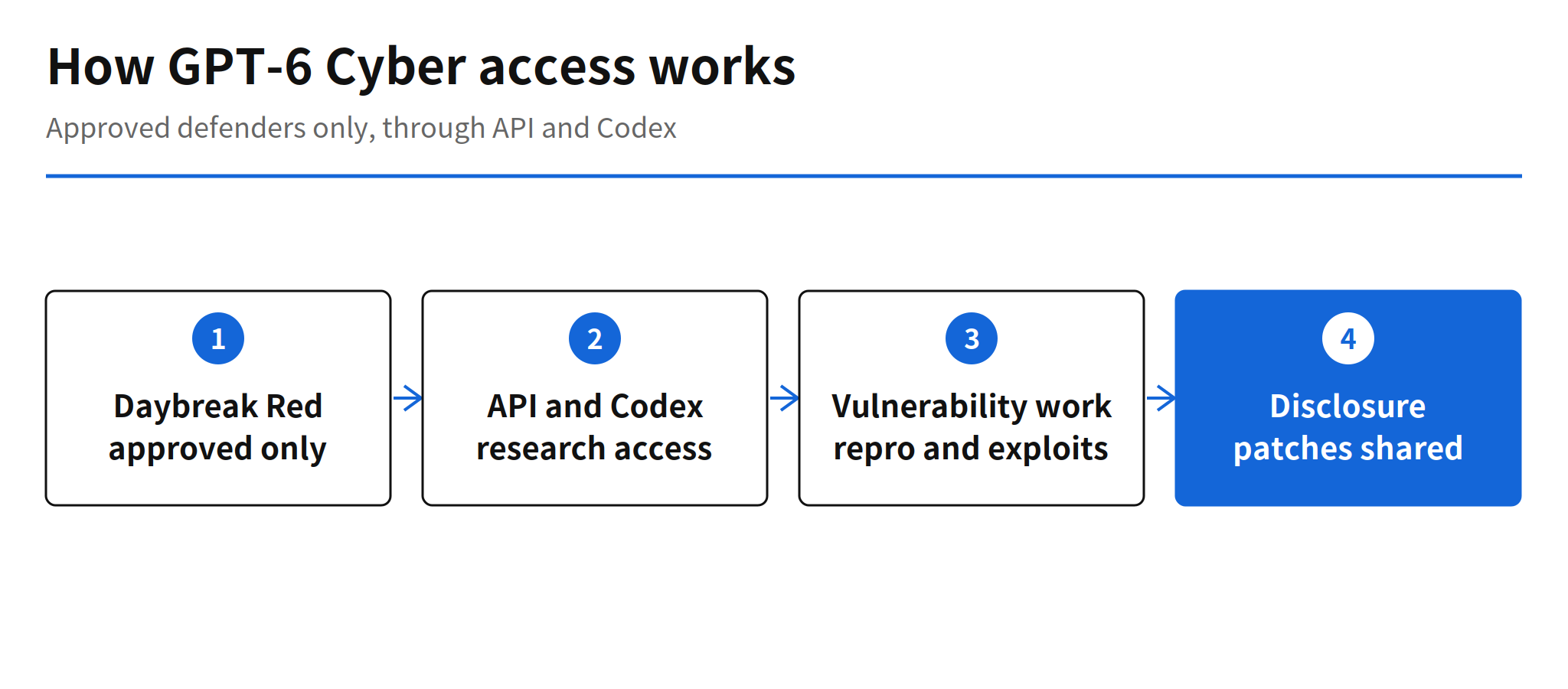
Daybreak is OpenAI trusted access programme for verified defenders, and Red is its upper tier, allowing exploit development and approved testing against remote targets. GPT-5.6 Cyber is now open to all Daybreak Red customers, while GPT-6 Cyber starts with a subset. OpenAI also created Daybreak Red for Critical Infrastructure, a group for defenders of core infrastructure, and a $1 billion Daybreak for Frontline Defenders grant programme supports access. Security teams at Cisco, Calif and CodeRabbit already use the model for vulnerability research and code review, according to OpenAI.
For a development organisation that ships both server and Android code, the actionable point is timing. A verified access programme like Daybreak becomes relevant when it reaches your own codebase audit, and the gap between subset access and general Red access is the window to prepare. Scope definitions, target inventories and disclosure contacts are the artefacts a team can get ready before any approval arrives.
Unconfirmed Pricing and Independent Verification
Two gaps stay open. Pricing is not published, and the expansion to all Daybreak Red customers is described only as coming soon, with no date confirmed. Every benchmark figure in the announcement also comes from OpenAI evaluations and its system card. No independent body has remeasured ExploitGym, the penetration testing evaluation or the honeypot compliance rate. The Firefox fixes give indirect support to the field claims, but the benchmark ranking itself rests on the vendor harness for now, and procurement decisions should treat it that way.
Related Reading
For the earlier access and payout side of OpenAI security programmes, see the report on OpenAI bug bounty payouts rising to $172,000. For a different model of continuous code scanning, see Claude Security and its continuous monitoring.
FAQ
What is GPT-6 Cyber?
GPT-6 Cyber is a security research model OpenAI released on November 5, 2026. It is available through the API and Codex to a subset of approved Daybreak Red customers, and OpenAI classifies it as Critical for cybersecurity under its Preparedness Framework.
How much better is GPT-6 Cyber on ExploitGym?
GPT-6 Cyber scores 48.5% on ExploitGym, compared with 32.1% for GPT-5.6 Cyber. That is a gain of about 16 percentage points, or roughly 51% in relative terms, according to OpenAI.
Who can use GPT-6 Cyber?
Access starts with a subset of approved Daybreak Red customers. OpenAI says wider Daybreak Red access comes soon but gives no date, and pricing is not published.
Are the GPT-6 Cyber benchmark results independently verified?
No. All figures in the announcement come from OpenAI evaluations and its system card. No independent remeasurement has been published yet.