Claude Security: Continuous Monitoring Rescans Every Commit
Continuous Rescans That Follow the Code Instead of Waiting for a Scan Request
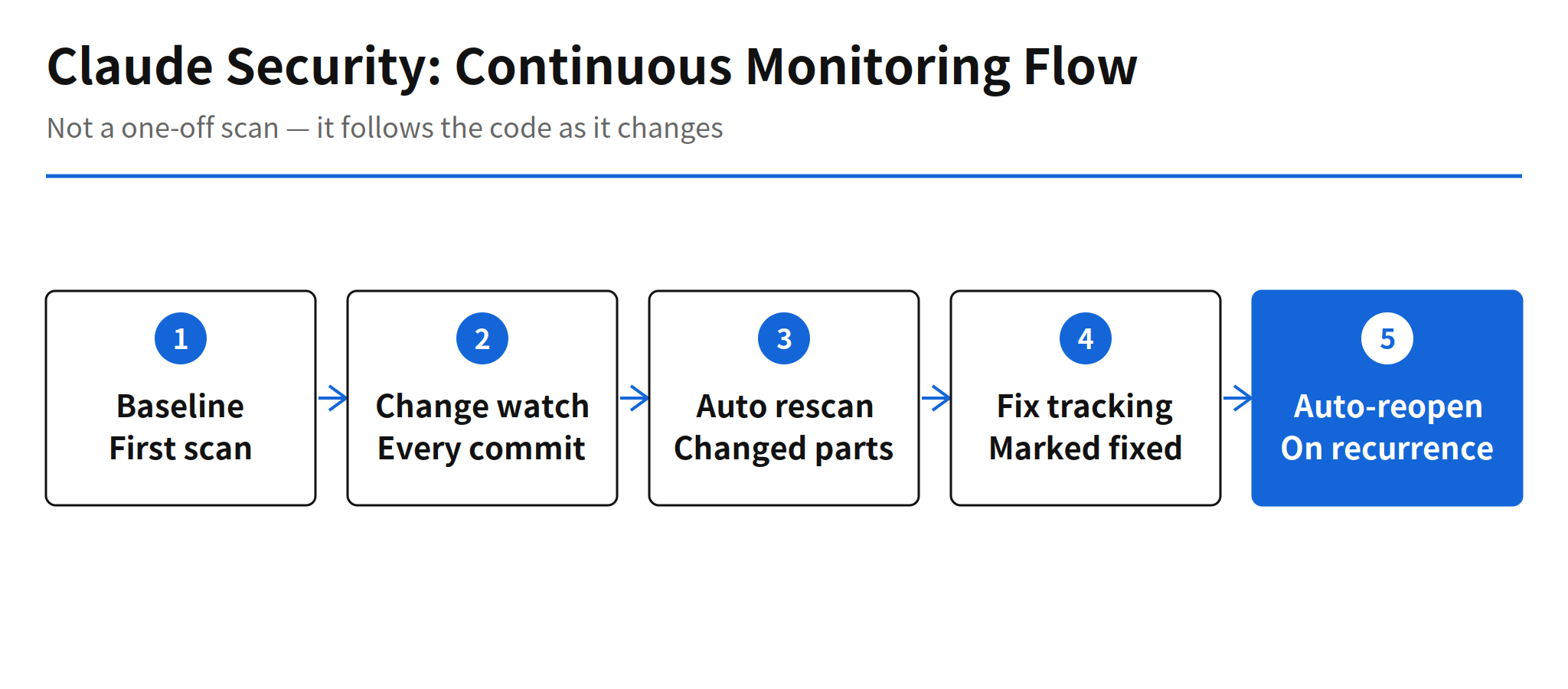
Anthropic has begun offering a new version of its code security analysis tool, Claude Security, in public beta. The core change fits in one sentence. Connect a repository and the tool first runs a deep baseline scan, then automatically rescans whenever the code changes. Security state no longer freezes at the moment someone presses a scan button; the structure now keeps pace with the speed of code change.
The background of the shift matters too. Claude Security started as a public beta in April. By the company's account, thousands of organizations have found more than one million vulnerabilities with it. Two qualifications attach: the figure is a company claim, not an independent verification, and it counts vulnerabilities 'found', not 'fixed': a distinction worth keeping.
- Public beta on October 21, 2026: the start date for the continuous monitoring version.
- A deep baseline scan on first connection: every later change scan runs on top of this baseline.
- An official X post the same day: "Claude Security now keeps up with your code as it changes."
Findings With a Lifecycle: Tracking, Fixed Marking, Automatic Reopening
The most practical change in this update is the lifecycle of a finding. Each discovered vulnerability is tracked individually. When fix code is detected, the finding is automatically marked 'fixed'; when the same problem reappears, it reopens automatically. Work that people used to do by hand, reconciling scan result lists, is handled by the tool as state transitions.
Every finding carries a severity rating and an explanation of the path an attacker would take to reach the vulnerable code. Some include attack-path diagrams. The composition reflects a judgment that matters in practice. Whether an attacker can actually reach a vulnerability counts for more than the bare fact that it exists.
Vulnerabilities Across Service Boundaries: Up to 8 Repositories per Project
Multiple repositories can be grouped into one project, another practical point in this update. Up to 8 repositories per project can be connected, and vulnerabilities that cross service boundaries are in scope. The example in the issue is intuitive. These are cases a single repository cannot reveal, such as a backend trusting input because it assumes the client validated it.
A knowledge base where the team records deployment practices and security policies ships alongside, as does an editable threat model generated from the code. The tool is expanding past scan results toward reflecting the team's own security policy in its scan criteria.
Connections at Developer Reach: API, Webhooks, MCP Connector
The connection surface is close to daily developer work. An API, webhooks, and an MCP connector for Claude Code are provided. Through the API, projects and findings can be queried, resolved, and reopened. Through the MCP connector, an engineer can move from querying a finding to discussion, starting a fix, and marking resolution inside a single session. Verification and fixing of agent-written code can flow inside the agent session itself, without a separate dashboard in between.
That is what makes this announcement a story about security operations in the agent era rather than a plain scanner update. With "who verifies agent-written code" now a bottleneck, a continuous scanner of this kind becomes a practical tool that drops straight into a CI pipeline.
Terms and Pricing: Enterprise Only, $25,000 Monthly Credit for Two Months
| Item | Details |
|---|---|
| Audience | Claude Enterprise customers |
| Credit | $25,000 in free usage credit per month for two months, per organization |
| Pricing after credit | Undisclosed |
| Models | The full Claude model family (including Claude Mythos) |
| Separate enrollment | No Cyber Verification Program enrollment required |
The same week brought the Claude API October 21, 2026 version (#3407) and Claude Duet (#3388), continuing Anthropic's enterprise push. The continuous monitoring announcement reads best inside that enterprise lineup expansion, not as an isolated news item.
Three Points Still Unconfirmed
This is an announcement-stage release, so the honest move is to leave gaps unconfirmed rather than fill them in.
- The one-million-vulnerability figure is a company claim, not an independent verification. It is a 'found' count, not a 'fixed' count.
- Scans are intentionally stochastic. Scanning the same code twice can produce different results. The consistency gap against deterministic static analysis is an operational consideration.
- Formal pricing after the credit period is undisclosed. What the cost structure looks like once the two-month credit ends is not yet known.
As agents write code faster, security verification moves closer to surveillance that follows the code than to an occasional audit. Claude Security's shift is one case showing that direction.
Practical Judgment: Where It Fits
It is hard to call this a universal tool for every team today. The audience is limited to Claude Enterprise customers, and post-credit pricing is undisclosed. For teams that do fit the conditions, it is a candidate worth reviewing for continuous checks on a CI pipeline. The checking order runs like this. First, measure whether the credit covers your repository scale. Next, test whether the result variance of stochastic scanning fits your operating standards. Then confirm whether the MCP connector's find-fix-resolve flow reaches the way your team actually works. Take the numbers, but leave the judgment to measurement.
Sources
- claude.com official guide, 'Claude Security now scans continuously and tracks fixes' (October 21, 2026)
- TestingCatalog (October 21, 2026): Claude Security gets continuous scans and fix tracking
- ax-trend issue #3484
- Related issue #3407: Claude API October 21, 2026 version
- Related issue #3388: Claude Duet
- Related issue #626: Anthropic ships a free security guide plugin for Claude Code
FAQ
How does Claude Security's continuous monitoring work?
Connect a repository and the tool first runs a deep baseline scan, then automatically rescans whenever the code changes. The continuous monitoring version entered public beta on October 21, 2026. Security state no longer freezes at the moment someone presses a scan button.
What happens to a finding after it is reported?
Each discovered vulnerability is tracked individually. When fix code is detected, the finding is automatically marked fixed, and when the same problem reappears, it reopens automatically. Every finding carries a severity rating and an explanation of the path an attacker would take to reach the vulnerable code.
How many repositories can one project cover?
Up to 8 repositories per project can be connected. Vulnerabilities that cross service boundaries are in scope, including cases a single repository cannot reveal, such as a backend trusting input because it assumes the client validated it.
Who can use Claude Security, and what does it cost?
The audience is Claude Enterprise customers. Each organization receives $25,000 in free usage credit per month for two months. Formal pricing after the credit period is undisclosed.
Is the one million vulnerabilities figure verified?
No. By the company's account, thousands of organizations have found more than one million vulnerabilities with the tool, but the figure is a company claim, not an independent verification. It also counts vulnerabilities found, not fixed.