ServiceNow in ChatGPT: OpenAI MCP Plugin, Action Fabric
ServiceNow and OpenAI announced an expanded enterprise AI partnership on October 28, 2026. The centerpiece is the ServiceNow MCP plugin, which runs ServiceNow workflows inside ChatGPT and is available now in the OpenAI marketplace. The structural detail worth attention is where execution lives. ChatGPT handles the conversation. Execution and control stay with ServiceNow: existing business rules, permissions, and approval flows are applied unchanged by ServiceNow Action Fabric.
The rest of the announcement still sits on a calendar. The joint security solution is slated for early access in January 2027 and general availability in the second quarter. Codex joining ServiceNow's AI Workflow Factory is also a 2027 item. The plugin is the only piece in hand today, and the security collaboration has no measured results yet, so judgment on it stays reserved.
Enterprise Workflows Inside ChatGPT: The Role of the MCP Plugin
This expansion extends the multi-year partnership signed in January, when OpenAI models were designated the preferred intelligence layer for the ServiceNow AI Platform. On October 6, ServiceNow had already unveiled its AI Workflow Factory and Autonomous Engineer. This announcement adds a conversational front end on top, marking a shift from asking questions and receiving answers toward getting work done inside the same conversation.
The plugin connects ServiceNow work context and execution functions inside a ChatGPT conversation. IT staff can find similar incidents, assess change risk, and update records. The practical change is less window-hopping and copy-pasting. The wider the conversational surface becomes, though, the more the choice of which functions to expose becomes a permissions design problem. The plugin's convenience and control over its exposure surface are two sides of the same question.
Separation of Execution and Control: Permissions and Approvals Stay in Action Fabric
In a structure where ChatGPT runs the conversation and ServiceNow keeps execution and control, Action Fabric applies existing business rules, permissions, and approval flows as they are. The agent does not act on its own discretion; it moves only within the governance the organization has already set.
This is a case that goes past reasoning and connects execution inside a governance frame of permissions and approvals. The implementation pattern — an MCP plugin plus a control layer like Action Fabric — is worth referencing when designing enterprise agents.
The reason this separation matters is straightforward. In enterprise systems, agent failures usually happen at permission and approval boundaries, not in reasoning. A design that splits the connection method (MCP) from the control layer (Action Fabric) transfers to other enterprise agents as well. The limit sits in the same place. The usable scope is bounded by the functions each customer chooses to expose. A well-built control layer still produces small perceived effects in organizations that keep exposure narrow. The usable range will differ from one organization to the next.
Security Collaboration: The Classification Problem Behind 10,000 to 100,000 Vulnerabilities
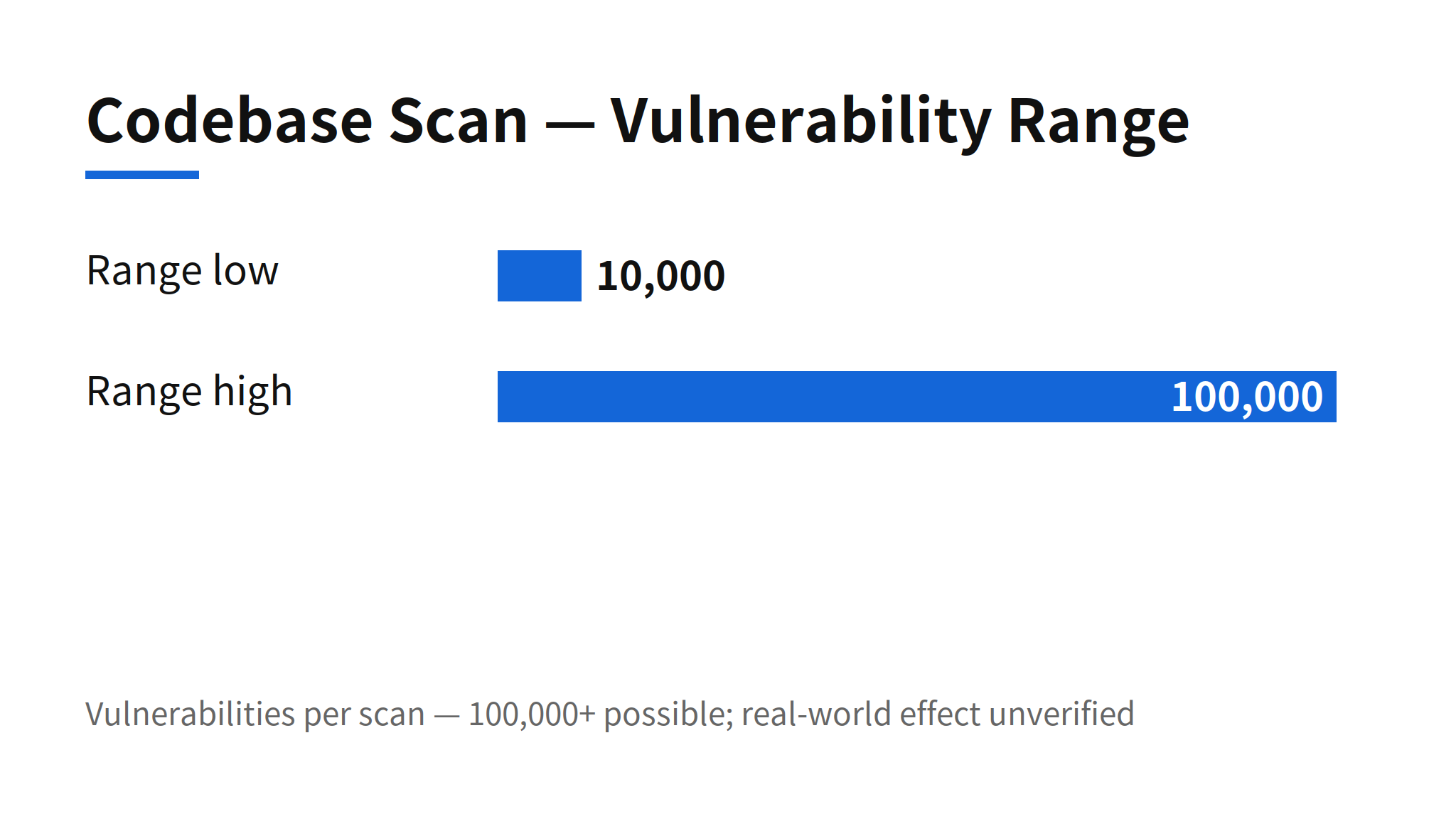
A security collaboration was announced alongside. The joint solution aims to identify, classify, verify, and remediate vulnerabilities coming out of codebase scans. A single scan can surface anywhere from 10,000 to more than 100,000 vulnerabilities. The hard part is less the volume than deciding which of them are risks that need attention now.
The joint solution combines OpenAI's cyber capabilities with ServiceNow's asset, access, and enterprise context. Its goal is to identify and remediate attack paths across code, applications, workloads, networks, and identities. The direction aligns with ServiceNow's 'Shift Zero' strategy: shifting weight toward prevention before exploitation. ServiceNow has also already joined OpenAI's Trusted Access for Cyber program. The diagnosis that classification and state tracking of scan results are the bottleneck overlaps with Claude Security's pivot in the same period. This put continuous scanning and fix tracking at the front. The competitive axis in security tooling looks to be moving from detection performance toward classification and tracking operations.
Security effects are not yet verified. There are no measured results for vulnerability classification or remediation, and judgment has to wait until after the January 2027 early access.
Announcement Timeline Into 2027
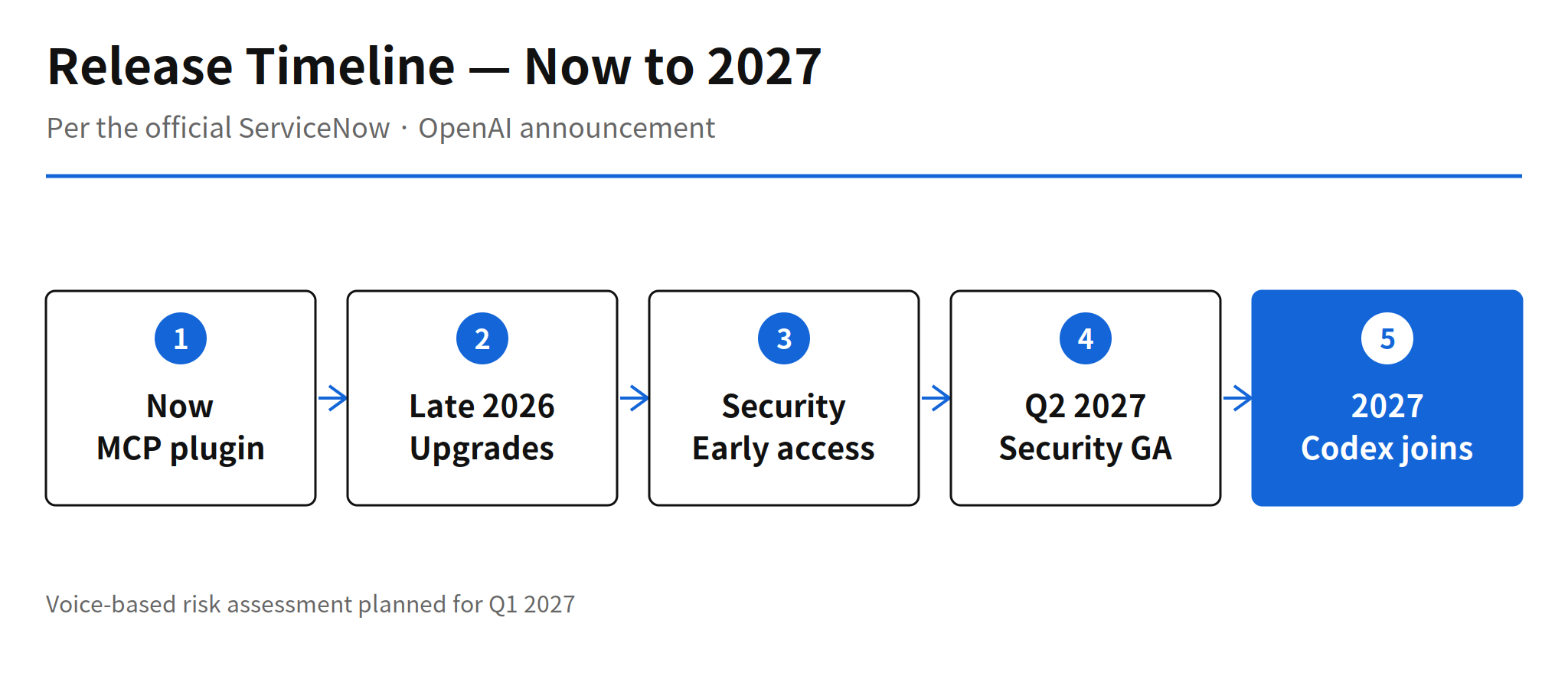
- Now: the ServiceNow MCP plugin is available in the OpenAI marketplace.
- Late 2026: plugin enhancements are scheduled to be added.
- January 2027: early access for the joint security solution begins.
- Q1 2027: risk assessment for the Super Intelligence Control Tower, powered by OpenAI voice models, is scheduled.
- Q2 2027: general availability of the joint security solution is planned.
- 2027: Codex enters ServiceNow's AI Workflow Factory. OpenAI models also back the factory's Build Agent and Autonomous Engineer.
Mutual adoption was part of the announcement too. OpenAI adopts ServiceNow for company-wide operations, and ServiceNow provides ChatGPT Work and Codex to its employees. OpenAI also joins as a founding member of ServiceNow's Control Tower Alliance. The partnership is widening from product integration into operations and ecosystem. One caution when reading the timeline: most items sit six months or more away from the announcement. Adoption planning should separate the plugin available now from the 2027 items.
Points Still Unconfirmed
- Deal terms undisclosed: no contract size or pricing terms were included in the announcement.
- Codex integration scope: how much of the AI Workflow Factory Codex will own can only be confirmed at the 2027 launch.
- Plugin exposure scope: only functions each customer chooses to expose are usable in ChatGPT, so real usage ranges will vary by organization.
- No security effect verification: classification and remediation effects have no measured results yet; this is a judgment for after early access.
Practical Judgment: The Order of an Adoption Review
For anyone designing enterprise agents, this announcement offers two patterns worth taking. Connect conversation and execution through a standard link such as MCP, and leave permissions and approvals in the existing system's control layer. For an adoption review, the right order is to compare the exposure scope and approval flows against internal policy first. The announcement's glamorous parts, the security collaboration and the Codex integration, are 2027 items, too early to serve as adoption grounds today. The point at which judgment material exists looks to be after the security early access begins.
Sources
- Original: ServiceNow official, Business Wire (October 28, 2026)
- Original: Unite.AI (October 28, 2026)
- ax-trend issue #3639
- Related issue #3040: ServiceNow unveils AI Workflow Factory and Autonomous Engineer (October 6, 2026)
- Related issue #3634: OpenAI ships iCloud Mail and Calendar plugins for ChatGPT (October 27, 2026)
FAQ
What is the ServiceNow MCP plugin?
The ServiceNow MCP plugin runs ServiceNow workflows inside ChatGPT, connecting ServiceNow work context and execution functions to a ChatGPT conversation. It is available now in the OpenAI marketplace. ServiceNow and OpenAI announced it on October 28, 2026 as the centerpiece of their expanded enterprise AI partnership.
How are permissions and approvals handled when work runs through ChatGPT?
ChatGPT handles the conversation, while execution and control stay with ServiceNow. ServiceNow Action Fabric applies existing business rules, permissions, and approval flows unchanged, so the agent moves only within the governance the organization has already set. The usable scope is bounded by the functions each customer chooses to expose.
What does the joint security solution do, and when does it arrive?
The joint solution aims to identify, classify, verify, and remediate vulnerabilities coming out of codebase scans, where a single scan can surface anywhere from 10,000 to more than 100,000 vulnerabilities. Early access begins in January 2027 and general availability is planned for the second quarter of 2027. There are no measured results yet for classification or remediation effects.
When does Codex join ServiceNow's AI Workflow Factory?
Codex joining the AI Workflow Factory is a 2027 item. How much of the factory Codex will own can only be confirmed at the 2027 launch. OpenAI models also back the factory's Build Agent and Autonomous Engineer.