MiniMax mcode-stack: 17 Open-Source Agent Skills and Setup
On October 28, 2026, MiniMax-AI published the mcode-stack repository. The release is not the source code of MiniMax Code. It is a set of 17 agent skills that the MiniMax Code team uses daily while building the product. Every skill is in SKILL.md format, so the set installs into Claude Code as well as MiniMax Code. Most of it works in any other agent that supports SKILL.md. The repository is MIT-licensed and had 193 stars at the time of checking.
The release stands out because of what was chosen for release. Coding-agent competition is shifting from raw model performance toward harness operations. This is a case of a company publishing its own operating procedures as executable files. One caveat applies from the start: the skills' effects are not yet verified in numbers. No published benchmark shows token savings or time reductions.
mcode-stack Contents: Ronny's 15 Skills and Jiachen's 2
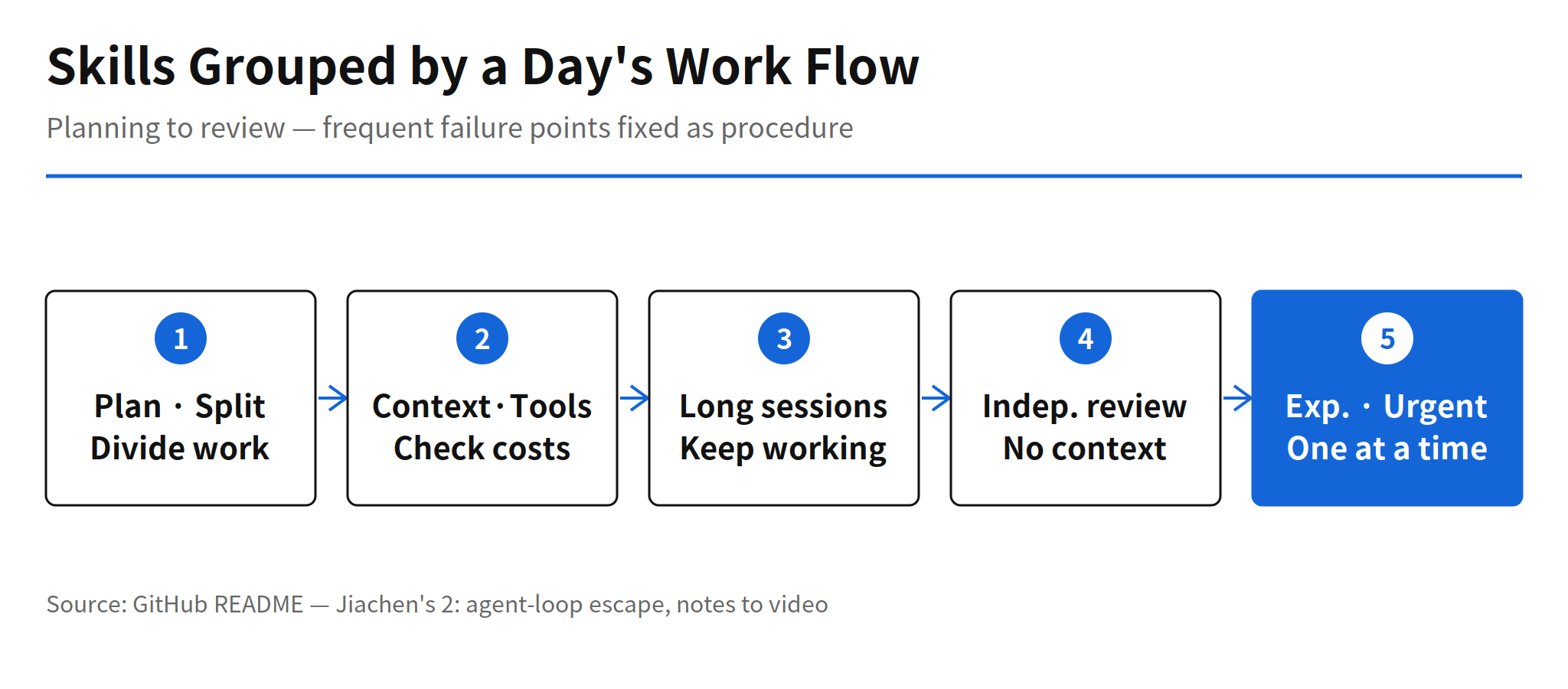
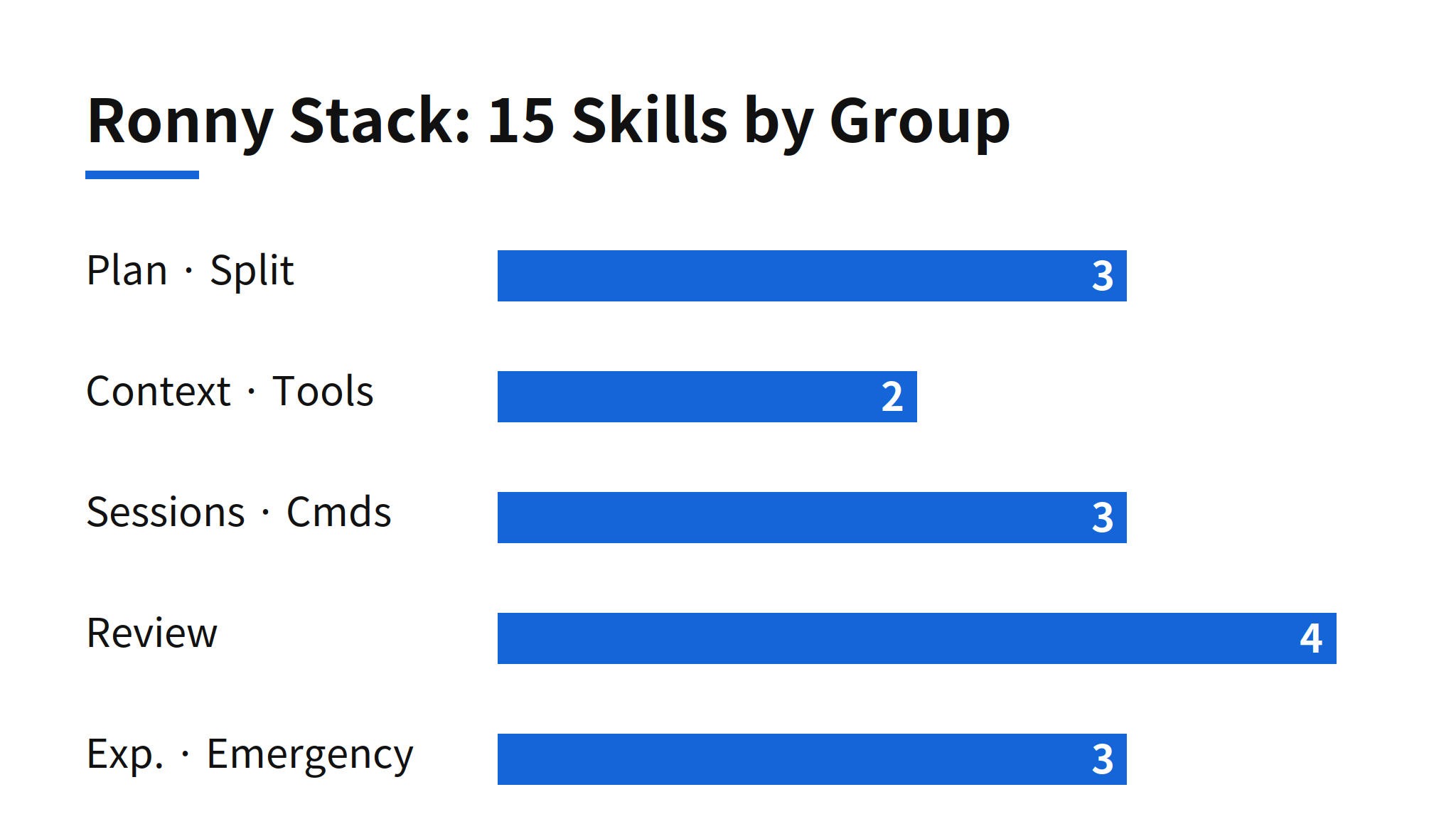
The set combines two stacks named after team members. Ronny's stack holds 15 skills in five groups, and Jiachen's stack adds 2 more, for 17 in total. Jiachen's pair covers escaping agent loops and turning notes into articles and videos. The exact names of the two skills are not spelled out in the README overview. That gap says something about the repository's nature. It reads less like a finished package and more like an internal asset being opened up in stages.
| Group | Skills | Count |
|---|---|---|
| Planning and splitting | subagent-split-check, engineering-small-prs, engineering-change-descriptions | 3 |
| Context and tools | tool-budget-audit, context-tax-audit | 2 |
| Long sessions and commands | long-session-check, handoff-doc, long-command-check | 3 |
| Review | independent-review, engineering-code-review, engineering-review-comments, engineering-review-feedback | 4 |
| Experiments and emergencies | harness-experiment, trajectory-review, engineering-emergency-changes | 3 |
Each skill pairs with an explainer post in the MCode Engineering Notes. The posts explain the ideas; the repository turns them into executable checklists. Four explainers are out, covering subagent management, tool context, long-session survival, and long bash commands. The repository ships five checklists and five explainers, with one explainer still marked as forthcoming. Slots for other team members and outside contributors are left open. Pairing explanation with executable files signals an intent to treat skills as maintained operating documents, not one-off prompt collections.
Key Skills in Detail: Split Criteria, Tool Costs, Review Procedure
The clearest criteria come from subagent-split-check, which governs subagent splitting. The skill allows splitting work only when the context is a measured problem. It states that splitting by team or by question type is not a valid reason. Set against the recent drift toward spawning ever more subagents, this reads as internal criticism. Splitting itself is treated as a cost that needs measured justification. In practice, coordination cost and duplicated context grow with agent count, so adopting this one criterion alone should curb over-splitting.
Tool costs are audited along two axes. tool-budget-audit looks at tool definition cost and tool result cost separately, while context-tax-audit checks the cost of what permanently resides in context. Tool definitions occupy context on every request, and long tool results weigh down all later reasoning. Measuring the two separately frames agent cost optimization as a problem of work structure rather than model price comparison. long-command-check audits long shell commands and background jobs against 10 checklist items, turning the familiar pain of untangling a failed long command into procedure.
The four review skills split review into a four-step procedure instead of a single pass of impressions. independent-review gives the reviewer only the diff, the requirements, and the test results: never the author's conversation context. A reviewer who does not know how the code came to be judges the artifact alone. This treats review quality as a problem of input selection rather than reviewer skill. engineering-code-review examines design, function, complexity, tests, and approval risk. engineering-review-comments writes review comments with severity markers, and engineering-review-feedback handles review comments from the author's side.
The experiment skills are equally explicit. harness-experiment changes one variable at a time and watches reverted work, request counts, tokens, cache hit rate, and runtime. trajectory-review looks at the path an agent took, not only at pass or fail. engineering-emergency-changes judges whether an urgent fix is a genuine emergency and runs expedited review safely. Licensing needs one note: the six skills starting with engineering- derive from Google Engineering Practices. Those parts carry a CC-BY 3.0 license on top of the repository's MIT.
Three Ways to Install mcode-stack
There are three install paths. Clone the repository and copy the skill folders into ~/.agents/skills/. Place the whole stacks/ronny directory into MiniMax Code's local plugin directory. Add the MiniMax-AI/mcode-stack marketplace inside the MiniMax Code desktop app. In Claude Code, the marketplace route looks like this:
# Claude Code
/plugin marketplace add MiniMax-AI/mcode-stack
/plugin install ronny@mcode-stack

# Direct copy (works everywhere)
git clone https://github.com/MiniMax-AI/mcode-stack
cp -r mcode-stack/stacks/* ~/.agents/skills/
Note: the marketplace add feature is rolling out in stages, so it may not appear yet depending on your MiniMax Code version
Installation ending in a single copy operation connects directly to what this repository is. The skills are portable text files, not features locked inside one agent. Skill packages are spreading beyond coding at the same time: the 11 day-trading skills released in the same period came from the same current. The compatibility boundary sits at the file format level, though. The skills were built for MiniMax Code, and Claude Code support runs through the shared SKILL.md format. Whether every skill behaves identically in Claude Code is still unverified.
Release Context: From Model Competition to Harness Operations
The backdrop is a shift in coding-agent competition. When to split subagents, what to put in context, and how to keep long sessions alive now decide output quality. MiniMax published its team's operating habits as executable skills rather than documents, placing the release in the same current as Anthropic's skills repository and collections such as obra's superpowers. MiniMax Code itself was already open source, so this release differs in kind from opening the product: what was opened is how the team works.
Two distinctions matter when reading the repository. First, as a reference for operating knowledge, its value is clear. Second, the publisher offers no effect numbers. A team considering adoption should separate importing the procedures from verifying that the procedures work on their own work.
Unverified Points and Adoption Order
No benchmarks or evaluation results have been published. How much the skills actually reduce tokens or working time is unverified. The marketplace add feature is rolling out in stages and may not appear yet depending on your MiniMax Code version. Whether all skills behave identically in Claude Code is unverified. The exact names of Jiachen stack's two skills are not detailed in the README overview.
Adoption order matters more than adoption breadth. Instead of installing all 17 skills at once, start from the point that fails most often. If subagent splitting keeps going wrong, start with subagent-split-check; if review stays at the level of impressions, start with independent-review. And to cite effects as a reason for adoption, before-and-after records on the same work have to exist first. The portability of the procedures is confirmed; the portability of their effects is not. That is the precise position from which to read this repository.
Sources
- Original: MiniMax-AI/mcode-stack (GitHub, October 28)
- MarkTechPost, October 28, 2026
- ax-trend issue #3615
- Related issue #3348: MiniMax releases 'M3.1 Flash'
- Related issue #3483: MiniMax open-sources 'M3.1 Flash' weights
- Related issue #2957: MiniMax ships coding model M3.1-Flash-Preview free in MiniMax Code
FAQ
What is mcode-stack?
mcode-stack is a set of 17 agent skills that the MiniMax Code team uses daily while building the product, published by MiniMax-AI on October 28, 2026. It is not the source code of MiniMax Code. Every skill is in SKILL.md format, and the repository is MIT-licensed.
Can the mcode-stack skills be used in Claude Code?
Yes. Because every skill is in SKILL.md format, the set installs into Claude Code as well as MiniMax Code, and most of it works in any other agent that supports SKILL.md. Whether all skills behave identically in Claude Code is still unverified.
How do you install mcode-stack?
There are three install paths: clone the repository and copy the skill folders into ~/.agents/skills/, place the whole stacks/ronny directory into MiniMax Code's local plugin directory, or add the MiniMax-AI/mcode-stack marketplace inside the MiniMax Code desktop app. The marketplace add feature is rolling out in stages and may not appear yet depending on your MiniMax Code version.
Are the effects of the skills measured?
No. No benchmarks or evaluation results have been published, so how much the skills actually reduce tokens or working time is unverified. The recommended adoption order is to start from the point that fails most often instead of installing all 17 skills at once.