huashu-motion: Coding-Agent Skill That Makes Launch Videos
ax-trend issue #3339 · October 18, 2026
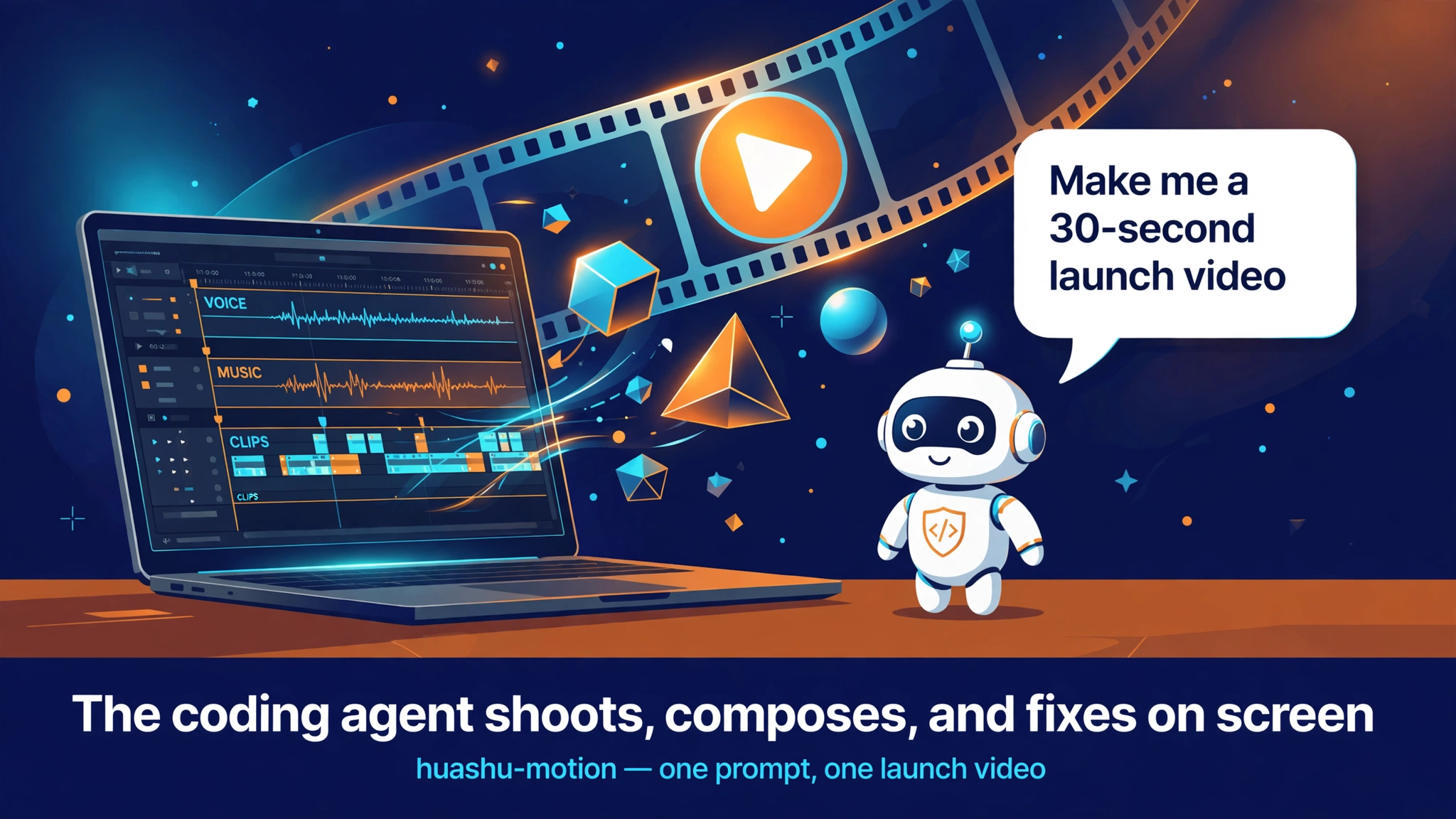
huashu-motion is an Agent Skill published by the independent developer Huashu (alchaincyf) that turns one prompt into a complete product launch video. Scaling on MIT-licensed Agent Skills infrastructure (Claude Code, Codex, WorkBuddy, Grok Bot, Muse, Dots runtimes). It handles the whole pipeline: product research, three direction proposals, script, composition, local rendering, and a browser editing loop. GitHub stars passed 204 in about six hours from release (roughly 35 per hour; extrapolated, about 840 per day).
One-line summary for developers: this is not another video-model wrapper. Huashu-motion's real point is that a video-pipeline skill built with code-based rendering easily beats generated video for launch work. The composer mode writes music first in plain-text ABC notation and snaps scene markers to the beat. So the audio sync is exact by construction.
What It Publishes: Installation and Trial Guide
Developer: Hwashu (alchaincyf), an independent developer who reached #1 on the App Store paid chart with the "Kitten Fill Light" app.
Release: GitHub, October 18 (MIT, Agent Skills standard badge).
Install: the README is in Chinese (README.en.md exists separately). Like other Agent Skills, it installs in one line: npx skills add alchaincyf/huashu-motion.
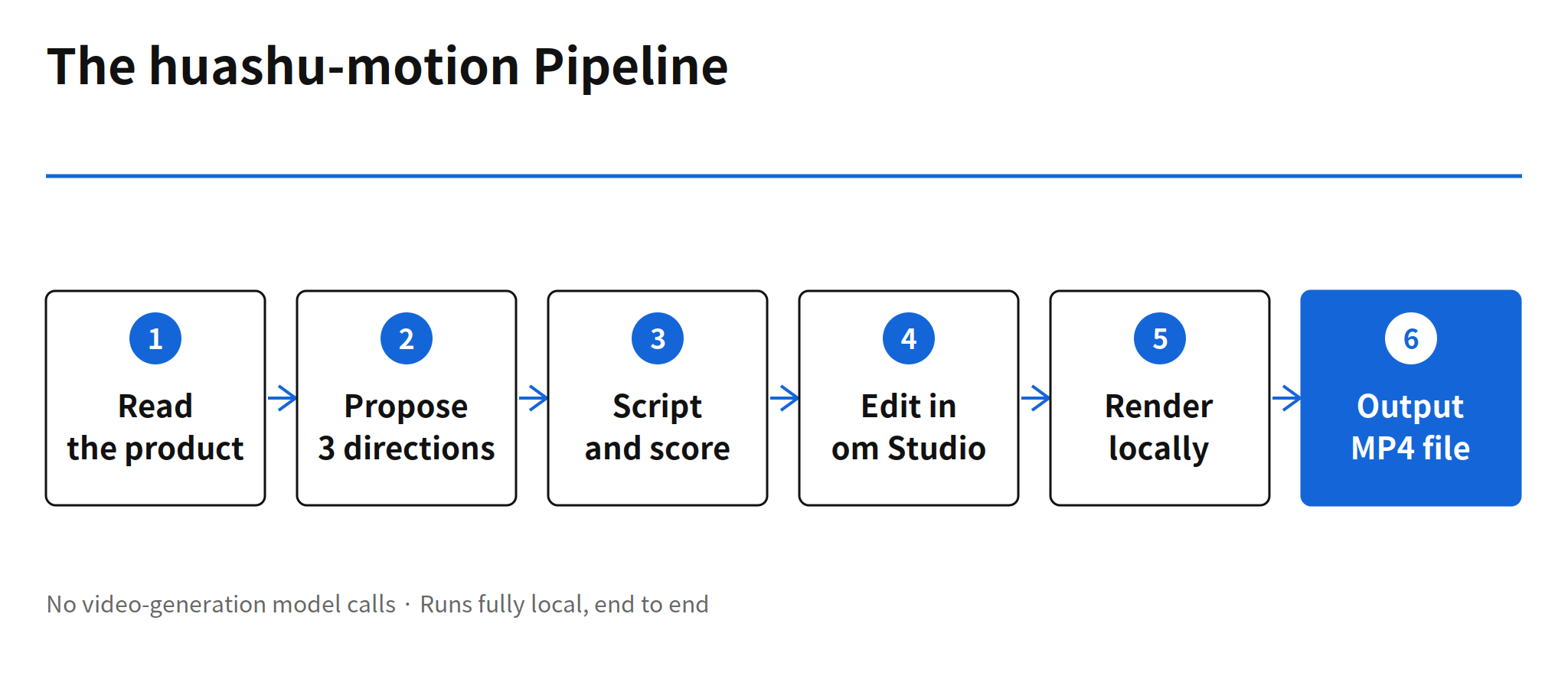
Claim: "一键直出商业级产品宣传片": one click to a commercial-grade product launch video. The flow is product reading, three direction proposals, script, composition, local rendering, and a browser editing loop.
Composer Mode: ABC Notation and Beat-Aligned Scene Markers
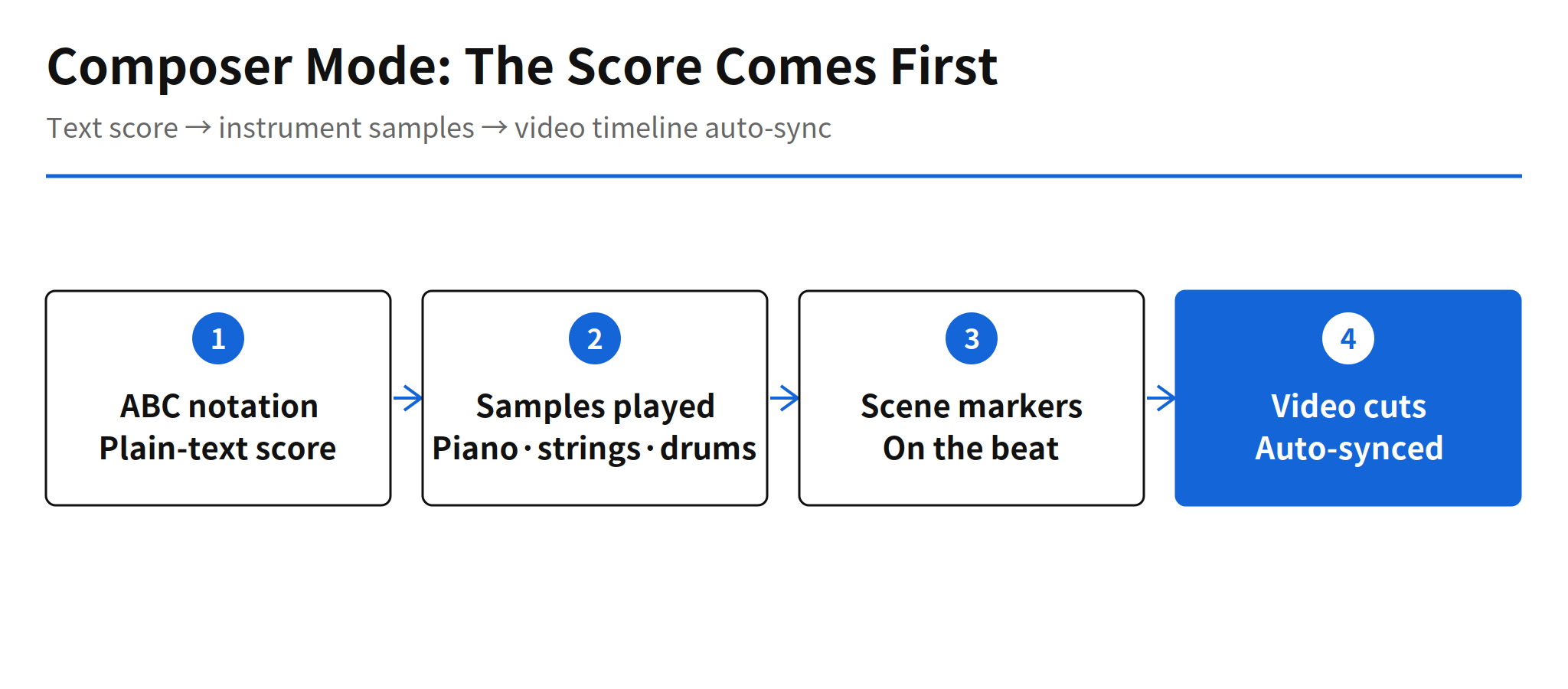
Composer mode: the ABC score is written first, and scene markers land on the beats
Composer mode is the design center of the skill:
ABC notation: the music is written as pure text first, and scene markers are aligned to the beats. The agent can synchronize scenes without hearing the audio.
Sound: performed with piano, string, and drum samples. Everything is generated locally, with no paid API.
The alternative: built-in seed-based backing track selection across 12 product categories × 3 tracks each.
Samples: about 55MB of CC0/CC-BY open samples are downloaded with om samples build.
Sound effects: 23 kinds of effects are auto-placed on object-drop frames and similar moments.
point-to-edit: Click the Screen, Revise Only That Frame
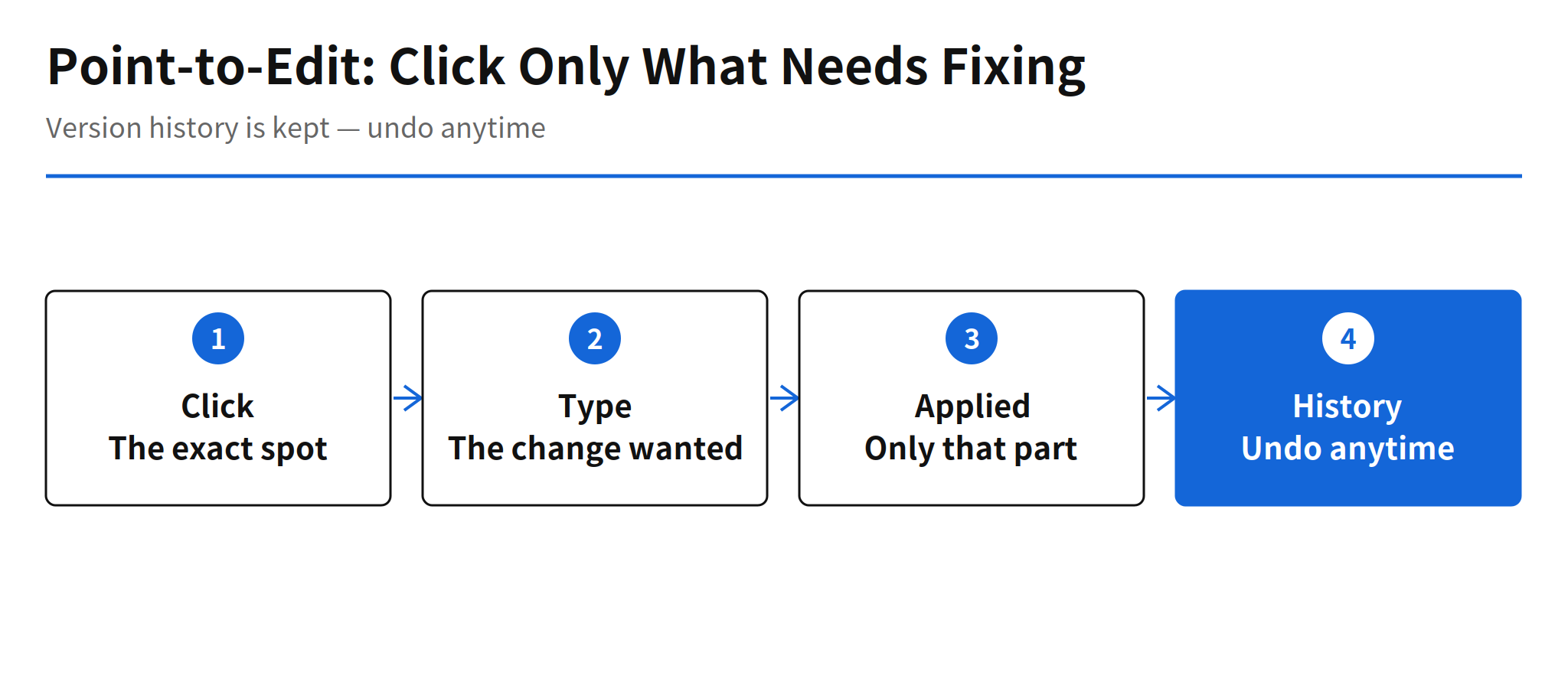
point-to-edit: click only the part that needs changing
The browser editing loop (om studio) plays the video and lets a user revise by pointing:
Flow: in the editor, press the C key, click the screen, and type what to change. The agent receives the timecode, the scene, the clicked element, and the source location. It then zooms in on that frame and area with a screenshot to verify and corrects only that part.
Safety: every prior version is kept, and ⌘Z rolls back. Titles, numbers, colors, and dwell time are directly editable in the right-hand panel.
The closest comparison is Claude Motion (released October 8, a Team and Enterprise limited beta), whose "point at the screen to edit" grammar this replicates. The difference is the release form: Motion is a paid beta feature while this is an MIT-released skill. The starting point, per the author, was a single instruction given to Claude Code after the October 8 Claude Motion announcement. "Let's have our skill perfectly reproduce Motion and do much more."
Structure: One Video Is One HTML File, Rendered Deterministically
The full pipeline: every video lives as one index.html file
File structure: one video equals one index.html file. The video is code-rendered with GSAP, Canvas, Three.js, and SVG, and no video generation model is ever called. Every frame is deterministic.
Directing rules: 21 real launch videos (Apple, Nothing, GoPro, Google, Vercel, Linear, Anthropic). Those videos were measured with FFmpeg for cut points, beats, loudness, and energy curves. 142 high-engagement videos were decomposed to systematize 20 motion languages. The rules include "hook within 3 seconds, one explosion in the middle, take one beat of rest before the loudest sound."
Rendering: local Chrome renders in parallel across CPU cores (default maximum 8). A 30-second video renders in about 12–15 seconds on a 14-core Mac, and 1–1.5 minutes with motion blur.
Built-in QA: om check before rendering, om qa on the finished film.
Learning loop: before starting, the skill reads past preferences and mistakes; after finishing, it absorbs editor comments for the next piece. Storage is local only, with no cloud sync.
The Author's Demo: A 22-Second Video for 1.95 Yuan
The author measured a real demo: using DeepSeek V4.1 Flash (1017), a 22-second video was completed through three feedback rounds in about 30 minutes. The cost was 1.95 yuan, with a cache hit rate of 99.4% (single-run measurement).
The predecessor was huashu-art-motion (#3231). Where that was interactive canvas art, this one is a commercial launch-video pipeline.
Honest limits: the working principle is that the agent has no ears. It works from spectrum analysis, and final listening checks are left to humans. Real footage and real people are not possible, and effects depend on model taste. The quality and composing claims rest on the author's demo GIFs, with no third-party verification.
Practical Takeaways: Three Checks for AX Builders
Distribution template for internal tools: follow the shape that released Agent Skills gallery-style: README in one language plus a separate English README, a one-line npx install command, and an Agent Skills standard badge for compatibility.
Grounded ideas for measuring video: localize the "director rules" measured with FFmpeg (hook within 3 seconds, one explosion in the middle, one beat of rest before the loudest sound) and adopt them as a QA reference.
Structure mapping to Android video production: a "one HTML file per video" deterministic rendering pipeline is reusable infrastructure in its own right. The local render story of 8 parallel Chrome instances maps cleanly to a personal video foundry.
huashu-motion is an Agent Skill published by the independent developer Huashu (alchaincyf) that turns one prompt into a complete product launch video. It handles the whole pipeline: product research, three direction proposals, script, composition, local rendering, and a browser editing loop. It was released on GitHub on October 18 under the MIT license.
How do you install huashu-motion?
Like other Agent Skills, it installs in one line: npx skills add alchaincyf/huashu-motion. Compatibility covers Claude Code, Codex, WorkBuddy, Grok Bot, Muse, and Dots. The README is in Chinese, with README.en.md available separately.
Does huashu-motion use a video generation model?
No. One video is one index.html file, code-rendered with GSAP, Canvas, Three.js, and SVG, and no video generation model is ever called, so every frame is deterministic. Local Chrome renders in parallel across CPU cores, with a default maximum of 8, and a 30-second video renders in about 12 to 15 seconds on a 14-core Mac.
How does the music stay in sync with the scenes?
In composer mode, the music is written first in plain-text ABC notation, and scene markers are aligned to the beats, so the audio sync is exact by construction. The music is performed with piano, string, and drum samples. Everything is generated locally, with no paid API.