day-trader-skill: 11 Claude Skills, Time Machine Replays
Jakeschincariol's day-trader-skill is a set of 11 Claude skills for day trading. Separate skills handle scanning thousands of charts, tracking breaking news, timing entries, and setting stops and targets, covering a whole trading session between them. The license is MIT, the primary language is Python, and it is free with no signup or API key required. The repository was created on October 20, 2026 and had collected 2,052 stars as of October 27, 2026. That is an average of about 293 stars per day over 7 days, past the 200-stars-a-day rapid-growth line. This post introduces the repository; it is not a trading recommendation.
The notable shift is where skills are being used. Agent skills had clustered in developer domains such as coding and reverse engineering. This package takes the same format into a live, money-at-stake work area. That makes the safety defaults it ships with as important to read as its composition. One disclosure up front: whether the core Time Machine probabilities translate into real returns or win rates is unverified.
The 11 Skills: A Division of Labor Across the Trading Session
The README's "The eleven" table gives the 11 roles as follows.
- trader-scanner (chart scanner): scans thousands of charts for opening-range breakouts, flags, and oversold bounce setups
- trader-news (news monitor): tracks breaking news on watched tickers and flags the news that moves them
- trader-entry (entry timer): watches a setup bar by bar and calls the entry moment
- trader-exit (exit planner): sets the stop and target before entry
- trader-timemachine (Time Machine): replays the outcome 10,000 times before any money is risked
- trader-risk (risk manager): checks every trade against limits
- trader-budget (budget manager): sizes positions against the budget and maximum loss per trade
- trader-broker (order execution): sends approved orders to the broker, with paper trading as the default
- trader-alerts (price alerts): fires at price levels, stops, and the market close
- trader-analyst (earnings analyst): reads earnings reports and summarizes what changed
- trader-pelosi (Pelosi tracker): reads congressional stock trade disclosures as they are filed
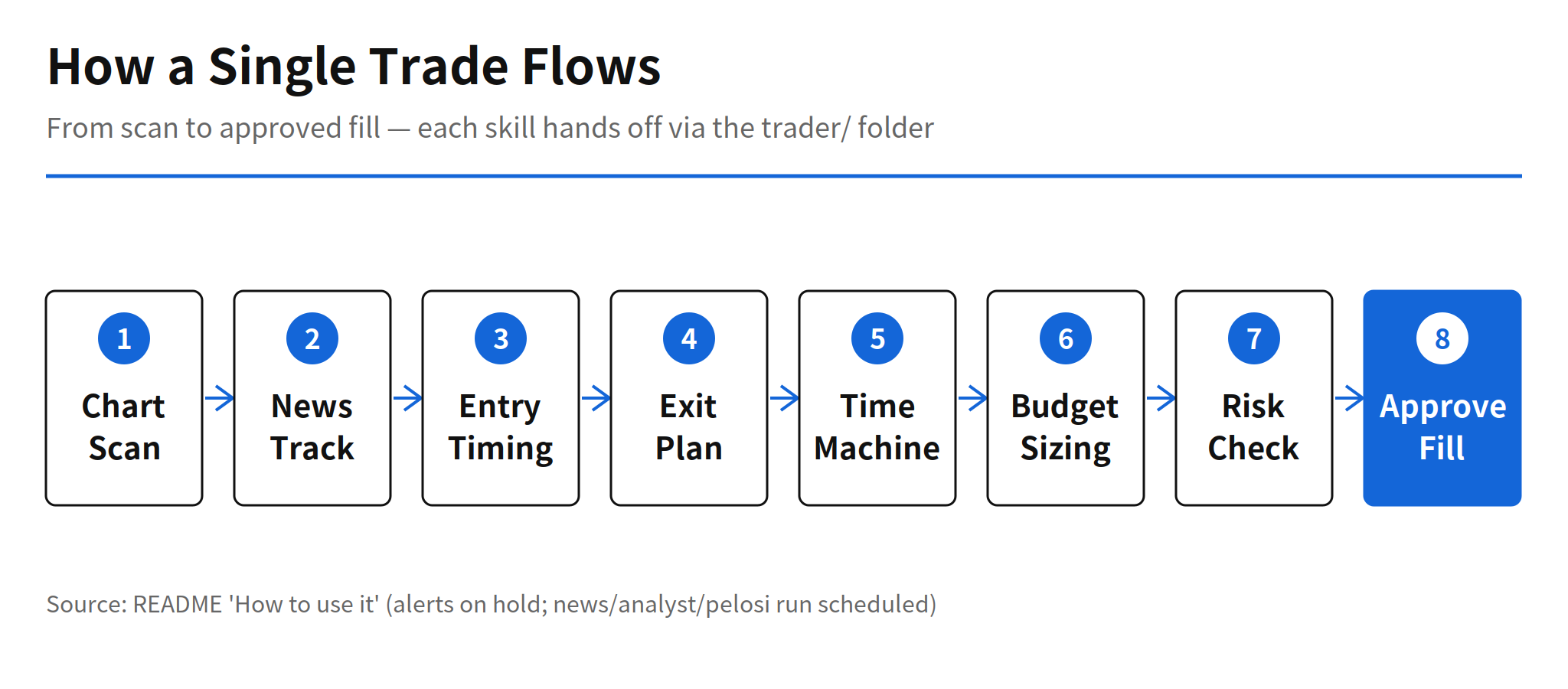
The structure is closer to a workflow package than a single skill. Each skill writes results into a trader/ folder that the next skill picks up. Scanning finds, entry times, risk checks, execution goes out after approval. It is a pipeline. The repository is the day-trading successor to an earlier trader-skill, splitting a long-term investing skill line from a short-term trading one. The tools read only free public data. Yahoo Finance charts, Nasdaq Trader symbol lists, SEC EDGAR, and the House Clerk are the sources named in the README. Running without paid data means users have to absorb the effect of data delays or gaps on judgment themselves.
Time Machine Numbers Checked: 10,000 Replays and 59 Past Sessions
Time Machine replays the recent remaining bars of a ticker 10,000 times before money is risked. It also shows the days the same setup appeared historically, to give an honest probability, per the README. The README's TSLA example (October 19, 2026, real data) puts numbers on the claim. Of 231 charts scanned, 42 closed above the 15-minute opening range, and TSLA was one of them. The opening range was 354.47–362.18; the 10:10 bar closed at 364.18, clearing the top of the range by 0.55%. The pre-entry plan was a stop at 358.32 (risk of 5.86 per share), a target at 370.04 (1x risk), and an exit by 15:55 either way.
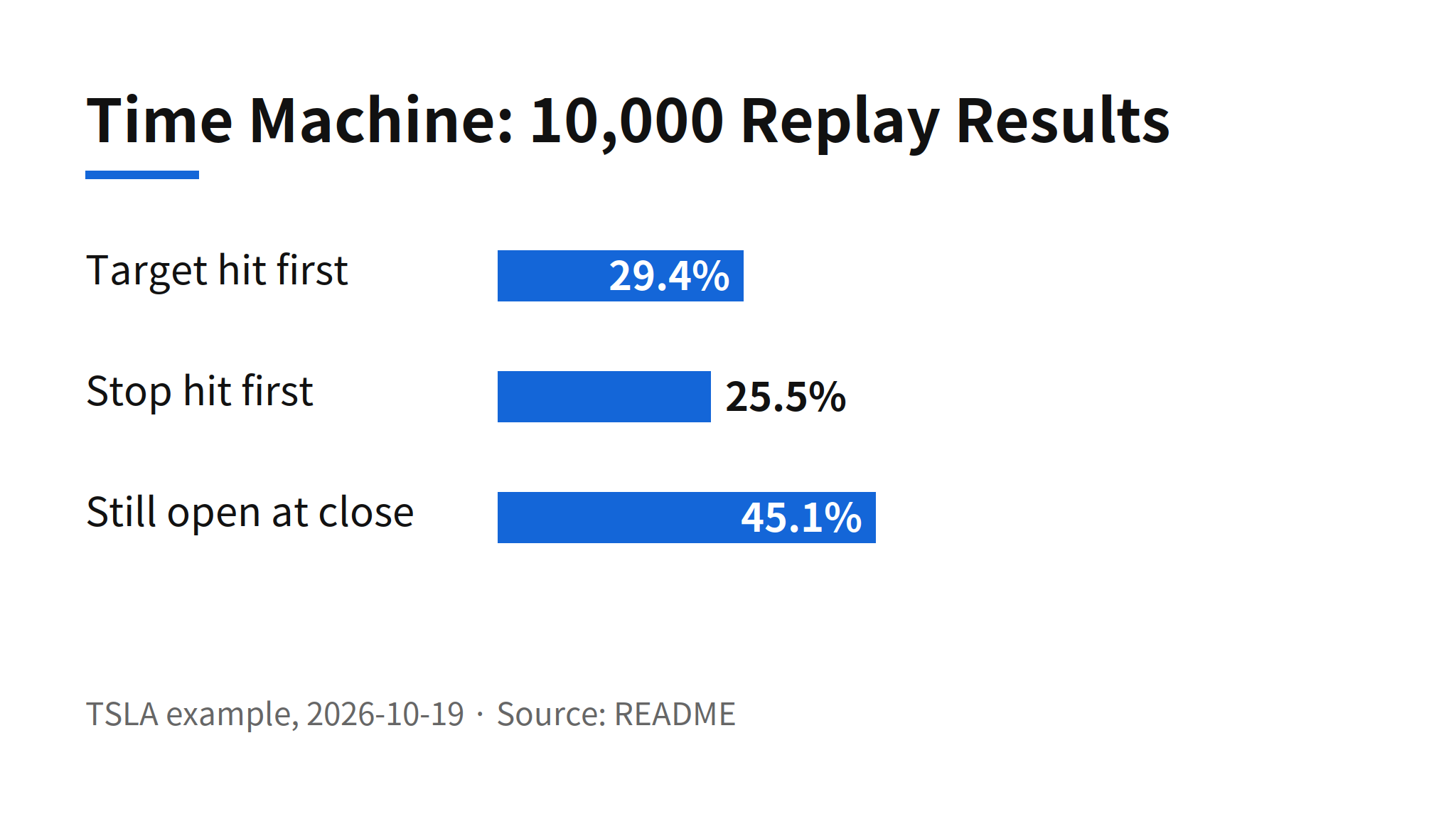
The 10,000-replay result was target first 29.4%, stop first 25.5%, still open at the close 45.1%. Running the same rules over 59 past sessions is reported too. The setup appeared on 33 days, reaching the target 13 times, the stop 15 times, and neither 5 times. Putting the two numbers side by side creates a productive tension. The replay model says target-first (29.4%) edges out stop-first (25.5%). Converting the historical frequency over the 33 setup days gives roughly 39% target and 45% stop. The order reverses. The replay probability and the historical frequency point in different directions, and both samples are too small to settle anything. The README itself concludes:
"Its verdict: close to a coin flip. That is the point of looking before you risk a dollar."
That passage shows the skill's character best. The replay does not certify a "good trade"; its value is in showing a near-coin-flip verdict as it is. Whether these probabilities connect to real returns or win rates remains unverified, and no independent backtest backing the README's probability account has been confirmed.
Safety Design: Paper Trading by Default and Double Approval
The principle the README puts first is paper trading by default. No trade executes before the user approves, and nothing in the package can place an order on its own. The execution step is double-locked as well. The broker skill reads the order aloud, the user must type "yes" to that exact order. Claude's own "Allow once / Deny" card asks once more. For an agent that touches money, defaults and approval gates are close to the product itself, and this package places them at the front.
Risk checks resolve to PASS or BLOCK. They test against maximum loss, daily loss limit, trades per day, risk-to-reward, entry time window, position size, and cash, with reasons stated. The budget example is concrete: on a $5,000 account with a $50 maximum loss per trade, 50 ÷ 5.86 gives 8 shares ($2,913.44). A filled stop produces a $46.88 loss. Because the check criteria are numeric limits rather than prose, the package's risk management is designed as a gate, not advice.
Installation and Usage Conditions
Installation is either the Claude Code plugin route or copying the skill folders. Installed as a plugin, skills appear under namespaces such as /day-trader-skill:trader-scanner; copied as folders, they are usable under plain names such as /trader-scanner. The tools need Python 3.8 or later and no separate pip install. That lightness connects to the mcode-stack skill collection released in the same period. Because skills port with a single file copy, packages are multiplying across domains. One condition needs care. The SEC-related tools (news filings, analyst) require identification: a name and email must go into trader/config.json as sec_user_agent, or into the SEC_USER_AGENT environment variable. The scanner's full universe is roughly 5,900 US stocks per Nasdaq Trader.
The unverified parts stay explicit. Whether Time Machine's 10,000 replays translate into real returns or win rates is unverified, and no independent backtest has been confirmed. The star increase over the most recent 24 hours is also unverified. Growth speed should be read only as an average over days since creation. This post introduces the repository; it is not a trading recommendation.
Practical Judgment: Package Flow and Safety-First as the Signal
This package shows two currents. Skill packs are evolving past single functions toward covering an entire work flow. In domains where agents touch money, safety mechanisms get top billing, as the README's front-loaded no-self-execution and paper-trading defaults show. Anyone trying it should start from the paper trading default as it stands and take verdicts like Time Machine's "coin flip" at face value. The order of operations is to watch for an independent backtest before using the probability figures as a basis for live trading.
Sources
FAQ
What is day-trader-skill?
day-trader-skill is a set of 11 Claude skills for day trading by Jakeschincariol. Separate skills handle scanning thousands of charts, tracking breaking news, timing entries, and setting stops and targets, covering a whole trading session between them. The license is MIT, the primary language is Python, and it is free with no signup or API key required.
What does the Time Machine skill do?
Time Machine replays the recent remaining bars of a ticker 10,000 times before any money is risked, and it also shows the days the same setup appeared historically. In the README's TSLA example, the replay gave target first 29.4%, stop first 25.5%, and still open at the close 45.1%. The README's own verdict on those numbers is close to a coin flip.
Can the package place trades on its own?
No. Paper trading is the default, no trade executes before the user approves, and nothing in the package can place an order on its own. The broker skill reads the order aloud and the user must type yes to that exact order, and Claude's Allow once / Deny card asks once more.
How do you install day-trader-skill?
Installation is either the Claude Code plugin route or copying the skill folders. The tools need Python 3.8 or later and no separate pip install. The SEC-related tools require identification: a name and email must go into trader/config.json as sec_user_agent, or into the SEC_USER_AGENT environment variable.
Are the Time Machine probabilities verified?
No. Whether the Time Machine probabilities translate into real returns or win rates is unverified, and no independent backtest backing the README's probability account has been confirmed. This post introduces the repository; it is not a trading recommendation.