OpenAI Bug Bounty: Critical Payouts Rise to $172,000
OpenAI published two security announcements on November 2, 2026. One raised the rewards in its bug bounty program, and the other previewed its next internal security sprint. For the core products, ChatGPT, Codex and the API Platform, a critical vulnerability now carries a base cap of $30,000. An exceptional critical finding can reach $100,000 before bonuses and $172,000 when every bonus is stacked.
The increase is broad rather than limited to the top tier. OpenAI says the midpoints of the reward ranges for medium, high and critical findings rose by more than four times on average. That detail matters for how the program works in practice. Most valid reports never reach the exceptional tier, so moving the midpoints changes the expected payout for ordinary serious findings, which is where a bounty program competes for researcher time week after week.
Reward Ceilings for Core Products
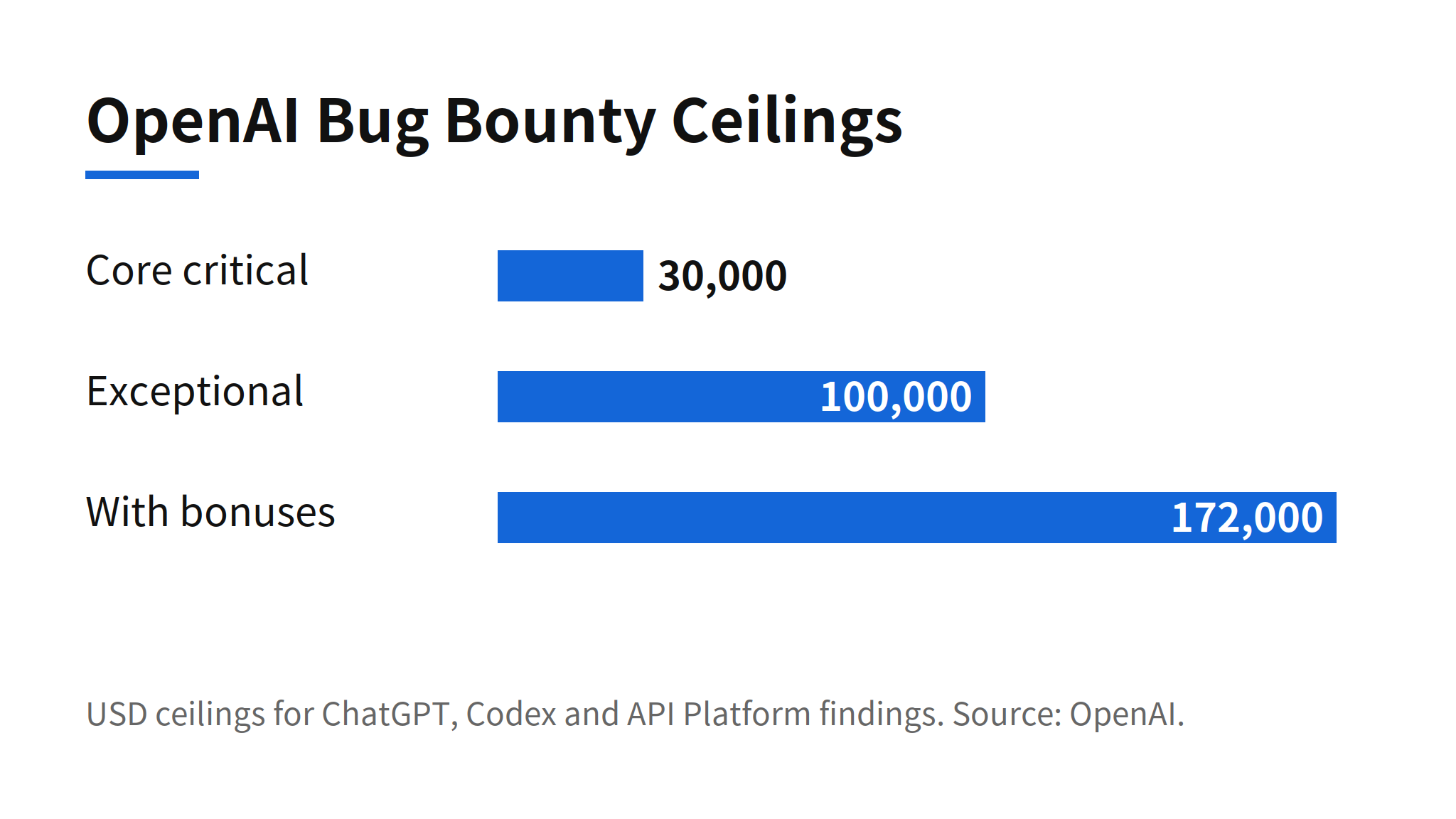
The three numbers describe three different situations, and reading them as one headline figure distorts the program. The $30,000 figure is the standard cap for a critical finding in a core product. The $100,000 figure is reserved for critical findings OpenAI judges exceptional, before any bonus is applied. The $172,000 figure is the stacked maximum for that exceptional tier. A researcher planning work against this program should price effort against the first two numbers and treat the third as a ceiling that requires every condition to line up.
The general critical cap is $30,000. The $172,000 figure is an exceptional case with all bonuses stacked, and the two numbers should not be mixed.
Bonus Multipliers and Loyalty Additions
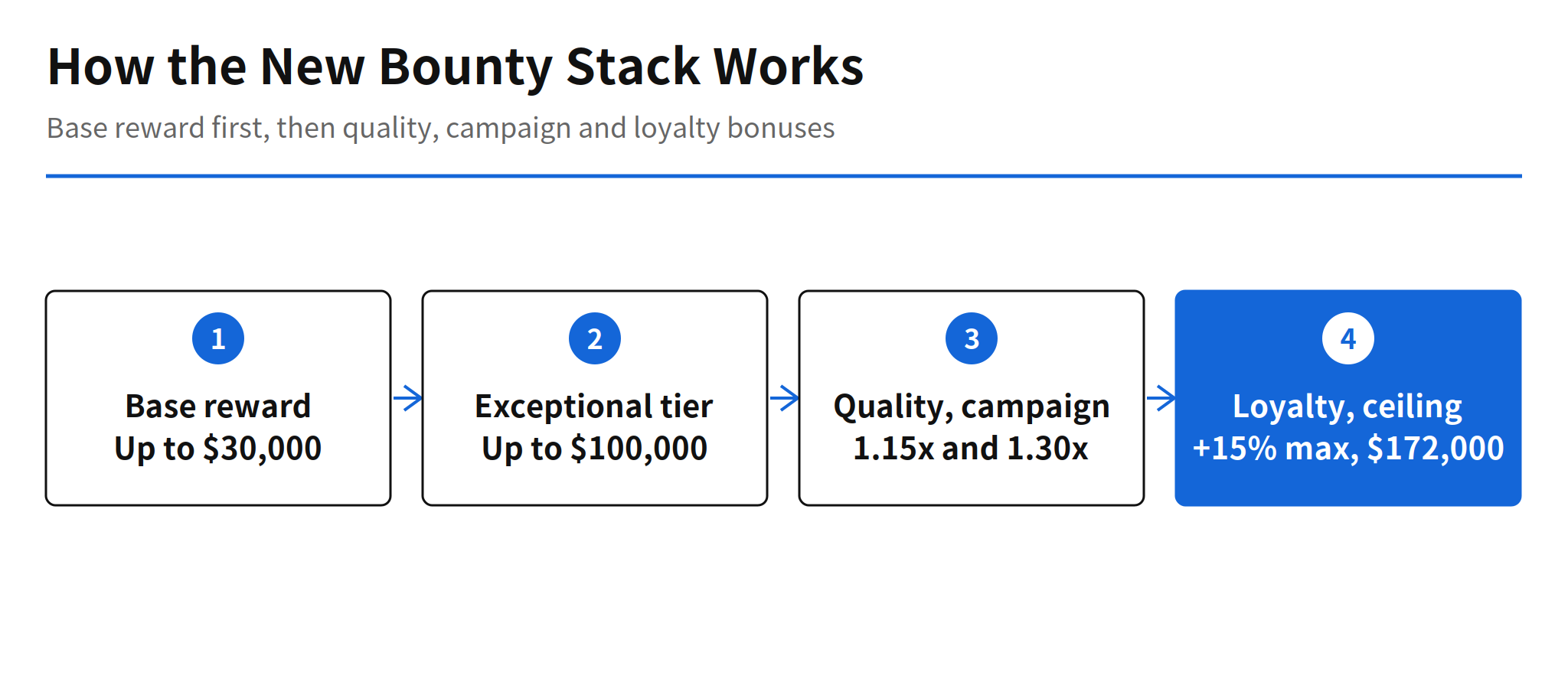
Three additions are new. Report quality can multiply a reward by up to 1.15 times. Priority campaigns can multiply it by up to 1.30 times. A loyalty bonus adds between 5 percent and 15 percent. Together they shift the program from paying only for severity toward paying for report usefulness and for sustained participation. A clear, reproducible report is now worth measurably more than a thin one at the same severity, and researchers who return to the program accumulate an advantage that a one time submitter does not have.
That structure also tells researchers where OpenAI wants attention. Priority campaigns exist to steer testing toward areas the company chooses, rather than leaving coverage to chance. Combined with the higher midpoints, the message is consistent: OpenAI is bidding for the best reports to arrive in its own queue first, at a moment when AI assisted vulnerability discovery is making good findings more plentiful and more valuable at the same time.
Retroactive Application and Program Scope
The new schedule applies to reports that have not been paid yet. It also reaches slightly backward. Rewards paid during the 30 days before the announcement are topped up when the new schedule would have paid more. That is a small clause with a clear purpose. Without it, researchers paid in October would have been penalized for submitting early, and the program would have created an incentive to sit on findings whenever a raise seemed likely.
The program runs on Bugcrowd. Its scope has a boundary worth noting for AI practitioners. Safety issues that amount only to a jailbreak or a prompt based bypass are outside the program scope, according to OpenAI. The bounty is priced for security vulnerabilities in products and infrastructure, not for demonstrations that a model can be talked around its guardrails.
Cathedral Systems and the Next Security Sprint
The second announcement concerns defense inside OpenAI itself. The next security sprint will include researchers from the external security firm Cathedral Systems. Cathedral researchers will use OpenAI models alongside OpenAI teams to probe the company defenses. Pairing an outside firm with internal staff is a deliberate choice. Internal teams know where the weak points are supposed to be, while an external team is more likely to question assumptions that insiders share without noticing.
The sprint builds on a previous round in which 25 percent of product engineers were assigned to finding and fixing vulnerabilities with Codex. That figure gives the new sprint its context. OpenAI has already run the experiment of turning a large share of its own engineering capacity toward agent assisted defense, and it describes the underlying race plainly. As models get better at finding vulnerabilities, defenders gain a window in which they can apply the same capability to their own systems first. The bounty raise and the sprint are two sides of that position: buy findings from outside, and generate findings from inside, before someone else does either against you.
Limits and Unconfirmed Details
- Sprint timing and cost: the start date and duration of the next sprint are undisclosed, and the amount paid to Cathedral Systems is undisclosed.
- Cathedral and Anthropic reporting: the claim that Cathedral found an access path inside a third party business system used by Anthropic last month comes from Washington Post reporting. It does not appear in the OpenAI announcement, and its details remain unconfirmed in the sources behind this post.
- Ceiling interpretation: $172,000 requires an exceptional critical finding plus the full bonus stack. It is not a typical payout and not the standard critical rate.
Those gaps do not weaken the confirmed core of the announcement, which is the published reward schedule itself. They do mean that the sprint half of the story is, for now, a statement of intent. No findings from the Cathedral collaboration have been published, and none should be inferred from the partnership announcement alone.
Practical Meaning for Teams Building With Coding Agents
For teams that ship software with coding agents, the useful takeaway is about cadence. The same class of tooling that writes code quickly can also search it for weaknesses quickly, and OpenAI is now paying market rates that reflect that shift. A team running an Android app together with its own APIs should assume its product will be examined with agent grade tooling, whether by its own staff, by bounty researchers, or by less friendly actors.
A reasonable response is procedural rather than dramatic. Add one exploratory, agent assisted security pass before releases, price that pass against the cost of a single serious finding, and keep the bounty or disclosure channel easy to find. OpenAI has just published what the top of this market pays for a critical finding. Smaller teams will not match those numbers, but the direction of the price signal applies to them as well: finding a vulnerability early is getting more expensive to skip.
Related Reading
Continuous security monitoring for agent written code is the subject of an earlier post in this series: Claude Security: Continuous Monitoring Rescans Every Commit. The two stories describe the same shift from different positions, one as a product that rescans every commit and one as a buyer raising the price of human and agent assisted findings.
FAQ
What is the new maximum OpenAI bug bounty?
The highest figure is $172,000, and it applies only to exceptional critical findings with every bonus stacked. The standard critical cap for core products is $30,000, and exceptional critical findings reach $100,000 before bonuses.
Which products do the new bounty ceilings cover?
The ceilings named in the announcement cover critical vulnerabilities in OpenAI core products: ChatGPT, Codex and the API Platform. The program runs on Bugcrowd.
How do the new OpenAI bounty bonuses work?
Three additions stack on the base reward. Report quality can add up to 1.15 times, priority campaigns up to 1.30 times, and a loyalty bonus adds between 5 percent and 15 percent.
Do the new bounty rates apply to earlier reports?
Yes, within limits stated by OpenAI. The new schedule applies to reports that have not been paid yet, and rewards paid during the 30 days before the announcement are topped up when the new schedule would have paid more.
Sources
- OpenAI, "Rewarding defenders with bigger bug bounties" (November 2, 2026, OpenAI official)
- OpenAI, "Preparing our next security sprint to harden OpenAI" (November 2, 2026, OpenAI official)
- Comparison of the reward table and multipliers against the Bugcrowd program page (November 3, 2026)
- Original issue: ax-trend issue #3736