Olala mini 7A1B Release: OVHcloud First Open LLM, 8GB GPU
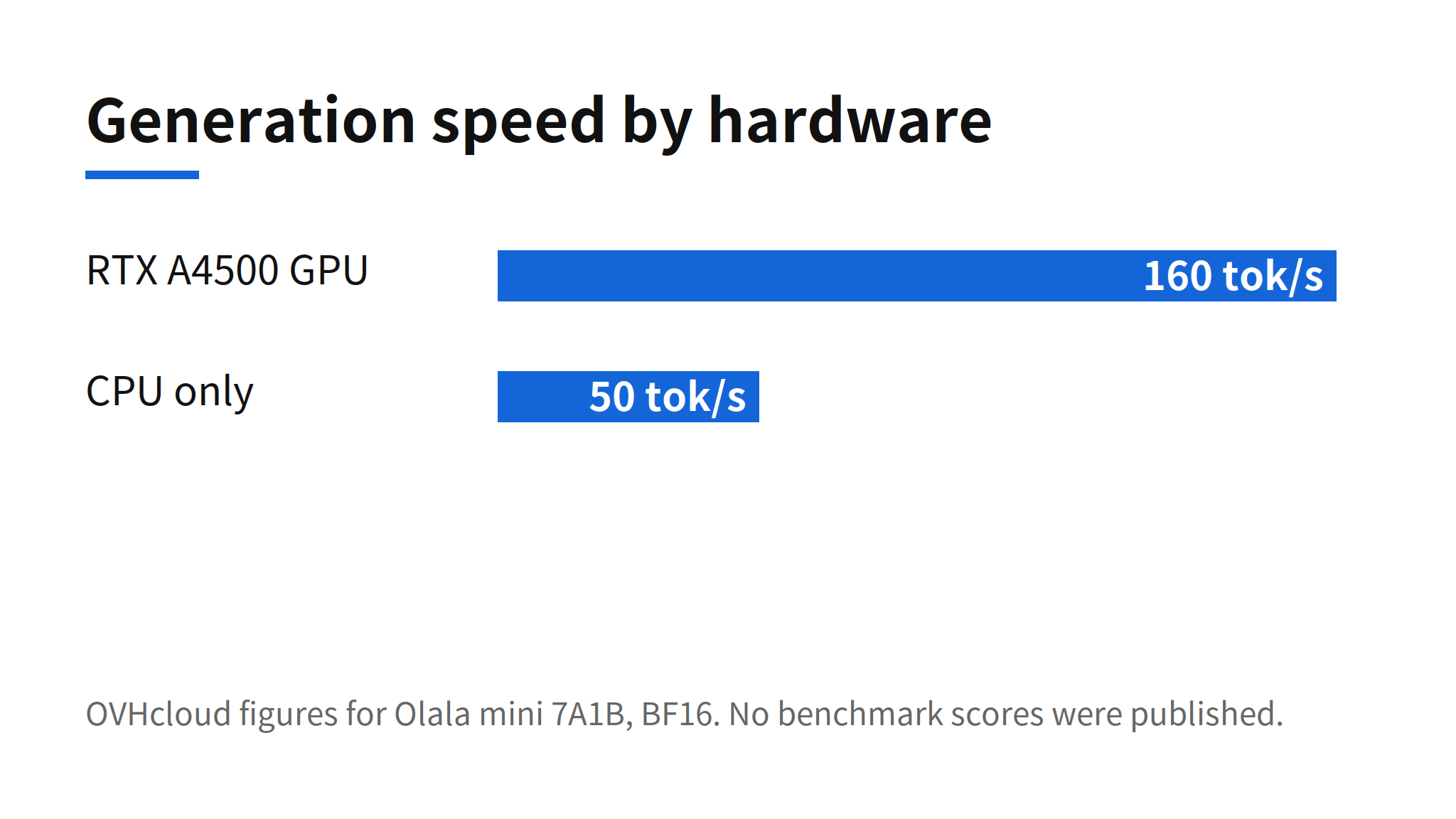
OVHcloud announced Olala mini 7A1B on November 17, 2026, the first model in Olala, its first family of large language models. The model holds 7 billion parameters and activates only 1 billion per token, spread across 256 experts per layer. That sparsity is why OVHcloud can claim it runs on a GPU with as little as 8 GB of memory, at 160 tokens per second on an RTX A4500, and still reaches 50 tokens per second on a standard processor with no GPU at all.
The launch is also a production claim, not only a research announcement. The search service Qwant has already adopted the model for its flash answer feature, with answers 20% faster and running costs divided by three compared with the model it used before. The official launch presentation follows at the OVHcloud AI Summit on November 19, and the model is slated for open source release on Hugging Face under the Apache 2.0 licence.
Hybrid Attention and Sparse Activation
The architecture combines two choices that each cut the cost of a token. The first is sparse activation: with 256 experts per layer and only a fraction of the model used for each request, most of the 7 billion parameters stay idle for any given token, which is what keeps memory and compute close to a 1B class model while the stored knowledge covers a larger network. The second is the attention design, a hybrid that combines Differential-TPA with Mamba-3, shipped in BF16 format. Mamba style sequence mixing is cheaper over long inputs than pure attention, so pairing it with a differential attention variant is a plausible route to the speed figures OVHcloud quotes, although the release gives no measurement conditions for those figures.
The practical reading of the hardware numbers matters more than the architecture labels. A model that fits in 8 GB of GPU memory fits on consumer cards and small workstation GPUs, and 50 tokens per second on CPU alone is fast enough for interactive use without any accelerator. That puts Olala mini in the same evaluation set as other small open models teams test for on-device assistants, local search answers and private self-hosting, where the deciding factors are memory footprint and latency rather than peak benchmark scores. Its current 32,000 token context window is the weak point in that comparison, since recent small models commonly ship with longer windows, and OVHcloud itself treats the extension to 128,000 tokens as a version 1.1 item rather than a launch feature.
Training on European Public Supercomputers
Olala mini was trained on three European public supercomputers, Jupiter, MeluXina and Jean Zay, equipped with GH200, A100 and H100 GPUs. OVHcloud puts the public support at the equivalent of €7 million in computing hours and calls it decisive. The training programme also produced a standing team: the release says the effort gave rise to OVH's Agentic Lab, OVHai LLM, which now owns the model roadmap.
The release package is broader than weights alone. OVHcloud says the model ships with its weights, its pre-trained base model, a technical report and AI Act compliance documentation. For European buyers who have to document how a model was built before they can deploy it, that compliance paperwork is a differentiator that most open model releases do not include. CEO Octave Klaba framed the strategic reason plainly: OVHcloud cannot rely on other labs continuing to share their models as open source, training know-how has become widely accessible, and the cost of training has been divided by 20 in three years.
My read: the significance here is the buyer, not the parameter count. Europe's largest cloud provider decided that hosting other labs' open models was not a durable position and built its own training capability with public compute. Whether Olala mini itself wins evaluations matters less than the fact that a sovereign European alternative now exists at the small end of the market, with compliance documentation included from day one.
Qwant Production Numbers and Their Limits
Qwant's flash answer feature is the only performance evidence in the release. Answers got 20% faster and running costs fell to one third of the previous setup. Those are deployment numbers from a real search product, which makes them more useful than a synthetic demo, but they come with two gaps. OVHcloud does not name the model Qwant replaced, so the size of the improvement cannot be mapped to a known baseline. And the release publishes no standard benchmark scores at all, so there is no public basis yet for comparing Olala mini's reasoning or knowledge quality against other 7B class open models. Both gaps should close when the technical report and the Hugging Face release land, and until then the honest summary is that the efficiency story is documented while the quality story is not.
Roadmap to Version 1.1 and Version 2.0
Version 1.1, expected by the end of the year, extends the context window to 128,000 tokens and improves performance in mathematical reasoning. Version 2.0 is a family expansion rather than a point upgrade: OVHai LLM plans models specialised in three areas, agentic AI for businesses, cloud DevOps for developers, architects and operations teams, and cybersecurity covering defensive and offensive work. OVHcloud also says Olala will in time power OVHai Workspace, whose encrypted version requires models that can run locally on the workstation, which explains why the family starts with a model small enough for an 8 GB GPU. The 2.0 models will exceed 100 billion parameters, a different class entirely from the mini, so the mini reads as the efficiency proof for a much larger programme.
Limits and Unconfirmed Points
- No benchmark scores published: the release contains no standard benchmark results. The only performance evidence is Qwant's production figures, and the model Qwant replaced is not named.
- Hugging Face timing unconfirmed: the release says the model will be available on Hugging Face under Apache 2.0, but does not confirm whether the weights land on November 19 with the AI Summit launch or later.
- Speed conditions unstated: the 160 and 50 tokens per second figures come without batch size, prompt length or measurement conditions, so they are vendor claims rather than reproducible results.
- Context window trails peers: 32,000 tokens at launch, with 128,000 tokens planned for version 1.1 by the end of the year. The 1.1 date is a plan, not a shipped feature.
FAQ
What is Olala mini 7A1B?
Olala mini 7A1B is the first model in Olala, OVHcloud's first family of large language models. It has 7 billion parameters in total, activates 1 billion per token across 256 experts per layer, and uses hybrid attention combining Differential-TPA and Mamba-3 in BF16 format.
What hardware does Olala mini 7A1B need?
OVHcloud says the model runs on a GPU with as little as 8 GB of memory, reaching 160 tokens per second on an RTX A4500. Without a GPU, it runs on a standard processor at 50 tokens per second.
Is Olala mini 7A1B open source?
Yes. OVHcloud says the model will be available as open source on Hugging Face under the Apache 2.0 licence, released with its weights, its pre-trained base model, its technical report and its AI Act compliance documentation.
Is Olala mini 7A1B already used in production?
Yes. The search service Qwant has already adopted it for its flash answer feature. OVHcloud reports answers 20% faster and running costs divided by three compared with the model Qwant used before, which it does not name.
What comes after Olala mini 7A1B?
Version 1.1, expected by the end of the year, extends the context window from 32,000 to 128,000 tokens and improves mathematical reasoning. Version 2.0 will exceed 100 billion parameters and add models specialised in agentic AI, cloud DevOps and cybersecurity.
Related Reading
- Edge0-145B Release: 145B On-Device Model, 29GB Peak, a much larger model built for on-device deployment, at the opposite end of the local inference trade-off
- Inkling 2 Small Open Weights: 500GB VRAM, Apache 2.0, another Apache 2.0 open weights release, with a far heavier hardware footprint
- Tencent Hy4 flash Release: Pricing, Specs and How It Works, a recent small fast model release from Tencent