Inkling 2 Small Open Weights: 500GB VRAM, Apache 2.0
Thinking Machines Lab released the Inkling 2 Small weights on Hugging Face on November 12, 2026, under an Apache 2.0 license. The company announced the release on its official X account at 20:50 UTC, and Mira Murati followed at 20:55 UTC with an "As promised" post. That wording matters, because the promise was specific: at the November 5 launch the model was closed and reachable only through Tinker, and the lab said the full weights would follow the next week once external safety testing and red-teaming were complete.
The release also redraws the practical question for this model. While it was hosted only, the decision was about API price. As open weights, the decision is about hardware, because the main checkpoint needs a GPU cluster with at least 500GB of aggregated VRAM. A 594B parameter model that activates 17B per token is now downloadable by anyone, and runnable by a much smaller set of teams.
What the weights release contains
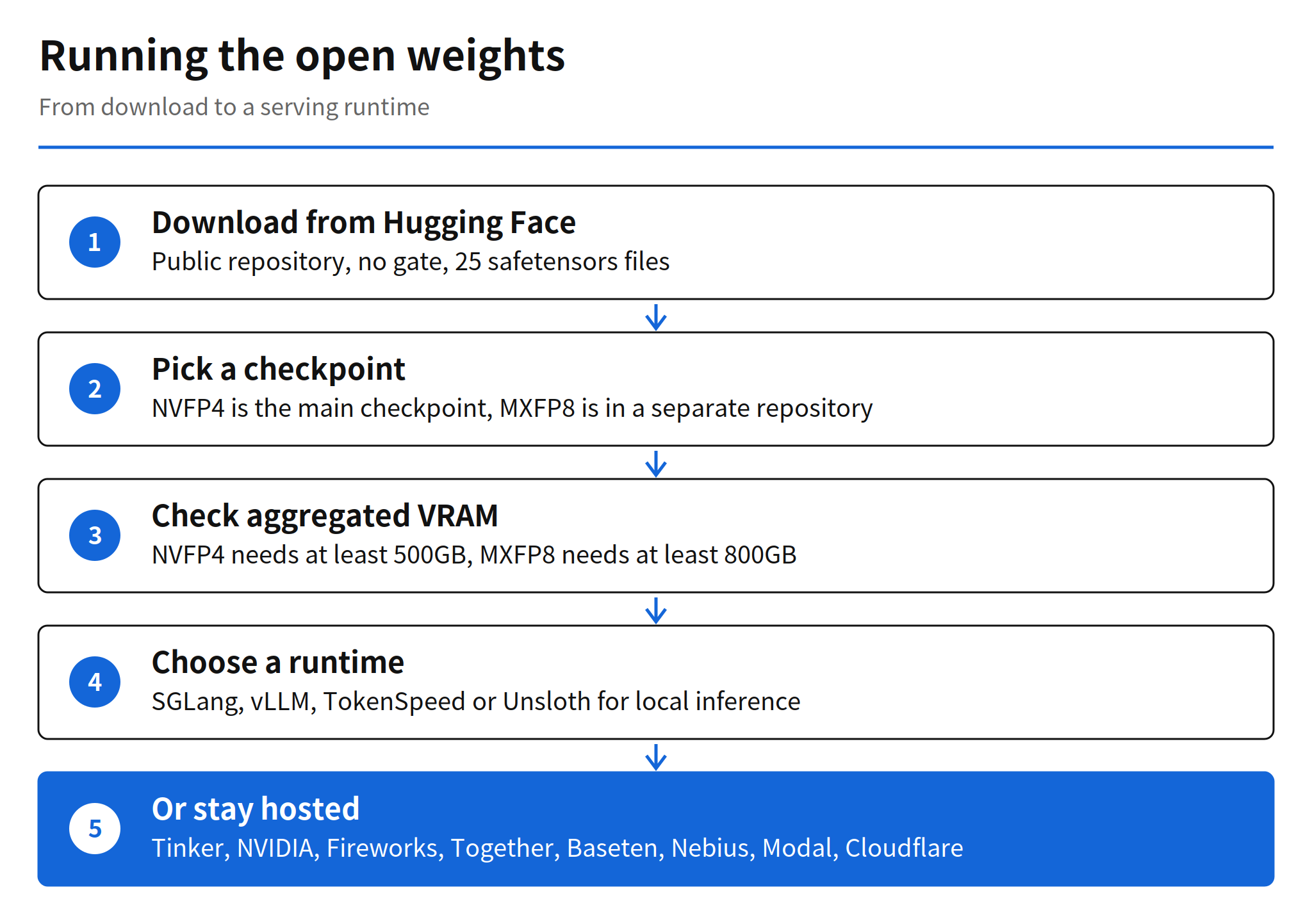
The Hugging Face repository is public and not gated, and it holds 25 weight files in safetensors format. The main checkpoint is NVFP4, and a second checkpoint in MXFP8 format lives in a separate repository. The Apache 2.0 license is declared in the model card header and links to the license text at apache.org. One detail is worth keeping attached to the release: when the repository was checked on November 12 at 21:38 UTC, it held no separate license file, so the license rests on that header declaration.
The November 12 update on the launch post widens the release beyond a download link. The weights are integrated with Unsloth, SGLang, vLLM and TokenSpeed, can be post-trained with Miles, SkyRL and Snowflake Cortex Training, and are available through hosted APIs at NVIDIA, Fireworks, Together, Baseten, Nebius, Modal and Cloudflare. In other words, the open release arrived with a serving and fine-tuning ecosystem already attached, rather than as a bare checkpoint that each adopter has to wire up alone.
The hardware requirement in detail
The model card states the floor plainly. The NVFP4 checkpoint needs at least 500GB of aggregated VRAM, with 2 NVIDIA B300 GPUs or 4 NVIDIA H200 GPUs given as examples. The MXFP8 checkpoint raises that floor to at least 800GB. Aggregated is the key word: this is a multi-GPU cluster requirement, not a single large card, and it puts ordinary workstations and small servers out of reach for self-hosting.
| Checkpoint | Minimum aggregated VRAM | Example hardware |
|---|---|---|
| NVFP4, main checkpoint | 500GB | 2 NVIDIA B300 or 4 NVIDIA H200 |
| MXFP8, separate repository | 800GB | No example given in the card summary |
That requirement is the honest counterweight to the open weights headline. Apache 2.0 removes the legal and access barriers, and the 25 safetensors files can be downloaded freely, but the compute barrier stays high. For most teams the realistic routes remain the hosted ones, Tinker or one of the API providers named in the update, and self-hosting is an option mainly for organizations that already operate large GPU clusters.
The model underneath the release
The model itself is unchanged from the November 5 launch. It is a mixture of experts model with 594B total parameters and 17B active per token, routing each token to 8 of 384 experts across a 48-layer decoder-only transformer, with a hybrid of local and global attention. Image input comes through a 292M parameter vision encoder based on Perception Encoder, using 20 by 20 pixel patches with 2 by 2 spatial pooling, interleaved with text tokens.
Two context figures need to be kept separate. The model card lists a context window of up to 1M tokens, while Tinker serves the model today in 64K and 256K variants. The card maximum describes the model, and the served variants describe what a hosted user can actually use now. On Tinker, pricing is $0.30 per million tokens for prefill, $0.03 for cached prefill, and $1.00 for sampling, with training at $1.50 per million tokens at 64K context and $3.00 at 256K. Sampling is about 79% cheaper than the original Inkling, which is part of why the hosted route remains competitive even after the weights opened.
Performance in context
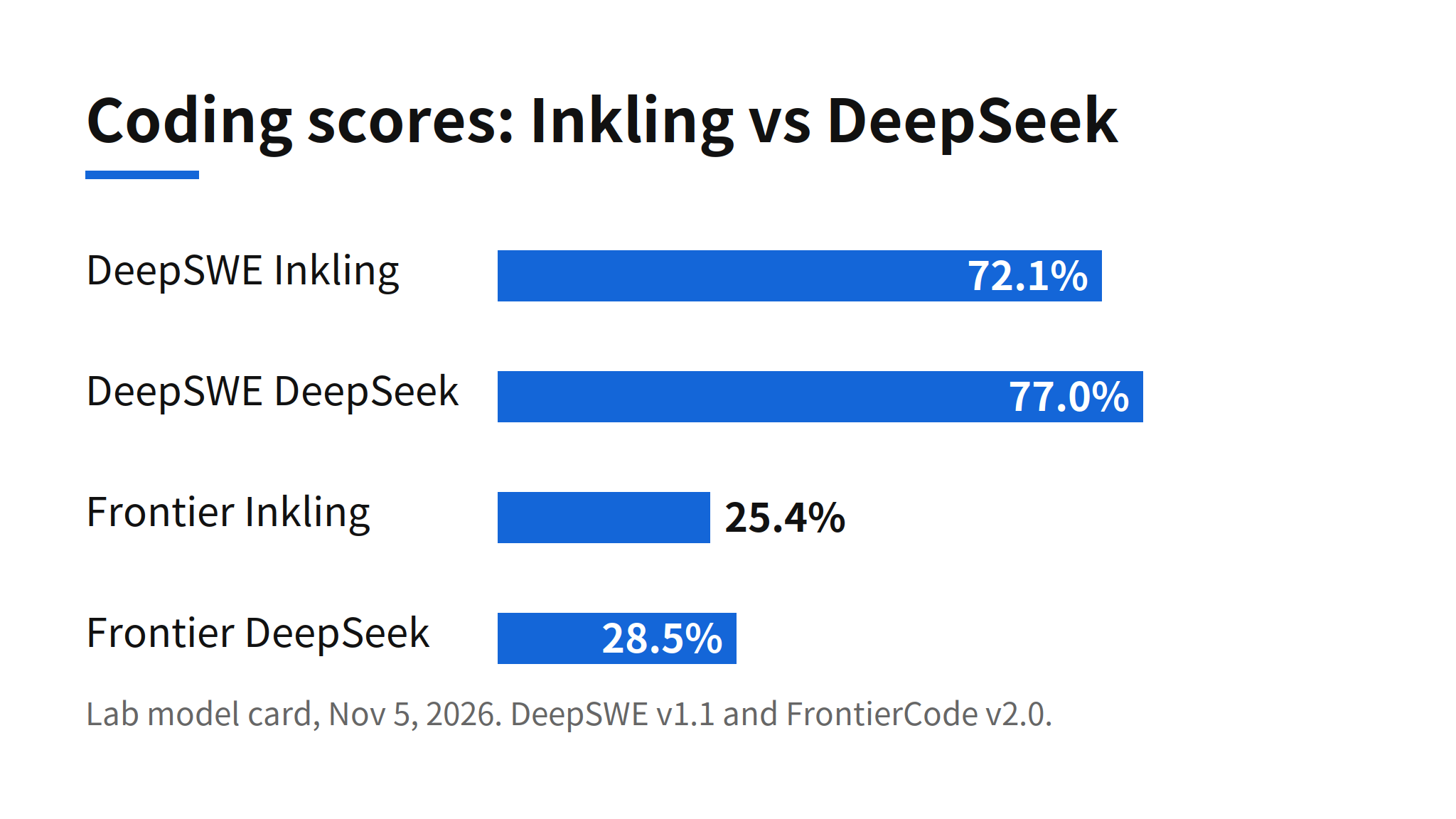
The open release does not change the scores, and the lab's own tables keep the ranking honest. On coding, DeepSeek V4.1 Flash still leads on most rows: DeepSWE v1.1 is 72.1% for Inkling 2 Small against 77.0%, and FrontierCode v2.0 is 25.4% against 28.5%. Vibe Code Bench shows the same pattern at 81.6% against 87.7%. A team choosing this model for coding alone would be choosing against the evidence in the publisher's own card.
The lead sits elsewhere. Inkling 2 Small is ahead on MMMU Pro at 81.6% against 80.6%, on HLE-Diamond at 28.7% against 25.3%, and on the Vals Finance Index at 61.5% against 60.9%. Its vision results are the strongest part of the launch material, including ScreenSpot Pro and DesignArena website scores that the lab said would make it the top open weights model on that board once the weights shipped. They have now shipped, and that board claim can be checked directly, although no post-release board check is recorded in the sources for this article.
Limits and unverified points
Four limits should stay attached to this release. First, no independent remeasurement is recorded yet: every score above is lab reported, and Artificial Analysis had not published its own page for the model in the sources checked. The release post rounds the Intelligence Index to 31, while the model card row reads 30.6, and both figures are the lab's.
Second, the license is confirmed only as a model card header declaration, with no separate license file in the repository at the time it was checked. Third, the model card links an acceptable use policy on the lab's site, and the CellCog record notes that policy was not read, so whether it adds conditions beside the license is unverified here. Fourth, the weights were not downloaded or run by the sources for this article, so serving behavior under the listed runtimes is documented by the card and the update post, not independently exercised.
None of that cancels the core fact. A frontier lab promised a dated open release after safety testing, delivered it one week later under Apache 2.0, and shipped it with runtimes, post-training tools and hosted APIs already attached. The constraint that decides adoption is no longer access. It is the 500GB of VRAM standing between a download and a running model.
Related articles
- Inkling 2 Small Release: 17B Active, Pricing and Scores
- Runway Praxis-1 Open Weights: 46.2% on RoboLab-120
FAQ
When were the Inkling 2 Small weights released and under what license?
Thinking Machines announced the weights on November 12, 2026 at 20:50 UTC. They are on Hugging Face under Apache 2.0, declared in the model card header. The repository itself held no separate license file when it was checked that day.
How much VRAM does self-hosting Inkling 2 Small need?
The main NVFP4 checkpoint needs a GPU cluster with at least 500GB of aggregated VRAM, with 2 NVIDIA B300 or 4 NVIDIA H200 GPUs given as examples. The separate MXFP8 checkpoint needs at least 800GB.
Which runtimes can serve the open weights locally?
The model card lists SGLang, vLLM, TokenSpeed and Unsloth for local inference. The November 12 update also names Miles, SkyRL and Snowflake Cortex Training for post-training, and hosted APIs at NVIDIA, Fireworks, Together, Baseten, Nebius, Modal and Cloudflare.
How much does hosted use cost on Tinker?
On Tinker the model costs $0.30 for prefill and $1.00 for sampling per million tokens, with cached prefill at $0.03. Training costs $1.50 per million tokens at 64K context and $3.00 at 256K context.
What context window does the model support?
The model card lists a context window of up to 1M tokens. Tinker serves the model today in 64K and 256K variants, so the served limit is lower than the card maximum.