Inkling 2 Small Release: 17B Active, Pricing and Scores
Thinking Machines Lab released Inkling 2 Small on November 5, 2026, the first model in its second generation. It is a Mixture-of-Experts model with 594B total parameters and only 17B active per token, it takes image input, and it exposes variable effort so callers can trade reasoning depth against cost. Its Artificial Analysis Intelligence Index score is 31. For now the weights are closed and the model runs only on Tinker. The full weights are planned for release next week under Apache 2.0, once external safety testing and red-teaming finish.
That sequence matters more than the headline size. The first generation was larger, at 975B total and 41B active, so this generation deliberately shrinks both numbers while putting the training budget into long agentic coding work. A smaller active footprint lowers the serving cost of each token, and the open-weights promise, if it lands on schedule, makes the model a self-hosting candidate rather than only a hosted API. Until the weights actually appear, though, every practical judgment runs through Tinker pricing and Tinker tooling.
Coding Scores and What They Actually Show
The company table reports 25.4% on FrontierCode v2.0, 72.1% on DeepSWE v1.1, 86.3% on SWEBench Pro v2 (Hard), and 81.6% on Vibe Code Bench v1.1. Read together, the spread is the story. The hardest frontier-style test sits near one quarter, while the narrower software engineering benches sit much higher. That pattern is consistent with a model trained heavily for sustained coding tasks inside known harnesses, and it warns against quoting the highest number as a general coding score.
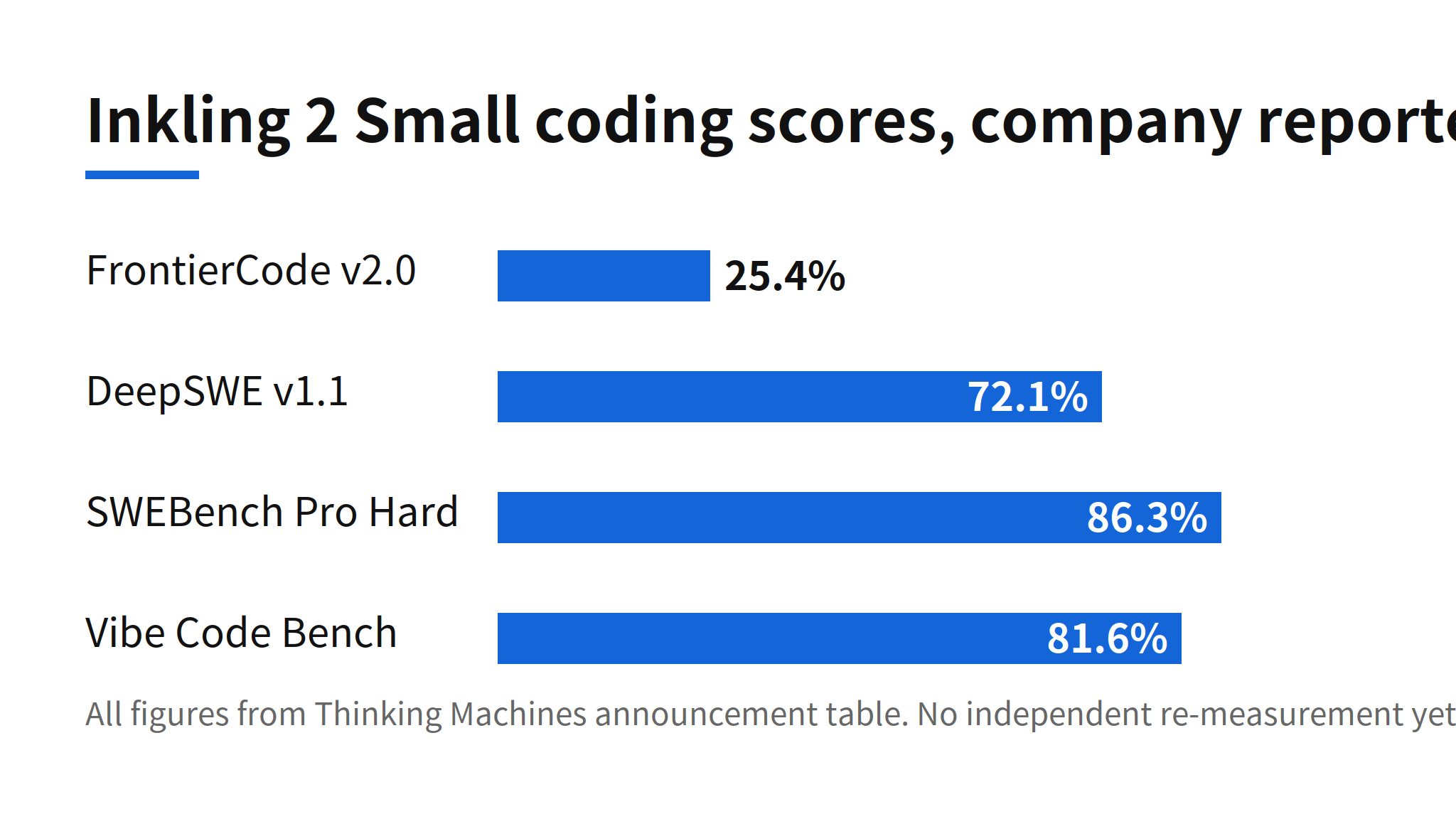
Every one of these numbers is a company figure. Apart from the Intelligence Index score of 31, no independent group has re-measured the model under the same conditions yet. That does not make the table useless. It makes it a claim to test once the weights or broader API access arrive, and a reason to weight the Index score, which at least comes from an outside evaluator, more heavily in early comparisons.
Training Built Around Long Coding Tasks
Training used reinforcement learning on hundreds of thousands of long coding tasks. The runs spanned several agent harnesses and context compression strategies, and tasks that unit-test rewards could not judge were scored by agentic graders instead. That last detail is easy to miss and it is the most consequential one. A reward that only checks tests teaches a model to satisfy tests. A grader that reviews the work itself can reward approaches that tests miss, which is closer to how long autonomous coding sessions actually succeed or fail.
The company also published an automated research case alongside the model. Inkling 2 Small itself trained Qwen3.5-4B on Tinker for time-series forecasting, spending $426 of a $500 budget over 4.5 hours and more than doubling the forecasting score. Treat it as a demonstration, not a benchmark. It shows the intended use, a model directing another model training run end to end within a fixed budget, and it gives a concrete cost anchor for that kind of delegated work. Whether the same loop holds up on less tidy tasks is unproven.
Access Today Through Tinker, Weights Next Week
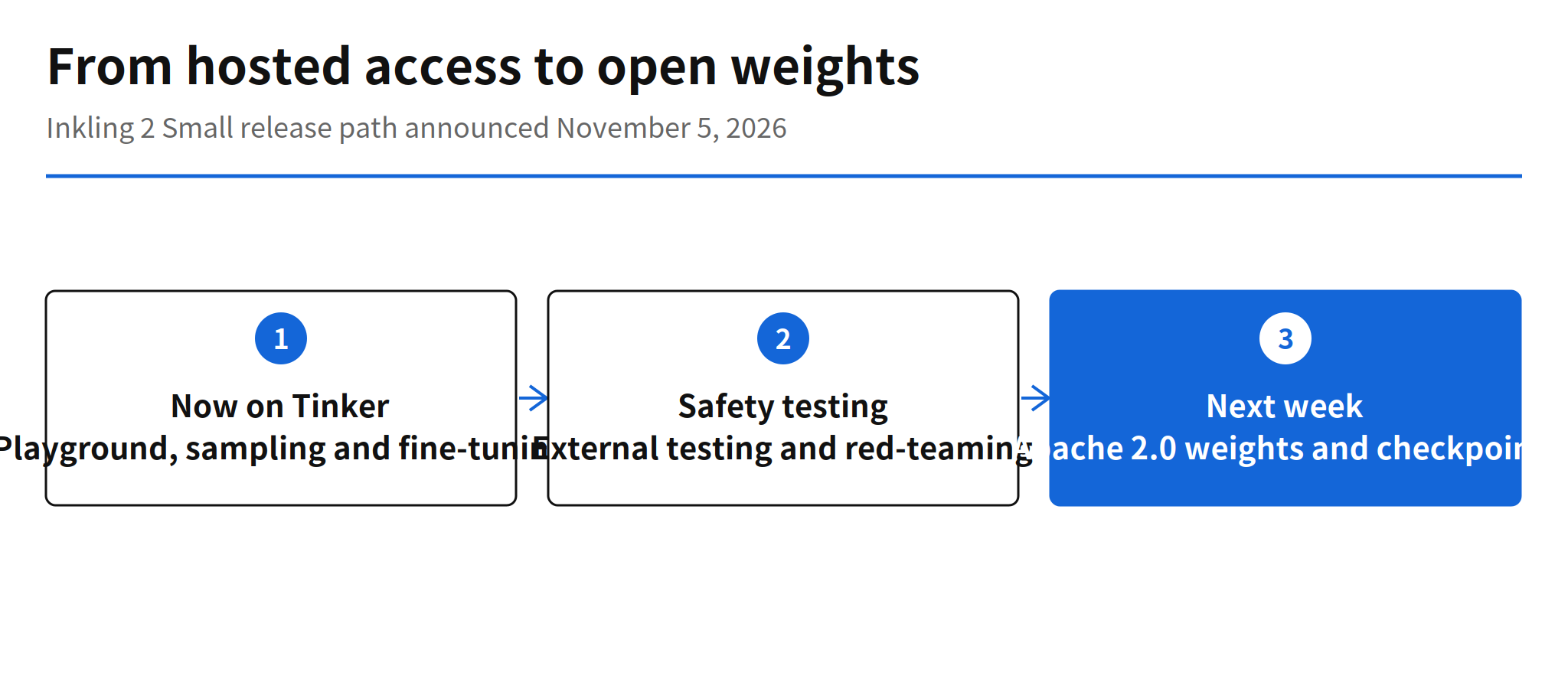
Today the model is available only through Tinker. The Tinker Playground offers immediate trials, and Tinker also provides fine-tuning and sampling. The documentation lists input at $0.30 per million tokens, cached input at $0.03, and output at $1.00 per million tokens, at a 64K context, with training at $1.50. Those prices set the comparison point for hosted use this week. They are low enough that trying the model on a real coding workload costs little, which is presumably the point of opening hosted access before the weights.
The staged path follows the approach the company described in its July 31 post: hosted access first, weights after external checks. The risk is in the wording. Next week is not a date, and the announcement itself notes the release depends on safety testing and red-teaming finishing. A slip would not be unusual, and plans that require the weights should treat the timing as unconfirmed until the checkpoints are actually downloadable.
Open Questions on Audio and Independent Verification
Audio is the quiet gap in the announcement. The first generation and Inkling-Small supported audio, while this release specifies image input only and says nothing about audio. Silence in a spec sheet is not proof of absence, but teams that built on the earlier audio path should not assume it carries over. Support is unconfirmed until Thinking Machines states it directly.
The second open item is verification. Benchmark scores, the automated research result, and the Index framing all originate with the company, with the Index as the partial exception. Independent replication under shared conditions is the missing piece, and the Apache 2.0 release is what will make that replication possible at scale. In that sense the most important number in this announcement is not in the table at all. It is whether the weights arrive next week as promised.
Related Reading
For another terminal coding benchmark that included the first Inkling generation, see the report on Ricursive Ripple-65B Preview. For a recent small model released with open weights from the start, see Alpie Seed 9B and its open weights release. Follow-up: the weights did arrive as promised, see Inkling 2 Small Open Weights: 500GB VRAM, Apache 2.0.
FAQ
How large is Inkling 2 Small?
It is a Mixture-of-Experts model with 594B total parameters and 17B active parameters per token. That is smaller on both counts than the first generation, which had 975B total and 41B active parameters.
When will the Inkling 2 Small weights be released?
Thinking Machines said the full weights will be released next week under the Apache 2.0 license, after external safety testing and red-teaming finish. No exact date was given, and checkpoint downloads open at the same time.
How much does Inkling 2 Small cost on Tinker?
The Tinker documentation lists $0.30 per million input tokens, $0.03 for cached input, and $1.00 per million output tokens at a 64K context. Training is listed at $1.50.
Does Inkling 2 Small support audio input?
Audio support is unconfirmed. The announcement specifies image input and variable effort for reasoning, and does not mention audio, unlike the first generation and Inkling-Small, which supported audio.