Ricursive Ripple-65B: Open-Weight Coding Model Benchmarks
Ricursive Intelligence released Ripple-65B Preview on November 4, 2026, the first public model from the AI chip design company. It is a 65B dense open-weight coding model, pretrained from scratch on 12T tokens with a context window of up to 1M tokens. The weights are published on Hugging Face under the Apache 2.0 license.
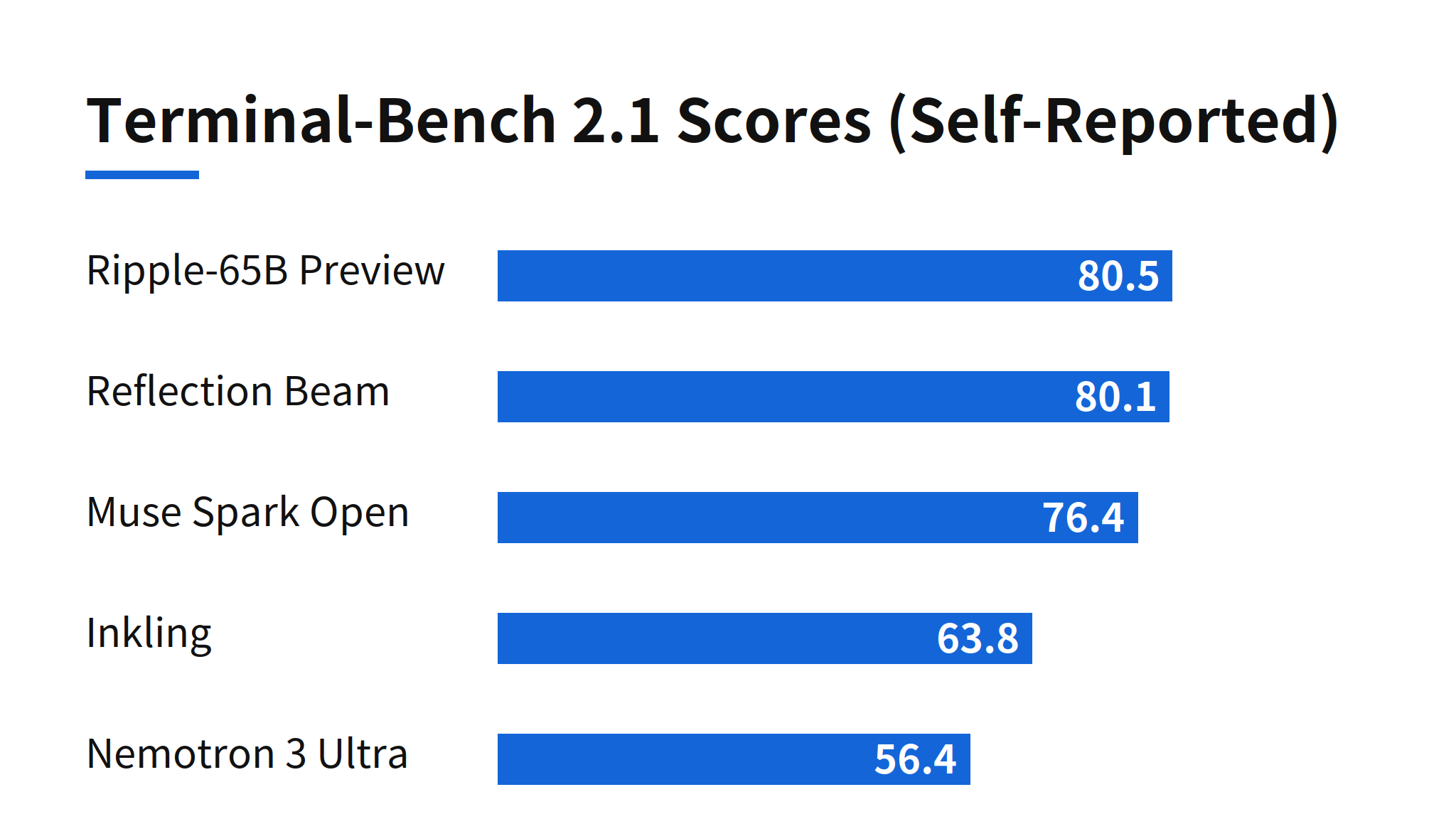
The headline result is a score of 80.5 on Terminal-Bench 2.1, the agentic coding benchmark. In Ricursive's own comparison table, that puts the 65B dense model ahead of Reflection Beam at 80.1, a model the issue record puts at 501B, and well ahead of Muse Spark Open at 76.4, Inkling at 63.8 and Nemotron 3 Ultra at 56.4. Every one of these numbers is a score Ricursive reported itself, and no independent reproduction exists yet. That caveat does not erase the claim, but it sets how much weight the ranking can carry today.
The practical side of the release is already usable. OpenRouter lists the model at $0.20 per million input tokens and $0.60 per million output tokens, and the Apache 2.0 weights can be self-hosted. If a third party rerun confirms numbers near 80 on Terminal-Bench, teams without the infrastructure for a several-hundred-billion-parameter MoE would gain a credible self-hosted option for agentic coding.
The Release: Three Checkpoints and Open Serving Paths
Ricursive published three checkpoints: an instruction-tuned BF16 model, an NVFP4 build, and a BF16 base model. The NVFP4 checkpoint is an experimental build aimed at local hardware such as NVIDIA DGX Spark. Serving is open from day one through direct Hugging Face downloads, OpenRouter and GMI Cloud. A Together AI listing is still marked coming soon, so the hosted routes available today are the three open ones.
On datacenter GPUs, Ricursive reports throughput of 250 tokens per second on two B200 cards at batch size 8. A dense 65B model has a simpler serving story than a sparse MoE of similar benchmark rank: every parameter is active on every token, which raises compute per token, but there is no expert routing layer to operate. That trade sits at the center of the design choices described below.
Benchmark Results
Beyond Terminal-Bench, Ricursive reports 79.1 on SWE-bench Pro v2.0 Hard and 76.5 on SWE-bench Verified. The reasoning benchmarks are higher still: 98.3 on AIME 2025, 90.5 on HMMT February 2026 and 85.2 on GPQA Diamond. Read together, the table describes a model tuned hardest for terminal-driven agent work and competition mathematics, with a more mixed picture on the patch-based software engineering benchmarks, where the Verified score trails Beam and Inkling.
Dense Architecture Over Mixture of Experts
Ricursive was founded by Anna Goldie and Azalia Mirhoseini, known for the AlphaChip work on AI-driven chip placement. Ripple is a general-purpose variant of the private model that runs the company's chip design platform, which makes this release a byproduct of an internal tool rather than a lab's flagship research line. The company says it chose a dense architecture over MoE to reduce operational complexity.
The layout is thin and deep: a model dimension of 5120 across 80 layers. Gated attention, global NoPE and value residuals were kept only after surviving ladder experiments at 4B scale, according to the model card. That selection process matters for how to read the release. The architecture is presented as the residue of small-scale elimination tests, not as a new theoretical claim, so its credibility rests on the benchmark table more than on any single design idea.
Training Cost and Rollout Claims
Ricursive puts the total R&D cost of the model at $32M and the reinforcement learning effort at 1.4M rollouts. The rollout figure is the sharper claim, because Beam's team has reported more than 100M rollouts for its model. A gap of that size, if it holds up, suggests the score came from data quality and curriculum choices rather than from brute rollout volume.
Both sides of that comparison are company-reported, so it works as a reference point rather than a settled fact. Still, a frontier-adjacent coding model with a stated $32M total cost gives other teams a concrete number to plan against, at a moment when training budgets at this level are usually left vague.
Limits and Unconfirmed Points
The weaker results are visible in Ricursive's own table. SciCode sits at 39.4 and DeepSWE 1.1 at 44.3, both low within the comparison group, and the SWE-bench Verified score of 76.5 is below Beam and Inkling. The profile is therefore uneven: first place on the terminal benchmark, mid-pack on parts of the patch-based suite. Until an outside group reruns the same harnesses, the safest reading is that Ripple-65B is a serious new entry whose exact rank is still provisional.
Related Reading
For the opposite architectural bet at a far larger scale, see the Kimi K3.1 Pro open weights release, a 2.8T MoE model published two days earlier. For a broader open-model release wave from an established vendor, see the NVIDIA open models report from GTC Berlin.
FAQ
What is Ripple-65B Preview?
Ripple-65B Preview is an open-weight coding model released by Ricursive Intelligence on November 4, 2026. It is a 65B dense model pretrained from scratch on 12T tokens with a context window of up to 1M tokens, and the weights are published on Hugging Face under the Apache 2.0 license.
How does Ripple-65B score on Terminal-Bench 2.1?
Ricursive reports 80.5 on Terminal-Bench 2.1, ahead of Reflection Beam at 80.1, Muse Spark Open at 76.4, Inkling at 63.8 and Nemotron 3 Ultra at 56.4 in the same table. The score is self-reported and has not been independently reproduced.
What does Ripple-65B cost on OpenRouter?
OpenRouter lists Ripple-65B Preview at $0.20 per million input tokens and $0.60 per million output tokens, with cache reads at $0.05 per million. The weights can also be downloaded from Hugging Face and self-hosted under Apache 2.0.
Have the Ripple-65B benchmark results been verified independently?
No. Every published score, including the 80.5 on Terminal-Bench 2.1, is Ricursive's own reported result, and the Terminus 2 harness rerun was also performed by Ricursive. Independent reproduction results are not yet available.