Kimi K3.1 Pro Open Weights: 2.8T MoE Release Explained
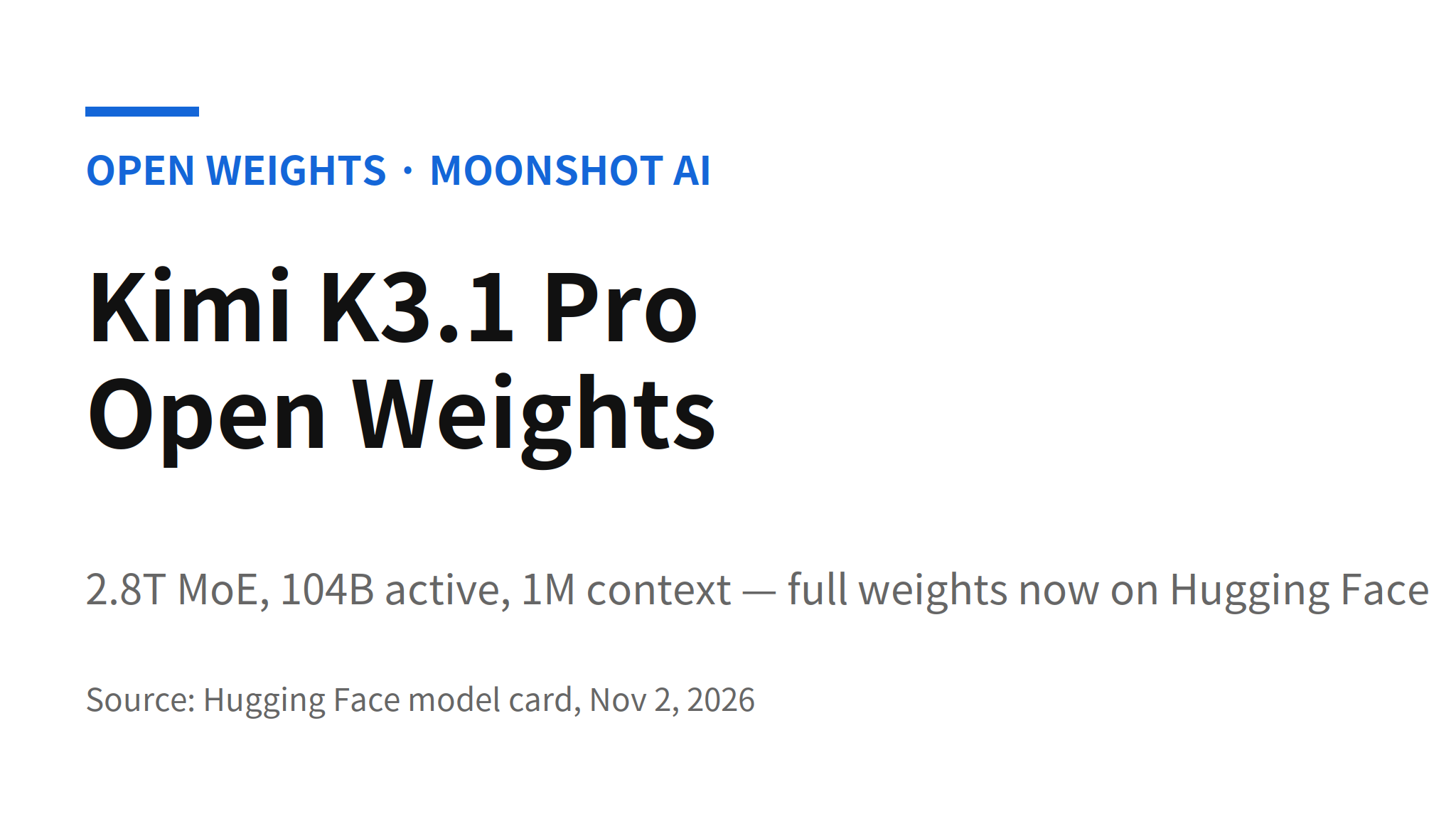
Moonshot AI has posted the full weights of Kimi K3.1 Pro on Hugging Face. The repository was created on November 2, 2026 and holds the complete model in 96 safetensors shards, according to the Hugging Face API file listing. That fulfills the commitment made at launch, when Moonshot AI said the full weights would be public by November 4.
The scale is the headline. The model card lists 2.8 trillion total parameters with 104 billion active parameters, a context length of 1,048,576 tokens, and native multimodal input through a separate vision encoder. By November 5 at 09:03 KST, the repository stood at trending rank 6 on Hugging Face with a trending score of 469, 477 likes and 797 downloads.
The timing of that attention matters. Kimi K3.1 Pro launched on October 23 as an API and hosted service only, so the first wave of coverage rested on Moonshot AI claims. The weight release changes the position for everyone evaluating it: the benchmark numbers can now be tested on independent hardware, and the serving recipes in the model card give those tests a defined starting point.
Architecture and Model Card Specifications
The model card describes Kimi K3.1 Pro as an open-weight, natively multimodal agentic model and as the most capable 3T class model Moonshot AI has released to date. It is a post-trained version of Kimi K3, trained with large scale reinforcement learning across hundreds of downstream domains.
The structure is a large mixture of experts design. The model has 93 layers, 896 experts and selects 16 experts per token, alongside 2 shared experts. The vocabulary is 160K. Vision input comes from MoonViT-V2, a vision encoder with 401 million parameters, so image understanding is part of the base model rather than an external adapter.
Two design choices stand out for serving. First, quantization was applied during training rather than added afterwards: the weights use MXFP4 and the activations use MXFP8. Second, the attention layout changed from the base model. The card lists 69 KDA layers and 24 Gated DSA layers, and notes that Gated DSA replaces the full attention Gated MLA layers used in Kimi K3. Practical consequences for throughput and memory still need independent serving measurements, which the card does not provide.
Release Timeline and the Kept November 4 Commitment
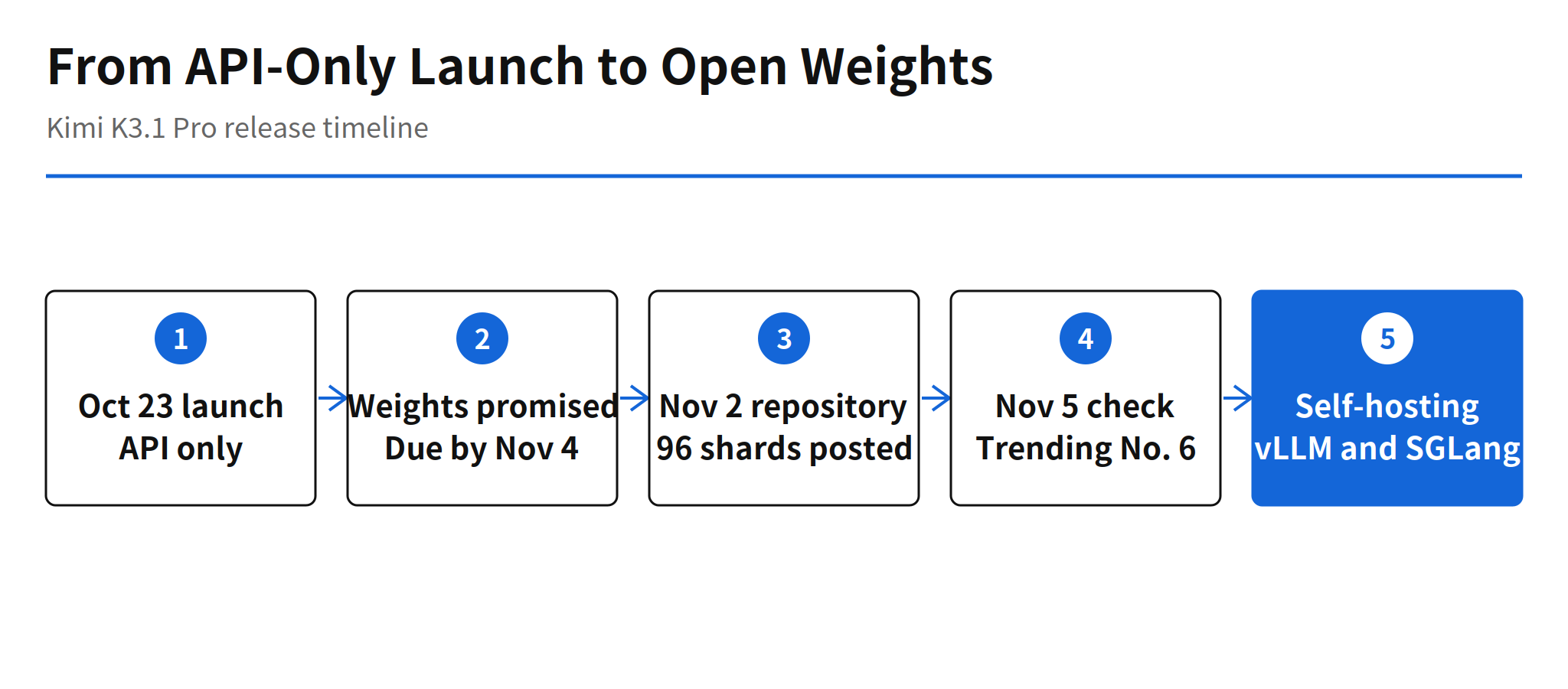
At the October 23 launch, covered in the earlier release report, Kimi K3.1 Pro was available only through the API and Moonshot AI services, with a weight release promised by November 4. The November 2 repository post keeps that promise with two days to spare. A teaser on October 22 had already shown the model name inside the Kimi Code terminal, signalling that a coding focused release was close.
That sequence is worth noting because delayed or partial weight releases are common for frontier class models. Here the delivered artefact matches the announced scope: the full weight set is posted, not a smaller distilled variant, and the file listing can be checked directly on Hugging Face.
Deployment Paths for Self-Hosting and API Use
For self-hosting, the model card points to serving recipes for three engines: vLLM, SGLang and TokenSpeed. Those recipes define the supported entry points for anyone who wants to run the 2.8T model on their own infrastructure. For hosted use, the model remains available through platform.kimi.ai in forms compatible with the OpenAI and Anthropic APIs, which lowers the integration cost for teams already built on either interface.
The honest limit is hardware. The model card does not state what hardware scale or cost is required to serve the full 2.8T weights in practice. A 104B active parameter count keeps per token compute far below the total size, but the full expert pool still has to be stored and loaded. Teams planning a deployment should treat the recipes as a starting point and budget for their own capacity tests rather than assuming a figure the card never gives.
Benchmark Claims and Independent Verification
The evaluation table on the model card lists Terminal-Bench 4.0 at 65.7. That is the same score Moonshot AI reported at launch, where it sat 0.7 percentage points behind Opus 5.5 in the launch comparison. Seeing the identical figure on the card confirms consistency, not independence: this remains a Moonshot AI self-measurement.
What changed is verifiability. While the model was API only, outside teams could probe behaviour but could not rerun the benchmark against the exact released weights under their own harness. With the weights public, independent reproduction is now possible in principle. Until such results appear, the 65.7 figure should be cited as the vendor score it is.
License Terms and Open Questions
The license deserves particular care. Hugging Face metadata lists the license type as other and the license name as kimi-k3.1-pro, which means this is a custom license rather than a standard permissive one. Calling the release open weight is accurate in the sense that the weights can be downloaded and run. Treating it as MIT style freedom would be a mistake until the full terms are read.
Related Reading
For the launch that this release completes, see the original Kimi K3.1 Pro release coverage linked in the source issue, including the Terminal-Bench comparison at announcement. For another open model release on this site, see the NVIDIA open models report, which covers a different approach to publishing model artefacts.
FAQ
What was released for Kimi K3.1 Pro on November 2?
Moonshot AI created the Kimi-K3.1-Pro repository on Hugging Face on November 2, 2026 and posted the full weights in 96 safetensors shards. The model card describes it as an open-weight, natively multimodal agentic model and a post-trained version of Kimi K3.
How large is Kimi K3.1 Pro?
The model has 2.8 trillion total parameters and 104 billion active parameters. It has 93 layers, 896 experts with 16 selected per token plus 2 shared experts, a 160K vocabulary and a context length of 1,048,576 tokens.
How can Kimi K3.1 Pro be run?
The model card points to serving recipes for vLLM, SGLang and TokenSpeed for self-hosting. Moonshot AI also offers the model through platform.kimi.ai in OpenAI and Anthropic compatible API forms.
What license covers Kimi K3.1 Pro?
The weights use a dedicated Kimi K3.1 Pro License, listed on Hugging Face as license type other with license name kimi-k3.1-pro. The commercial use and redistribution terms in the full license text were not confirmed from the model card summary alone.
What benchmark score is listed on the model card?
The model card evaluation table lists Terminal-Bench 4.0 at 65.7, the same figure Moonshot AI reported at launch. That score is a Moonshot AI self-measurement, and the open weights now make independent reproduction possible.