Alpie Seed 9B Release: Offline Coding, 61.2 SWE-bench
169Pi released Alpie Seed 9B as open weights on November 6, 2026. It is a vision language model that handles text, images and video, ships under the Apache 2.0 license, and is built to run locally: the default Ollama build is 5.6 GB, and the model card shows it running fully offline on a phone through the PocketPal app. 169Pi reports a vendor measured 61.20 on SWE-bench Verified for the FP16 model.
The practical pitch is verification cost. A 9B model with quantized builds at this size can be pulled down and tested against a real codebase in minutes, with no API account and no code leaving the machine. That makes the release easy to judge on local evidence, which matters because every benchmark number attached to it so far comes from the vendor.
Model Build and Local Distribution
Alpie Seed is not a new architecture. It builds on the Qwen3.5-9B architecture and was produced with two post-training stages, supervised fine-tuning (SFT) followed by GRPO. The context length is 262,144 tokens. Distribution runs through Hugging Face, Ollama, LM Studio and the PocketPal app, and 169Pi also opened a hosted playground for trying the model without installing anything.
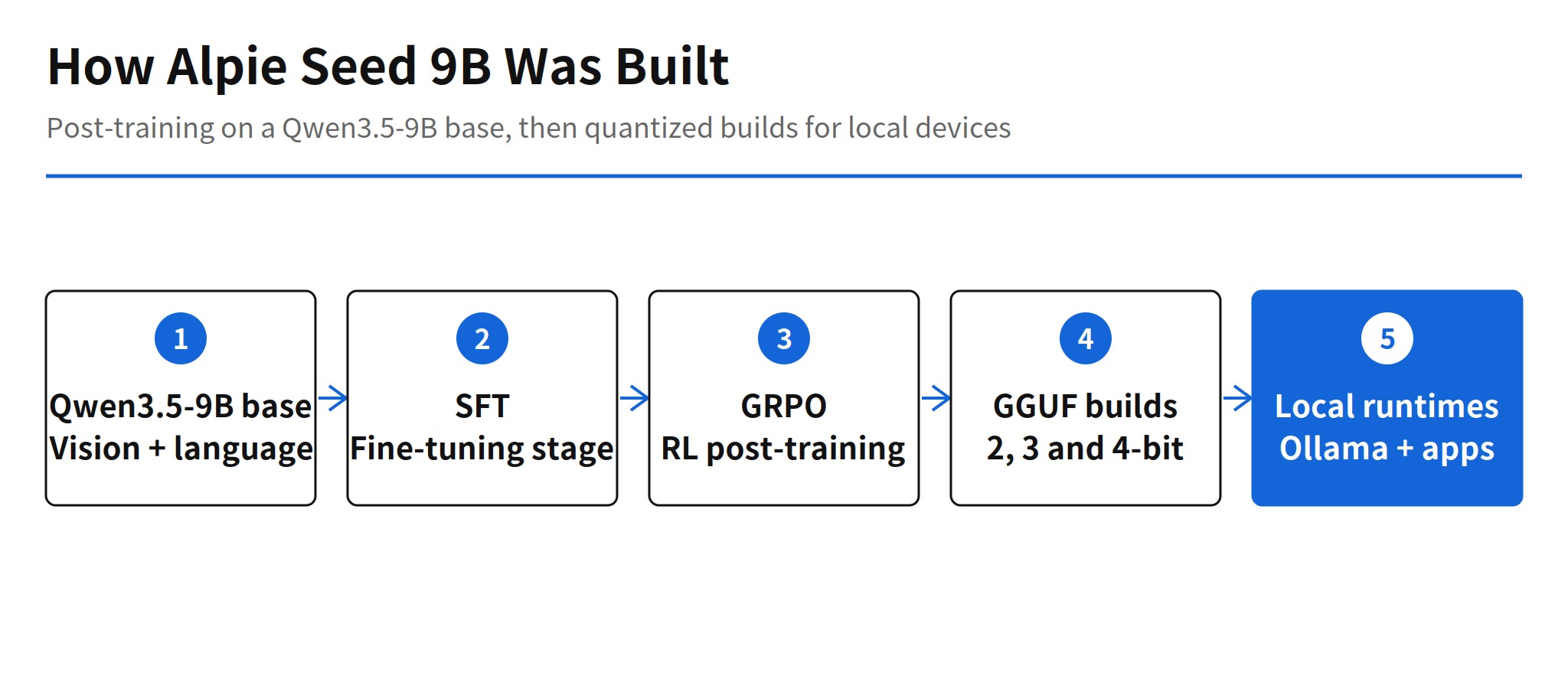
The local builds are where the release aims. Alongside the main model, 169Pi ships GGUF builds at 2-bit, 3-bit and 4-bit. By Ollama tag, the default build is 5.6 GB, the q2 build is 3.8 GB and the vision build is 6.6 GB. The model card includes a demo of the model running completely offline on a mobile device in PocketPal. Founder Rajat Arya framed the release as a challenge to the assumption that competing in models takes thousands of GPUs and large amounts of capital.
Coding Benchmarks and Their Limits
169Pi reports 61.20 on SWE-bench Verified and 72.99 on LiveCodeBench v6. In the model card comparison table, the base model Qwen3.5-9B is listed at 60.0 on SWE-bench Verified and Sarvam 30B at 34.0. Read narrowly, the table says the two post-training stages bought a small gain over the base model on this benchmark, at the same parameter count.
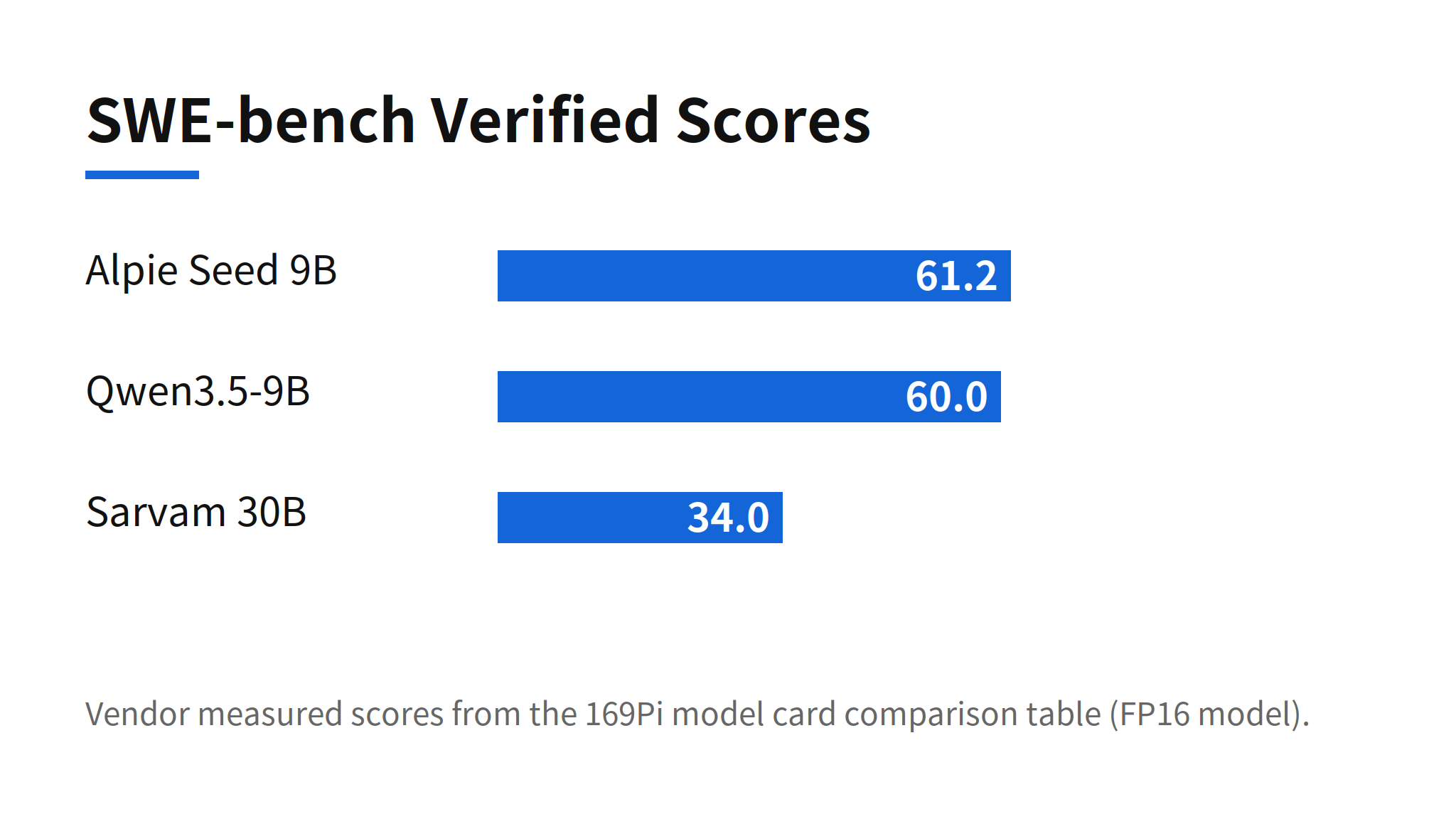
The card itself limits how far those numbers travel. It states that the comparison model scores were not rerun by 169Pi, and that differences in harness and prompts make simple comparison difficult. There is no independent verification yet. The scores also describe the FP16 model, while the builds most people will actually run on a laptop or phone are the 2-bit to 4-bit quantized ones, and the card publishes no scores for those builds. The gap between the headline number and the quantized build on local hardware is the open question of this release.
Alpie Local, the Invite Only Coding Agent
On the same day, 169Pi opened invite only access to Alpie Local, a coding agent that runs on the developer's own device. It reads a codebase, edits files and runs tests locally, which pairs the model with the environment it was sized for: machines where code cannot be sent to a cloud API, or where there is no network at all. 169Pi says it plans to widen access within the month.
The agent is also the least documented part of the launch. Its pricing, supported operating systems and invitation criteria are all unconfirmed. Until those details are public, Alpie Local is a direction signal rather than a product a team can plan around, and the openly downloadable model remains the part of the release that can be evaluated today.
Position in the Small Open Model Race
Small open weight models have been competing for the environments cloud APIs cannot reach: flights, field work, and offices where data cannot leave the building. Alpie Seed enters that race at 9B with multimodal input and aggressive quantization, rather than at the very small end. For Android and on-device work in particular, a model that reads screenshots and code in one package, at a 3.8 GB entry size, is a plausible fit for offline code assistance and for in-house environments with strict data rules.
The counterweight is the vendor itself. 169Pi is a small startup, and whether model maintenance and updates continue is unproven. The sensible adoption path is the one the release makes cheap: pull the Ollama build, run it against a local repository, and let that measurement, not the card, decide.
Related Reading
For another recent open weight release built for offline use on phones, see the earlier report on PLaMo 3 Translate, the open weight model for offline translation on smartphones. PLaMo 3 targets translation at smaller sizes, while Alpie Seed targets coding at 9B, and together they mark how fast the offline on-device category is filling in.
FAQ
What is Alpie Seed 9B?
Alpie Seed 9B is an open weight vision language model that 169Pi released on November 6, 2026. It processes text, images and video, builds on the Qwen3.5-9B architecture, and was produced with two post-training stages, SFT and GRPO. The license is Apache 2.0 and the context length is 262,144 tokens.
How can Alpie Seed 9B be run locally?
The model is distributed through Hugging Face, Ollama, LM Studio and the PocketPal app, and a hosted playground is also available. By Ollama tag, the default build is 5.6 GB, the q2 build is 3.8 GB and the vision build is 6.6 GB. The model card includes a demo of the model running fully offline on a mobile device through PocketPal.
What coding scores does 169Pi report for Alpie Seed 9B?
169Pi reports 61.20 on SWE-bench Verified and 72.99 on LiveCodeBench v6. Both are vendor measurements for the FP16 model. The model card notes that comparison model scores were not rerun and that harness and prompt differences make simple comparison difficult, and no independent verification exists yet.
What is Alpie Local?
Alpie Local is a local coding agent that 169Pi opened to invite only access on the same day as the model release. It reads a codebase, edits files and runs tests on the developer's own device. Its pricing, supported operating systems and invitation criteria have not been confirmed, and 169Pi plans to widen access within the month.