PLaMo 3 Translate Open Weights: 0.8B to 31B, 53 Languages
Preferred Networks (PFN) released the weights for PLaMo 3 Translate on November 5, 2026. The translation model comes in four sizes, 0.8B, 2B, 8B and 31B, covers 53 languages including English and Japanese, and is built to run inside device apps with no internet connection. The weights are available from the PFN page on Hugging Face.
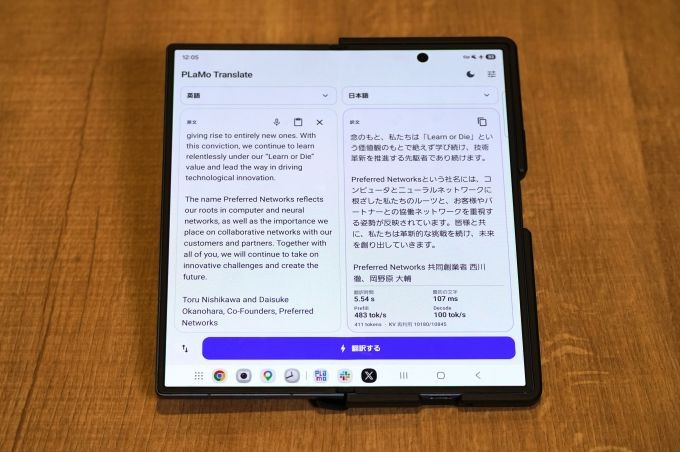
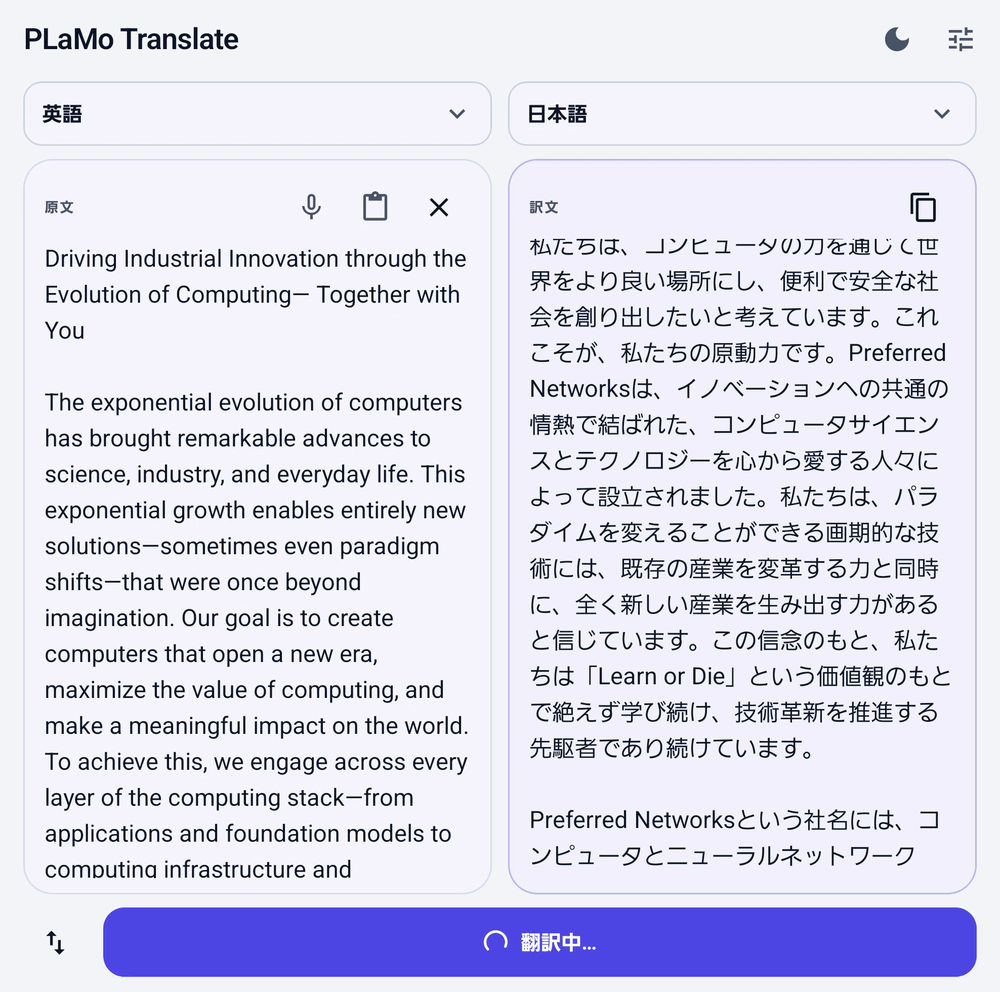
The smallest model is the headline. PFN published a demonstration of the 0.8B model translating in real time on a smartphone in airplane mode, filmed at normal speed in a demo environment. If that size holds up in real apps, translation stops being a server feature. It becomes a component a developer can ship, with no per-request server cost and no user text leaving the device.
That promise needs a caveat, and PFN states the basis openly. The quality comparison behind the release is PFN's own evaluation. PFN says the 0.8B model scored better than translation-specific models such as Google's TranslateGemma and Tencent's Hy-MT2 in that evaluation, which includes PFN's own benchmark. Independent confirmation is still unconfirmed, so the practical reading is narrower: the sizes, the language count and the licence terms are hard facts, while the quality ranking is a claim to test on real language pairs.
Model Sizes and Target Hardware
The four sizes split by translation quality, latency, throughput and target hardware. The smaller models, led by the 0.8B and 2B sizes, target smartphones, laptops and wearable devices, where PFN says they run fully offline. The larger models target in-house servers and embedded services, where throughput and quality matter more than device limits.
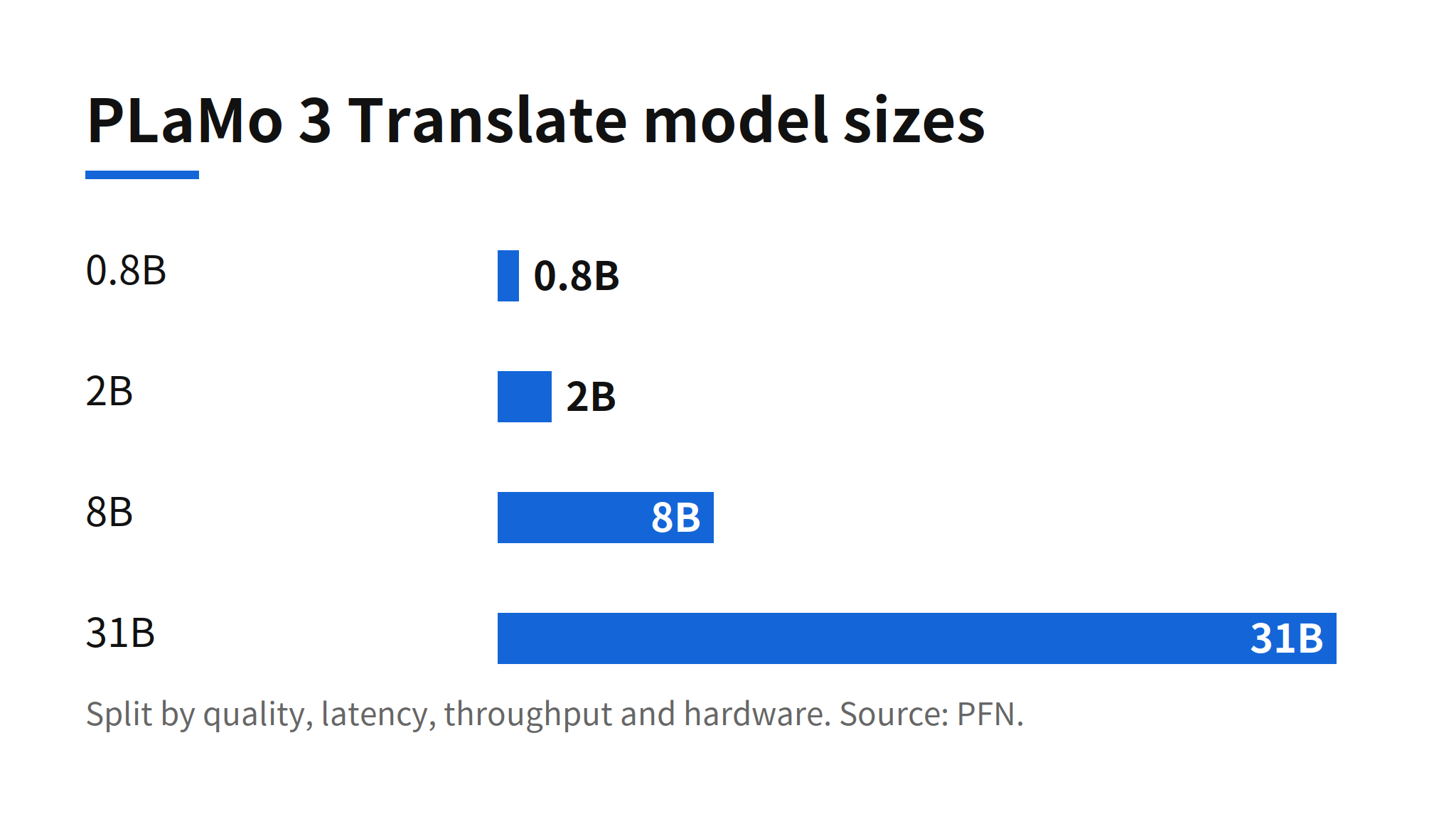
This split is the useful part of the release for product teams. A single model family covers both ends of a common product shape: a small model inside the app for private and offline text, and a larger model on a server for bulk or high-value documents. The base behind the family also matters for context. PLaMo 3 Translate builds on PLaMo 3 NICT, a pretrained model developed jointly by PFN and Japan's National Institute of Information and Communications Technology (NICT), and the translation model itself was originally built for PFN's own PLaMo Translate service.
Offline Use and Privacy-Sensitive Text
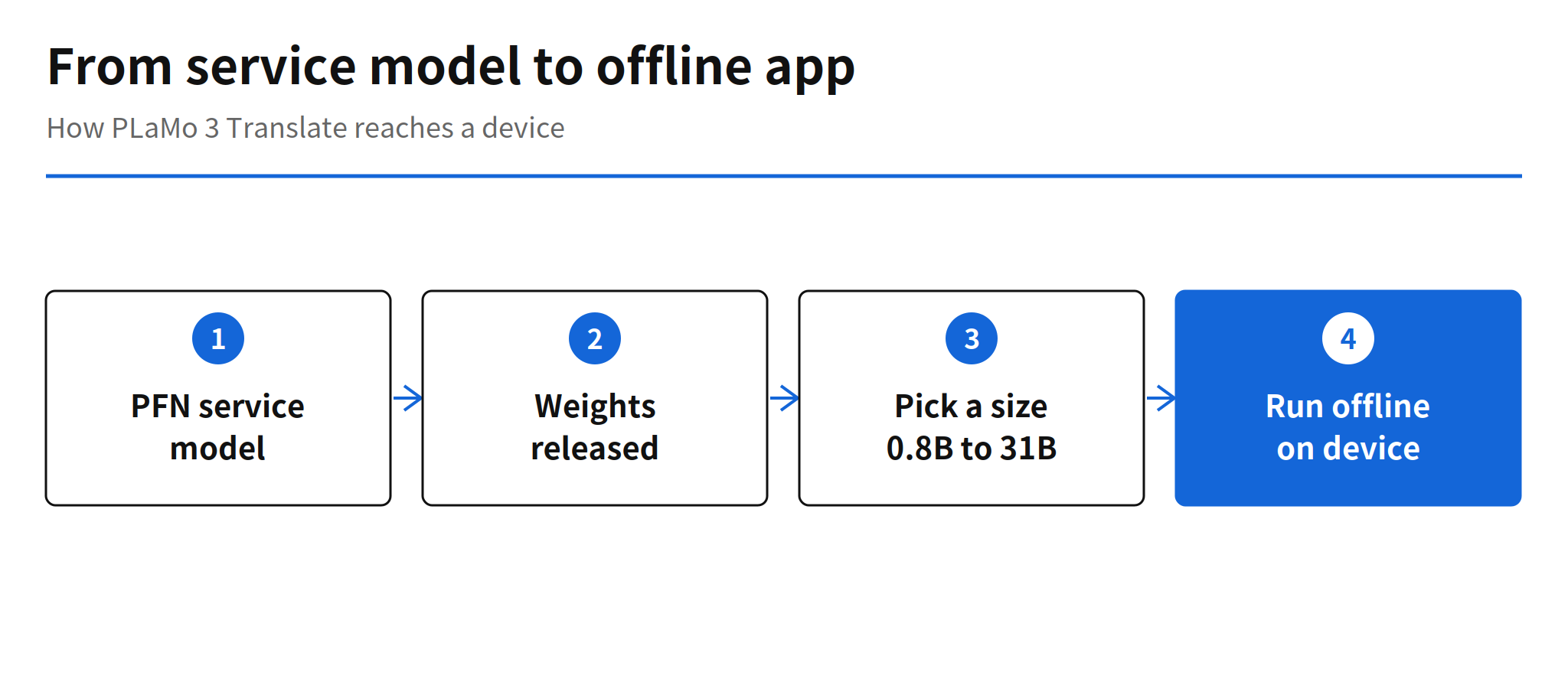
Translation is one of the clearest cases for on-device models. It has to work when a connection drops, and it often handles text that should not leave the device, such as contracts and research documents. PFN makes that case directly: placed inside a device app, the model offers high-quality and high-speed translation without an internet connection.
In our reading, the privacy point is as important as the convenience point. A cloud translation call sends the source text to a server by design. An on-device model removes that transfer entirely, which changes the compliance conversation for apps that handle internal documents. The trade-off is that quality now depends on the size the device can carry, and the 0.8B size is where PFN's quality claim is boldest and least independently tested.
Glossary Control and Register Control
The release includes glossary control. Developers can supply proper nouns, technical terms and product names as a glossary, together with surrounding context, and steer the output toward those terms. For Japanese output, the model also accepts a register choice, such as honorific or plain speech.
These controls address the two failures that make raw machine translation hard to ship in products: inconsistent names and wrong tone. A glossary keeps a product name stable across a long document, and register control matters in Japanese, where the same sentence can read as polite or casual depending on the ending. Neither feature removes the need for review, but both reduce the correction work after generation.
Licence Terms and the Revenue Threshold
The weights ship under the PLaMo Community License. Individuals and companies with annual revenue of 1 billion yen or less in the most recent fiscal year can use the model for free, for commercial and non-commercial use alike. Organisations above that threshold need a separate commercial licence agreement with PFN. The announcement also gives an approximate conversion of $6.5M USD for the threshold.
For app developers, a stated revenue threshold is easier to plan around than a vague non-commercial clause. A small team can check its own revenue against one number and know whether the free terms apply. The limit is still a real limit: a product that succeeds can grow past the threshold, at which point the licence cost becomes part of the product economics.
Quality Claims and Open Questions
Three gaps remain in the release record. First, the quality comparison is PFN's own evaluation, and whether the same ranking holds on independent benchmarks is unconfirmed. The comparison graph attached to the announcement also uses PFN's evaluation criteria.
Second, the announcement does not list all 53 languages or give per-language quality differences. Korean performance, for example, cannot be confirmed from the announcement alone. Third, the demo shows one setting, a smartphone in airplane mode at normal speed. It does not establish latency or battery cost across devices. None of these gaps cancels the release. They define the test a serious adopter has to run: pick the target language pairs, run the 0.8B and 2B sizes on real text, and compare against the service the app uses today.
Related Reading
For another on-device release, see the earlier report on DigUp and on-device semantic file search with EmbeddingGemma 2. The shared point is placement: both releases put the model inside the device, so the feature works without a server round trip.
For a later open weight release built for offline use on phones, see the follow-up report on Alpie Seed 9B, the 9B open weight model for offline coding. Alpie Seed targets coding at 9B where PLaMo 3 targets translation, and both ship quantized builds sized for local devices.
FAQ
What is PLaMo 3 Translate?
PLaMo 3 Translate is a translation-specific model family from Preferred Networks. PFN originally built it for its PLaMo Translate service and released the weights on November 5, 2026 through its Hugging Face page.
What sizes does PLaMo 3 Translate come in?
The release includes four sizes: 0.8B, 2B, 8B and 31B. The smaller sizes target smartphones, laptops and wearables for fully offline use, while the larger sizes target in-house servers and embedded services.
How many languages does PLaMo 3 Translate support?
PFN states support for 53 languages, including English and Japanese. The announcement does not publish the full language list or per-language quality results, so performance for a specific language pair needs direct testing.
Is PLaMo 3 Translate free to use?
Use is free under the PLaMo Community License for individuals and companies with annual revenue at or below 1 billion yen, for commercial and non-commercial use. Organisations above that threshold need a separate commercial licence from PFN.
How strong is the quality claim for the 0.8B model?
PFN says its own evaluation placed the 0.8B model ahead of translation-specific models such as Google TranslateGemma and Tencent Hy-MT2. That evaluation includes PFN's own benchmark, and independent confirmation is unconfirmed.