Runway Praxis-1 Open Weights: 46.2% on RoboLab-120
Runway began the open weight release of Praxis-1, its world action model, on November 11, 2026. The weights ship under the Apache 2.0 license, which allows commercial use, and the release carries inference code and fine-tuning code with it. On NVIDIA's RoboLab-120 leaderboard, Praxis-1 recorded a 46.2% success rate across 1,200 episodes, the top score among the models Runway listed.
The release matters because of who is making it. Runway built its business on video generation, and Praxis-1 is its argument that large scale video pretraining is a starting point for robot control, not just for media. Putting that argument out as open weights turns it into something robotics teams can test on their own hardware instead of a claim they have to take on trust.
RoboLab-120 Results and the Comparison Set
Praxis-1 scored 46.2% on RoboLab-120. The comparison set Runway published puts FLUX 3 Action at 42.9%, Cosmos3 Nano at 36.8% and π0.5 at 28.0%. The gap to the nearest rival is 3.3 percentage points, which is a lead but not a runaway one, and the absolute level is worth holding onto: even the top model in this table fails more episodes than it completes. Robot policy benchmarks are still measuring early systems, and a leaderboard lead at 46.2% says more about relative standing than about readiness for unattended work.
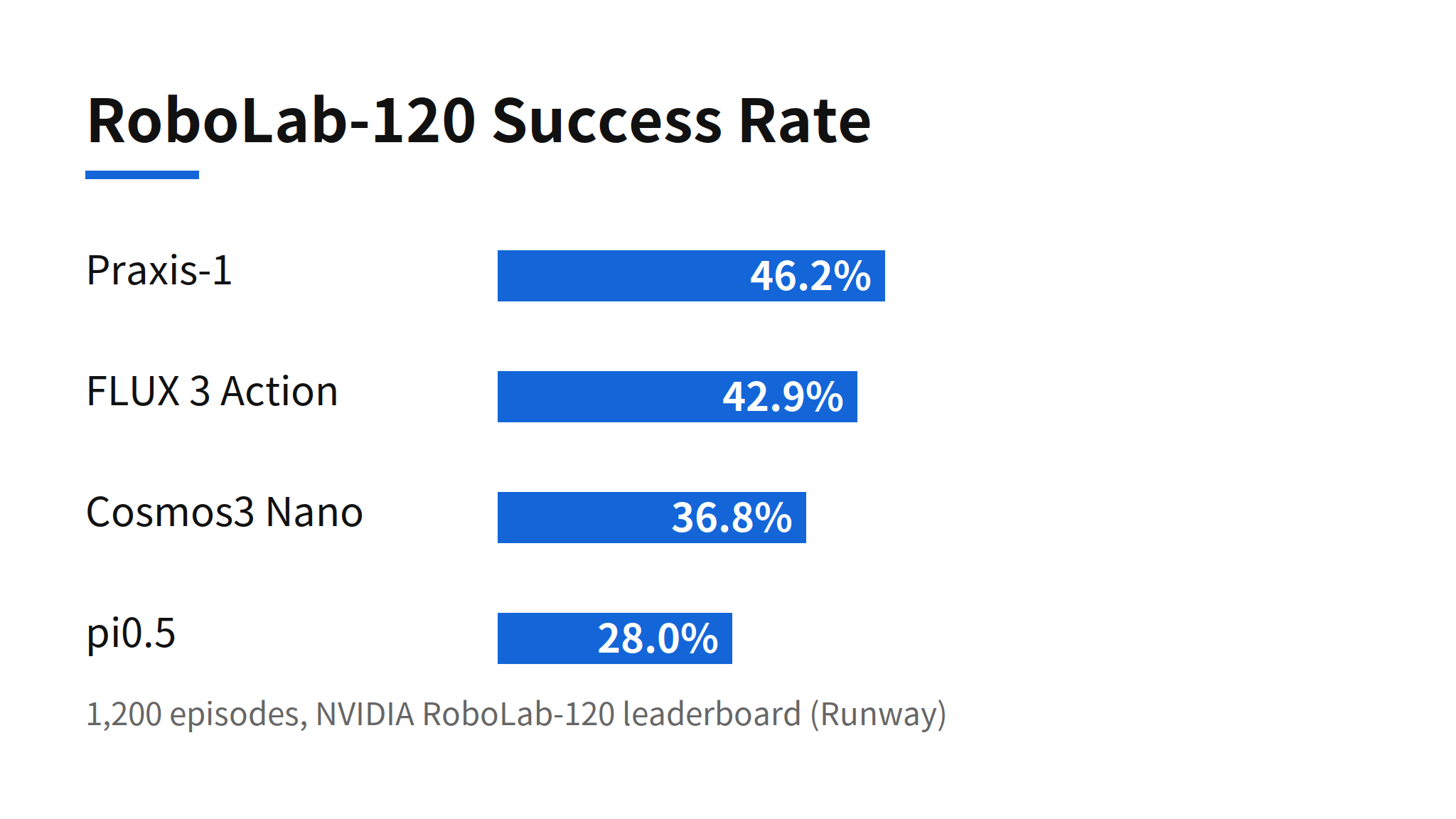
These are also Runway's numbers, published on Runway's leaderboard terms. No independent remeasurement has been published yet, so the ranking should be read as a vendor result awaiting replication. That caveat applies to most robot model launches, and the open weights at least make replication possible in principle, which is more than a closed release would allow.
What the Open Release Actually Includes
The release is broader than a weight file. Runway shipped inference code and fine-tuning code alongside the weights, and fine-tuning supports both full fine-tuning and LoRA. Distribution runs through three channels, GitHub, Hugging Face with native LeRobot support, and vLLM-Omni, while hosted inference is offered through Reactor. The LeRobot detail is practical rather than cosmetic: teams already working in that framework can slot the model into an existing robot data and evaluation pipeline instead of building an adapter first.
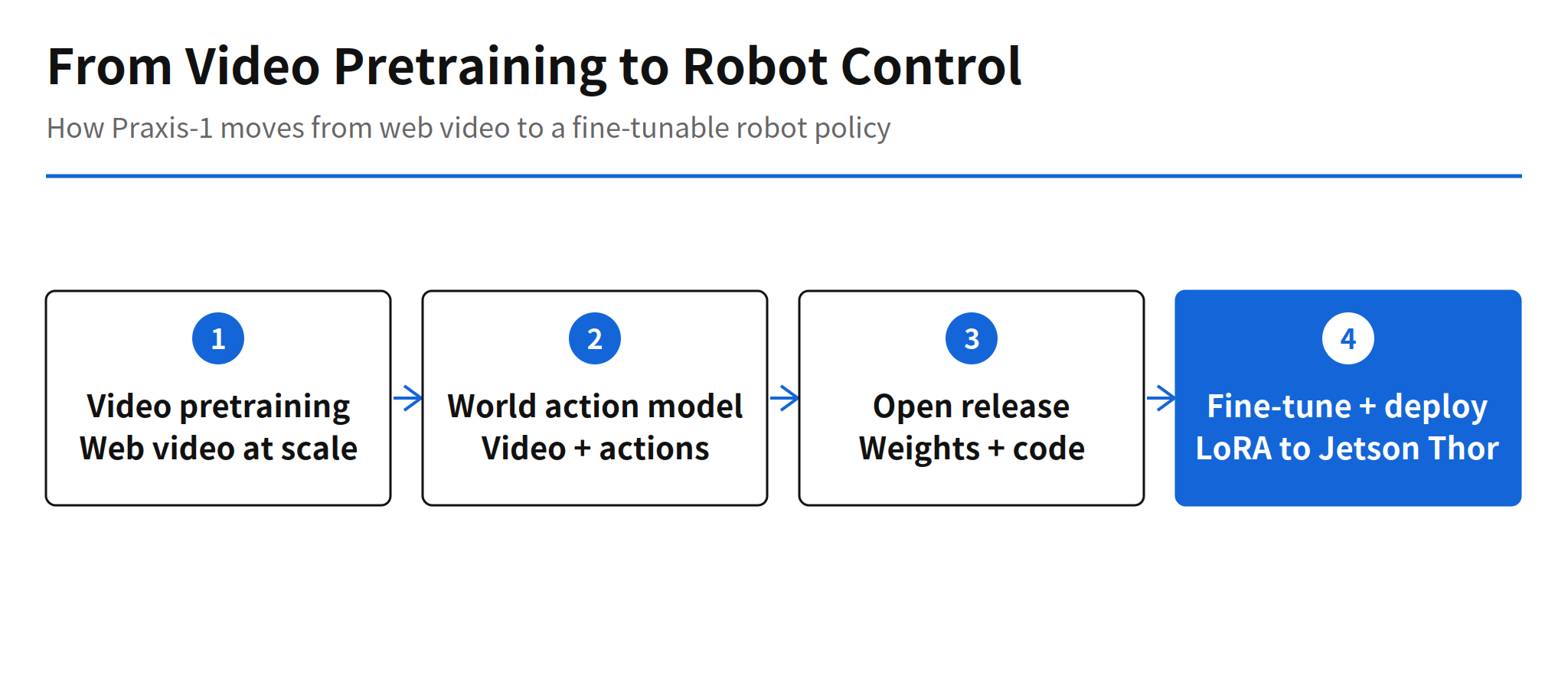
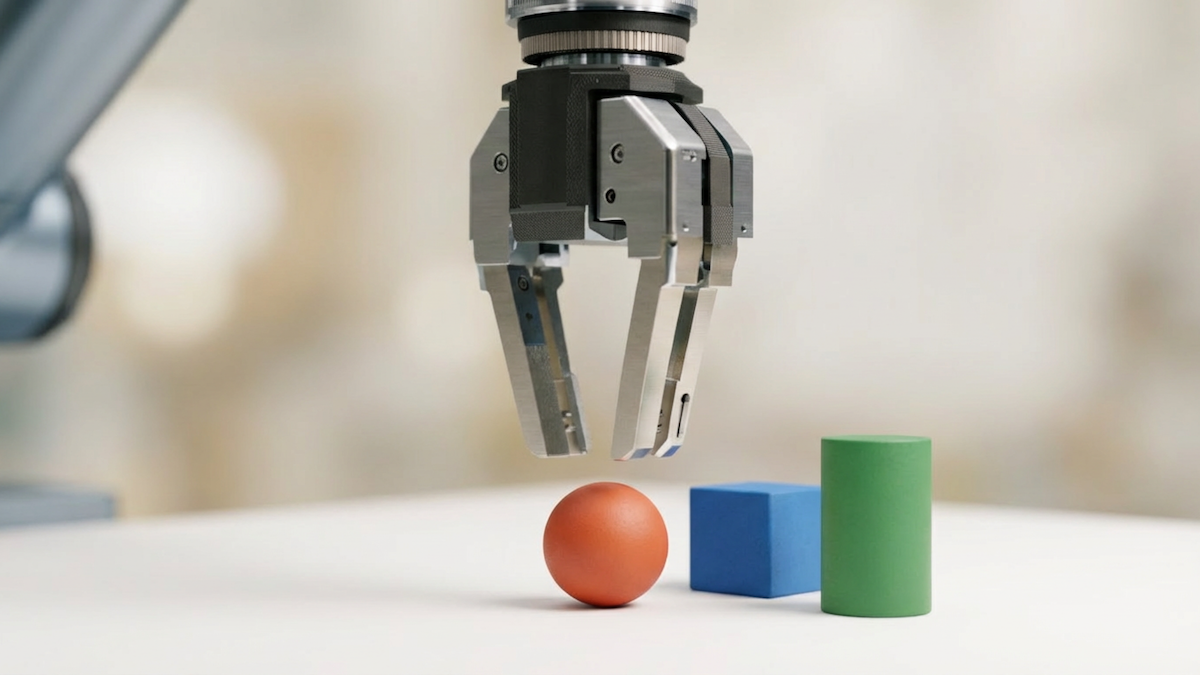
The listed hardware range is wide. Runway names data center GPUs, the H100 and B200, workstation GPUs, the RTX 5090 and RTX PRO 6000, and Jetson Thor for on-robot deployment. A range that reaches from a data center card down to an embedded robot module suggests the intended users are not only labs with clusters, but also teams that need the policy running on the machine itself, where latency and connectivity rule out a hosted call.
From Video Pretraining to Robot Policies
Praxis-1 is a 27B parameter mixture-of-experts diffusion transformer that predicts video and actions together. That joint prediction is the core of the world action model idea: a model trained to predict what a scene looks like next is also trained, in the same pass, to predict what the robot should do next. Runway first introduced Praxis-1 in September as its first world action model and promised an open release at the time, so this launch is the delivery of that promise rather than a new announcement.
Runway's stated position is that large scale video pretraining can serve as the starting point for learning robot policies, and the company points to research indicating that web video works as pretraining data on a level comparable to teleoperated robot footage. If that holds up, it changes the data economics of robotics. Teleoperation data is slow and expensive to collect for each new robot body, while web video already exists at scale. A model that starts from video and needs only adaptation per robot body has a much cheaper path to each new deployment.
A video generation company has now published an open reference point for the video to robot path, with weights and fine-tuning code that any hardware team can pick up.
Fine-Tuning Evidence From an Unseen Robot
The most concrete adaptation evidence in the release comes from a robot the model had not seen in training. Fine-tuned onto Google's RT-1 robot, Praxis-1 reached 80.0% success on SimplerEnv, against 52.4% for the original RT-1 policy. A jump of that size on an unseen body is the kind of result the video pretraining thesis needs, because it speaks to transfer rather than memorized performance on familiar hardware.
The scope still needs care. The 80.0% figure is a fine-tuned result for one specific robot in a simulation evaluation, and it should not be read as general performance across robots or tasks. Runway's deployment partners, Noble Machines, Standard Bots and Ultra, have run the model on a legged humanoid, a 6-axis industrial arm and a dual-arm warehouse robot respectively, which shows breadth of form factor. What the release does not include is per-task success rates for those partner deployments, so the real robot evidence remains at the level of named deployments rather than measured results.
What Has Not Been Shown Yet
The RoboLab-120 figures are Runway's own leaderboard results. Independent remeasurement has not been published, partner deployment results are described without per-task success rates, and the 80.0% SimplerEnv figure is a fine-tuned result for one robot.
- Vendor benchmark: the 46.2% headline and the comparison scores come from Runway's presentation of the RoboLab-120 leaderboard.
- No per-task partner data: the three partner robots are named, but task level success rates for real deployments were not released.
- Conditional transfer result: the 80.0% SimplerEnv score required fine-tuning onto the RT-1 robot and does not describe out of the box performance.
None of that makes the release minor. An Apache 2.0 world action model with full and LoRA fine-tuning code, three distribution channels and a hardware range down to Jetson Thor is a usable artifact, not a teaser. The open question is how the numbers travel: whether independent teams reproduce the RoboLab-120 standing and the RT-1 transfer result on their own setups. Because the weights are open, that question can actually be answered, and the answers will say more about the video to robot path than any single launch post.
FAQ
What did Runway release for Praxis-1?
Runway began the open weight release of Praxis-1 on November 11, 2026 under the Apache 2.0 license, which allows commercial use. The release includes inference code and fine-tuning code alongside the weights.
How did Praxis-1 score on RoboLab-120?
Praxis-1 recorded a 46.2% success rate across 1,200 episodes on NVIDIA's RoboLab-120 leaderboard, ahead of FLUX 3 Action at 42.9%, Cosmos3 Nano at 36.8% and π0.5 at 28.0%. The figures are Runway's leaderboard numbers and have not been independently remeasured.
What kind of model is Praxis-1?
Praxis-1 is a 27B parameter mixture-of-experts diffusion transformer that predicts video and actions together. Runway calls it a world action model, built on large scale video pretraining.
Where can Praxis-1 be run and fine-tuned?
Distribution runs through GitHub, Hugging Face with native LeRobot support, and vLLM-Omni, with hosted inference on Reactor. Fine-tuning supports both full fine-tuning and LoRA, and listed hardware ranges from H100 and B200 data center GPUs to RTX 5090 and RTX PRO 6000 workstation GPUs and Jetson Thor for on-robot use.
What did the RT-1 fine-tuning result show?
Fine-tuned onto Google's RT-1 robot, which was not part of its training data, Praxis-1 reached 80.0% success on SimplerEnv against 52.4% for the original RT-1 policy. That is a result for one fine-tuned robot, not a general performance figure.
Related Reading
- Gemini Robotics 2.5 Release: 96% on a Mercedes-Benz Line, another foundation model line moving into physical robots
- NVIDIA GR00T 2 Release: Performance, Data and How It Works, a competing robot foundation model effort