NVIDIA GR00T 2 Release: Performance, Data and How It Works
NVIDIA unveiled GR00T 2 at the Conference on Robot Learning (CoRL) in Austin on November 9, 2026, describing it as an open frontier world action model built on NVIDIA Cosmos. On 50 tasks the target robot had never seen, the model averaged 40% success with no per-task demonstration, 71% with one demonstration and 95% with five demonstrations. It also succeeded at least once on 40 of those 50 tasks with no demonstration at all.
The headline is really about data cost. Five demonstrations amount to under three minutes of robot data per task, and fine-tuning took 30 minutes on a single RTX 5090. Robot data collection has been the bottleneck for general robot skills for years, because every new task usually meant hours of teleoperation on the exact robot that would run it. If results anywhere near these numbers hold up outside NVIDIA's own evaluation, the economics of teaching a robot a new task change first, and the model rankings matter second.
How GR00T 2 Works
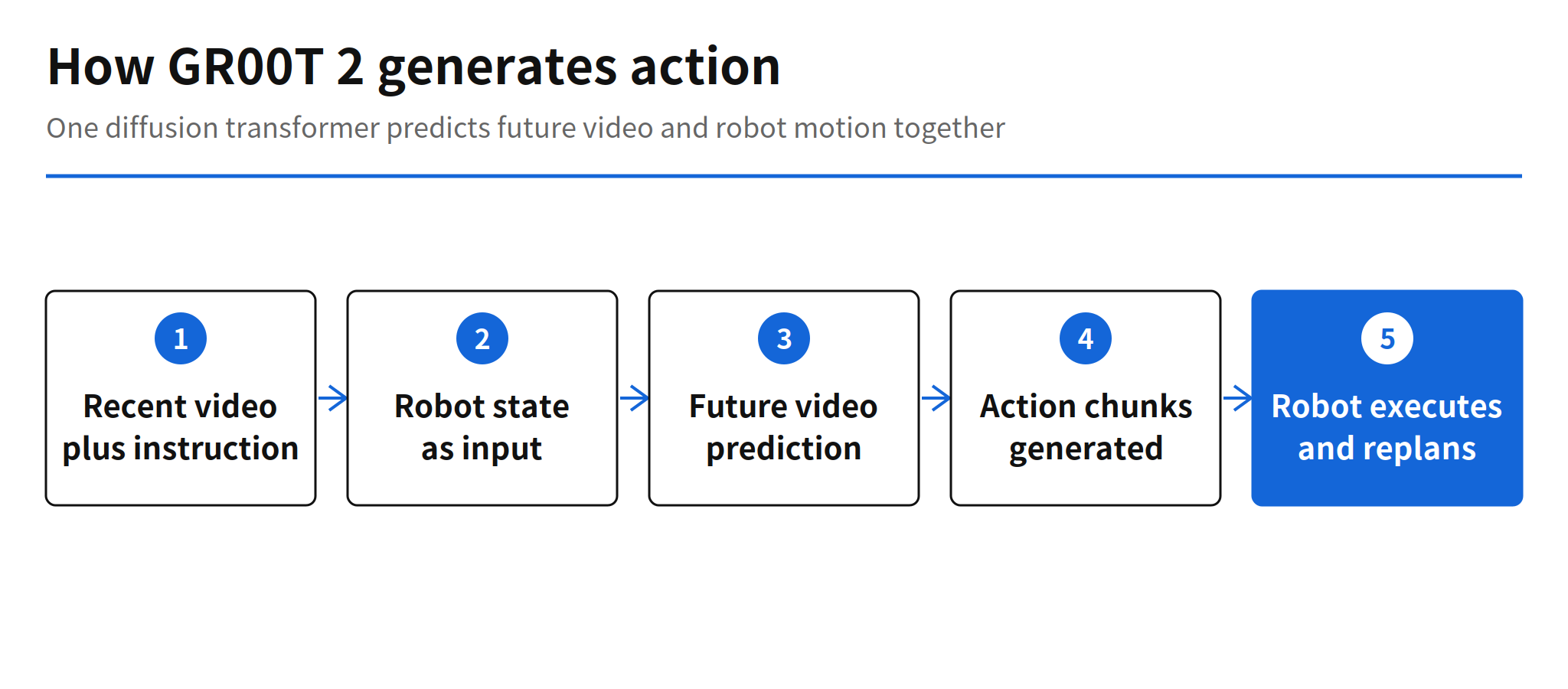
A world action model predicts future video and robot actions together. GR00T 2 reads recent video, a text instruction and the robot's current state, then generates future video frames and action chunks jointly inside one diffusion transformer. That design is the break from the previous GR00T N1 generation, which followed the vision-language-action pattern of turning camera input more directly into joint commands.
The joint prediction is what lets NVIDIA use video that has no robot action labels. Human first-person video shows hands moving objects, opening containers and recovering from small mistakes, but it carries no joint angles to copy. A model that must predict the next frames still has to learn how scenes change when someone acts on them, and NVIDIA argues that this physical sense transfers to robot bodies. The claim is plausible and it is also the part that needs independent testing most, because the reported gains could come from the sheer scale of the data rather than from the world modeling design itself.
Training Data at Human Video Scale
The pretraining mix combines 402,730 hours of first-person human video, 10,184 hours of handheld UMI gripper demonstrations covering 2,897 tasks, and 23,500 hours of robot teleoperation. Human video outweighs robot data by more than seventeen to one, which inverts the usual recipe for robot foundation models. A 100,000 hour slice of the human video, named Human-1M-100K, is already public on Hugging Face, so other teams can test parts of the data thesis without waiting for the model release.
The mix also explains the adaptation numbers. A model pretrained mostly on human activity still needs a bridge to a specific robot body, and the UMI gripper data plus a few minutes of on-robot demonstrations appear to serve as that bridge. The practical question for buyers is narrower than the research question: whether five demonstrations on their own robot, in their own workspace, reproduce anything close to 95%. Lighting, camera placement and gripper differences are exactly the variables a vendor benchmark tends to hold constant.
Performance on Unseen Tasks and Benchmarks
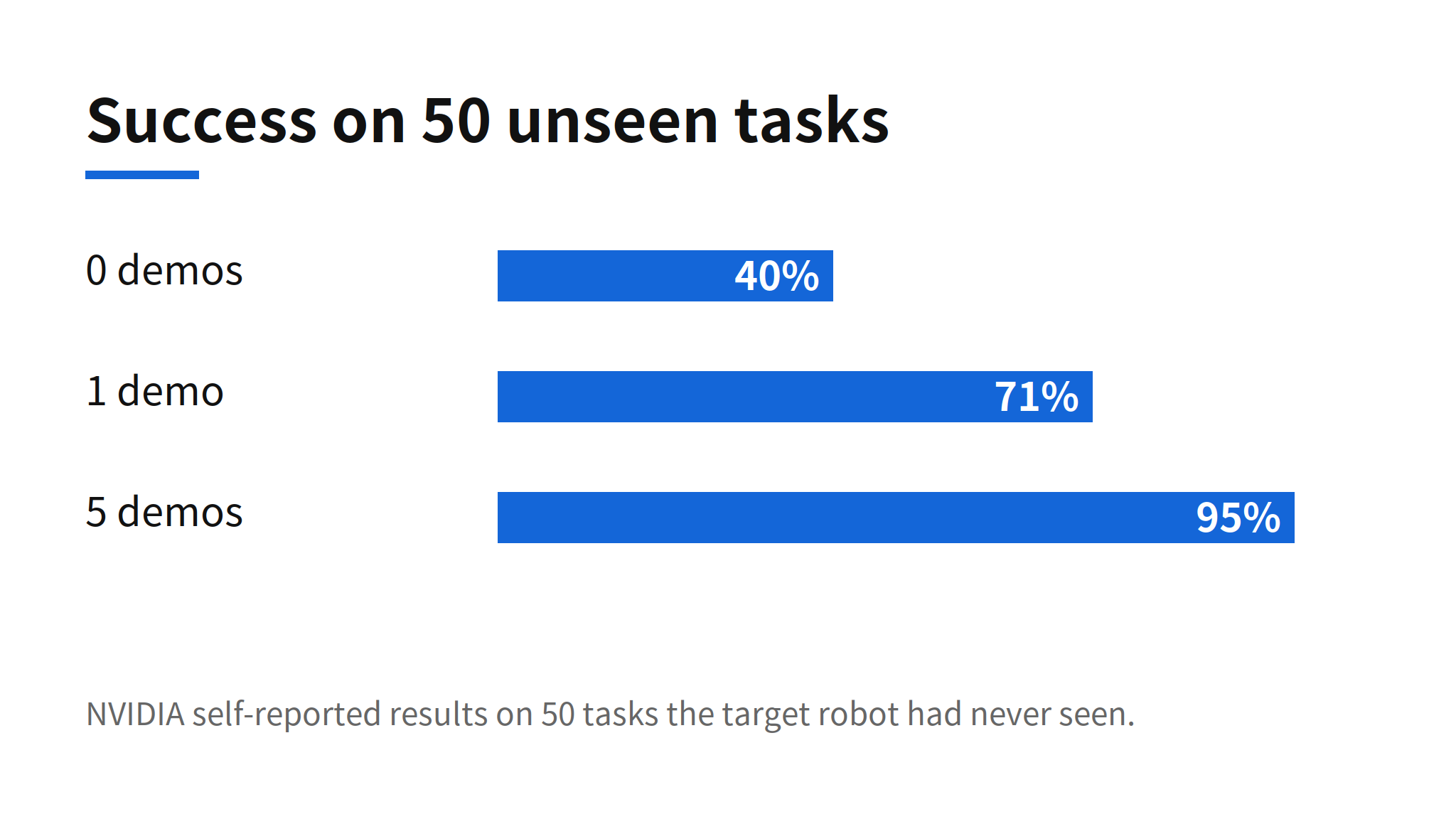
The jump from 40% to 71% with a single demonstration is the most useful number in the release. It suggests the model usually has the right skill and mainly needs one example to calibrate it to a new body or workspace. The move to 95% with five demonstrations then looks less like learning a task and more like removing the remaining calibration errors. For a deployment team, that profile matters more than the zero-shot figure, because one to five demonstrations is a realistic commissioning step while zero-shot deployment on a factory floor is not.
Beyond the 50-task test, GR00T 2 placed in the top three across the RoboCasa365, RoboLab, RoboDojo and MolmoSpaces benchmarks, spanning both vision-language-action models and world action models, and took first place on several leaderboards. The lightweight GR00T 2 Turbo runs at 124ms per prediction on a Jetson Thor inside a Unitree G1 humanoid, which puts the smaller variant in range for on-body control loops instead of cloud inference.
Isaac Lab 3.0 and Partner Trials
NVIDIA paired the model with Isaac Lab 3.0, which can switch between the PhysX and Newton physics engines and recorded up to 2.5x higher training throughput than the Isaac Lab 2.3 and PhysX combination on dexterous manipulation benchmarks. The CoRL package also included an Isaac Lab-Arena 0.4 developer preview and industrial benchmarks such as DexBench and VABAR. Simulation throughput is not a side detail here: a world action model strategy depends on rehearsing tasks in simulation before spending real robot time, so the lab tooling and the model advance or stall together.
Partner use is still at trial stage. Nexuni is testing GR00T 2 on robot laundry handling, Foxconn is applying it to server manufacturing factory automation, and Siemens is evaluating it for industrial use. None of these is a production line deployment, and NVIDIA has not published cycle time, error recovery or uptime figures for any of them. The trials do show which tasks vendors reach for first: repetitive handling work where a few demonstrations per variant is a credible setup cost.
Limits and Open Questions
- Weights and license are not out yet. GR00T 2 and GR00T 2 Turbo weights and the training recipe are scheduled for December 2026, and the weight license terms have not been published.
- All success figures are NVIDIA self-reported. No independent replication exists yet, and the 50 evaluation tasks were selected by NVIDIA, so task difficulty and selection criteria affect how the numbers should be read.
- Partner work is trials and evaluation only. No partner has announced production deployment, and no operating cost or reliability data has been shared.
- Agent integration is a proposal, not a measured result. NVIDIA also presented reasoning agents calling GR00T 2 through an API to run skills and recover from failures, without published success rates for that layer.
Related Reading
NVIDIA's infrastructure push around agents and robots shows up across recent releases. See the report on NVIDIA Reshard and collective refits for reinforcement learning for the training side, and the report on NVIDIA Vera CPU agent measurements for the compute layer that agent workloads run on.
FAQ
What is NVIDIA GR00T 2?
GR00T 2 is an open frontier world action model built on NVIDIA Cosmos. It reads recent video, an instruction and robot state, then generates future video and action chunks together in one diffusion transformer.
How well does GR00T 2 perform on unseen tasks?
On 50 tasks the target robot had never seen, NVIDIA reports 40% average success with no per-task demonstration, 71% with one demonstration and 95% with five. The five demonstrations use under three minutes of robot data per task.
What data was GR00T 2 trained on?
Pretraining mixed 402,730 hours of first-person human video, 10,184 hours of handheld UMI gripper demonstrations across 2,897 tasks and 23,500 hours of robot teleoperation. A 100,000 hour human video subset called Human-1M-100K is public on Hugging Face.
When will GR00T 2 weights be released?
NVIDIA says the weights and training recipe for GR00T 2 and GR00T 2 Turbo are scheduled for December 2026. The weight license terms have not been published yet.
How fast is GR00T 2 Turbo?
The lightweight GR00T 2 Turbo runs at 124 milliseconds per prediction on a Jetson Thor inside a Unitree G1 humanoid body, according to NVIDIA Research.
Sources
- NVIDIA official blog: Practice Makes Precise, robotics simulation advancements at CoRL (November 9, 2026)
- NVIDIA Research: GR00T 2, scaling robot foundation models for generalization, dexterity and adaptation
- The Robot Report: NVIDIA launches GR00T 2 and Isaac Lab 3.0 at CoRL
- Original issue: ax-trend issue #3894