NVIDIA Vera CPU Agent Performance: 1.6x Throughput
NVIDIA published agent workload measurements for its Vera CPU on November 5, 2026. In a 100 megawatt data center comparison, a single Vera CPU delivered 1.6 times more agents per watt than the fastest x86 CPU and ran agents 2 times faster than the most power efficient x86 CPU, according to NVIDIA. Six partners added production style results, including a sandbox launch test that fell from 88.4 seconds on x86 to 10.8 seconds on Vera.
Vera itself was announced earlier this year. This post is a follow up measurement release rather than a chip introduction, and that distinction matters for how to read it. The claim is no longer that a CPU designed for agents exists. The claim is that named operators have run their own agent workloads on it and measured the difference, and NVIDIA has put those numbers in one place.
Partner Results From Production Style Workloads
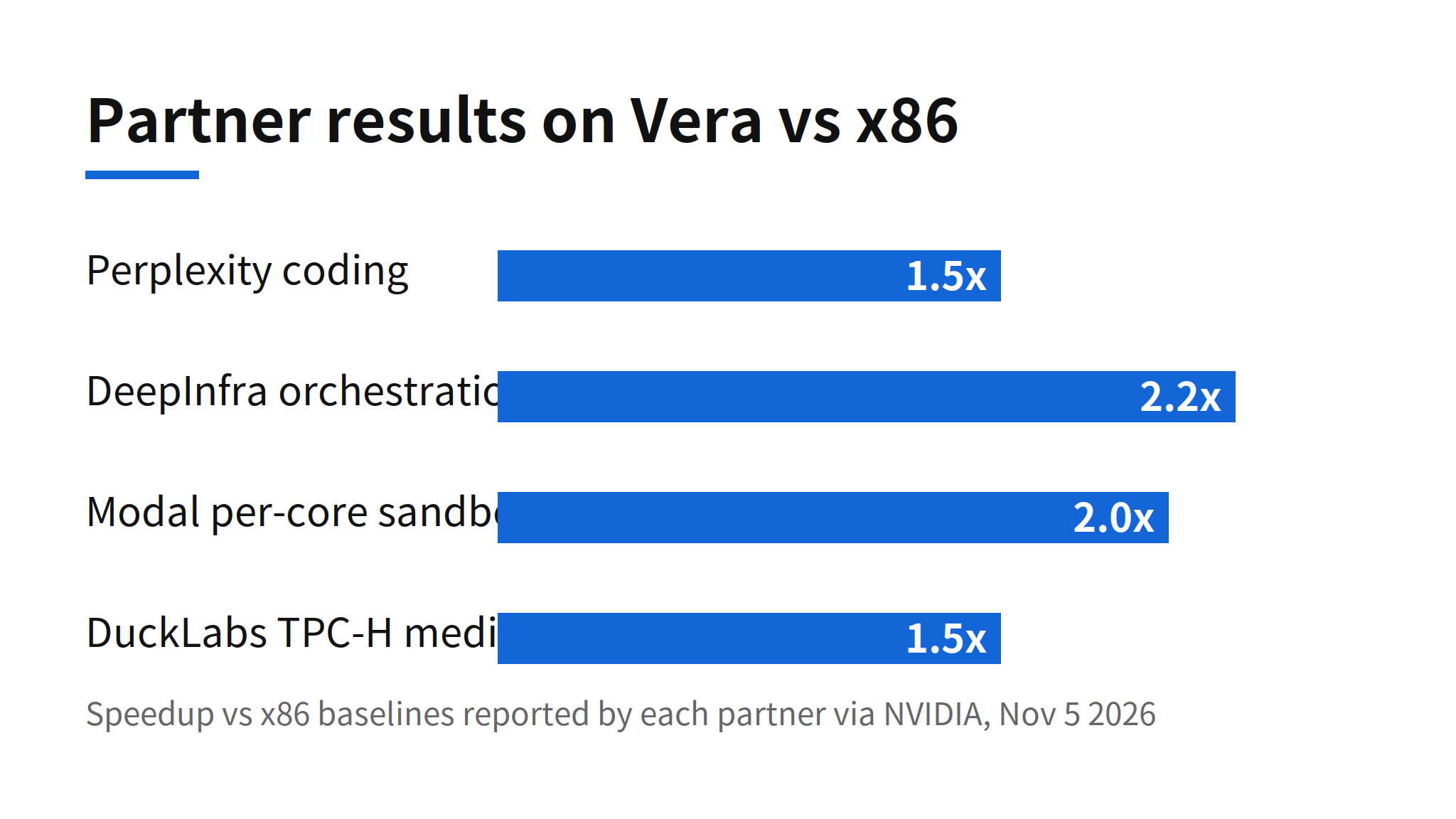
The strongest evidence in the release comes from workloads that resemble live services rather than synthetic loops. Perplexity ran agentic coding work 1.5 times faster on Vera than on its existing CPU and plans to adopt Vera in its next production system. An adoption plan from a named operator carries more weight than a benchmark alone, because it implies the result survived contact with a real serving stack, even though the underlying test conditions are still Perplexity and NVIDIA reporting rather than an independent audit.
DeepInfra recorded up to 2.2 times the speed of a top x86 processor on its production agent orchestration workload, the fastest result among the four architectures it tested. Daytona launched 1,000 agent sandboxes in 10.8 seconds on Vera against 88.4 seconds on x86, and at 2,000 concurrent sandboxes it completed 12.7 jobs per second. Modal reported up to 2 times the per core sandbox throughput of comparable x86 hardware, with the gap widening as load increased. Sandbox startup and orchestration delay are direct operating costs for anyone selling a coding agent as a service, so these are the numbers a platform team can map onto its own unit economics first.
Database and Analytics Results
Two results cover the data layer that agents query between model calls. ClickHouse scaled almost in proportion up to 176 cores using a standard binary with no Vera specific tuning, and placed first on the ClickBench hardware leaderboard. A result obtained without a special build is easier for other operators to reproduce, because it does not depend on a vendor maintained fork. DuckLabs reported median TPC-H SF1000 performance at about 1.5 times its Intel Xeon 6 baseline.
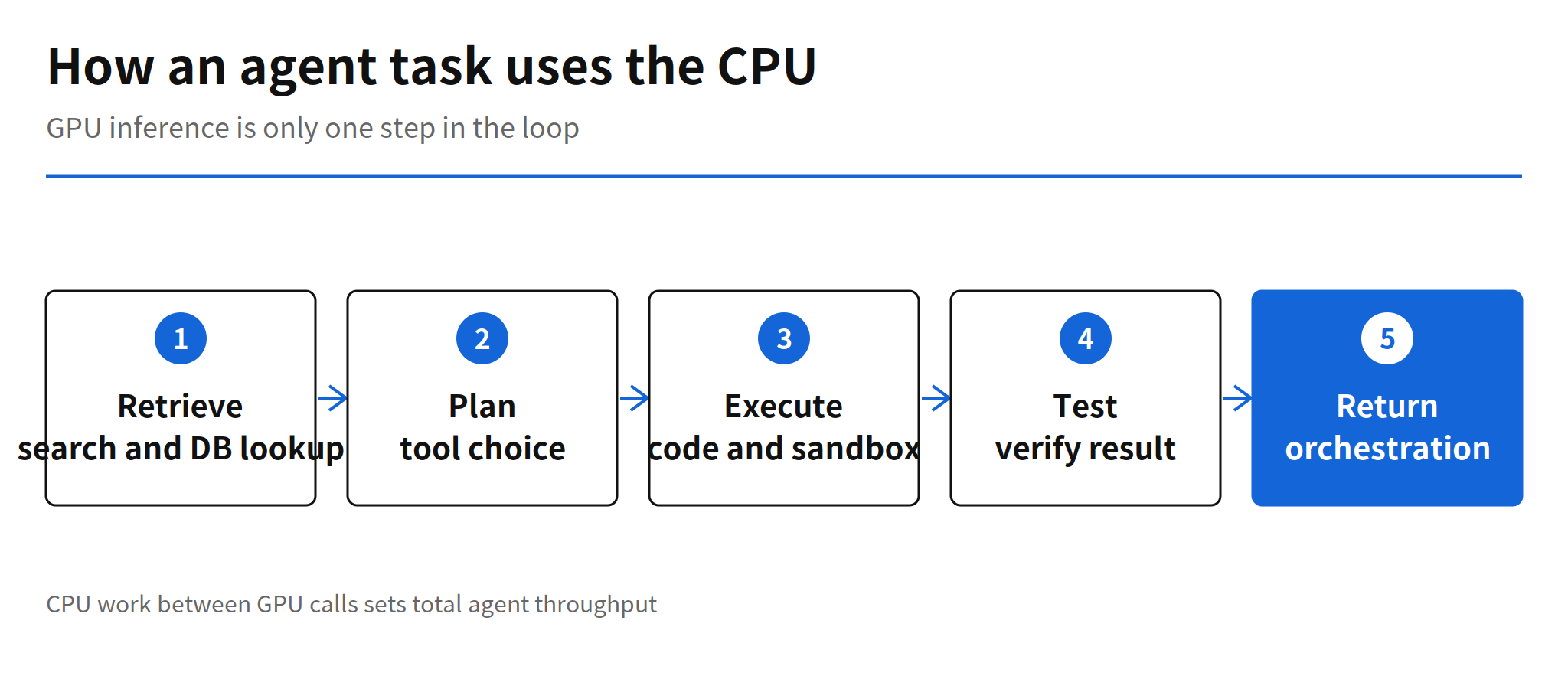
The specification helps explain where those gains come from. Each Vera CPU carries 88 custom Olympus cores, 176 threads through Spatial Multithreading, up to 1.2 TB/s of LPDDR5X bandwidth and up to 1.5 TB of memory. Agent work is a sequence of retrieval, database lookup, code execution and tool calls around GPU inference, so memory bandwidth and thread count shape total throughput as much as raw inference speed does.
Limits and Unconfirmed Details
The headline comparisons have a clear gap. NVIDIA does not name the specific x86 models behind the 1.6x and 2x figures, and the official post gives no detailed methodology. The partner numbers were also measured by each company on its own workload and collected by NVIDIA, so they are not cross validation by an independent body. Buyers should treat the release as a set of vendor collected field reports with named sources, not as a neutral benchmark suite.
Those caveats shape the practical reading. Vera looks strongest where the bottleneck is orchestration, sandbox startup and parallel tool execution, which is exactly the layer that decides how many agents a fixed power budget can serve. It looks less decisive where a workload is bound by memory bandwidth or by isolation overhead that no CPU architecture removes. For teams choosing remote agent execution hardware, sandbox throughput now belongs on the same checklist as model performance.
Related Reading
For another Perplexity agent release, see the earlier report on Perplexity Teammates and persistent agents. For a hosted agent platform with a different execution model, see Kimi Hosted Agents, pricing and skills.
FAQ
What did NVIDIA report for the Vera CPU on agent workloads?
NVIDIA reported on November 5, 2026 that a single Vera CPU beat both the fastest x86 CPU and the most power efficient x86 CPU in a 100 megawatt data center comparison. Vera delivered 1.6 times more agents per watt than the fastest x86 CPU and ran agents 2 times faster than the most power efficient x86 CPU.
What is the Vera CPU specification?
Each Vera CPU has 88 custom Olympus cores and 176 threads through Spatial Multithreading. It supports up to 1.2 TB/s of LPDDR5X bandwidth and up to 1.5 TB of memory.
Which partners reported production style results on Vera?
Perplexity ran agentic coding work 1.5 times faster and plans to adopt Vera in its next production system. DeepInfra recorded up to 2.2 times the speed of a top x86 processor, Daytona launched 1,000 agent sandboxes in 10.8 seconds, and Modal, ClickHouse and DuckLabs also reported gains.
Are the Vera results independently verified?
No. The partner figures were measured by each company on its own workload and collected by NVIDIA. The official post does not name the specific x86 models used for the 1.6x and 2x comparisons and does not give full methodology details.