Kimi Hosted Agents: Pricing, Skills and How It Works
Moonshot AI has formally launched Kimi Hosted Agents, a managed cloud service for running AI agents without building the execution infrastructure in house. The launch was reported on November 5, 2026 by TechInAsia and Unite.AI, and the Kimi API documentation describes the product in detail.
The core idea is simple to state. The documentation calls the offer Harness as a Service: the platform supplies the harness that carries agent execution, inside a hosting environment that runs 24 hours a day, 7 days a week, with support for long-running tasks and multi-agent collaboration. Session management, tool execution and failure recovery move from each customer team to Moonshot AI.
That shift is the real news here. In practice, the expensive part of putting agents to work is rarely the model call. It is the surrounding machinery: how sessions are stored, where tools run, and where a failed run restarts. Hosted Agents packages that machinery as a product, and the rest of this report looks at what the package contains, what it costs, and where its limits sit.
Harness as a Service and the Runtime Layers
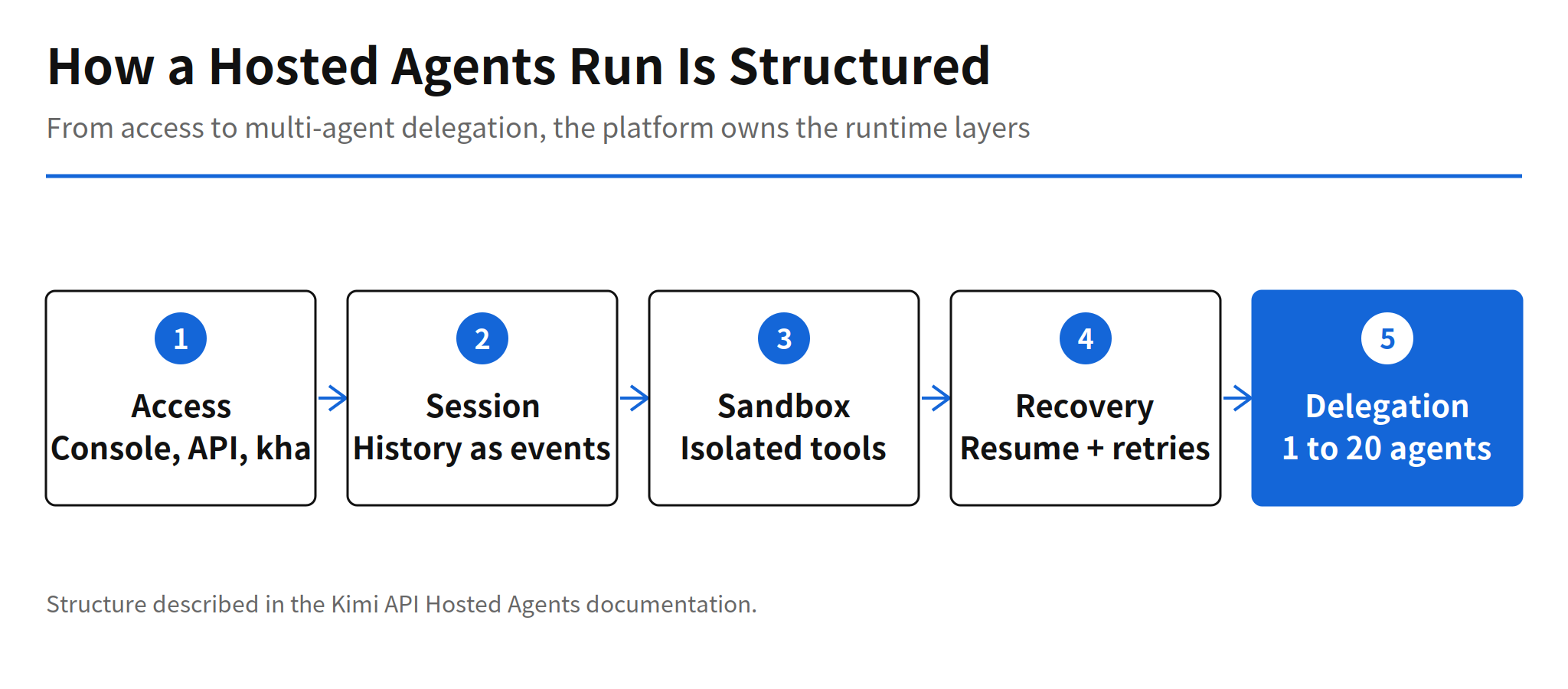
The documentation describes a runtime built around sessions. The full history of a session is stored in event form, so a run keeps its record as a sequence of events rather than as a loose transcript. Built-in tools execute inside an isolated cloud sandbox, which keeps tool activity separated from the customer environment.
Failure handling sits with the platform as well. If the platform hits a fault during a run, the platform takes over execution and restores the same behaviour the run had before the interruption. Retries and scheduling are also platform responsibilities. For a team, that removes three separate engineering problems at once: state storage, sandbox operations and restart logic. It also means the quality of those layers is now a vendor property, judged by behaviour in production rather than by internal design reviews.
Access Paths and Multi-Agent Delegation
There are three ways in: a web console, a REST API and the kha command line tool. That spread covers interactive use, programmatic integration and terminal-driven work without forcing one interface on every team.
Multi-agent work runs inside a single session. A coordinator agent assigns work to sub-threads within the same session, and a delegation setup can include from 1 to 20 agents. Keeping delegation inside one session matters for traceability: the coordinator and its sub-threads share the event history described above, so the division of labour stays visible in one record instead of scattering across separate runs.
Skills, Plugins and Templates in the Launch Bundle
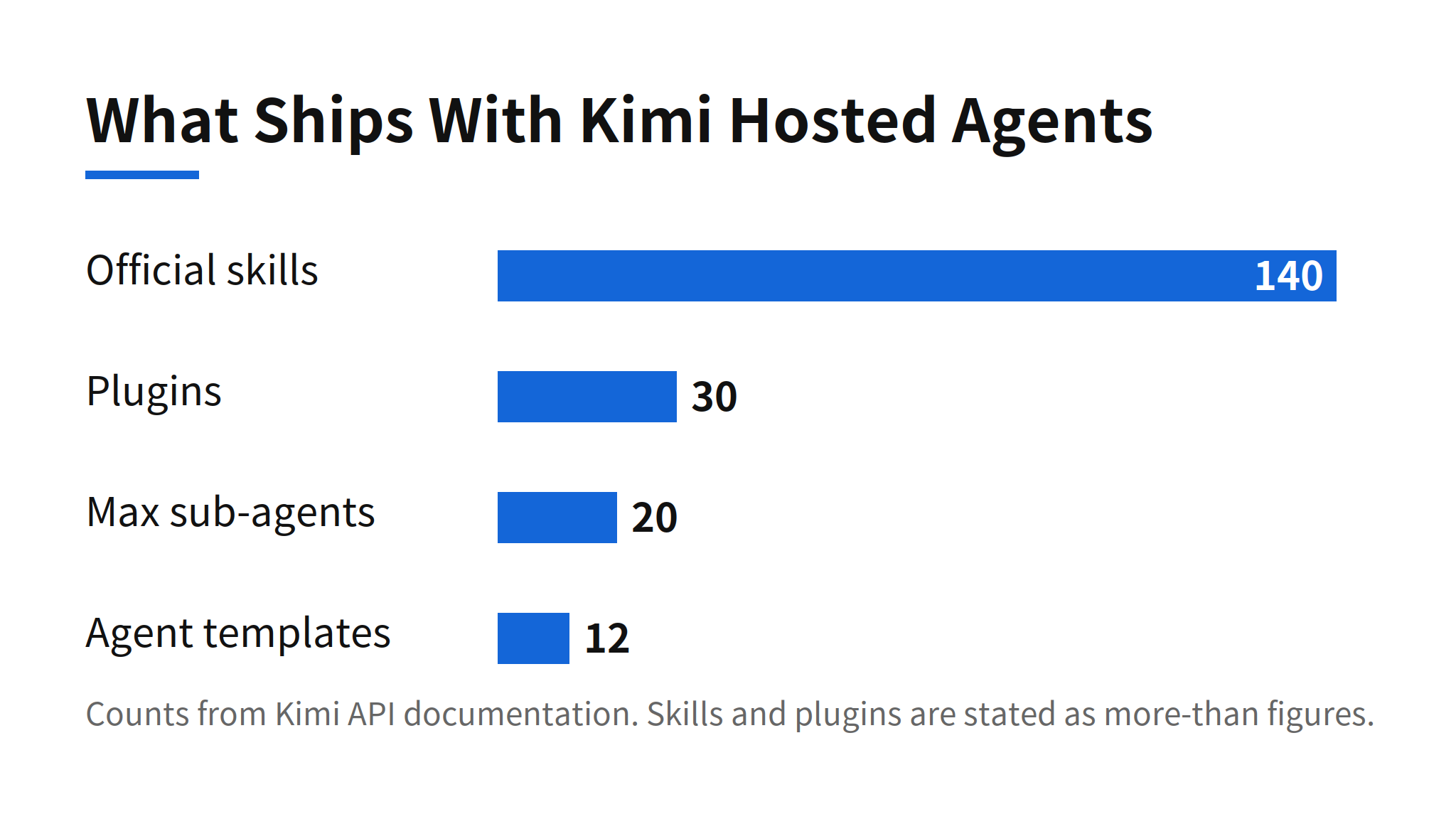
The launch bundle is large. The documentation lists more than 140 official skills and more than 30 plugins, covering web search, specialist data lookup, office document handling and content generation. Enterprises can also attach their own skills, plugins and MCP services, so the hosted runtime is not limited to the vendor catalogue.
The starting points are templates. The official Agent template set counts 12 templates at first release, spanning financial research, game development, operations response and overseas community management. Templates of that kind lower the first-use cost: a team begins from a working configuration and adjusts it, rather than assembling an agent from an empty session.
Usage Pricing and the Sandbox Rate
Pricing is usage based and split into three streams. Sandbox execution time costs 0.072 yuan per hour. Model inference is billed at the token price of whichever model the customer selects. Plugins are billed separately, by call count and unit price.
The sandbox rate is strikingly low, and it changes how the total should be read. At that level, the runtime layer is close to a commodity line item, and the real cost drivers become inference tokens and plugin calls. A team estimating spend should therefore model token volume first. Long-running agents with heavy tool use will spend their budget on inference and plugins, not on the hosted harness itself.
Inference Hook and Enterprise Security Controls
The Kimi Inference Hook is the enterprise control point. It connects a security service that the enterprise built or bought, and it inspects task inputs and tool return values before model inference takes place. The enterprise defines the rules, and the hook executes the allow and deny decisions.
Placement matters here. Inspection happens before inference, on both the input side and the tool output side, which covers the two paths where sensitive content enters a run. In our reading, this is the feature that decides whether regulated teams can consider the service at all, because a hosted runtime without a pre-inference inspection point would route enterprise data through a path the enterprise cannot audit.
Beta History and the Limits of the Launch Record
Hosted Agents first appeared in beta form in September 2026 for enterprise certified users. The November announcement converts that beta into a formal launch. The direction is consistent with the product shape: Moonshot AI is moving one step beyond selling model inference APIs, toward operating the agent execution environment itself as a product, including session management, sandboxes and failure recovery.
The launch record has one soft spot. The release is confirmed through official platform documentation and multiple media reports, not through a formal announcement post on the official blog. The documentation itself carries an update timestamp of October 27, 2026, so the boundary between features opened at launch and features present since the beta cannot be drawn from the documents alone. Claims about what is new in this release should be read with that caveat.
Trade-Offs for Teams Comparing Hosted and Self-Built Harnesses
The comparison every team will make is rental against ownership. Hosted Agents removes the work of building session storage, sandbox isolation and recovery, and prices the runtime layer low enough that cost is unlikely to block adoption. In exchange, execution records and data paths pass through the platform, and some controls, including the Inference Hook, are gated behind enterprise certification.
Our assessment is that the deciding question is not price. It is which parts of the harness a team needs to hold itself: audit points, data routing and recovery behaviour. Teams that can accept platform handling on those points gain a working runtime immediately. Teams that cannot will treat Hosted Agents as a reference design for the harness they still have to build.
Related Reading
For the model side of the same vendor, see the earlier report on the Kimi K3.1 Pro open weight release, which covers the 2.8 trillion parameter model Moonshot AI published on Hugging Face. The two stories sit on the same axis: Moonshot AI is publishing both the model artefacts and the hosted runtime that runs agents on top of them.
FAQ
What is Kimi Hosted Agents?
Kimi Hosted Agents is a managed cloud service from Moonshot AI that provides the agent harness as a service. It runs long tasks and multi-agent collaboration in a hosted environment available around the clock, so teams do not build the execution layer themselves.
How much does Kimi Hosted Agents cost?
Pricing is usage based. Sandbox execution time costs 0.072 yuan per hour, model inference is billed at the token price of the selected model, and plugins are billed separately by call count and unit price.
How many agents can work together in Kimi Hosted Agents?
A coordinator agent can divide work among sub-threads inside the same session, and a delegation setup can include from 1 to 20 agents. Access is through a web console, a REST API and the kha command line tool.
What does the Kimi Inference Hook do?
The Kimi Inference Hook connects a security service that an enterprise built or bought, and it inspects task inputs and tool outputs before model inference runs. The enterprise sets the rules, and the hook enforces allow and deny decisions.
Sources
- Kimi API official documentation, Hosted Agents product overview
- Unite.AI, Kimi Formally Launches Hosted Agents for Enterprise AI Workloads (November 5, 2026)
- TechInAsia, Moonshot AI launches hosted AI agent service for enterprise (November 5, 2026)
- Original issue: ax-trend issue #3818
- Related issue: ax-trend issue #3793, Kimi K3.1 Pro open weights