Gemini Robotics 2.5 Release: 96% on a Mercedes-Benz Line
Google DeepMind released Gemini Robotics 2.5 on November 10, 2026, describing it as the most capable model in its vision-language-action (VLA) family. The headline result is not a lab demo. Apptronik Apollo 2 humanoids running the model performed automotive parts kitting on real Mercedes-Benz production lines and scored 96%. The plants are in Kecskemet, Hungary and Sindelfingen, Germany.
That setting changes how the number should be read. Kitting means picking the right parts in the right order for the next assembly step. A mistake does not just fail one task, it can stall the line behind it. A 96% score in that context is a production claim, and the remaining 4% becomes the operational question: who catches those failures, and how fast.
Evaluation Across More Than 200 Tasks
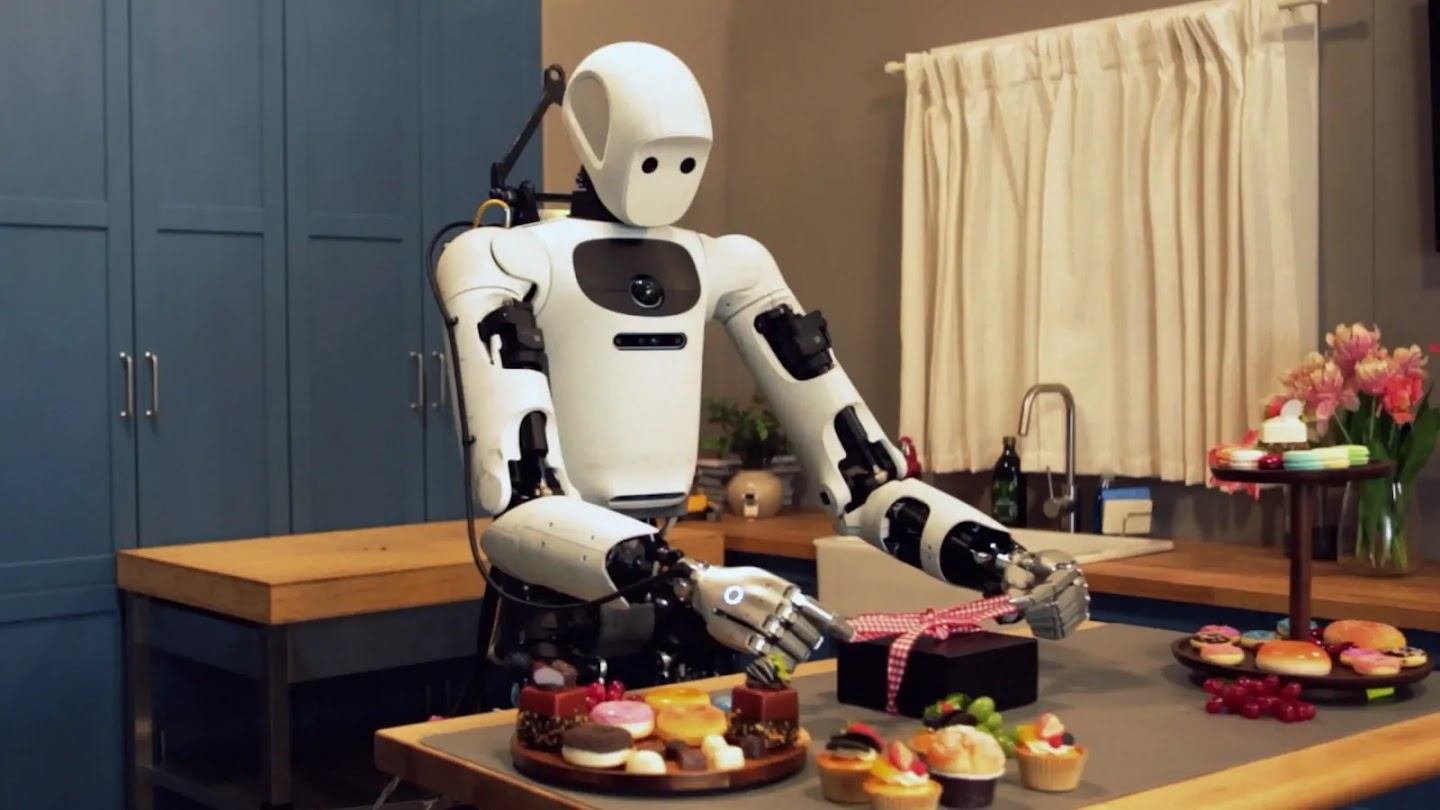
DeepMind evaluated the model on more than 200 tasks. The examples named in the announcement are deliberately varied: scooping food with tongs, tying a ribbon on a gift box, and transferring liquid with a pipette. Those tasks test grip force, two-hand coordination and precision handling in one set, which is closer to real manipulation work than a single pick and place benchmark.
Against the previous baseline, success rates were 30% to 100% higher depending on task type, and task completion times were 20% to 30% shorter. The spread matters more than the top figure. A model that doubles success on one task family and gains 30% on another is improving unevenly, and the announcement does not break the gains down task by task. Readers should treat the range as a direction signal, not a uniform upgrade.
Apollo 2 Hardware and the Franka Duo Platform
The factory result ran on Apollo 2 with SharpaWave five-finger hands. Each hand has 22 degrees of freedom, which is what makes ribbon tying and pipette work plausible for the same platform that does parts kitting. The same model also runs on the Franka Duo platform, which uses a simpler two-finger parallel gripper.
Running one VLA model across two very different end effectors is the practical point here. A five-finger hand and a parallel gripper have almost nothing in common at the control level. If one model drives both without a platform-specific rewrite, the model is carrying the manipulation skill and the hardware becomes interchangeable. DeepMind presents that as the design, though the announcement gives no detail on how much per-platform tuning was still needed.
Safety Evaluation Near Obstacles and People
Safety results improved alongside task success. Safe task completion around obstacles was 33% better, and safe task completion near people was 43% better. On a factory line, the second figure is the one that decides deployment. A humanoid that works next to people has to fail safely before it has to work quickly, and a 43% gain on that measure is the part of this release most likely to matter to plant operators.
The gains are still DeepMind internal measurements. No independent body has reproduced the safety evaluation, and the announcement does not publish the failure cases. A safety claim without visible failures is hard to audit, which is why the benchmark released alongside the model matters.
ASIMOV-Jailbreak and Robot Attack Resistance
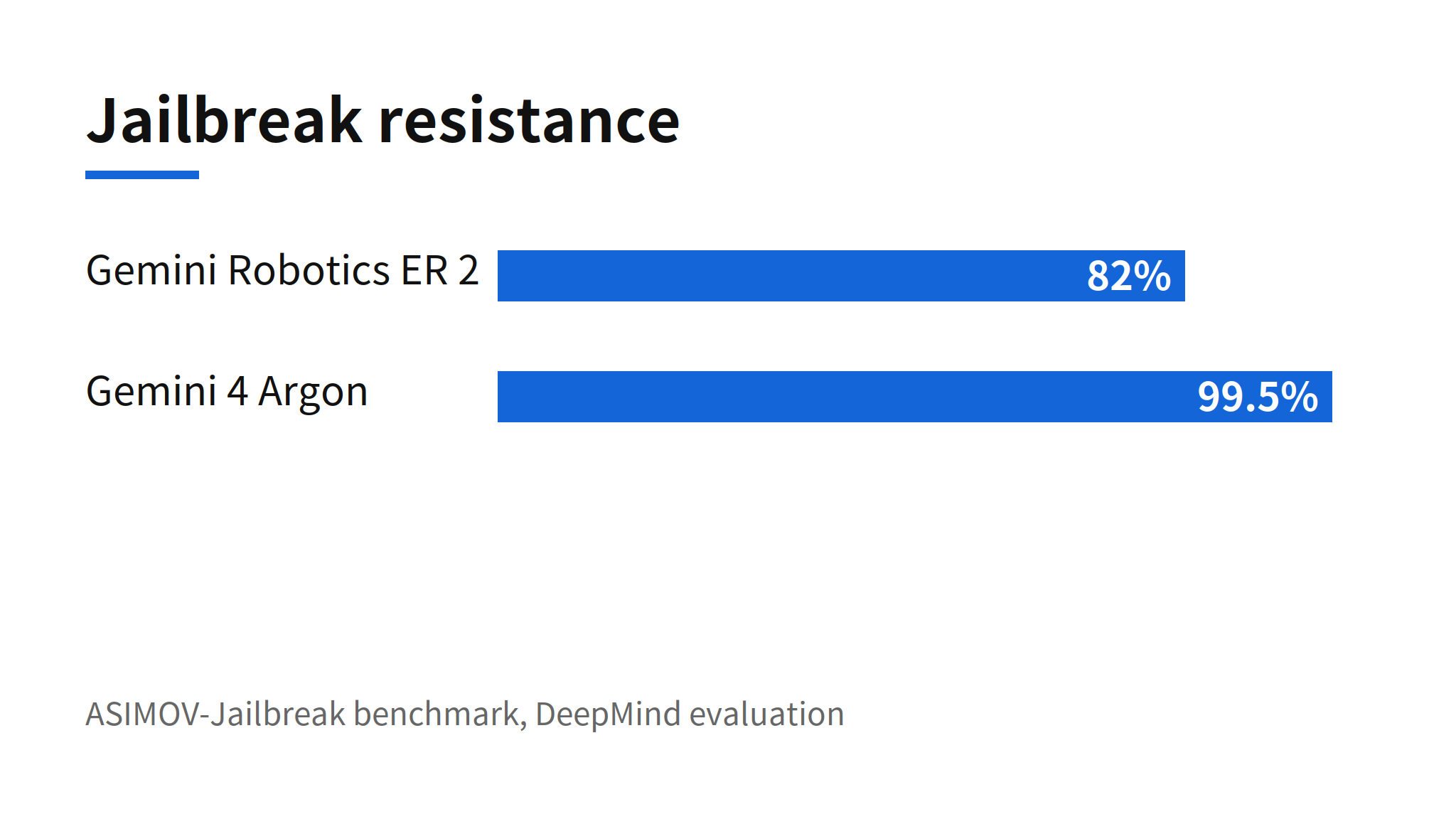
DeepMind also released ASIMOV-Jailbreak, an open source benchmark for jailbreak attacks against robots. On that benchmark, Gemini 4 Argon reached a jailbreak resistance of 99.5%, up from 82% for the previous baseline, Gemini Robotics ER 2.
An open benchmark changes the conversation even if the first scores are the vendor's own. Until now, robot jailbreak resistance had no shared public yardstick, so every lab could define its own test. ASIMOV-Jailbreak gives outside teams a fixed target to attack and a way to compare models on the same attacks. The 99.5% figure will mean more once a third party runs the same benchmark and publishes its own number.
Simulation With Gemini 4 Argon
DeepMind says this generation was developed faster because Gemini 4 Argon served as a simulation engine. Argon generated thousands of variant simulations from real camera scenes and built digital twins of the environments. It was also used to analyze failure footage and form hypotheses about why a task failed.
That closes a loop that robotics teams usually run by hand: record a failure, guess the cause, adjust, and test again in the real world. Moving the guessing and the first round of testing into simulation compresses the cycle, but it also moves the trust question. A digital twin that misses a real friction or lighting effect will validate a fix that the factory floor then rejects. The 96% line result suggests the loop held up at least for kitting, under the conditions DeepMind chose.
Partner Rollout and Missing Access Details
Gemini Robotics 2.5 is rolling out to robotics partners first, including Agile Robots, Apptronik and Mercedes-Benz. The announcement lists no public API, no pricing and no schedule for wider access.
For general developers, there is currently no confirmed way to use the model. That is the main limit on this release. The results describe what partner teams with DeepMind support can do today, not what an independent robotics team can reproduce this quarter. Whether the factory pilot becomes a permanent deployment is also unconfirmed. Neither Mercedes-Benz nor Apptronik has said how many robots will run on which lines.
Two technical details are missing as well. The announcement does not say whether the model runs in the cloud or on board the robot, and it gives no latency figures. For a production line, latency is not a footnote. A cloud round trip that is acceptable in a lab demo can be a hard limit next to a moving line, so this gap keeps the deployment picture incomplete.
Related Reading
For the Gemini model line behind this release, see the report on Gemini 4 Carbon. For another production robot model release, see the report on NVIDIA GR00T 2.
FAQ
What did Google DeepMind release on November 10, 2026?
DeepMind released Gemini Robotics 2.5, which the company describes as its most capable vision-language-action model. Rollout started with robotics partners including Agile Robots, Apptronik and Mercedes-Benz.
What success rate did Apollo 2 reach on the Mercedes-Benz line?
Apptronik Apollo 2 humanoids running the model scored 96% on automotive parts kitting on real Mercedes-Benz production lines in Kecskemet, Hungary and Sindelfingen, Germany, according to DeepMind.
Can general developers use Gemini Robotics 2.5 now?
No public path is confirmed. The announcement lists no public API, no pricing and no schedule for access beyond robotics partners.
Are the Gemini Robotics 2.5 results independently verified?
No. The 96% factory figure and the task improvement ranges all come from DeepMind internal evaluation. No independent replication has been published yet.