Gemini 4 Carbon Release: Pricing, Access and How It Works
Google opened Gemini 4 Carbon to general developers on November 10, 2026. The model is available on the paid Gemini API tier through Google AI Studio and Android Studio, according to the Google official blog. Introductory pricing is $2 per million input tokens and $10 per million output tokens, and that pricing ends on November 30, 2026.
Carbon was unveiled on October 28, but real access stayed narrow. Only selected cyber defense participants in the Fairwind Program could use it, and the date for a general developer release was unconfirmed at the time. This announcement fills that gap. A day earlier, the same model was already running a Signal code verification agent inside DeepMind AlphaProof Code, which suggests Google had been testing Carbon on long, tool driven work before opening the API.
Access Paths for Developers and Enterprises
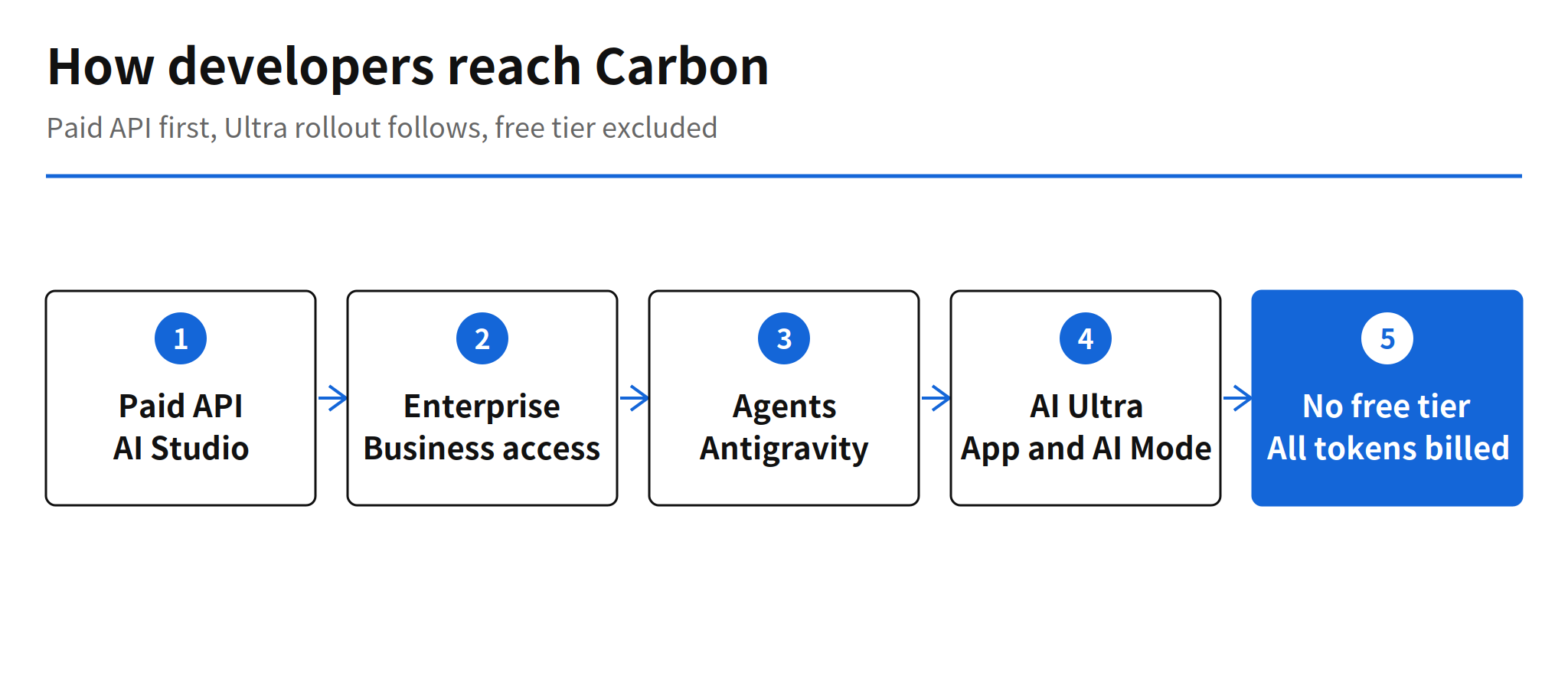
Enterprises can reach Carbon through Gemini for business, either through the API or through a model selection menu, as reported by 9to5Google. The model is also offered inside specialized agents such as Google Antigravity and CodeMender. That placement matters because Carbon is positioned for agent work, and agent products are where a frontier model with long reasoning chains earns its price.
For subscribers, Google AI Ultra members receive Carbon in Antigravity, the Gemini app and AI Mode in Search as a staged rollout. Google has not published a country by country schedule, and it has not said whether the free tier or AI Pro subscribers will get access later. For now the dividing line is clear: paid API and Ultra are in, free is out.
Pricing and the December 1 Increase
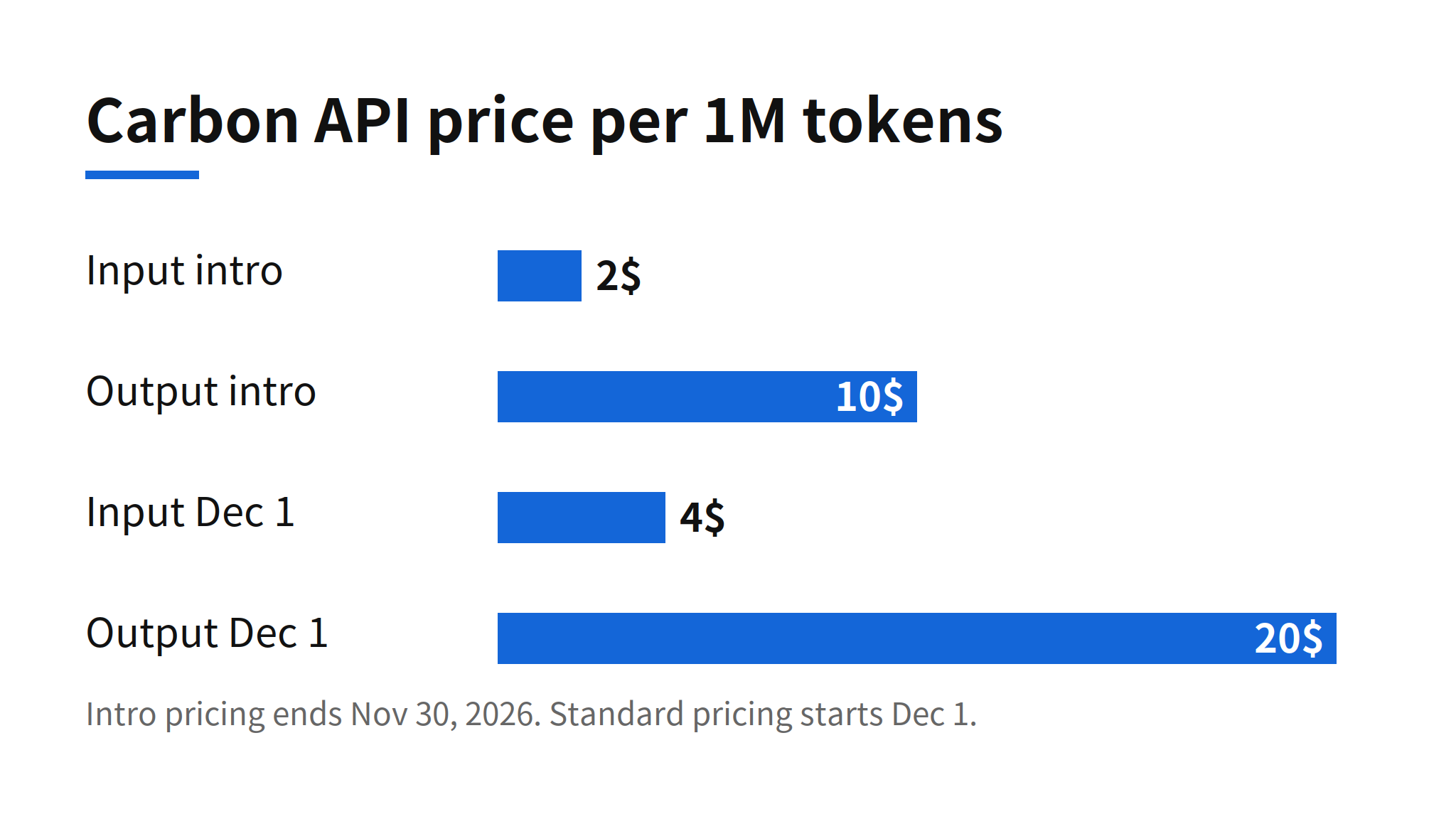
| Period | Input per 1M tokens | Output per 1M tokens |
|---|---|---|
| Introductory, until November 30, 2026 | $2 | $10 |
| Standard, from December 1, 2026 | $4 | $20 |
The introductory window lasts less than a month, and both rates double on December 1. Any cost model built during November therefore needs a second calculation at the December rates before it can support a production decision. The billing base also matters: Carbon is not available on the free Gemini API tier, and all processed tokens are billed, including reasoning tokens, according to Unite.AI reporting. A model that reasons longer at higher settings will consume more of those billed tokens, a limit the model card itself notes.
The practical use of the November window is evaluation rather than savings. A team can run its real agent workloads against Carbon for three weeks at half price, measure token consumption including reasoning, and then decide whether the December price still clears its budget. Treating the intro price as the long term price would understate steady state cost by a factor of two.
Antigravity /swarm and the Researcher Program
Google Antigravity launched a /swarm feature in preview alongside the Carbon expansion, according to VentureBeat. A team of agents divides a project into parts and checks each other's work. That is a notable product choice: multi agent verification moves from a pattern developers assemble themselves into a feature the platform ships and maintains.
The science support program also widened. Selected researchers can use Argon and Carbon free for six months at the highest Antigravity usage tier, and applications remain open, according to 9to5Google. The cyber security configuration, by contrast, did not change. It still requires a Fairwind Program application and staged approval, so the general release does not open the security tuned setup to everyone.
Limits and Open Questions
- No new external benchmarks. The benchmark figures remain Google's own numbers from the October unveiling. No newly measured external results accompanied this expansion.
- Knowledge cutoff is March 2026. The model card gives that cutoff, and it also notes that higher reasoning levels can increase token consumption and latency.
- Regional rollout is unpublished. Country level timing is not public, and access for the free tier and AI Pro remains undecided in public reporting.
- Pricing doubles within a month. Introductory rates end on November 30, 2026, so November evaluations do not predict December costs without recalculation.
The significance of this release is operational rather than rhetorical. Carbon is no longer a model in an announcement post. It is a callable option inside AI Studio and Android Studio, with a known price, a known billing rule and a known deadline for that price. Whether it stays attractive after December 1 is the separate question every evaluating team now has three weeks to answer with its own workloads.
Related Reading
Carbon arrives in a busy Gemini release cycle. See the report on Gemini Omni 1.2 Flash reaching general availability for the multimodal side of that cycle, the report on Google ADK 2.14 for the agent development kit that surrounds these models, and the report on Google TPU 8t and 8i for the hardware layer underneath.
FAQ
What is Gemini 4 Carbon?
Gemini 4 Carbon is a Google frontier model first unveiled on October 28, 2026. Access was initially limited to selected cyber defense participants in the Fairwind Program. On November 10, 2026 Google opened it to general developers on the paid Gemini API tier.
How much does Gemini 4 Carbon cost?
Introductory pricing is $2 per million input tokens and $10 per million output tokens. That pricing ends on November 30, 2026, and from December 1 the rates rise to $4 for input and $20 for output. All processed tokens, including reasoning tokens, are billed, and Carbon is not available on the free Gemini API tier.
Where can developers use Gemini 4 Carbon?
Developers can use Carbon through the paid Gemini API in Google AI Studio and Android Studio. Enterprises can reach it through Gemini for business, and it is also offered in specialized agents such as Google Antigravity and CodeMender. Google AI Ultra subscribers receive it in Antigravity, the Gemini app and AI Mode in Search as the rollout proceeds.
What is the Antigravity /swarm feature?
Google Antigravity launched /swarm in preview alongside the Carbon expansion. A team of agents splits a project into parts and checks each other's work. It is a product level example of multi agent verification rather than a single agent working alone.