Google ADK v2.14.0: Stable Environments, A2A and Evals
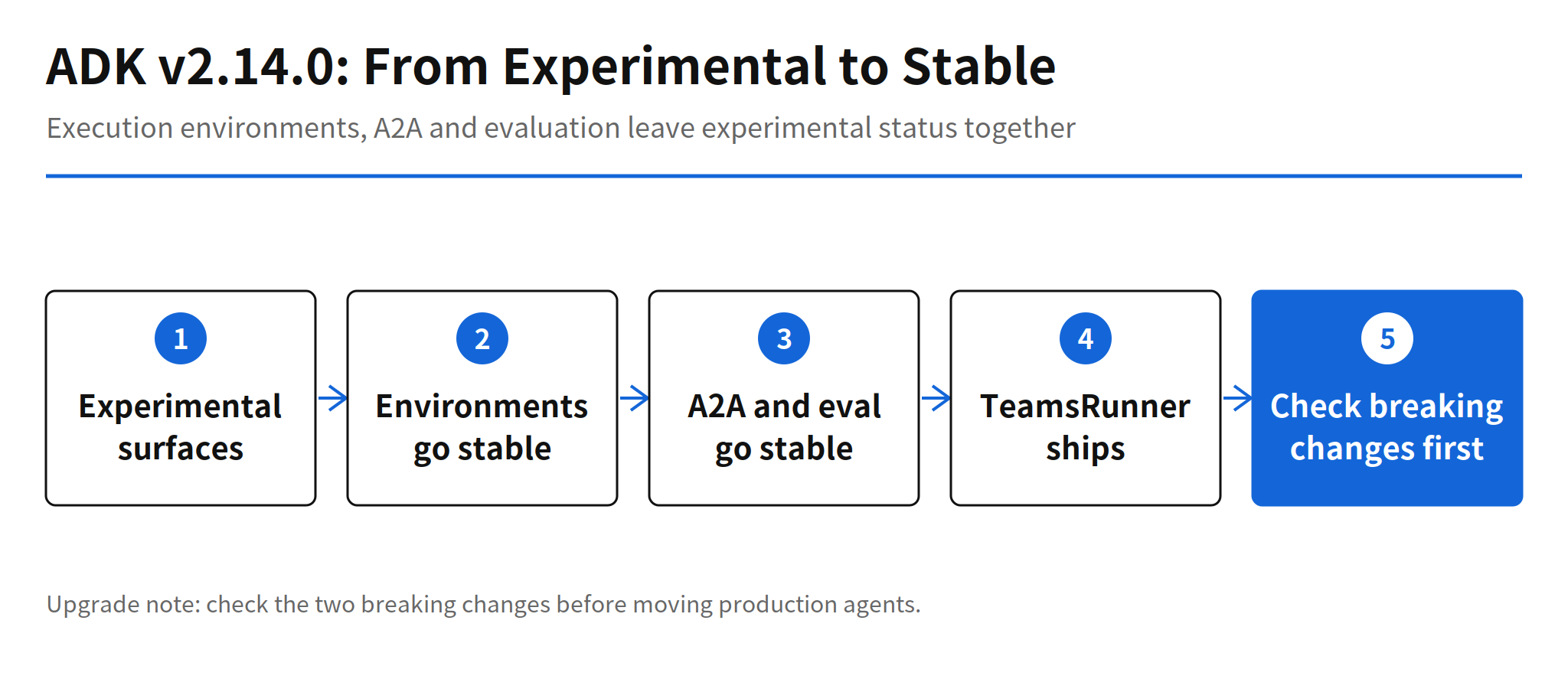
Google published Agent Development Kit (ADK) Python v2.14.0 on GitHub on November 7, 2026. The release notes carry a version date of November 4, 2026, while the GitHub release itself was posted at 2026-11-07T00:58:18Z. The point of this release is consolidation rather than a new headline feature. Execution environments, A2A integration and evaluation all move from experimental status to stable APIs in a single version, and that changes what teams can rely on when they move ADK agents from prototypes into production.
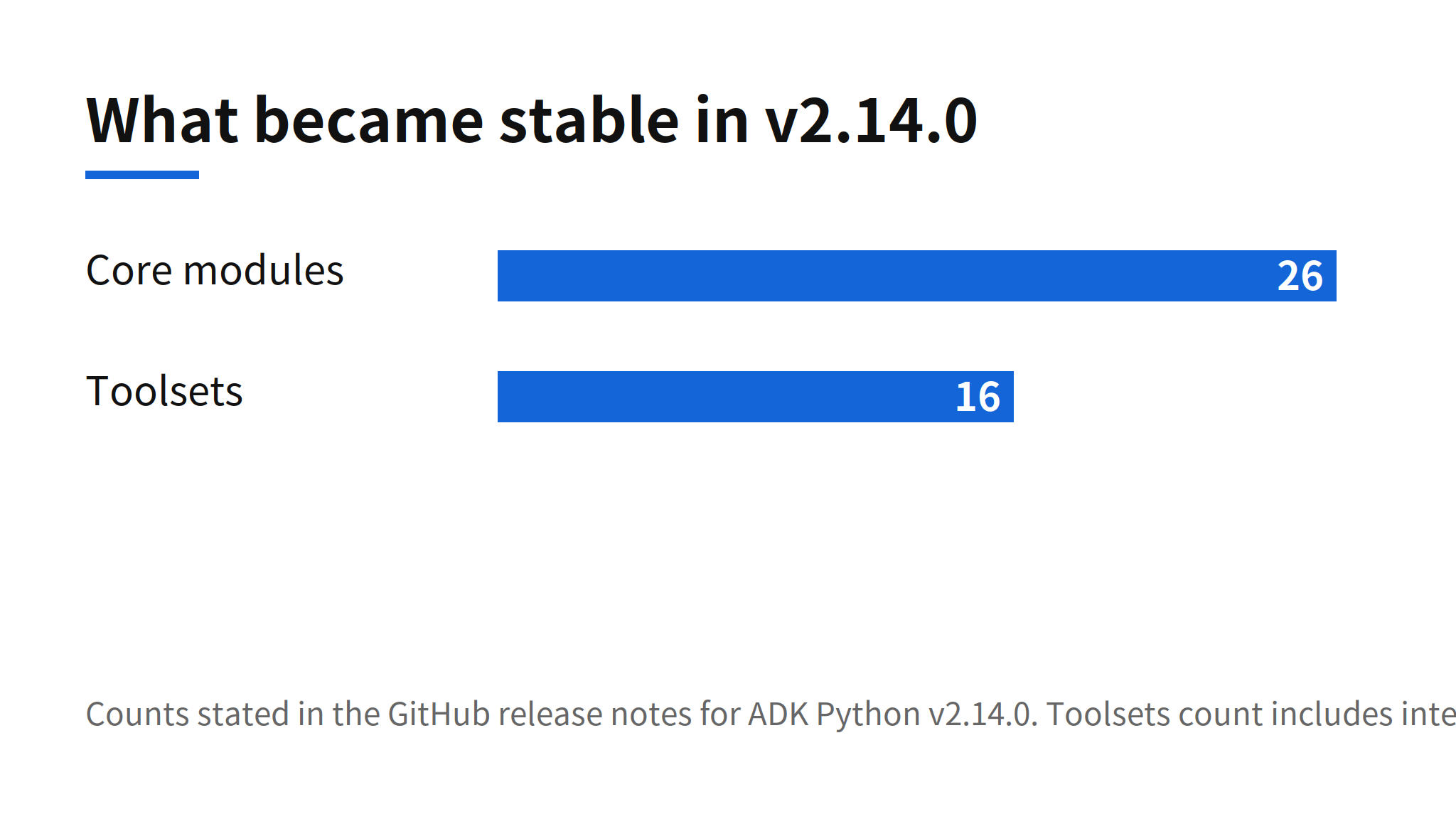
The scale of the promotion is stated in the release notes. 26 core modules covering authentication, environments, apps, CLI and cache become stable, along with 16 toolsets and integration features. Two integrations are new in this version: TeamsRunner, which connects ADK agents to Microsoft Teams chats and channels, and OpenAIDecisionsClassifier, which uses the OpenAI Decisions API to classify workflow and tool gating questions. For existing users, the practical work starts elsewhere. Two breaking changes ship in the same release, and both can fail silently or loudly depending on how a codebase passes tool arguments and skill scripts.
Stable Execution Environments and Streamed File Reads
The environment surface is now stable, including BaseEnvironment, LocalEnvironment, EnvironmentToolset, DaytonaEnvironment and E2BEnvironment. That naming matters because environments are where agent code actually runs. A stable contract here means teams can build deployment and sandboxing choices on these classes without expecting the interface to shift in the next minor release, which is the usual risk with experimental APIs.
One detail shows the direction of the work. BaseEnvironment.read_file_stream reads a file in chunks, so ReadFileTool can return a line range without loading the whole file into memory. For agents that inspect large logs or generated files inside a sandbox, that is a concrete operational improvement rather than a cosmetic API change. It also fits the performance story Google tells for this release, even though the headline numbers come with caveats covered below.
Evaluation With Repeated Runs and Four Way Argument Matching
Evaluation receives the most usable additions. MultiRunConfig, exposed as adk eval --num_runs, runs each evaluation case multiple times, and a new --parallelism option runs those cases concurrently. Scores and pass rates are then aggregated across runs. Single run evaluation is a weak signal for agents, because model output varies between calls. Repeated runs with aggregated pass rates give teams a more honest picture, at the cost of more model calls per evaluation cycle.
ToolArgsMatcher adds four ways to compare tool call arguments: exact match, case insensitive match, numeric tolerance and LLM based semantic comparison. That spread is sensible. Exact matching is too strict for free form text arguments, while semantic comparison on every argument would be slow and hard to reproduce. Letting a test choose the comparison per argument keeps deterministic checks where they belong and reserves model judgment for arguments that actually need it.
A2A Stability and Agent Cards From the CLI
A2A integration is now a stable API, and the CLI gains adk generate_agent_card to create an A2A agent card. Agent to agent communication only becomes useful infrastructure when the interface stops moving, because two independently maintained agents have to agree on it. Stability here is therefore worth more than another incremental protocol feature. Teams that already use ADK alongside other frameworks get a steadier target for interoperability work, while the card generation command lowers the setup cost for a first A2A endpoint.
Teams Integration and the Performance Claim
TeamsRunner connects ADK agents to Microsoft Teams chats and channels. Combined with the recent pattern of agent frameworks shipping chat surface integrations, the read is straightforward: distribution inside tools people already use is now part of framework competition, not an afterthought. OpenAIDecisionsClassifier points in a similar direction. It uses the OpenAI Decisions API to classify workflow and tool gating questions, which means ADK is willing to route a narrow classification job to another vendor model when that is the available tool.
Google says long multi turn workflows run faster in this version. The stated figures are a 200 turn run of a 30 node workflow running 23 percent faster, with peak memory use 9 percent lower. The release notes do not disclose the measurement conditions, the hardware or the version used for comparison. Those omissions matter. The numbers show the direction Google is optimizing for, long workflows rather than single calls, but they cannot be used to predict gains on a different workload. Treat them as a vendor claim to verify on your own workflow before citing them in a migration plan.
Breaking Changes and the Security Tightening
Two changes can break existing code. First, tool arguments declared as Enum are now passed as enum members rather than strings. Code that compares those arguments to strings, or that relies on json.dumps handling them as strings, needs to be updated. Second, in environment mode, RunSkillScriptTool no longer accepts a free form shell command string. Calls pass only args, short_options and positional_args, supported scripts are limited to .py, .sh and .bash, and a call that still passes command returns INVALID_ARGUMENTS.
The second change is also the security story of the release. The release notes explain that the structured argument form closes a hole where a model influenced by prompt injection could execute arbitrary shell commands. That is a credible design trade. Free form command strings are convenient for a framework to offer and dangerous for exactly the same reason. Moving the boundary to structured arguments will break some skill scripts, and in this case the break is the point. Teams upgrading should inventory skill script calls first, then check Enum argument handling, before they test anything else.
Related Reading
The framework landscape around ADK shifted in the same week. See the coverage of AutoGen being archived after the end of Microsoft AI Frontiers, and of Mistral Studio managed agents, where the direction runs toward hosted agent platforms rather than open frameworks.
FAQ
What became stable in Google ADK v2.14.0?
Execution environments, A2A integration and evaluation moved from experimental to stable APIs. The promotion covers 26 core modules covering authentication, environments, apps, CLI and cache, plus 16 toolsets and integration features.
What is new in ADK evaluation in v2.14.0?
Evaluation adds MultiRunConfig through adk eval --num_runs and a --parallelism option, so each case can run several times in parallel with scores and pass rates aggregated. ToolArgsMatcher compares tool call arguments in four ways: exact match, case insensitive match, numeric tolerance and LLM based semantic comparison.
What performance improvement does Google claim for ADK v2.14.0?
Google says a 200 turn run of a 30 node workflow is 23 percent faster and peak memory use is 9 percent lower. The release notes do not disclose the measurement conditions, the hardware or the comparison version, so the figures are vendor claims without a published method.
What breaks when upgrading to ADK v2.14.0?
Tool arguments declared as Enum are now passed as enum members rather than strings, so code that relies on string comparison or json.dumps needs changes. In environment mode, skill script calls that pass a free form command string now return INVALID_ARGUMENTS, and supported scripts are limited to .py, .sh and .bash.