Edge0-145B Release: 145B On-Device Model, 29GB Peak
Edge0 open-sourced Edge0-145B and Edge0-120B on November 12, 2026, together with a unified inference framework and deployment tools. The company calls the 145B model the world's first open-source on-device AI model with 145 billion parameters, and that wording matters: it is Edge0's claim, not a verified record. The reported laptop figures are the part worth checking first. Edge0 reports 29GB peak memory, decoding above 80 tokens/s, prefill above 1,100 tokens/s, typical power around 120W and a context of 128K to 256K.
If those numbers hold outside Edge0's own lab, the practical change is straightforward. A model in the size class that normally lives behind a cloud API could run coding and agent work on a personal laptop, with code and documents staying on the machine and no cloud token bill for local inference. Hardware and electricity still cost money, and a compatible laptop is a real requirement, so local does not mean free. It means the cost and the data move from a provider's meter to hardware the user already owns.
Release Scope and Reported Laptop Performance
The release is a full stack, not a weights file alone. Edge0 published the two model weights, the inference framework and one-click deployment tools with hardware guides, and it points users who do not want to set up an environment to the Edge0 App, whose core model capabilities work offline without an account or a usage quota. Day-one platform support covers macOS, Windows and Linux, including Apple M-series chips and NVIDIA platforms such as RTX Spark, RTX 4090 and RTX 5090. The base model listed on the Hugging Face model card is Qwen3.8-Flash-Next.
The performance table in the release post sets four requirements side by side: fit in memory, process prompts promptly, generate fast enough to use, and keep power under control during long tasks. The 29GB peak is the figure that decides which laptops qualify. Edge0 frames the model as usable on a 48GB laptop, and its quality-versus-memory chart marks 48GB laptop and 64GB workstation capacities explicitly. A 32GB machine sits below the reported peak once the operating system and other applications take their share, so the realistic floor is higher than the headline number suggests.
Context is the second constraint. The reported 128K to 256K range supports long agent sessions with large codebases in the prompt, and Edge0 says speed stays essentially the same on long inputs. That claim, like the speed figures, comes from internal testing. The release post notes that the complete evaluation setup, hardware environment and reproduction instructions are being released with the technical report, which means the conditions behind the 29GB figure, including how it varies with context length, still need that report to be checked properly.
Architecture, Training, Loading and Scheduling
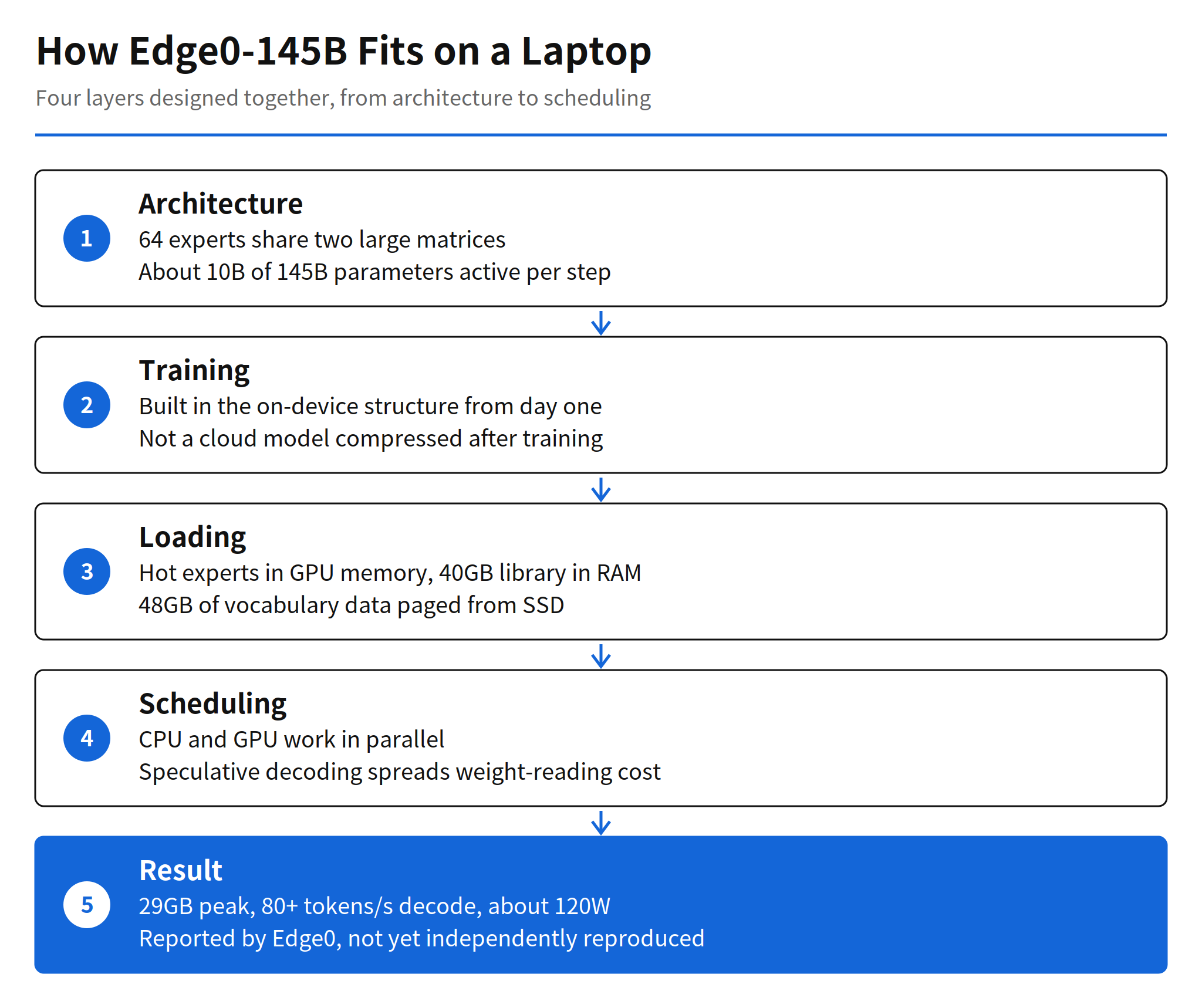
The core trick is in the architecture. In a conventional sparse expert design, every expert stores a complete set of large matrices. In Edge0-145B, each group of 64 experts shares two large matrices, and each expert keeps only a small set of parameters that captures its differences. The expert count stays the same while the weights that must be stored and moved shrink sharply. That is how the model reaches 145B total parameters with only about 10B active in each inference step.
Training follows the same logic. Edge0 says it trains the model in its on-device architecture from the start, with deployment constraints built into the design, instead of training a cloud model first and compressing or pruning it afterwards. Compression after the fact usually trades capability for size. Building the constraint into training is the company's answer to that tradeoff, and it is also the part that is hardest for an outside observer to verify from a release post alone.
Loading is split across three tiers that work as a pipeline, so reading and computation overlap instead of waiting in line. Frequently used hot experts remain in GPU memory. An expert library of about 40GB sits in system memory and experts move into GPU memory as needed. About 48GB of vocabulary data resides on the SSD and is read on demand. Scheduling then uses the CPU and GPU together: the GPU computes cached experts while the CPU handles the remaining work in parallel, and speculative decoding verifies multiple candidate tokens at once, spreading the cost of reading weights across more output tokens.
My read: the design is credible as engineering, because each layer attacks data movement rather than raw compute, and data movement is the real wall for local inference. The open question is not whether the architecture can work, but whether the reported numbers survive different laptops, longer contexts and independent test harnesses. Until then, 29GB and 80 tokens/s are vendor measurements with a plausible mechanism behind them.
Benchmark Scores and Comparison Context
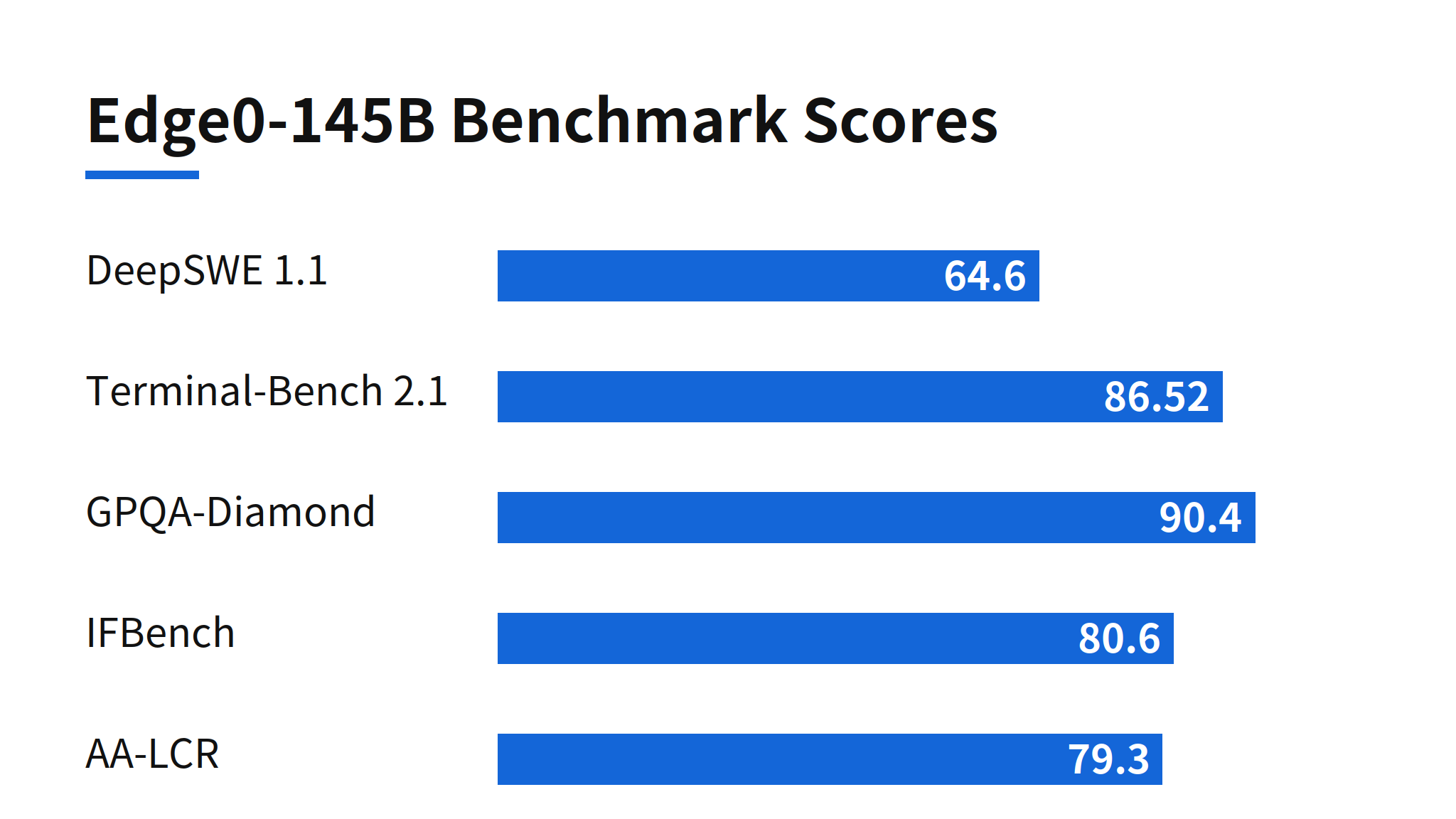
Edge0 reports six benchmark scores for the 145B model: DeepSWE 1.1 at 64.6, Terminal-Bench 2.1 at 86.52, HLE at 35.4, GPQA-Diamond at 90.4, IFBench at 80.6 and AA-LCR at 79.3, for a mean of 72.8 across the six. The strongest comparisons are in agent and coding work. On DeepSWE, 64.6 sits ahead of Qwen3.8-Flash-Next at 58.7 and DeepSeek-V4-Flash-0731 at 54.4. On Terminal-Bench, 86.52 sits ahead of Qwen3.8-Flash-Next at 83.3, DeepSeek-V4-Flash-0731 at 82.7 and Claude at 78.2 in Edge0's table.
The knowledge and instruction results are closer to the frontier pack rather than ahead of it. GPQA-Diamond at 90.4 is near DeepSeek-V4-Flash-0731 at 90.8 and Claude-Opus-4.6 (Max) at 91.3. IFBench at 80.6 is ahead of DeepSeek at 79.2 and well ahead of Claude-Opus-4.6 (Max) at 62.5, while HLE at 35.4 trails Claude at 40.0. The 120B sibling scores lower on most measures, with a 68.9 mean, but it posts a slightly higher AA-LCR at 81.0 against 79.3 for the 145B model.
The memory comparison is the claim Edge0 leads with. Its table puts Edge0-145B at a measured 29GB peak against an estimated 70GB for Qwen3.8-Flash-Next in a standard 4-bit deployment and about 87GB for DeepSeek-V4-Flash-0731, with means of 72.8, 71.7 and 70.1 respectively. Two cautions belong next to that table. The baseline memory figures are estimates for 4-bit deployment and are marked as still to be measured, while the Edge0 figures are measured internal peaks. And Edge0 states plainly that the Edge0, Qwen, DeepSeek and Claude results in its comparison come from its own internal evaluations. These are competitive numbers from an interested party, presented with more methodological honesty than most launch posts, and they still need outside reproduction.
Demonstrations in Coding, 3D, Games and Hardware
The demonstrations are agent workflows rather than chat answers. Edge0 says a single request can start a local workflow in which the model plans the steps, writes code, runs tools, debugs failures and takes screenshots to inspect the result, iterating for dozens of rounds. The examples include an explainer video about the Tesla Roadster produced within an hour, a Manhattan city scene built in Blender within an hour, playable games and a medieval capital with a 20-second fly-through, a drone program written from one instruction that flew a real drone through obstacles to find a red backpack, and a PCB design taken from KiCad component placement to an assembly animation in Unreal Engine 5.
The cost comparisons attached to those demos need the same care as the benchmarks. Edge0 estimates that the Manhattan scene would typically cost about $12,000 to $18,000 and at least a month by hand, and more than $150 in cloud tokens with a leading cloud model. Those are the company's estimates for work it chose to demonstrate, not audited figures. What the demos do establish, if the recordings are representative, is the workflow shape: long, tool-heavy agent loops are exactly the workload where per-token cloud pricing hurts most, so they are the strongest practical case for a capable local model.
For software teams, the nearer test is more ordinary. Code, build logs and board layouts that cannot leave the building are the inputs cloud agents handle worst from a compliance point of view. A local model that can plan, edit, run and inspect on the same machine removes the data question from that loop entirely. Whether Edge0-145B is good enough at that loop, at the reported speed, on hardware a team actually has, is the question independent testing will answer.
Getting the Model and License Limits
The weights for Edge0-145B and Edge0-120B are on Hugging Face, the inference framework and deployment guides are on GitHub, and the Edge0 App offers a no-setup route. The portfolio around the flagship also matters for fit: the Edge0 family includes 35B and 8B phone models, and the wider company portfolio covers Audio8 speech models, Decision0 fast decision models and Embedding0 memory models, with day-one support for the 145B model limited to suitably equipped laptops rather than phones.
The license is the main friction for product use. The weights ship under the Edge0 Community License, which is not a standard open-source license such as Apache 2.0. Reporting based on the model card says model resale and operating a commercial service require separate permission. Downloading and evaluating the model is one thing; shipping it inside a product or a paid service is another, and teams need to read the actual license terms before planning around it.
Limits and Unconfirmed Points
- All headline figures are vendor-reported: the 29GB peak, the speed figures, the power figure and all six benchmark scores come from Edge0's internal testing. No independent reproduction was available when this article was written.
- Measurement conditions are incomplete: Edge0 says the full evaluation setup and reproduction instructions arrive with its technical report. How peak memory changes with context length and workload is not yet checkable from the release post alone.
- Baseline memory figures are estimates: the 70GB and 87GB comparison figures are estimates for standard 4-bit deployment, marked by Edge0 as still to be measured, while the Edge0 figures are measured peaks.
- Community skepticism is on record: the original research notes community reactions questioning whether the reported numbers are credible. That reaction is not evidence either way, but it underlines why outside replication is the deciding step.
- License restricts product use: the Edge0 Community License is not Apache 2.0, and resale or commercial service use needs separate permission according to reporting on the model card.
FAQ
What is Edge0-145B?
Edge0-145B is an open-source model with 145 billion parameters that Edge0 released on November 12, 2026, together with Edge0-120B, a unified inference framework and deployment tools. Edge0 describes it as the first open-source on-device model at this size, and that description is the company's own claim.
What laptop performance does Edge0 report for the 145B model?
Edge0 reports 29GB peak memory, decoding above 80 tokens per second, prefill above 1,100 tokens per second, typical power around 120W and a 128K to 256K context. All of these figures come from Edge0's own testing and have not been independently reproduced.
How does a 145B model fit in 29GB of memory?
Groups of 64 experts share two large matrices, so only about 10B of the 145B parameters take part in each inference step. Loading is split across three tiers: hot experts stay in GPU memory, an expert library of about 40GB sits in system memory, and about 48GB of vocabulary data is paged from SSD on demand.
Can Edge0-145B be used in a commercial product?
The weights use the Edge0 Community License, not a standard license such as Apache 2.0. Reporting on the model card says model resale and running a commercial service need separate permission, so product teams need to read the license terms before building on it.
Related Reading
- BotPsy 0.8B Release: On-Device Agent Scores and Limits, a much smaller on-device agent model, useful as the opposite end of the size range from Edge0-145B