BotPsy 0.8B Release: On-Device Agent Scores and Limits
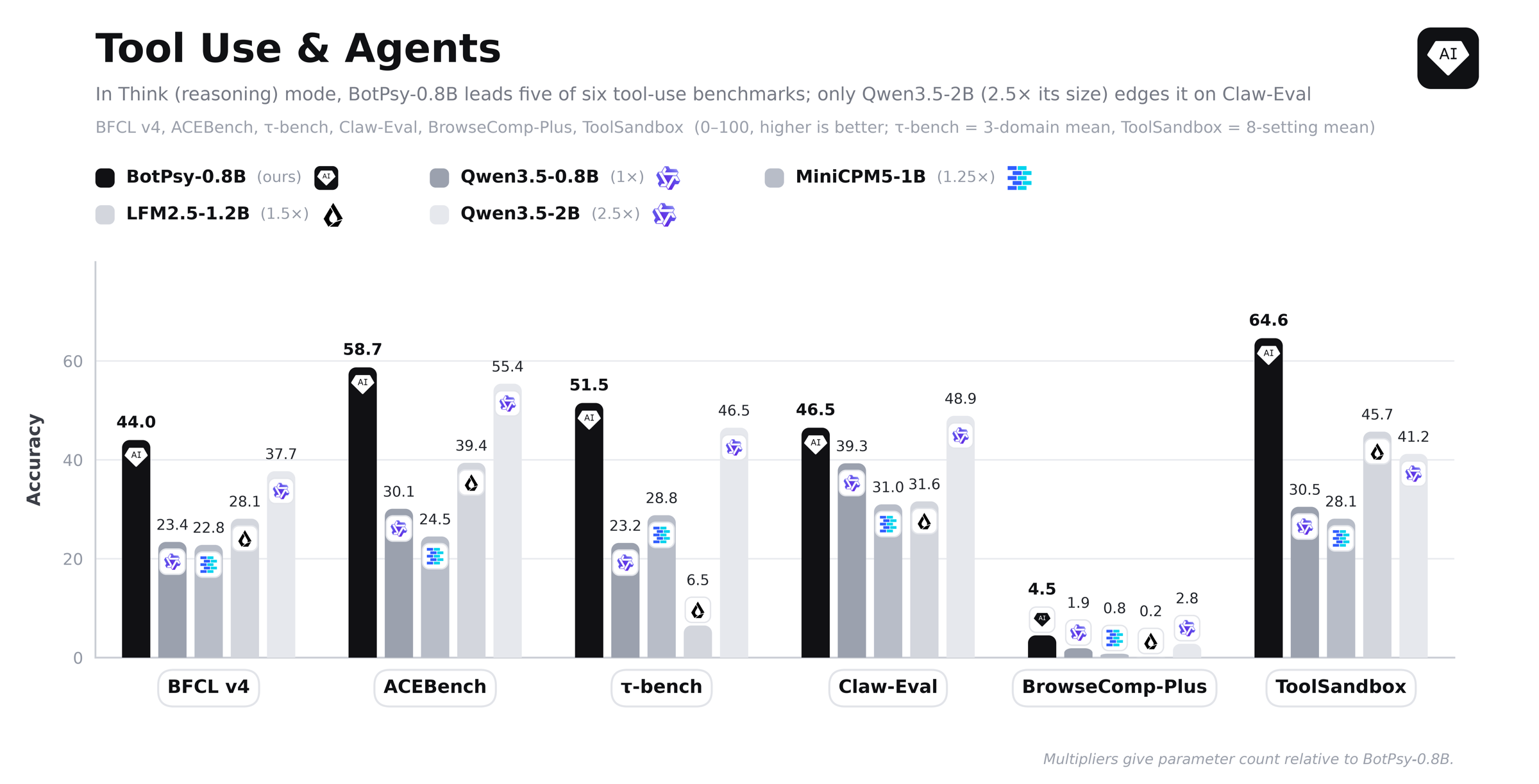
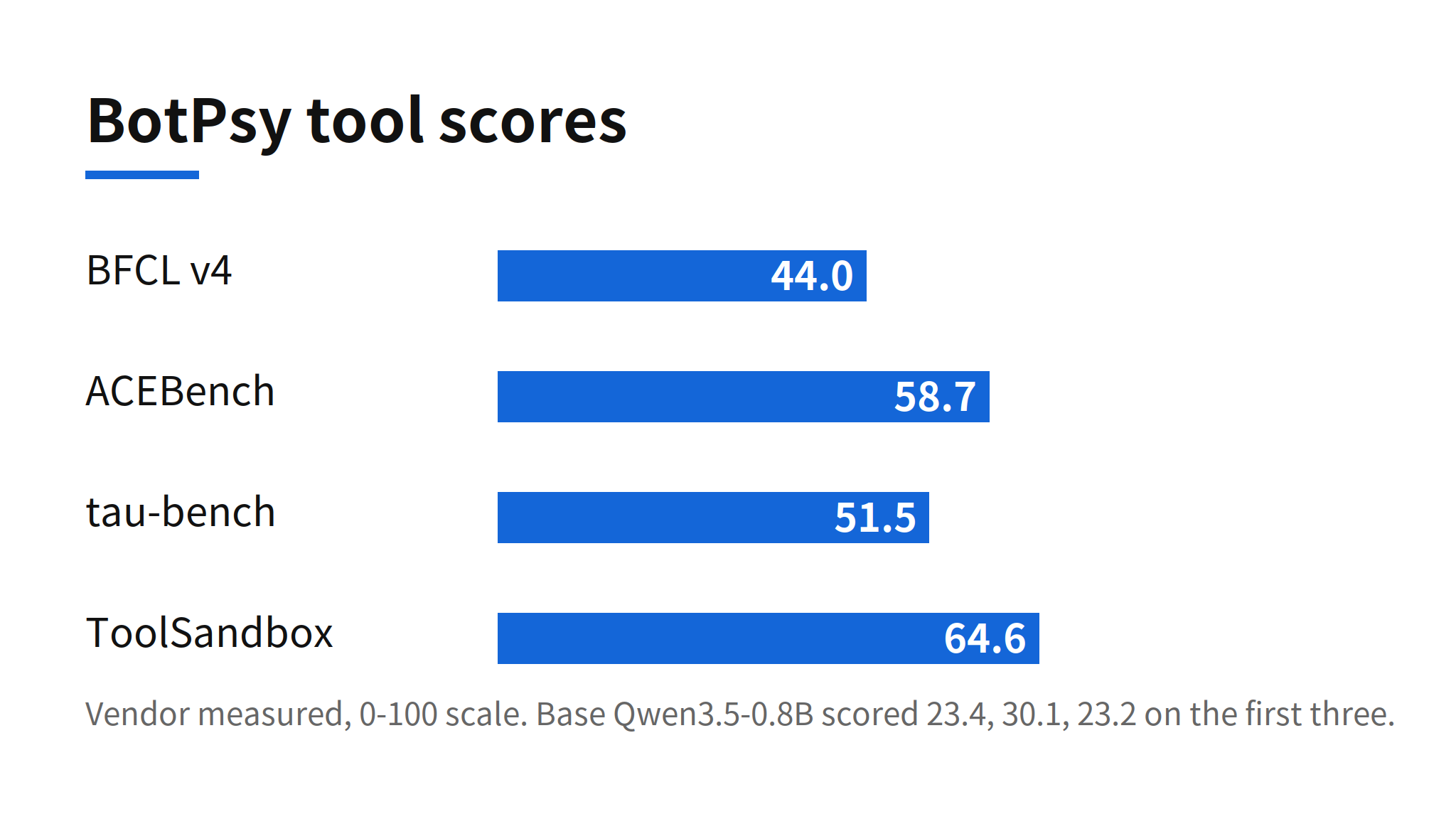
BotPsy is a 0.8B on-device agent model released by Tether AI Research on November 11, 2026. It is a post-trained version of Qwen3.5-0.8B, and in the vendor measurements it roughly doubles its base model on tool calling: BFCL v4 rose from 23.4 to 44.0, ACEBench from 30.1 to 58.7 and tau-bench from 23.2 to 51.5. Against Qwen3.5-2B-Think, a model 2.5 times its size, BotPsy leads on five of the six benchmarks tested.
That headline needs its context in the same breath. Every figure in this article is measured by Tether AI Research itself, and no independent remeasurement exists yet. The useful reading is therefore narrower and stronger: a heavily post-trained small model can close, and on some tests pass, the tool calling gap to a model several times larger. Whether it does so on a real phone workload is the test anyone can now run, because the weights, including GGUF files for llama.cpp, are public under Apache 2.0.
What BotPsy Is Built to Do
The target workload is routine assistant work: web search and research, travel, commerce and finance, device and vehicle control, files and documents, calendar, email and messages. None of that needs frontier level reasoning on every step. It needs reliable tool selection, correct arguments, sensible sequencing over several turns, and the judgement to refuse a call when no suitable tool exists. BotPsy is trained specifically for that profile, which is why its gains concentrate in tool and instruction benchmarks rather than in knowledge tests.
The starting premise is operational as much as technical. Cloud models carry shifting cost and a provider that can change or cut access. A small specialist model running on the device keeps personal data local and removes the network round trip for tasks that are simple but frequent. For an Android developer, that is the practical question BotPsy raises: how much of an agent workload can move from a server call to a local 0.8B model without the tool calls falling apart.
Tool Calling Scores Against the Base and the 2B Model
Among models at or below 1.2B, BotPsy ranked first on all six benchmarks tested. The comparison set was Qwen3.5-0.8B-Think, LFM2.5-1.2B-Think and MiniCPM5-1B-Think. The more interesting comparison is upward: against Qwen3.5-2B-Think, BotPsy scored 64.6 against 41.2 on ToolSandbox and 44.0 against 37.7 on BFCL v4, losing only Claw-Eval at 46.5 against 48.9. A 23 point gap on ToolSandbox is too large to explain by noise alone, and it points at training fit: ToolSandbox rewards exactly the stateful, multi-step tool behaviour the post-training targeted.
Two quieter numbers may matter more in production. Multi-turn function calling on BFCL v4 rose from 7.5 to 46.1, which is the difference between an agent that loses the thread after the first call and one that can finish a sequence. On the hallucination test for refusing a call when no matching tool exists, BotPsy scored 86.1, the highest of the models compared. An on-device agent that calls a wrong tool confidently is worse than one that does nothing, so refusal quality is a safety property, not a footnote.
Instruction Following, Safety and Token Cost
Instruction following rose with the tool scores. IFEval went from 59.7 to 90.8 and IFBench from 22.0 to 55.9. That pairing is what makes the model plausible as an assistant rather than a pure function caller: it has to follow the user instruction that frames the call, not just emit a well formed call.
The safety and efficiency figures move in the same direction. In automated red teaming, the share of unsafe responses fell from 36% for the base model to 21%, and under prompt injection conditions from 46% to 31%. Those are improvements, not a clean bill: roughly one response in five still failed the vendor own safety test, and roughly one in three under injection. On cost, the reasoning tokens needed to reach an answer on GPQA Diamond fell from 11,563 to 3,690. On a device, fewer reasoning tokens translate directly into lower latency and battery use per task, which is where a small model has to win to be worth running locally.
Training Recipe in Four Stages
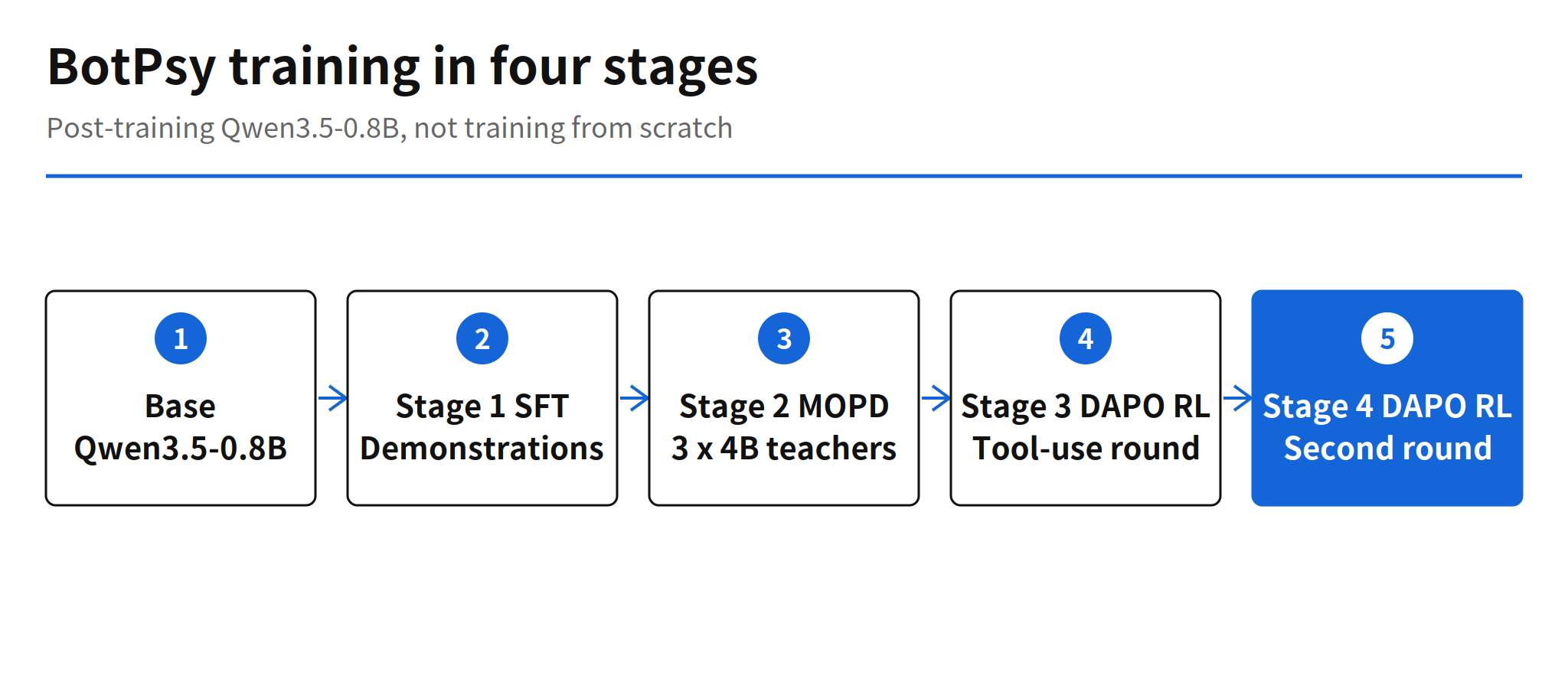
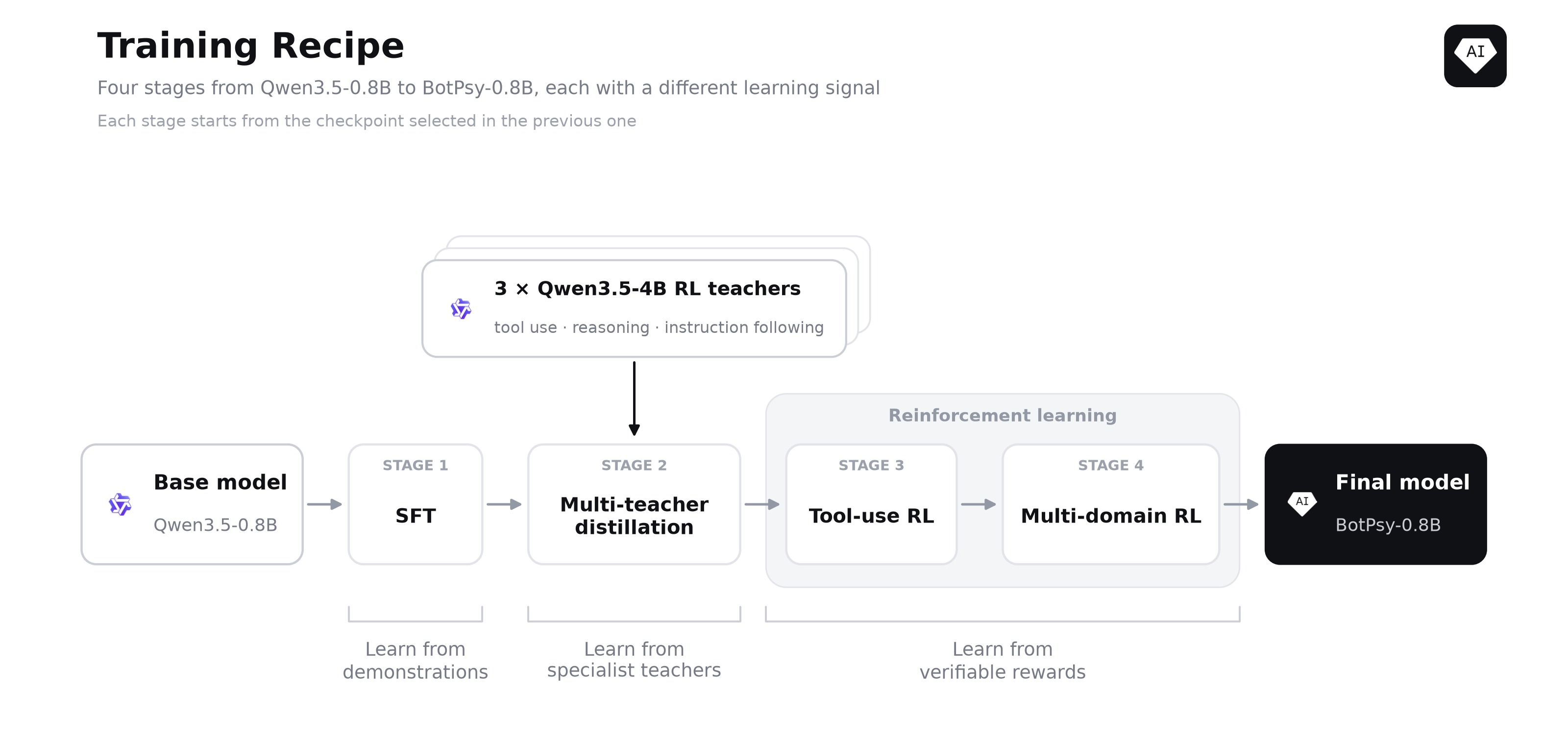
BotPsy is a post-training result, not a new architecture. Training ran in four stages: supervised fine-tuning first, then on-policy distillation (MOPD) from three specialist Qwen3.5-4B teachers, then two rounds of DAPO reinforcement learning. The recipe is a useful template beyond this release. A small base model, teachers only five times its size, and reinforcement focused on the target behaviour produced gains that scale alone did not: the 2B comparison model is larger than BotPsy and, on the release data composition, less specialised.
Release Formats and License
The weights are released under Apache 2.0 and described as usable for research and education. Three precisions ship: bf16, Q8 and Q4. Distribution covers both Hugging Face safetensors and GGUF files for the QVAC SDK and llama.cpp. The Q4 GGUF path is the one most developers will test first, because it is the format that fits a phone class device and runs with tooling that already exists. No separate application process or commercial agreement is described in the release.
Limits Stated in the Release
The release post is unusually direct about weak areas, and those numbers belong next to the headline scores. BrowseComp-Plus scored only 4.5. On tau3-bench banking, no model in the comparison passed 5 points. Multilingual instruction following splits sharply by language: on Multi-IF, Hindi scored 24.5 and Russian 57.6, against a 72 to 80 range for languages such as English and Chinese. A team shipping in a low scoring language should treat the headline averages as not applicable to its users.
The development team states plainly that the model still makes mistakes, and advises against using it for high risk automated decisions involving money, personal data or health. Combined with the vendor only measurement, that warning sets the correct first use: supervised, low risk tasks with a human able to catch a wrong call.
Why BotPsy Matters for On-Device Agents
The bottleneck for on-device agents on Android has been tool calling accuracy in small models, not raw chat quality. If a 0.8B model genuinely holds multi-turn calling and refusal behaviour at the level these vendor figures claim, the set of tasks that can run without a server round trip grows: device settings, calendar and message handling, file operations and simple research chains. The claim is testable today with the published GGUF weights and a handful of real tasks from your own workflow, scored against the cloud model you currently call. That local test, not the release chart, is the evidence worth trusting for an adoption decision.
FAQ
What is BotPsy?
BotPsy is a 0.8B on-device agent model released by Tether AI Research on November 11, 2026. It is a post-trained version of Qwen3.5-0.8B, built to handle everyday assistant work such as web search, travel, commerce, device control, files, calendar, email and messages on the device itself.
How much better is BotPsy than its base model on tool calling?
In Tether AI Research measurements, BFCL v4 rose from 23.4 to 44.0, ACEBench from 30.1 to 58.7 and tau-bench from 23.2 to 51.5. Multi-turn function calling on BFCL v4 rose from 7.5 to 46.1.
How can BotPsy be downloaded and run?
The weights are released under Apache 2.0 for research and education use. They ship in bf16, Q8 and Q4 precision, as Hugging Face safetensors and as GGUF files for the QVAC SDK and llama.cpp.
What are the known limits of BotPsy?
All benchmark figures are vendor measured, with no independent remeasurement yet. BrowseComp-Plus scored only 4.5, no model passed 5 on tau3-bench banking, and Multi-IF scores for Hindi and Russian lagged far behind English and Chinese. The team also warns against using it for high risk automated decisions involving money, personal data or health.
Related Reading
- Expo Exact: Write Once, Run Natively on Four Platforms
- Runpod for Agents Release: MCP, 35 Skills, Pricing and Setup