Runpod for Agents Release: MCP, 35 Skills, Pricing and Setup
Runpod expanded Runpod for Agents on November 10, 2026, giving coding agents a hosted MCP (Model Context Protocol) server and a library of 35 verified skills for infrastructure work. Agents are not a hypothetical user group for the company: Runpod says agents already execute more than half of all CLI commands across the platform, and that more than 1.2 million developers build on Runpod.
That usage figure explains the shape of the release. Instead of asking agents to improvise against a raw API, Runpod packages two things agents are known to lack: a live connection to the platform and written procedures that were checked against the real system. The bet is that most agent failures in infrastructure work come from missing operational knowledge, not from missing API access.
CEO Zhen Lu put the distinction plainly: an agent with API access is not the same as an agent that knows how to run a workload correctly.
What Runpod for Agents Includes
- Hosted MCP server: the agent operates Runpod through it and looks up current documentation while it works.
- Verified skills library: 35 skills covering frequent infrastructure tasks, split into core and specialized sets.
- Native plugins: plugins for Claude Code, Codex and ChatGPT that install a router skill and the runpod-mcp skill.
- Shared REST v2 foundation: the MCP server, the Terraform provider 2.0, the Go SDK v2 and the TypeScript SDK all sit on the Runpod REST v2 API.
The shared foundation matters for teams that mix tools. An agent action taken through MCP and a deployment defined in Terraform are not two separate integrations with separate behavior; they resolve to the same underlying API. That narrows the gap between what an agent does interactively and what a team later codifies.
The Skills Library in Detail
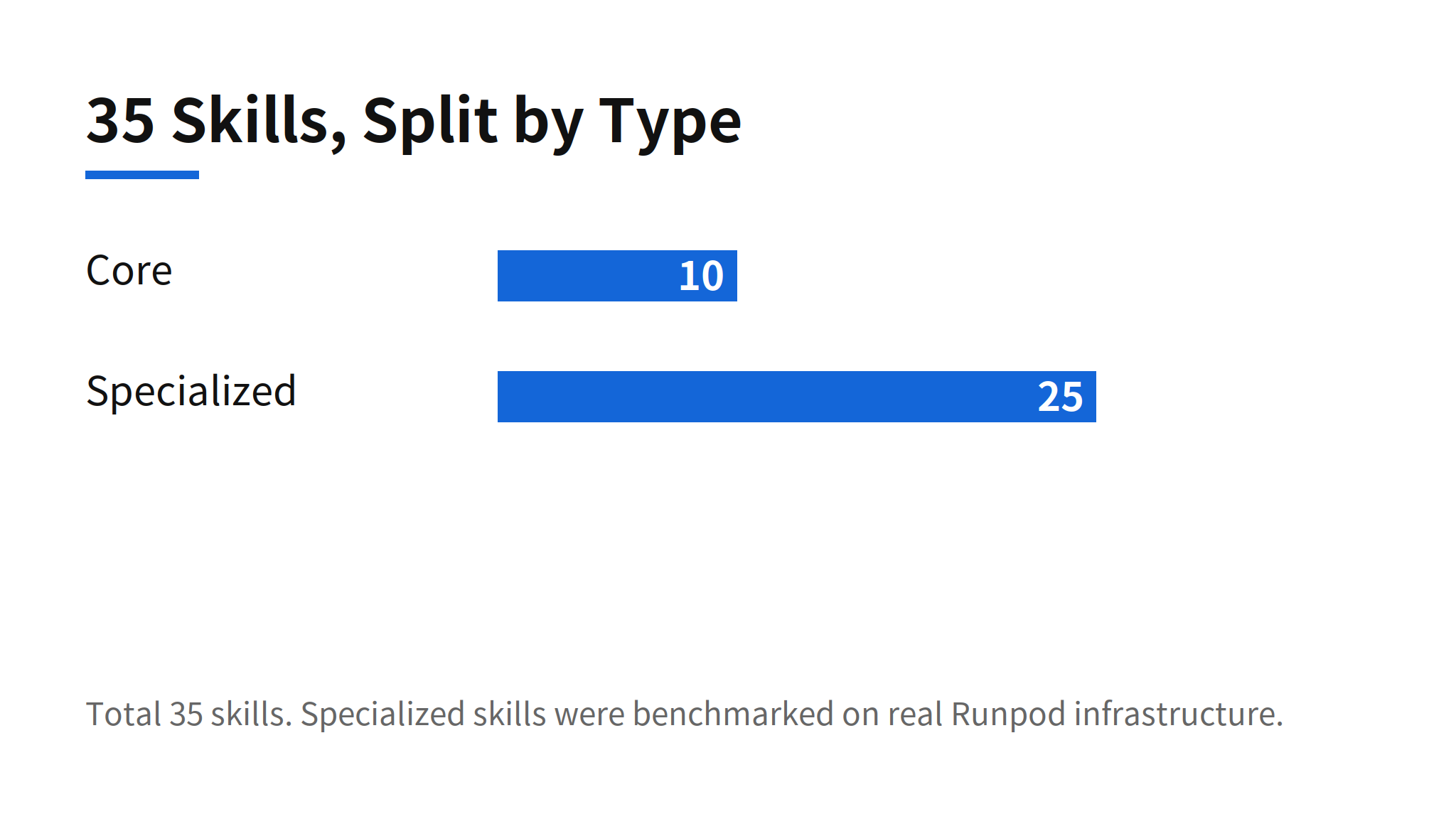
The library holds 10 core skills and 25 specialized skills. The documented coverage includes hardware selection, Pod and Serverless deployment, troubleshooting, endpoint operations and cost audits. Runpod says the specialized skills were benchmarked and verified on real Runpod infrastructure, which is the part of the claim that separates a skill library from a prompt pack: the procedures were run against the system they describe.
There is a limit to how far that verification can be checked from outside. Only part of the full list of 35 skills is visible in the official documentation so far, and the individual verification results for the remaining skills have not been published. The structure is verifiable today; the depth of testing behind each specialized skill is not.
One-Prompt Setup and Native Plugins
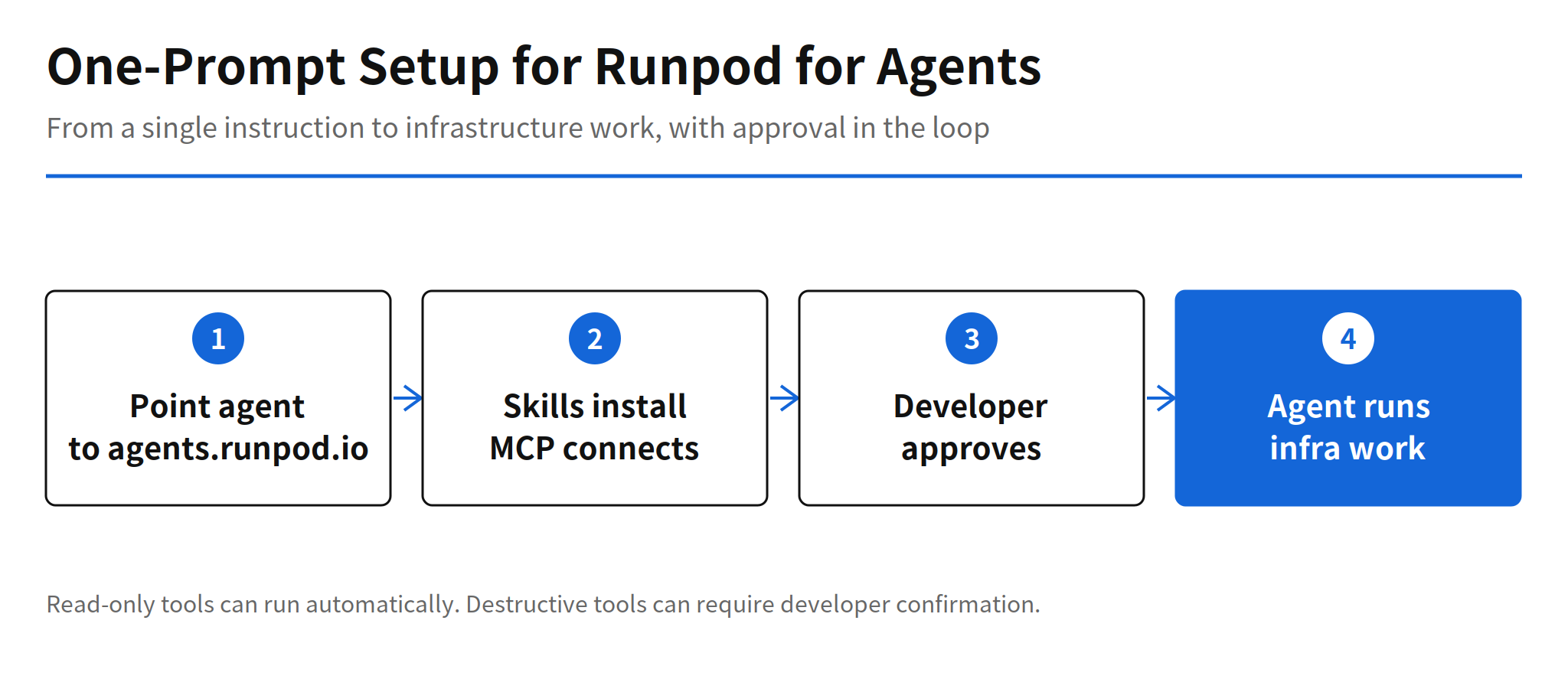
Setup is a single instruction. A developer points a coding agent to agents.runpod.io, and the agent installs the skills, connects to the hosted MCP server and then asks the developer for approval. Clients that support OAuth can authenticate in the browser, so no API key has to be issued or pasted into a config file first. That removes the two steps that usually stall agent integrations, key provisioning and config editing, and replaces them with one approval the developer can actually read.
For Claude Code, the official documentation gives an explicit install path through the plugin marketplace:
claude plugin marketplace add runpod/runpod-plugins-official
claude plugin install runpod@runpod
The plugins install a router skill alongside the runpod-mcp skill. The router is the quiet but important piece: with 35 skills available, the agent first has to pick the right procedure for a task before it can follow one. Routing the selection keeps individual skills narrow, which is what makes them practical to verify in the first place.
Tool-Level Safety for Agent Actions
Every MCP tool is classified as either read-only or destructive. Compatible clients can run read-only actions automatically and require developer confirmation before destructive actions such as deletion. The classification lives at tool level, so the approval boundary follows the action itself rather than a blanket setting for the whole session.
This is the part of the design most likely to travel beyond Runpod. Letting an agent provision and diagnose freely while gating deletion is a workable middle ground between two positions teams usually get stuck between: full autonomy they do not trust, and manual approval for everything, which makes the agent pointless. Classifying tools once, at the platform layer, also means every client inherits the same boundary instead of each team inventing its own.
Pricing and Unconfirmed Claims
The announcement lists no separate price for Runpod for Agents itself. Whether any fee exists apart from GPU usage is unconfirmed, so teams evaluating it should treat the current cost as their normal Runpod usage until Runpod states otherwise in writing.
The customer figure in the announcement needs the same care. Runpod says the film production company Open Source Films handed compute provisioning to agents and saw production throughput rise by about 10x. That is a statement from the production company carried in a vendor release, not an independently measured result.
Runpod also teased further additions for December with a "more coming" note, without saying what they contain. The content of that follow-up is undisclosed, and any reading of it as new skills, new clients or new pricing would be speculation at this point.
Why This Release Matters for Coding Agent Workflows
The scope of coding agents is widening from writing code to operating the machines the code runs on. Runpod for Agents is a clean example of what that shift demands from a platform: current documentation served at the moment of work, procedures fixed as verified skills so the agent guesses less, and a tool-level split between actions that can run freely and actions that need a human yes.
Developers already using Claude Code or Codex can test the whole idea with one prompt, because setup is deliberately a single step. The realistic first test is also the safest one: let the agent handle hardware selection, deployment and diagnosis, keep destructive actions behind confirmation, and judge the skills on whether their procedures match what an experienced operator would have done by hand.
FAQ
What is Runpod for Agents?
Runpod for Agents is a toolset that lets coding agents do infrastructure work on Runpod. It combines a hosted MCP server, which the agent uses to operate Runpod and look up documentation, with a library of verified skills for common infrastructure tasks.
How many skills does Runpod for Agents include?
The library has 35 skills in total, split into 10 core skills and 25 specialized skills. They cover hardware selection, Pod and Serverless deployment, troubleshooting, endpoint operations and cost audits, and Runpod says the specialized skills were benchmarked and verified on real Runpod infrastructure.
How does setup work for Runpod for Agents?
A developer points a coding agent to agents.runpod.io. The agent installs the skills, connects to the hosted MCP server and then asks the developer for approval. Clients that support OAuth can authenticate in the browser without an API key.
Does Runpod for Agents cost extra?
The November 10, 2026 announcement does not mention separate pricing for Runpod for Agents itself. Whether it is billed separately from GPU usage is unconfirmed.
How are destructive actions handled in Runpod for Agents?
Every MCP tool is classified as read-only or destructive. Compatible clients can run read-only actions automatically and require developer confirmation for destructive actions such as deletion.