Tencent Hy4 flash Release: Pricing, Specs and How It Works
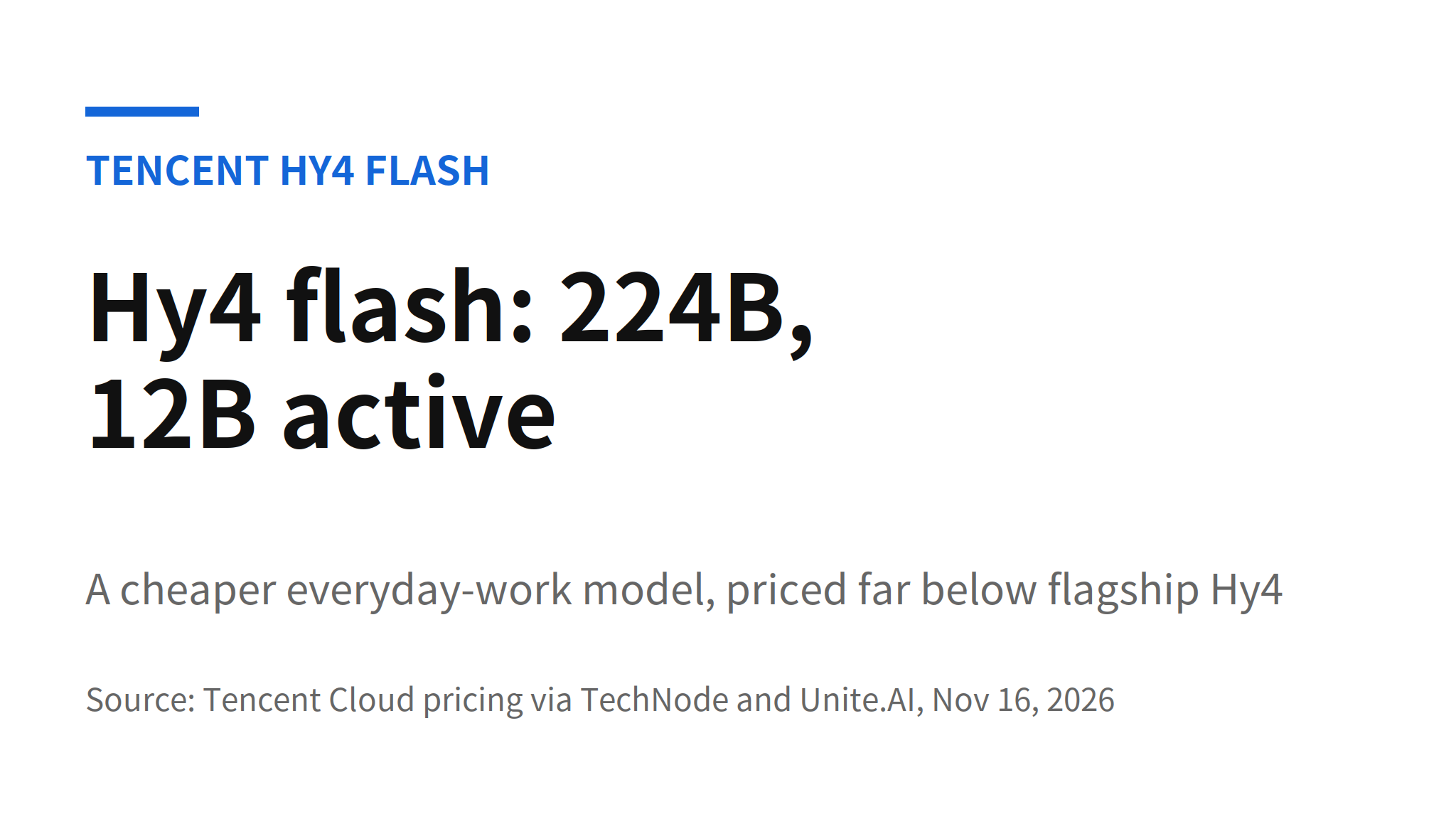
Tencent released Hy4 flash on November 16, 2026, the lightweight model it had only named when the flagship Hy4 launched on November 4. The specification is now concrete. Hy4 flash carries 224B total parameters, including 64B Engram parameters, and activates 12B parameters per token. Its API list price is $0.07 per million input tokens and $0.281 per million output tokens, with cache hit input at $0.003.
Those prices sit far below the flagship. Against Hy4 at $0.834 input, $2.501 output and $0.042 cached input, Flash input is about 92 percent lower and output about 89 percent lower. Tencent goes further on finished work rather than tokens. On its internal WorkIndex benchmark, it says the cost per task is one twentieth of Hy4, one thirteenth of Hy4 preview and one eighth of DeepSeek-V4.1-Flash-1017. That task level claim is the real pitch, and it is also the part with the weakest outside evidence, because WorkIndex is not a public benchmark.
Release Scope and Model Design
The Flash name can mislead if it is read as a small model. At 224B total parameters this is a large sparse system whose cost control comes from activating only 12B parameters for each token. The practical reading is that Tencent is selling routing efficiency, not a compact checkpoint. A request can draw on a wide pool of stored capacity while paying the compute bill of a much smaller active path, and the Engram share of 64B parameters is part of that total rather than an addition on top of it.
Capability coverage is broad for a cost tier. The model document cited in the issue lists image understanding, reasoning, structured output, function calling and caching. That list matters for agent work, where a cheap model that cannot call tools or return structured output saves money only by failing earlier. Hy4 flash is presented as a drop in worker for routine agent tasks, with the flagship kept for the work where errors are expensive.
Tencent draws that routing line explicitly. Deep search, document processing, slide creation, simple front end demos and computer use are assigned to Hy4 flash. Complex, long running software engineering stays on Hy4. In other words, the vendor itself does not claim Flash replaces the flagship. It claims most everyday tasks never needed the flagship in the first place, which is a different and more testable claim.
API Pricing Against the Flagship
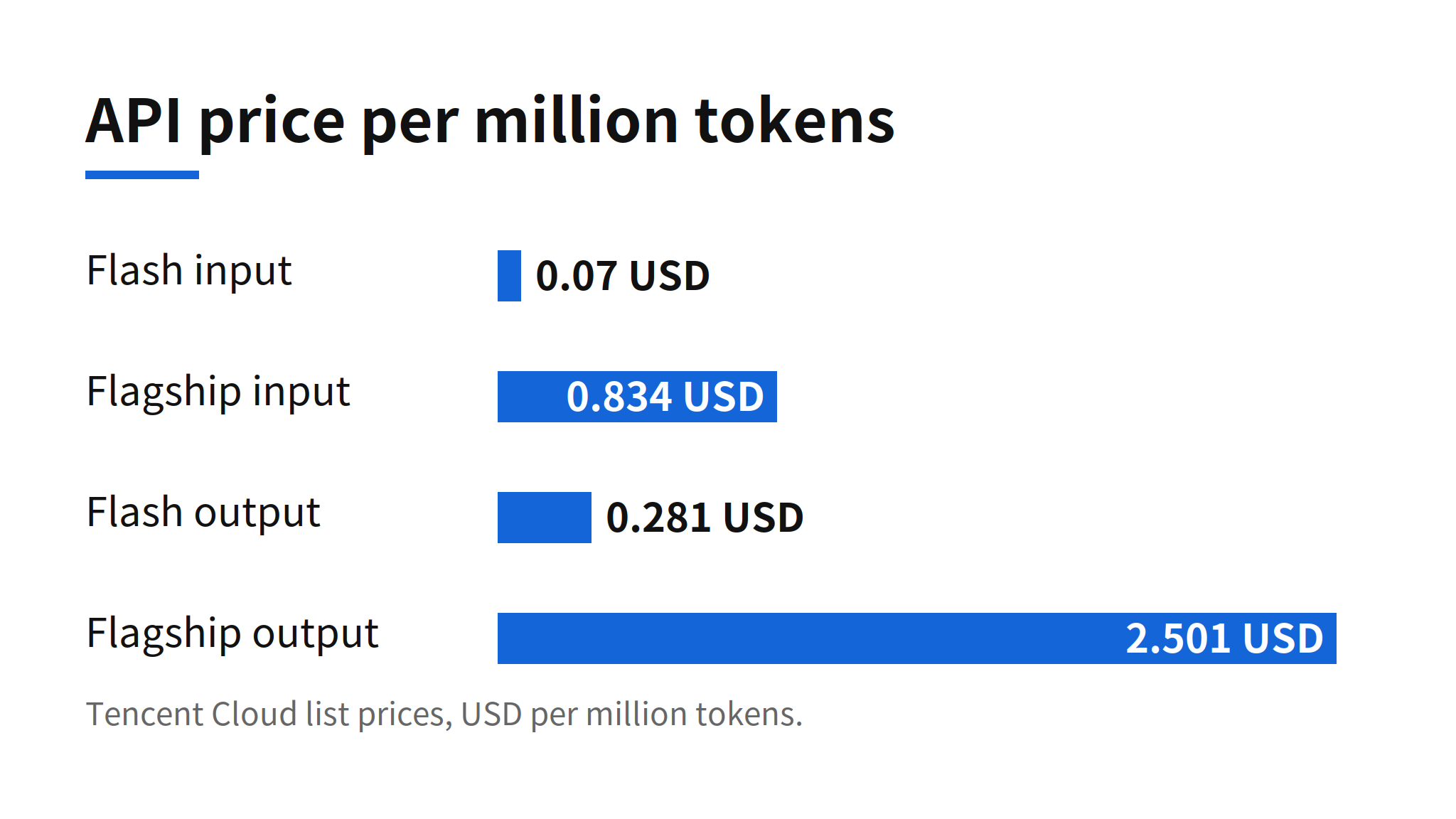
Token pricing and task pricing answer different questions. The token table above is verifiable from the Tencent Cloud price list cited by the issue, and it already shows a gap of roughly an order of magnitude. The task gap Tencent claims is larger, one twentieth rather than roughly one twelfth on output tokens, because task cost also depends on how many tokens a model spends finishing the job. Tencent attributes part of that to reinforcement learning that cut output tokens by 50 percent, a figure it reports without publishing the measurement setup in the sources used here.
Two launch offers soften the entry price further. WorkBuddy users can use Hy4 flash free until November 30, and the TokenHub API is offered at half the list price until noon Beijing time on the same day. Those are dated promotions, not the standing price, so any cost model built during the launch window needs the list price as its baseline. OpenRouter listing is described as planned, not live, in the sources.
Caching deserves attention in agent setups. At $0.003 per million cache hit input tokens, repeated system prompts and long shared context become close to free on the input side compared with the $0.07 uncached rate. For a harness that resends the same instructions on every step, the cache hit rate will move the real bill more than small differences in the headline input price. Tencent's own task cost comparisons were calculated at the maximum tier during peak hours, so a workload with strong caching can land below the comparison, and a workload with no cache reuse can land above it.
Access Paths and API Use
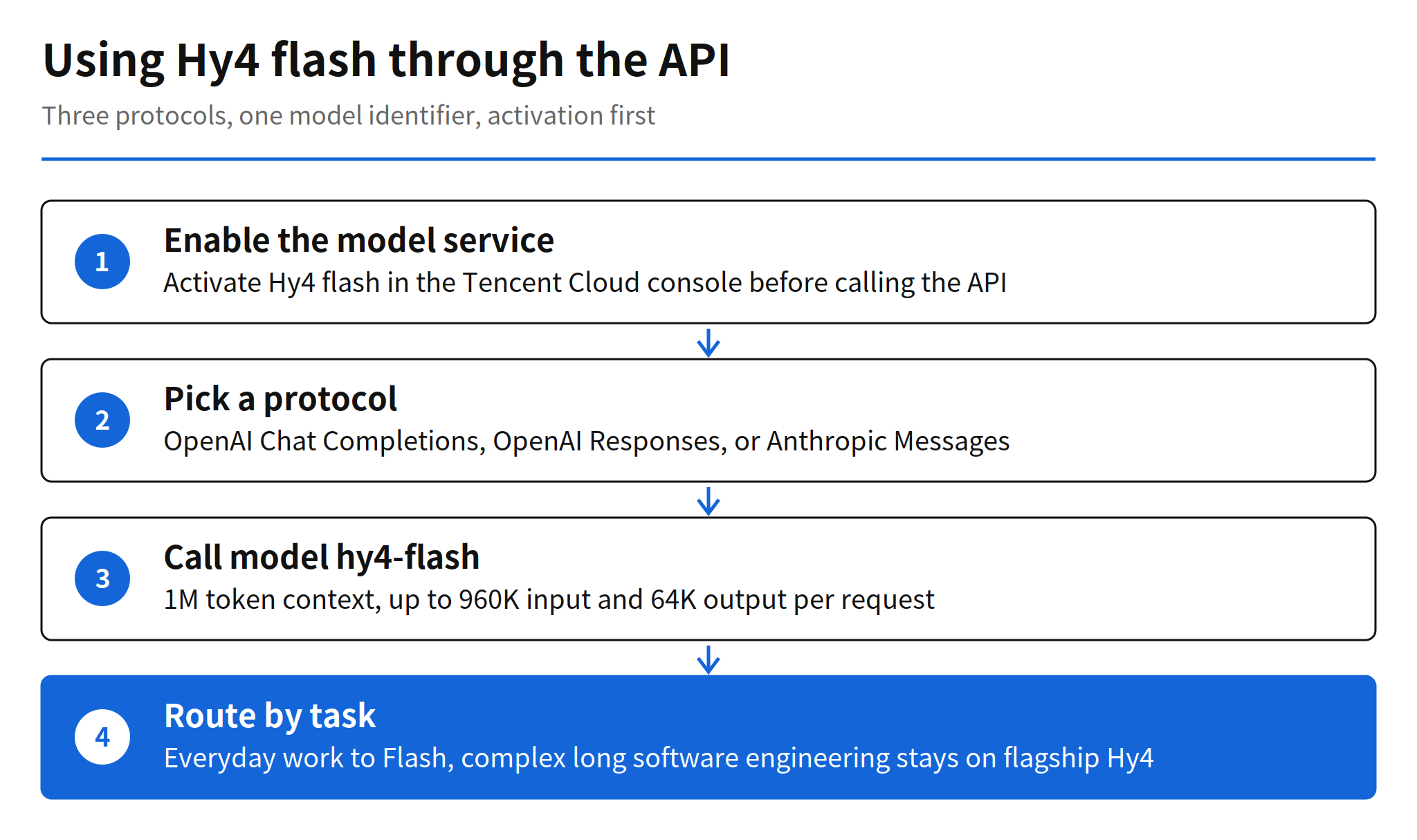
The hosted route starts with an activation step that is easy to miss. The API guide cited in the issue says the model service must be enabled in the Tencent Cloud console before calling. After that, the integration surface is deliberately familiar. Hy4 flash supports the OpenAI Chat Completions, OpenAI Responses and Anthropic Messages protocols under the single model identifier hy4-flash, so an existing agent harness built against either ecosystem can point at it without a new client shape.
Beyond the API, distribution runs through Tencent's own products: Tencent Cloud TokenHub, WorkBuddy, Yuanbao, WeCom, QQ, ima and Marvis. That spread signals where Tencent expects volume, inside office and messaging workflows rather than only in developer consoles. For outside developers, the API and the planned OpenRouter listing are the relevant doors, and only the API door is confirmed open today.
My read: the protocol choice is as important as the price. A cheap model that speaks both the OpenAI and Anthropic message formats can be A/B tested inside an existing harness in an afternoon. The barrier to testing Hy4 flash is low, which is exactly why the internal benchmark claims should be tested rather than debated.
Internal Test Evidence and Its Limits
The blind test behind the launch involved 85 WorkBuddy users, 259 tasks and 27 categories. Tencent says user satisfaction came close to Claude Haiku 5.5, while cost per task and completion time were the lowest among the compared models. Those are plausible numbers for a launch claim, and they are still a vendor run test on the vendor's own product users. Participants who already work inside WorkBuddy are not a neutral sample, and the task mix across the 27 categories is not published in the sources used here.
Several efficiency numbers carry the same caveat. Tencent says KV cache use fell to one twenty-fourth of Hy3 and one sixth of Hy4, that reinforcement learning halved output tokens, and that decoding speed exceeds 150 tokens per second. Each figure is attributed to Tencent in the issue, and the measurement conditions are unconfirmed. They should be read as claims to verify on a buyer's own workload, not as specifications in the same sense as context length or list price.
The WorkIndex result itself has one interesting detail. Tencent says Hy4 flash scored slightly above Hy4 preview on WorkIndex while costing one thirteenth as much per task. If that holds outside Tencent, the preview tier has no remaining reason to exist for work tasks. If it does not hold, the gap will show up first in long, ambiguous tasks, which is why a sensible trial set should include the messy tasks a team actually runs, not only short clean prompts.
Limits and Unconfirmed Points
- No independent measurement yet: WorkIndex is an internal Tencent benchmark and the blind test used 85 of its own WorkBuddy users. No third party remeasurement is available in the sources.
- Weights are not out: a weights release is announced as planned, but the date and license are unconfirmed. Today the model is hosted API and Tencent products only.
- Efficiency claims lack published conditions: the KV cache reductions, the 50 percent output token cut and decoding above 150 tokens per second are Tencent figures without detailed measurement conditions in the sources.
- Task cost depends on workload: the one twentieth figure uses maximum tier, peak hour pricing as its basis. Cache hit rate and task mix will move a real bill in either direction.
FAQ
What is Tencent Hy4 flash?
Hy4 flash is the lightweight version of Tencent's Hy4 flagship, released on November 16, 2026. It has 224B total parameters, including 64B Engram parameters, and activates 12B parameters per token. Tencent positions it for everyday work such as deep search, document processing, slide creation and simple front end demos.
How much does the Hy4 flash API cost?
List pricing is $0.07 per million input tokens, $0.281 per million output tokens and $0.003 per million cache hit input tokens. That is about 92 percent lower on input and about 89 percent lower on output than the flagship Hy4 at $0.834 and $2.501.
How do developers call Hy4 flash?
The API identifier is hy4-flash. Developers first activate the model service in the Tencent Cloud console, then call it through the OpenAI Chat Completions, OpenAI Responses or Anthropic Messages protocol. Context is 1M tokens, with up to 960,000 input tokens and 64,000 output tokens per request.
Is the claimed task cost saving independently verified?
No. The claim that a task costs one twentieth of the flagship Hy4 comes from WorkIndex, Tencent's internal work benchmark, and the blind test used 85 WorkBuddy users across 259 tasks in 27 categories. No independent remeasurement has been published yet.
Are Hy4 flash weights available?
Not yet. Tencent says a weights release is planned, but the date and license are unconfirmed. For now the model is available only through the hosted API and Tencent products such as WorkBuddy, Yuanbao, WeCom, QQ, ima and Marvis.
Related Reading
- Tencent Hy4 Release: 770B MoE With Vision and Computer Use, the flagship release that first named the Flash version this launch delivers