Tencent Hy4 Release: 770B MoE With Vision and Computer Use
Tencent Hunyuan released the final version of Hy4 on November 4, 2026. The model keeps the 770B parameter MoE (Mixture of Experts) scale of the August preview and adds two capabilities the line has never had: vision understanding and Computer Use. It is available through Tencent Cloud TokenHub, WorkBuddy, CodeBuddy, Yuanbao, ima, the enterprise WeChat assistant Dayuan, and OpenRouter.
The release also carries a clear limit. The weights are not public. Hugging Face still hosts only the August preview, and Tencent has given no date for the weight release, the vLLM and SGLang support, or the system card it says will accompany them. Hy4 is therefore an API product today, whatever the open source framing around it, and every performance figure in the announcement comes from Tencent's own testing.
That combination is what makes the release worth reading closely. A 770B class model that can read screens and operate software is a real capability step for the Hunyuan line, and Tencent published enough of its own numbers, including unflattering ones, to show where the model actually stands against Claude Opus 5.5 and GPT-6.1 Sol.
Release Scope and Model Design
Hy4 follows the Hy4 preview from August 2026, which had neither vision nor computer operation. Tencent says the final version scaled up both pretraining and post-training while keeping the same total parameter count. The cadence matches the pattern the company has run since rebuilding its infrastructure in February 2026: a preview first, then a final version roughly two months later.
The safety design is part of the release notes. Tencent says exploit development, reverse engineering, and penetration testing material was removed from the training data, while defensive security data was kept. Its internal biology lab risk assessment scored 30.4 out of 100, which the company places below its own high risk threshold. These are company statements about its own process; no outside audit of either claim has been published.
Vision and Computer Use in the Hunyuan Line
Vision is new to the family. Tencent describes detailed image processing, complex chart analysis, and mathematical reasoning over images. In the launch demo, the model located a roof component about 2 meters across inside a 2.8 billion pixel aerial photograph. A demo of that kind proves fine-grained retrieval on one chosen example, and it does not substitute for a public vision benchmark, which the announcement does not provide.
Computer Use is the larger change. Hy4 moves between a command line and graphical screens, and Tencent says it was trained on long tasks spanning professional software such as Blender and CAD tools and multiple applications in sequence. That is the workload profile of an agent runtime rather than a chat model: reading a screen, deciding the next action, and recovering across many steps. A model at this scale shipping with that training focus signals that Tencent wants Hunyuan inside its work products, WorkBuddy and CodeBuddy first, and not only inside a chat window.
Benchmark Results From Tencent's Own Charts
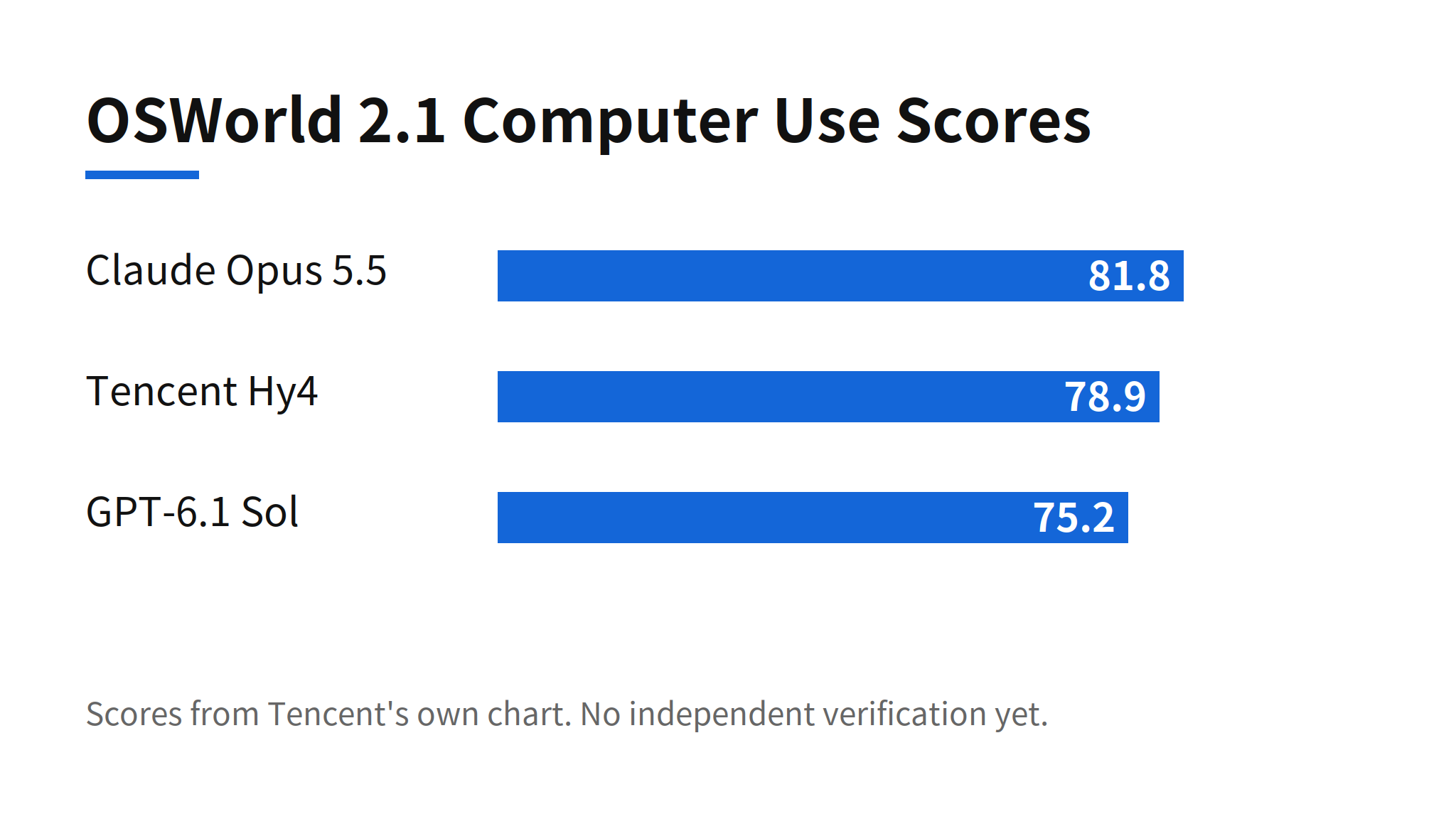
On OSWorld 2.1, Hy4 scored 78.9, close to Claude Opus 5.5 at 81.8 and ahead of GPT-6.1 Sol at 75.2. The coding and terminal numbers tell a different story. On Terminal-Bench 4.0, Hy4 scored 44.4 against 66.4 for Claude Opus 5.5 and 55.5 for GPT-6.1 Sol. On ProgramBench the gap is wider still, 30.0 against 56.5 for Claude. Computer operation is near the frontier by these charts; sustained coding work is not.
That split matters for the launch claim. Nikkei Asia reported that Tencent says Hy4 beats Claude Opus 5.5 in agent coding, yet the Terminal-Bench chart Tencent published alongside the claim shows a 22 point deficit. Which tasks the claim refers to is not identifiable from the announcement material, so the chart is the more usable evidence: it is specific, comparable, and unfavorable enough that the company had no reason to inflate it.
Two quality measures round out the picture. Tencent's internal testing puts the hallucination rate at 5.45%, down from 15.76% for the preview. In a finance field evaluation run with Tencent's financial technology group, 213 experts graded 579 real tasks and gave Hy4 an average of 3.04 out of 4, ahead of DeepSeek at 2.97 and Kimi K3.1 Pro and GLM 5.3 at 2.68 each. The expert panel design is more credible than a synthetic benchmark, but the evaluator is still the vendor, and Tencent itself concedes that a significant gap to the top closed models remains, naming frontier mathematics, long software projects, model development, and visual questions as the weak areas.
Pricing and Access Channels
Pricing is unchanged from the preview: 6 yuan per million input tokens, 18 yuan per million output tokens, and 0.3 yuan for cache-hit input. Tencent Cloud TokenHub applies a 50% discount until December 31, and WorkBuddy and CodeBuddy carry free usage quotas from November 4 to November 15. OpenRouter lists the model at $0.42 per million input tokens and $1.25 per million output tokens.
At those prices, Hy4 undercuts frontier closed models by a wide margin, which fits the role the benchmarks suggest: high volume screen and document work where 78.9 on OSWorld is close enough, rather than top end coding where the gap is documented. One specification stays unconfirmed. The context length appears as roughly 1 million tokens in the OpenRouter listing, but Tencent's own announcement material does not state it directly.
The Open-Weight Gap
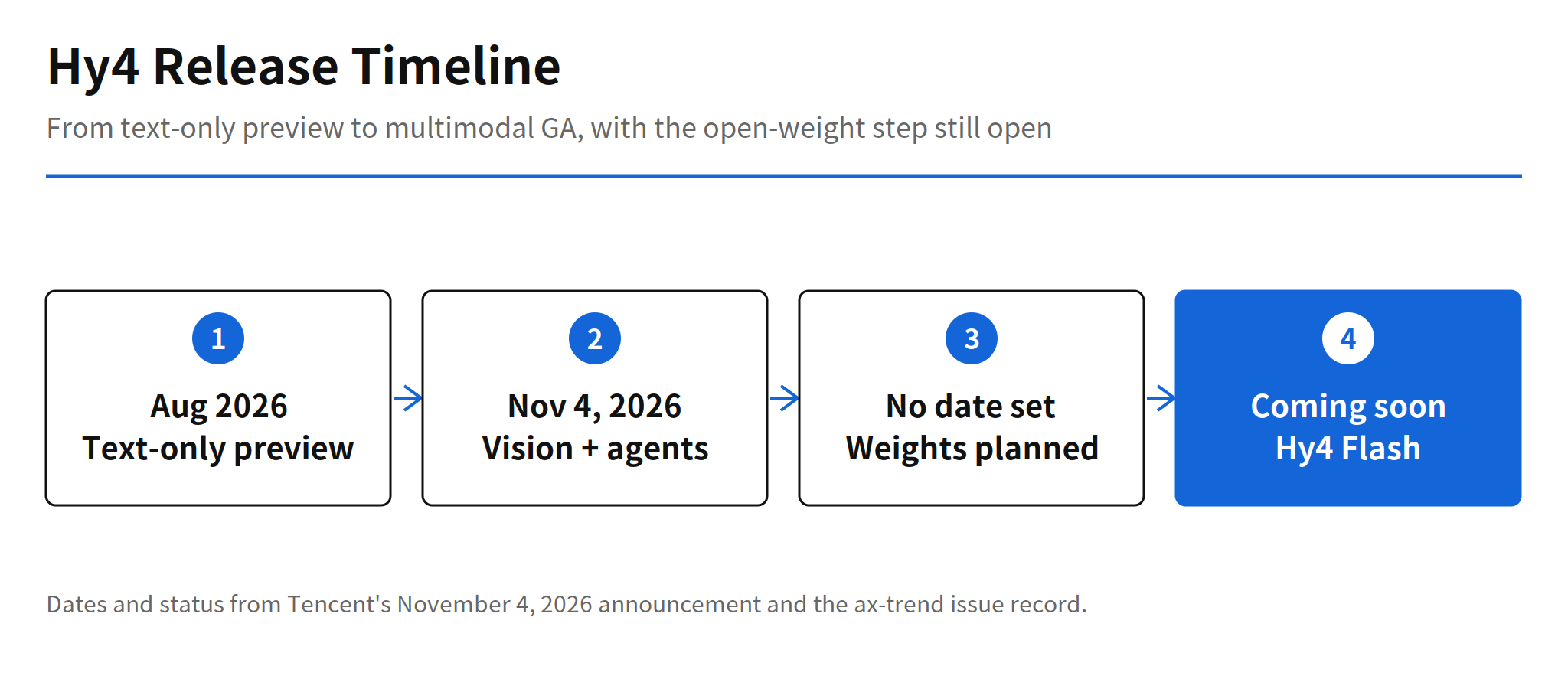
The distance between the framing and the artifact is the main open issue. Tencent describes Hy4 as joining the top tier of open source models, but the final weights are unreleased, the license for the final version is undecided, and even the preview's Apache 2.0 terms cannot be assumed to carry over. Until the weights ship, self-hosting, fine-tuning, and independent benchmarking are all impossible, and the comparison with genuinely open rivals such as DeepSeek and Kimi stays one-sided: their numbers can be checked, and Hy4's cannot.
Two further claims sit in the same unverified category. Tencent says the model worked with Peking University mathematicians to find a counterexample to an existing conjecture and verify the proof in Lean, which has not been independently confirmed. The smaller Hy4 Flash is described as coming soon, with no specifications and no date. Neither should factor into an adoption decision yet.
What to Watch Next
- Weight release: the date, the license, and whether vLLM and SGLang support and the system card ship with it as promised.
- Independent benchmarks: any third party run of Terminal-Bench, ProgramBench, or OSWorld against the released artifact.
- Hy4 Flash: specifications and pricing for the smaller variant, which would show where Tencent aims the line on cost.
- Context length: direct confirmation of the roughly 1 million token figure currently visible only in the OpenRouter listing.
The practical reading is narrow. Hy4 is a credible, cheap, multimodal agent model from a vendor that published its own weak spots, and it is not yet the open model its framing suggests. Teams evaluating it today are evaluating an API and a set of vendor charts. The decision changes when the weights land.
Related Reading
Hy4 lands in the middle of a Chinese open model race that this site tracks release by release, most recently Kimi K3.1 Pro and its open weights, the rival whose finance evaluation score Hy4 is now compared against. The previous Hunyuan generation is covered in the Hy3 release issue.
FAQ
Is Tencent Hy4 open source?
Not yet in practice. The weights have not been released, and Hugging Face still hosts only the August preview under Apache 2.0. Tencent says vLLM and SGLang support and a system card will come with the weights, but it has given no date and the license for the final version is undecided.
How much does Hy4 cost to use?
List pricing matches the preview: 6 yuan per million input tokens, 18 yuan per million output tokens, and 0.3 yuan for cache-hit input. OpenRouter lists $0.42 per million input tokens and $1.25 per million output tokens, and Tencent Cloud TokenHub applies a 50% discount until December 31.
How does Hy4 score against Claude Opus 5.5 on computer use?
On OSWorld 2.1, Hy4 scored 78.9 against 81.8 for Claude Opus 5.5 and 75.2 for GPT-6.1 Sol. On Terminal-Bench 4.0 and ProgramBench the gap is much wider, at 44.4 against 66.4 and 30.0 against 56.5. All of these figures come from Tencent's own charts.
When will the Hy4 weights and Hy4 Flash arrive?
No date has been announced for either. Tencent says the weights will ship with vLLM and SGLang support and a system card, and describes the smaller Hy4 Flash as coming soon, without specifications or a schedule.