NVIDIA Vera Rubin MLPerf Training: 2x Per GPU Results
NVIDIA's next platform has its first public measurement. In MLPerf Training v6.1, published on November 16, 2026, the Vera Rubin NVL72 made its benchmark debut and recorded the fastest time to train on six of the seven benchmarks. Against an optimized GB300 NVL72 baseline, the per GPU gain reached 2x, and NVIDIA platforms were the only ones to submit results across the full suite.
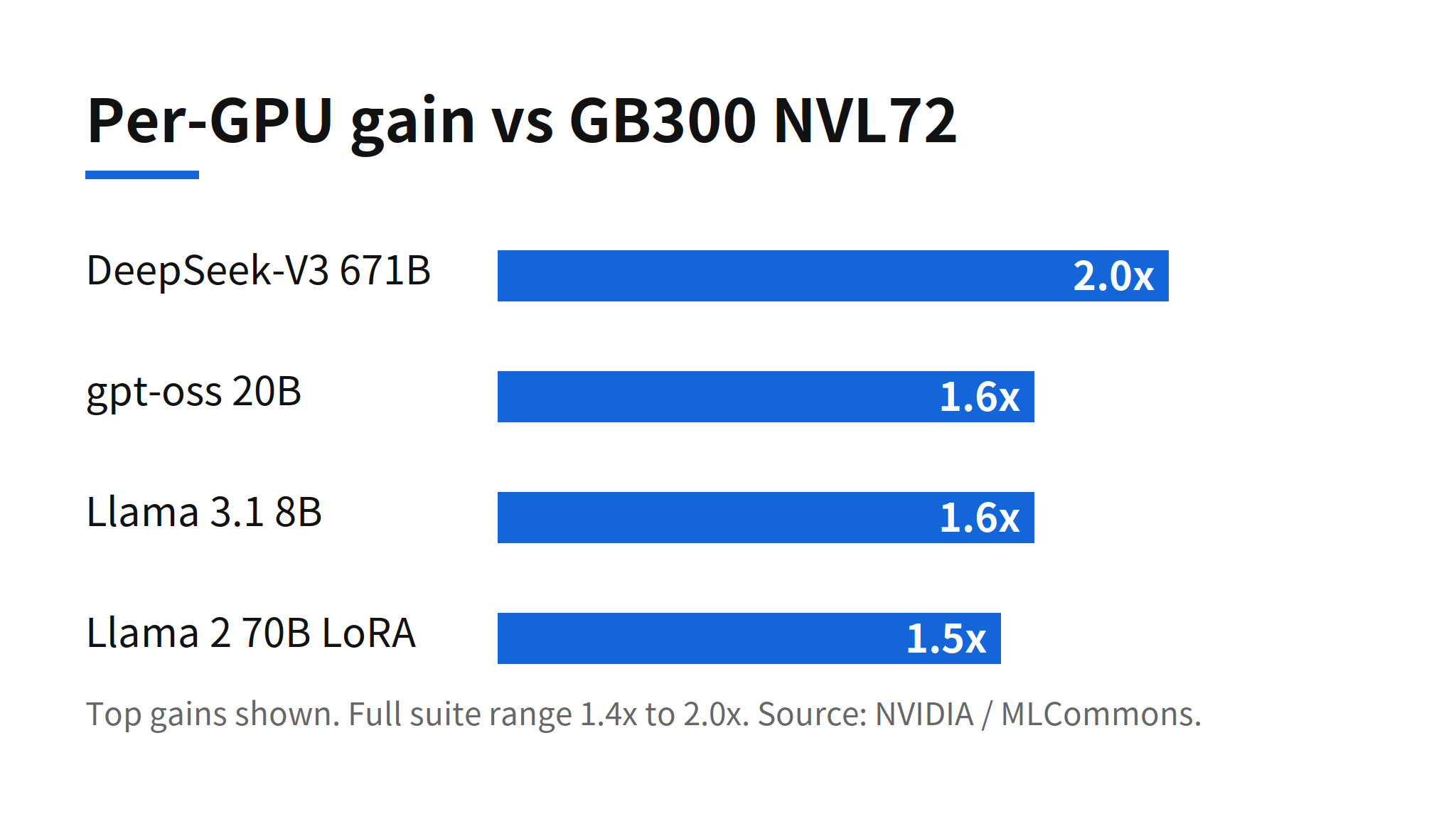
The headline number comes with a useful shape. The largest gain lands on the largest and most communication heavy model in the suite, while the rest of the benchmarks cluster between 1.4x and 1.6x. That pattern says the generational step is real but uneven, and it is strongest exactly where expert parallel traffic usually eats the speedup.
The full v6.1 result table
MLPerf Training measures time to train a model to a fixed quality target, and v6.1 is the first round to include Vera Rubin. Read per benchmark, at the same GPU count, the comparison against GB300 NVL72 looks like this:
| Benchmark | Model type | Vera Rubin per GPU gain |
|---|---|---|
| DeepSeek-V3 671B | Mixture of Experts | 2.0x |
| gpt-oss 20B | Mixture of Experts | 1.6x |
| Llama 3.1 8B | Dense | 1.6x |
| Llama 2 70B LoRA | Dense | 1.5x |
| FLUX.1 | Diffusion | 1.5x |
| Qwen 3.5 397B GRPO | Mixture of Experts, RL | 1.4x |
| DLRMv4 | Recommender | 1.4x |
Breadth is the second result hiding inside the first. Submitting on all seven benchmarks in a debut round, across language models, image generation, recommendation and reinforcement learning, is a software maturity claim as much as a hardware one. A new platform that only wins the workload it was tuned for would be easier to discount. NVIDIA also notes that 80 percent of closed division submissions ran on NVIDIA platforms across 20 partner organizations, so the numbers are not a single laboratory configuration.
DeepSeek-V3 and the networking result underneath
DeepSeek-V3 671B is a token dropless Mixture of Experts model, and expert parallelism turns every iteration into bursts of all to all communication. That is why the 2x gain matters more than the same gain would on a dense model: the fabric, not just the arithmetic, is being measured. At 1,024 GPUs across 16 racks, Vera Rubin NVL72 finished in 4.14 minutes against 8.03 minutes for GB300 NVL72 at the identical scale. Halving time to train on a model of this class roughly doubles how many experiments a team can run in a quarter.
The hardware explanation NVIDIA gives is specific. Inside the rack, a copper NVLink 6 spine connects 72 GPUs and 36 CPUs at 3.6 TB/s per GPU and 260 TB/s per rack. Beyond the rack, ConnectX-9 SuperNICs run over Quantum-X800 InfiniBand or Spectrum-X Ethernet, with adaptive routing and congestion control aimed at bursty MoE traffic. The measured consequence is scaling: on DeepSeek-V3, Vera Rubin held above 97 percent scaling efficiency going from 256 to 1,024 GPUs.
The seventh benchmark needs a careful read. The fastest absolute DeepSeek-V3 time of the round, 1.38 minutes, belongs to GB300 NVL72 at 10,240 GPUs, a job spread across 160 racks. Vera Rubin won the per GPU comparison at matched scale; the older platform still holds the scale record. NVIDIA presents the two results as complementary, current scale today and per GPU efficiency next, and the table supports that framing rather than a clean sweep.
Post-training enters the suite
v6.1 also adds the first reinforcement learning post-training benchmark in MLPerf Training history, Qwen 3.5 397B GRPO. Vera Rubin NVL72 led it at 10.44 minutes on 1,024 GPUs, against 13.78 minutes for GB300 NVL72. The workload is structurally different from pretraining: rollouts are generated, scored and folded back into weight updates, which forces constant weight movement between inference and training engines and leans hard on CPUs to run the simulated environments. NVIDIA says a single Vera CPU rack sustains more than 22,500 concurrent RL environments across 256 CPUs.
Two details in this section are easy to miss. Vera Rubin submitted the GRPO benchmark on two inference backends, NeMo RL with TensorRT-LLM at 10.44 minutes and with vLLM at 10.94 minutes, which suggests the software path is not a single fragile route. And the benchmark's existence changes what a platform purchase is evaluated on. Pretraining throughput used to dominate the comparison; a lab buying for agentic model development now has a public, reviewed number for the post-training loop as well.
Verified results and the unverified reruns
NVIDIA's post mixes two classes of numbers, and keeping them apart is the main reading skill this round requires. The table above is the MLCommons reviewed, closed division result set. Separately, NVIDIA reran three benchmarks on the same hardware with a newer software stack and published faster times: Llama 3.1 8B at 6.140 minutes, gpt-oss 20B at 8.080 minutes and DLRMv4 at 1.628 minutes on the Vera Rubin side. The company labels these unverified, because MLCommons has not reviewed them and the methodology may differ from the verified runs.
The reruns still carry information. They show the submitted scores are not the platform's ceiling, and that software work after submission keeps moving time to train on fixed hardware. What they cannot do is extend the verified comparison. Any claim of the form Vera Rubin is 2.4x faster, which NVIDIA's own figure caption uses against the GB300 MLPerf submission, is built from an unverified rerun on one side of the comparison and should be quoted with that label attached.
Limits and unconfirmed points
Several practical questions stay open. NVIDIA says Vera Rubin systems are generally available through cloud infrastructure partners, and CoreWeave published multi rack Vera Rubin results in the same round, but the announcement gives no pricing for the systems, and per GPU benchmark gains do not translate directly into per dollar gains until cloud pricing is known. Cost per experiment, the number a lab actually budgets on, remains unconfirmed.
There is also the standard benchmark caveat, sharpened by who is reporting. Every figure here comes from NVIDIA's own technical blog summarizing MLCommons results. The underlying entries are public and reviewed, which makes this stronger than a vendor internal test, but the selection of comparisons, the optimized GB300 baseline and the rerun framing are NVIDIA's choices. Whether the DeepSeek-V3 advantage holds on a lab's own mixture, sequence lengths and checkpointing overhead is a separate measurement that no MLPerf round can settle.
Related articles
- NVIDIA Vera CPU Agent Performance: 1.6x Throughput
- NVIDIA GR00T 2 Release: Performance, Data and How It Works
- Google TPU 8tx and 8i Max Release: Confidential, Big Context
FAQ
How did Vera Rubin NVL72 do in MLPerf Training v6.1?
In its debut round, Vera Rubin NVL72 recorded the fastest time to train on six of the seven benchmarks and delivered up to 2x more performance per GPU than an optimized GB300 NVL72 baseline. NVIDIA was also the only platform to submit results on all seven benchmarks.
What was the DeepSeek-V3 671B result?
At 1,024 GPUs, Vera Rubin NVL72 trained DeepSeek-V3 671B in 4.14 minutes, against 8.03 minutes for GB300 NVL72 at the same scale. The fastest absolute time of the round, 1.38 minutes, came from a 10,240 GPU GB300 NVL72 cluster.
What is new about the Qwen 3.5 397B GRPO benchmark?
MLPerf Training v6.1 adds the suite's first reinforcement learning post-training benchmark, Qwen 3.5 397B GRPO. Vera Rubin NVL72 led it at 10.44 minutes on 1,024 GPUs, compared with 13.78 minutes for GB300 NVL72.
Are all the numbers in NVIDIA's post MLCommons verified?
No. The MLPerf table is the verified closed division result set. NVIDIA also published reruns on a newer software stack that cut some times further, and the company labels those results unverified because MLCommons has not reviewed them.