kosem: Coding Agents Get microVMs, Short-Lived Credentials
kosem, introduced on November 16, 2026, gives each coding agent three things of its own: a microVM environment with its own kernel, an identity that starts with no access at all, and credentials that are minted per command and expire with the work. The product is in private beta with a waitlist. Pricing and a general availability date have not been disclosed, and the launch post contains no performance benchmarks or independent verification, so every capability claim below is kosem's own design description.
The framing is a mainframe analogy. kosem argues that today's coding agents relive the mainframe era in reverse: the developer's laptop is the shared machine, the agents are the users at its terminals, and all of them run as the developer, sharing one operating system, one identity and one set of keys. The proposed fix is to draw the boundary in two places, around the machine and at its edge, rather than adding more approval prompts on top of a shared laptop.
The Problem kosem Names on the Laptop
The security argument starts from Simon Willison's lethal trifecta. An agent needs private code and secrets, it reads text from strangers in issues, docs and dependencies, and it needs a way to push and call out. kosem notes that the work itself needs all three, so the combination cannot be designed away, and any text the agent reads can carry a prompt injection.
On a laptop, kosem argues, only the first defense layer really exists. The model is trained to follow the developer rather than what it reads, and the post cites Anthropic's position that prompt injection is far from a solved problem. Least privilege fails structurally, because the agent runs as the developer, so one successful injection reaches that person's GitHub and cloud credentials, SSH keys and every repository on disk. Audit fails for the same reason: actions are logged as the developer, and the transcript sits in the home directory, where the agent itself can rewrite it.
The patches layered on top mostly add friction, in kosem's account. Approval prompts are not a security boundary and lead to what Anthropic calls approval fatigue. OS sandboxes share the laptop kernel, and kosem points to vendor documentation warning against relying on them to stop a malicious command, as well as sandbox breakage around tools such as Docker. The practical result the post describes is developers running with permissions effectively skipped, which it treats as a symptom of the setup rather than carelessness.
The second set of problems is resource contention. Agents on one laptop share ports, the Docker daemon, databases and often the working tree, so one agent can switch branches under another or reset the database another is testing against. They compete for the same cores, so one ten-minute build stalls the other agents and the editor. They stop when the laptop stops, which turns long tasks into supervised terminal sessions. And their work belongs to one developer alone, so a teammate cannot easily see how a fix was verified or pick the task up where it stopped.
Environments That Resize and Persist
Each kosem agent runs in a microVM with its own kernel, adjustable CPU and memory, a persistent disk, and a Docker image from the team's own registry, so the environment starts with the team's languages, databases and tools already present. The agent is root inside its environment and runs Docker there, and nothing of the developer's is present, which is why kosem says it does not need to ask before each command.
The agent picks its own size and changes it as the workload changes, within limits the team sets. In the worked example in the launch post, an agent starts Small at 1 vCPU to read code, moves to Large at 4 vCPUs and 16 GiB for an integration build that runs 212 tests, then drops back to Small when the build is done, all on the same disk. When the agent goes idle, its environment stops and only the disk remains, in the example a 20 GiB disk kept for 7 days, so the task resumes where it left off and keeps going with the laptop lid closed.
That resizing detail matters more than it first looks. A fixed cloud sandbox charges for its peak size or forces a restart to change it. kosem's claim is that the size follows the step, small for reading and large for building, so less capacity is wasted. The post gives no latency numbers for a resize or a resume, and no cost comparison against a fixed-size sandbox, so the efficiency claim is plausible from the design but unmeasured in the source.
Identity and Access Per Agent
Every agent is a principal of its own, shown in the post in the form agent:ags_..., and it starts with no access. The team grants secrets to the agent, and nobody can grant more than they themselves hold, because granting a secret to an agent requires access to that secret. When the task ends, the agent's access ends with it.
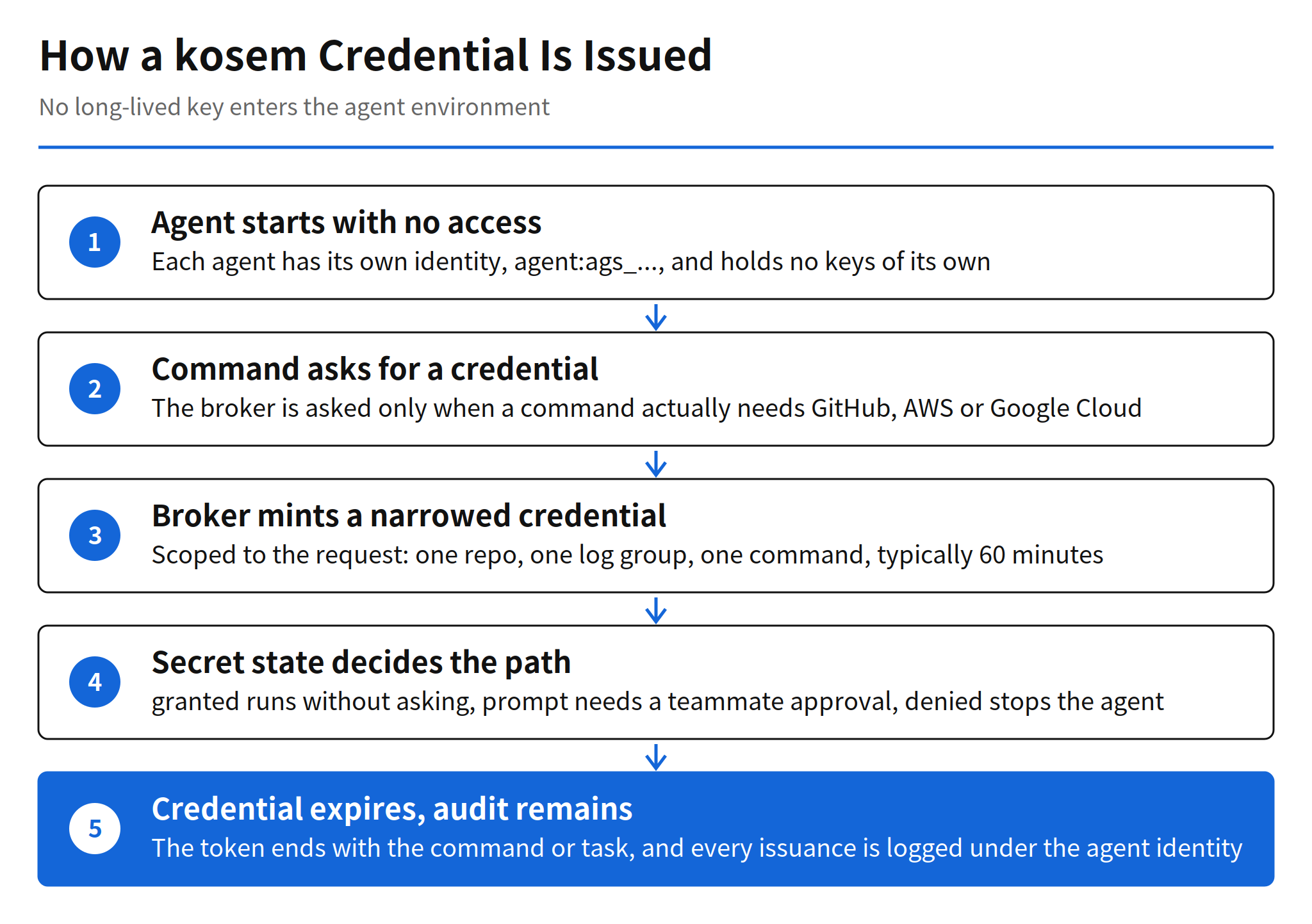
For GitHub, AWS and Google Cloud, a credential broker mints a short-lived credential when a command asks for one, narrowed to that request. The worked example shows the pattern three times in one task: a GitHub token for one repository with read access for 60 minutes, granted without asking; an AWS credential for one log group and one command, issued only after a teammate approved it; and a GitHub write token for contents and pull requests, again for 60 minutes, used to open the pull request. Each credential expired as the command or task ended, and no long-lived key entered the environment.
Each secret carries one of three states. granted secrets are used without asking. prompt secrets need a teammate's approval, scoped to the command in the example rather than to the whole session. denied secrets are a hard stop: the agent is expected to say it is blocked instead of working around the denial. That three-state model is the direct replacement for approval fatigue, since routine access stops generating prompts and only the prompt tier interrupts a person, with a scope attached when it does.
Static secrets are the stated exception. kosem acknowledges that some credentials cannot be minted short-lived, and those remain a gap in the model rather than a solved case. The post does not say how static secrets are stored, rotated or scoped inside an environment, and that detail is promised for a follow-up post on access.
Models Through One Gateway
Agents call models through a single gateway covering every model the team has turned on, billed on the team's own accounts at Anthropic, OpenAI and Google Gemini, or on a compatible server the team runs. Provider keys never reach an agent or a person, which removes a second class of long-lived key from the environment alongside the cloud credentials.
The organization decides which projects can use which models and sets spend limits for itself and for each project. Usage is broken down by project, model and agent. The worked example shows an agent cost of $3.18 against a project total of $412 of a $2,000 limit. Those figures illustrate the accounting view in the launch post; they are not pricing, and kosem has published no per-seat or per-environment price to compare them against.
People, Projects and an Audit Trail the Agent Cannot Edit
People keep permissions of their own, separate from the agents. One organization holds the people and the projects, with roles that can be set at the level of the whole organization, one project, or a single resource such as one agent or one secret, for a person or a group. Roles split who can view, start and steer a project's agents, who can use which secrets, and who can grant them, and billing, members, policies and the audit log have roles of their own. Agents are shared with their project by default, so a teammate can read a run, answer the agent's question or take the task over, and an agent can also be made private.
The audit design is the part that closes the loop with identity. kosem keeps the transcript, every message, command and result, in kosem itself, where the team can read it and the agent cannot rewrite it. Every action is logged, including creating an agent, granting a secret, changing a role and reading a transcript. Every credential issuance is recorded under the agent's name and joined to the provider's own logs through GitHub's hashed_token or AWS CloudTrail's accessKeyId, and in AWS the agent's name is each session's source identity, so CloudTrail shows which agent made each call.
That join is what makes the identity model more than a label. A per-agent name only helps after an incident if the cloud provider's log and the platform's log can be matched on a shared identifier. kosem's design provides that identifier on both sides, which is the difference between knowing an agent was involved and being able to reconstruct exactly which credential it used for which call.
Limits and Unconfirmed Points
- Private beta only: kosem opened a waitlist on November 16, 2026. Pricing, plan structure and a general availability date have not been disclosed.
- No performance evidence in the source: the launch post publishes no benchmarks, resize or resume latency, or independent verification. The security and efficiency effects are design claims at this stage.
- Static secrets remain an exception: credentials that cannot be minted short-lived fall outside the per-command model, and their handling is not detailed in this post.
- Implementation details are deferred: kosem says environments, access and audit will each get a dedicated follow-up post, so the microVM implementation, broker internals and audit storage are not specified yet.
- Comparison is structural, not measured: the contrast with laptop agents and OS sandboxes in this article follows kosem's own argument and the vendor warnings it cites. No head-to-head test against a specific competing sandbox product appears in the source.
FAQ
What is kosem?
kosem is a platform, introduced on November 16, 2026 and now in private beta, that gives each coding agent an environment of its own, an identity of its own, and only the access its team grants it, instead of the developer laptop and keys.
How do kosem credentials work?
For GitHub, AWS and Google Cloud, kosem mints short-lived credentials when a command asks for them, narrowed to that request, so no long-lived key enters the agent environment. Static secrets are the stated exception for services that cannot mint short-lived tokens yet.
What do granted, prompt and denied mean in kosem?
The team marks each secret granted, prompt or denied. The agent uses granted secrets without asking, asks a teammate before using a prompt secret, and reports a block instead of working around a denied secret.
What does kosem cost?
Pricing has not been disclosed. kosem is in private beta and teams join through a waitlist, and the launch post gives no price or general availability date. The worked example in the post shows model usage broken down by agent and project, not a price list.
Can a kosem agent keep working when the laptop is closed?
Yes, by design. When an agent goes idle its environment stops but its disk persists, so it resumes where it left off, and the work continues with the developer laptop lid closed because the agent no longer runs on that laptop.
Related Reading
- Claude Code v2.1.325: Sandbox Permissions and Security, the permission and sandbox side of the same agent access problem, handled inside a local tool instead of a separate environment
- Claude Cage Release: Isolated VM, 3,181 Stars in 11 Days, an earlier take on isolating an agent in its own virtual machine
- Self-Hosted Claude Managed Agents: Pricing and How It Works, managed agent hosting with a different boundary between the platform and the team