Self-Hosted Claude Managed Agents: Pricing and How It Works
Anthropic opened self-hosted Claude Managed Agents in private beta on November 12, 2026. Every part of the service now runs inside the customer's own cloud or on-premise environment, including the agent harness, sandboxes, credentials and session history. The customer operates the server, its database and the workers, chooses where model requests go, and still builds agents with the same core APIs as the hosted service. Access is not self-serve: teams request it through their Anthropic account team.
The important boundary is what does not move. The Claude model itself is not self-hosted. Prompts still leave for Anthropic directly, Amazon Bedrock, Google's Agent Platform, Microsoft Foundry, or a gateway the customer runs, and completions come back. What changes is who controls the control plane around the model: the code the agent touches, the secrets it uses, and the record of everything it did.
What Anthropic Announced on November 12
Managed Agents is Anthropic's suite of composable APIs for building and deploying autonomous agents. It supplies the harness that runs the agent loop, the sandboxes where code executes, credential handling, and session history, so a team does not have to assemble those parts before an agent can do long-running work in production.
The self-hosted release moves that whole stack. In Anthropic's words, every part of the service runs in your own cloud or on-premise. That is a bigger step than it may sound, because the earlier self-hosting option covered only the sandbox. A team could keep the agent's code execution local while Anthropic still ran the harness, the credential handling and the session record. Teams that wanted the entire service inside their perimeter had one remaining option, which was to build the platform themselves.
The Path From Hosted to Fully Self-Hosted
The sequence explains the demand. Managed Agents launched first as a hosted service, with Anthropic operating the infrastructure. Self-hosted sandboxes followed for teams whose code had to stay in their own environment. This private beta is the third step, moving the server and the session history as well.
Anthropic ties the timing to the work agents now do unattended. The announcement names fixing broken builds, testing releases, triaging alerts and working through a bug backlog. These are jobs inside a company's code and internal systems, running without a person watching each step. The more access an unattended agent needs, the harder the security review becomes when the harness, the credentials and the activity record sit outside the company's perimeter. Self-hosting is aimed at that review, not at model performance.
What You Operate in the Self-Hosted Setup
The operating responsibility is concrete. The customer runs three things: the Managed Agents server, its database, and the workers where agents run their shell and file tools. Reporting on the launch identifies the database as PostgreSQL. Session history lives in that database, under the customer's control.
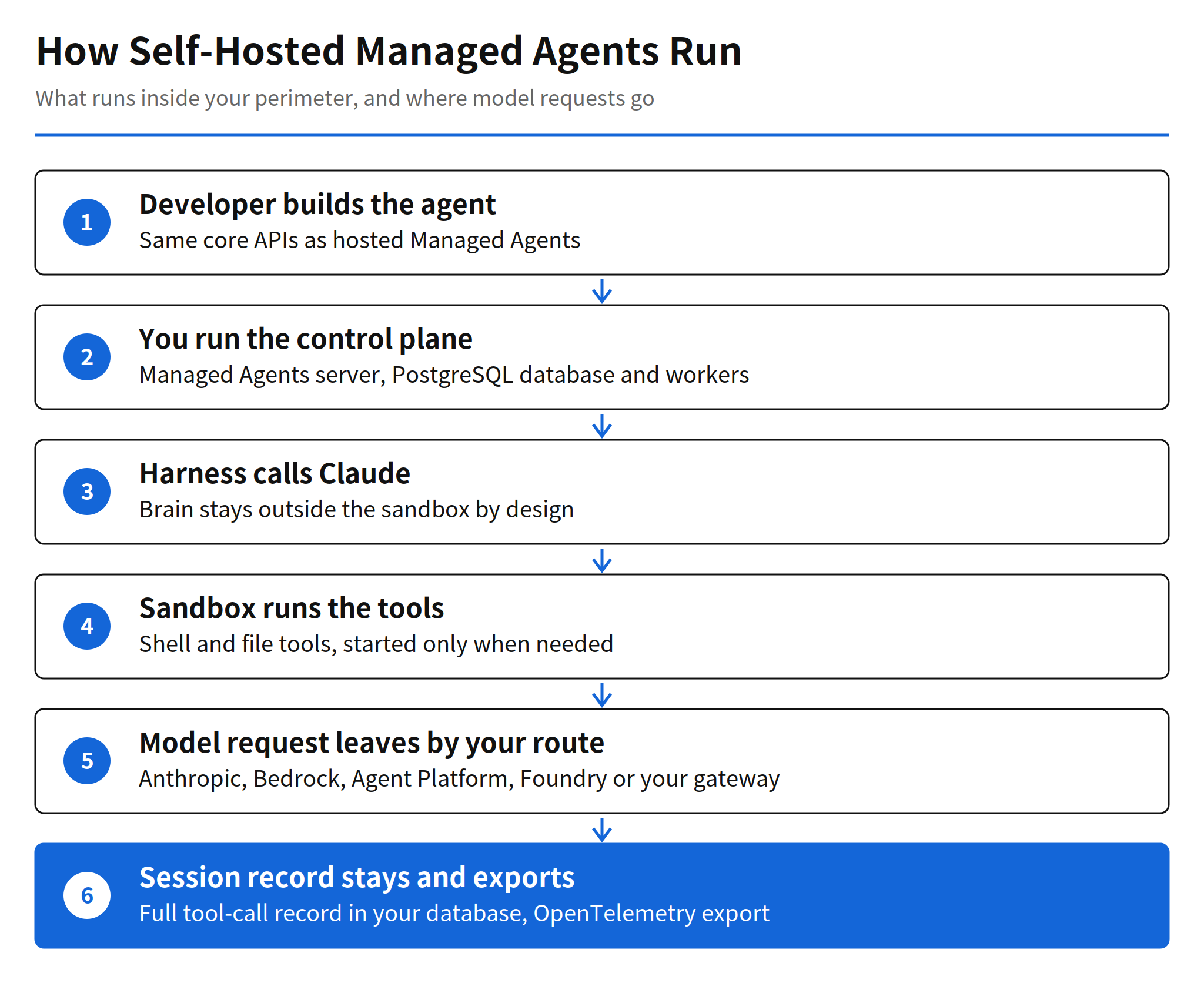
Model routing stays a choice rather than a fixed dependency. Requests can go to Anthropic directly, to a cloud provider such as Amazon Bedrock, Google's Agent Platform or Microsoft Foundry, or to the customer's own gateway. For organizations with a zero data retention (ZDR) agreement with Anthropic, that agreement applies to requests sent to Claude in the same way as any other Messages API call.
For developers, the surface does not change. Agents are built with the same core APIs as hosted Managed Agents, so the self-hosted decision is an infrastructure and governance decision, not a rewrite. That portability also cuts the other way: a team can start hosted, then move the control plane inward when an agent's access outgrows what its security review will accept on outside infrastructure.
Security Design for Unattended Agents
Anthropic frames the design around a simple premise: when an agent runs unattended inside your code and systems, you cannot rely on a person checking every step, so the limits have to be built into the system itself. Four principles carry that premise, and they apply across the hosted, sandbox-only and fully self-hosted setups.
Separation of the Brain and the Hands
The harness, which Anthropic calls the brain, calls Claude. The sandbox, the hands, is where the agent's code runs. They are kept separate by design: the agent loop, session history and vault secrets stay outside the sandbox. A practical consequence is that an agent does not depend on one sandbox surviving its whole run. Sandboxes start only when a tool needs them, and the session record lives outside the sandbox as an event log.
Credentials Kept Out of the Sandbox
Vaults keep credentials out of the sandbox. For MCP tools and supported API calls, a proxy outside the sandbox adds the credential to the request, so the agent's code never holds the secret it uses. In the self-hosted setup, customers can also store credentials in their own secrets manager. The scope limit in that sentence matters: the proxy guarantee covers MCP tools and supported API calls, so any other service an agent reaches is worth checking before the agent goes live.
Network Access Limited by Allowlist
Each environment can be limited to a list of allowed hosts, and requests to any other host are blocked. Anthropic's example is an agent that fixes broken builds, where the list might be just the git host and the package registry. When the customer hosts the sandbox, the same limits are set in the customer's own firewall, which makes the allowlist the customer's configuration to get right.
A Full Record of Every Session
Managed Agents keeps a record of every step an agent took, including the tool calls it made and what came back. The full record exports over OpenTelemetry, so a security team can send it to the monitoring tools it already runs and review agent activity alongside the rest of its systems. In the self-hosted setup that record never has to leave first: it is stored in the customer's own database.
My read: the product being sold here is a security review outcome. The model, the APIs and the agent capabilities are the same as the hosted service. What a team gains is a defensible answer to where code, credentials and the audit record live, and that answer is what has kept unattended agents out of regulated and security-sensitive environments.
Pricing and Access
There is no published price to quote. Anthropic has not released pricing for self-hosted Managed Agents, and no general availability date has been announced. Access runs through the Anthropic account team, and the detailed eligibility requirements for the private beta are unconfirmed. Any budget discussion today therefore has two parts that can be estimated and one that cannot: the infrastructure and operations cost of running the server, database and workers is yours to model, the model spend follows the route you choose, and the service price itself stays unknown until Anthropic publishes it or quotes it to your account team.
Limits and Open Questions
- The model still runs outside: self-hosting covers the harness, sandboxes, credentials and session history. Inference happens at the provider or gateway you select, so prompts and completions still cross your perimeter.
- Operations move to you: the server, the database and the firewall rules are now the customer's to run, patch and configure correctly. A misconfigured allowlist is your incident, not the vendor's.
- Credential coverage has a stated scope: the out-of-sandbox proxy guarantee applies to MCP tools and supported API calls. Other integrations need their own check.
- Feature parity is unconfirmed: whether every hosted-only feature is available in the self-hosted setup has to be verified in the official documentation. The announcement does not publish a parity list.
- Pricing and GA timing are unpublished: no price, no general availability date, and no detailed beta eligibility criteria were released with the announcement.
FAQ
Does the Claude model itself run in your own infrastructure?
No. The harness, sandboxes, credentials and session history run in your environment, but model requests still leave for the provider you choose: Anthropic directly, Amazon Bedrock, Google Agent Platform, Microsoft Foundry, or your own gateway.
What does the customer operate in the self-hosted setup?
Three things: the Managed Agents server, its database, and the workers where agents run their shell and file tools. Session history is stored in that database, and developers build agents with the same core APIs as the hosted service.
How do you get access, and what does it cost?
Access is by request through your Anthropic account team, because the service is in private beta. Anthropic has not published pricing or a general availability date, and the eligibility requirements for the beta have not been confirmed in detail.
Where do credentials and session records live?
Credentials stay out of the sandbox. A proxy outside the sandbox adds them to requests, and self-hosted customers can store them in their own secrets manager. Every session leaves a full record of tool calls and results in your own database, exportable over OpenTelemetry.
Related Reading
- Mistral Studio Managed Agents and Apps: Release Guide, a competing managed agent platform that takes the hosted route
- Kimi Hosted Agents: Pricing, Skills and How It Works, hosted agents sold as a finished service rather than a control plane you operate