Muse Business Calls: Meta AI Calls US Firms for $20 a Month
Meta's consumer AI agent Muse can now place calls to U.S. businesses on behalf of its users, and the feature is no longer limited to a small test group. After an initial test in September, Meta opened calling to all paid subscribers, the company said. Free users do not get calling. The gate is the subscription itself, which starts at $20 per month.
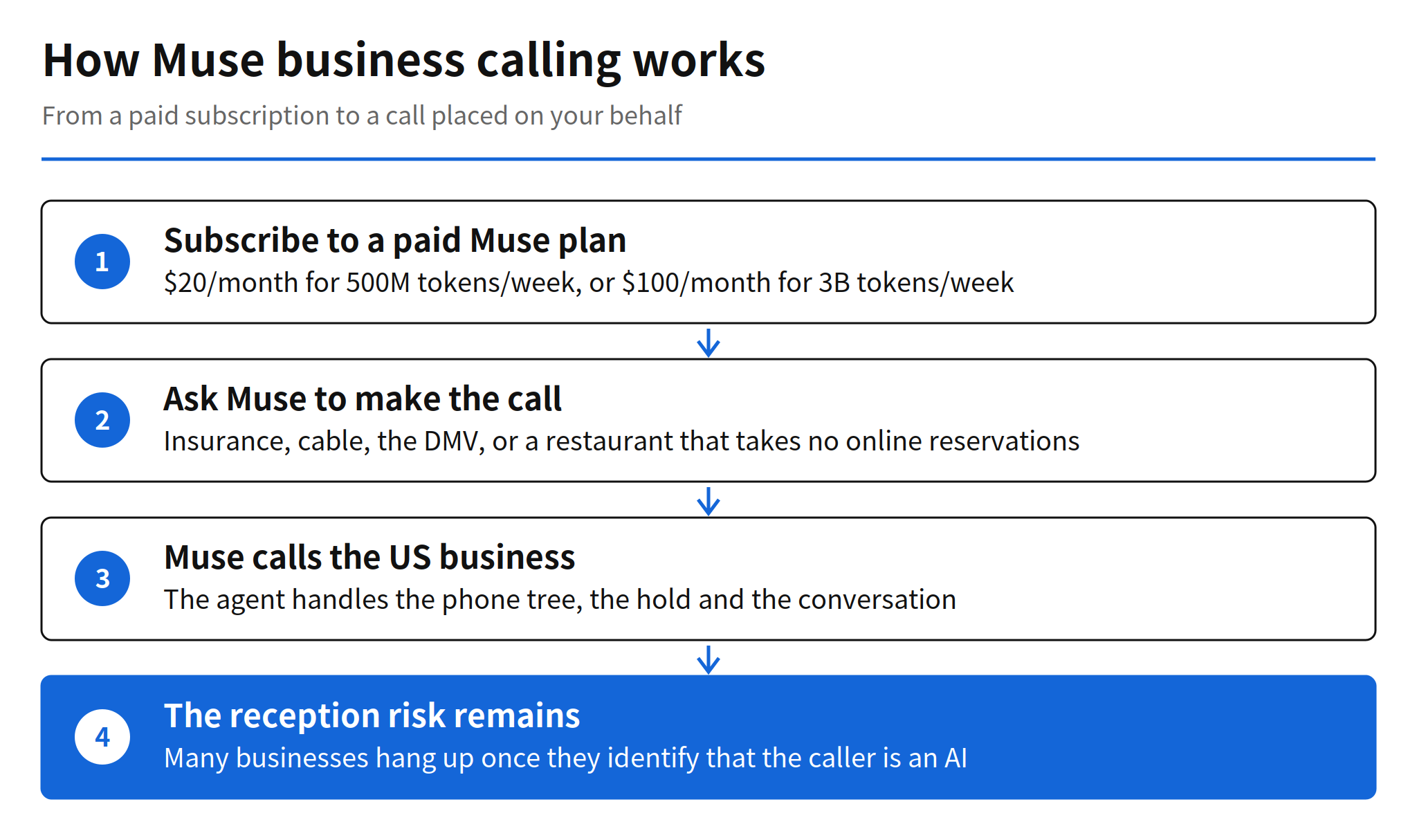
The announcement came in a November 12 post on X by Alexandr Wang, Meta's chief AI officer and head of its Superintelligence Labs division. Wang framed the feature around calls people do not want to make: an insurance company, a cable company, the DMV, or a restaurant that does not offer online reservations. That framing matters because it defines the product. Muse is not selling a better phone interface. It is selling the removal of a tedious task from a to-do list, and Meta has put that removal behind a paywall.

What changed in the November rollout
Before this change, only a select number of Muse early adopters were able to try business calling, and they got in after asking the AI for access. Now anyone who pays for Muse can make this type of request. The feature itself did not appear from nowhere. Meta first tested it in September, and that test drew extra scrutiny after reports that humans handled some calls during the test period. The November step is therefore less a launch than a promotion: a tested feature moved into the core paid offer.
Muse now has over 10 million users, according to a company figure from last month that TechCrunch cited. That scale explains why Meta is building everyday utility around the agent instead of treating it as a demo. A calling feature only works as a subscription argument if a large base of users regularly faces the kind of call it replaces, and customer service and booking calls are among the most common frustrations in that category.
Pricing and token allowances
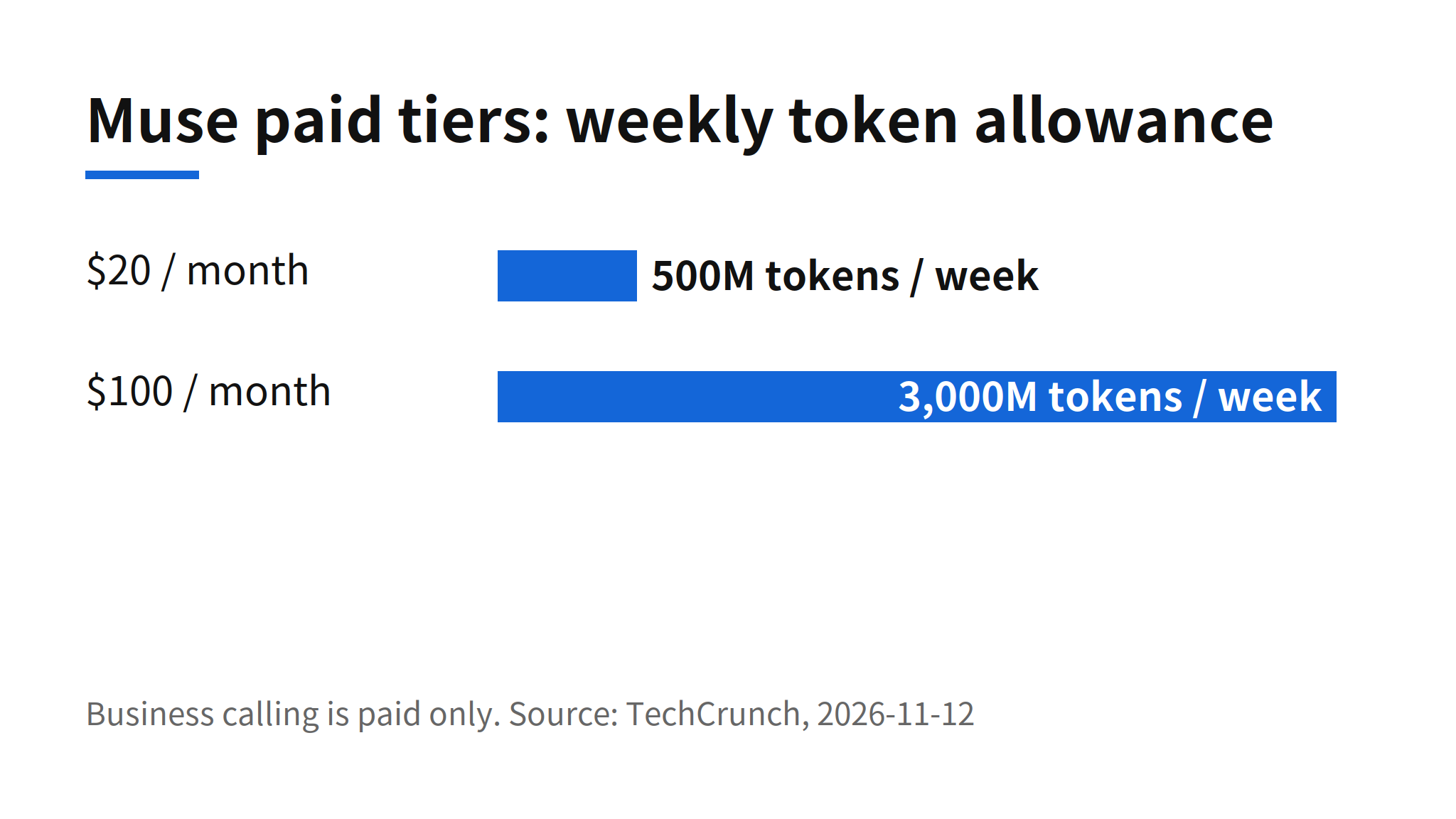
Muse subscription plans start at $20 per month for 500 million Muse tokens per week. Heavier AI users can pay $100 per month for 3 billion tokens per week. Calling sits inside those paid tiers, with no separate calling add-on announced. The pricing structure has a practical consequence that Meta has not filled in: because access is metered in tokens, the real cost of calling depends on how many tokens one call consumes, and that figure is not public.
One related change runs in the opposite direction on price. The recently added option to create a Muse email address will soon roll out to free users, Wang said this week. Meta is therefore splitting the agent's abilities by willingness to pay in a deliberate way: identity features such as an email address can spread to the free base, while an action feature that spends real-world effort, placing a call, stays paid only.
How Muse business calling works
The documented flow is short. A paid subscriber asks Muse to make a call, and Muse places the call to the U.S. business on the user's behalf. Meta has not published a step-by-step product guide in the announcement material, so details such as how a user briefs the agent on a negotiation limit or reviews a call afterwards remain unconfirmed in the sources for this article. The value proposition, as Wang presented it, is that the phone tree, the hold time and the conversation itself stop being the user's problem.
The appeal is easy to understand from the customer's side of recent customer service. Callers are routinely forced through complex phone trees, then sit on hold for a representative who may only transfer them to another department. An agent with effectively infinite patience changes that trade. The user gives up direct control of the conversation, and in return gives up the waiting entirely.
Rivals offering the same job
Muse is not the only AI agent able to place calls to businesses. The startup Instinct has been offering a similar option, as has Google's Gemini. The similarity is the point. Calling is becoming a standard capability in the consumer agent race rather than a single company's experiment, which means the competition shifts away from whether an agent can dial and toward whether the business on the other end stays on the line, and whether the subscription price feels justified month after month.
The hang-up problem on the other end
The reception on the other end of the line can be mixed. TechCrunch reports that many businesses and receptionists hang up on calls from AI agents as soon as they identify that it is not a human on the phone. That reaction is the central friction in the whole category. The agent's capability is no longer the bottleneck. The bottleneck is consent and recognition at the receiving business, one call at a time.
That friction may not stay stable. As AI becomes better able to mimic a real human voice, telling the difference between a customer and an AI working on the customer's behalf will get tougher, as TechCrunch noted. That creates an awkward near term for both sides: businesses that screen aggressively may hang up on legitimate customer requests, while businesses that do not screen may handle agent calls without ever knowing. Meta has published no data that resolves which outcome is more common today.
What Meta has not disclosed
- Call success rate: how often a Muse call reaches a human and completes its task is not public.
- Token cost per call: how many tokens one call consumes from the weekly allowance is not disclosed, so the effective number of calls in each tier cannot be calculated from the published pricing.
- Per-plan call limits: whether a separate cap on calls exists beyond the token allowance is not stated.
- International rollout: a release schedule outside the United States is unconfirmed.
Those gaps define how the feature should be judged for now. The announcement establishes availability and price with unusual clarity for an agent feature, and it leaves effectiveness unmeasured in public. A subscriber deciding whether $20 a month is justified is really buying a probability: that Muse will complete enough unwanted calls, without being hung up on, to be worth a recurring fee. Until Meta publishes a success rate or a per-call token cost, that probability stays a matter of personal trial rather than published evidence.
Related articles
- Meta Muse Voice Release: Realtime Avatar Video Calls
- Meta Muse Spaces: Custom App Spaces You Describe in Words
- Meta Muse Ember Release: Agent Pricing and Performance
FAQ
Who can use Muse to call US businesses?
Any Muse paid subscriber in the United States can now request this type of call. Before the November rollout, only a select group of early adopters who asked the AI for access could try the feature.
How much does Muse cost?
Muse subscription plans start at $20 per month for 500 million Muse tokens per week. Heavier users can pay $100 per month for 3 billion tokens per week. Business calling is open only on the paid tiers.
Which calls did Meta name as examples?
Alexandr Wang named calls to an insurance company, a cable company, the DMV and a restaurant that does not offer online reservations. The common thread is a call the user does not want to make personally.
Do businesses accept calls from an AI agent?
Reception is mixed. TechCrunch reports that many businesses and receptionists hang up as soon as they identify that the caller is not a human, and Meta has not published a call success rate.