Meta Muse Voice Release: Realtime Avatar Video Calls
Meta opened Muse Voice to all users in the United States on November 5, 2026. The feature lets people talk with the consumer AI agent Muse by phone call and video call inside the Muse app, on mobile, the web and Mac. Tapping the phone icon at the top right of the app starts the call. Two models power the experience, Muse Realtime Voice and Muse Realtime Avatar, the same technology Meta previewed at Meta Connect 2026 in September.
The important shift sits underneath the novelty of a talking avatar. Muse already worked as a delegated agent that sends email and books travel, kept working after the app closed, and asked for approval before sensitive actions such as purchases. Voice and video now attach to that task delegation model rather than replacing it. The agent keeps working in the background while the call runs, the user can interrupt mid sentence, and conversation and delegated work proceed together inside one session. The interface moved from a text box to a call, while the work model stayed the same.
The Avatar Experience in the Muse App
The default avatar is named Jolly. Users can change the avatar into a person, an animal or another character, and the avatar shows what TechCrunch described as "subtle expressions and gestures" matched to the tone of the conversation. The direction of the video call is one way in an important respect. The avatar can hear the user but cannot see the user, so the call borrows the shape of a video call without the exposure of one. For a consumer agent that people may talk to at home, that asymmetry is a deliberate product choice rather than a missing feature.
Generated avatar video also carries a durable, invisible Meta Video Seal watermark, and Meta says the watermark adds no real time latency. Muse use is limited to people aged 18 and over. Both details matter for how far this format can travel. A realtime generated face is exactly the kind of media that needs provenance marking by default, and Meta built the marking into the generation path instead of treating it as a post processing step.
One Streaming System for Voice and Face
The technical structure is a single streaming system. The voice model produces speech tokens that carry both content and delivery, an audio decoder turns those tokens into speech, and the avatar model receives the same stream and aligns expression and lip movement with it. Sharing one token stream is what keeps voice and face synchronized by construction. Two separately generated outputs would need a synchronization layer on top, and any drift between them would read immediately as a broken call.
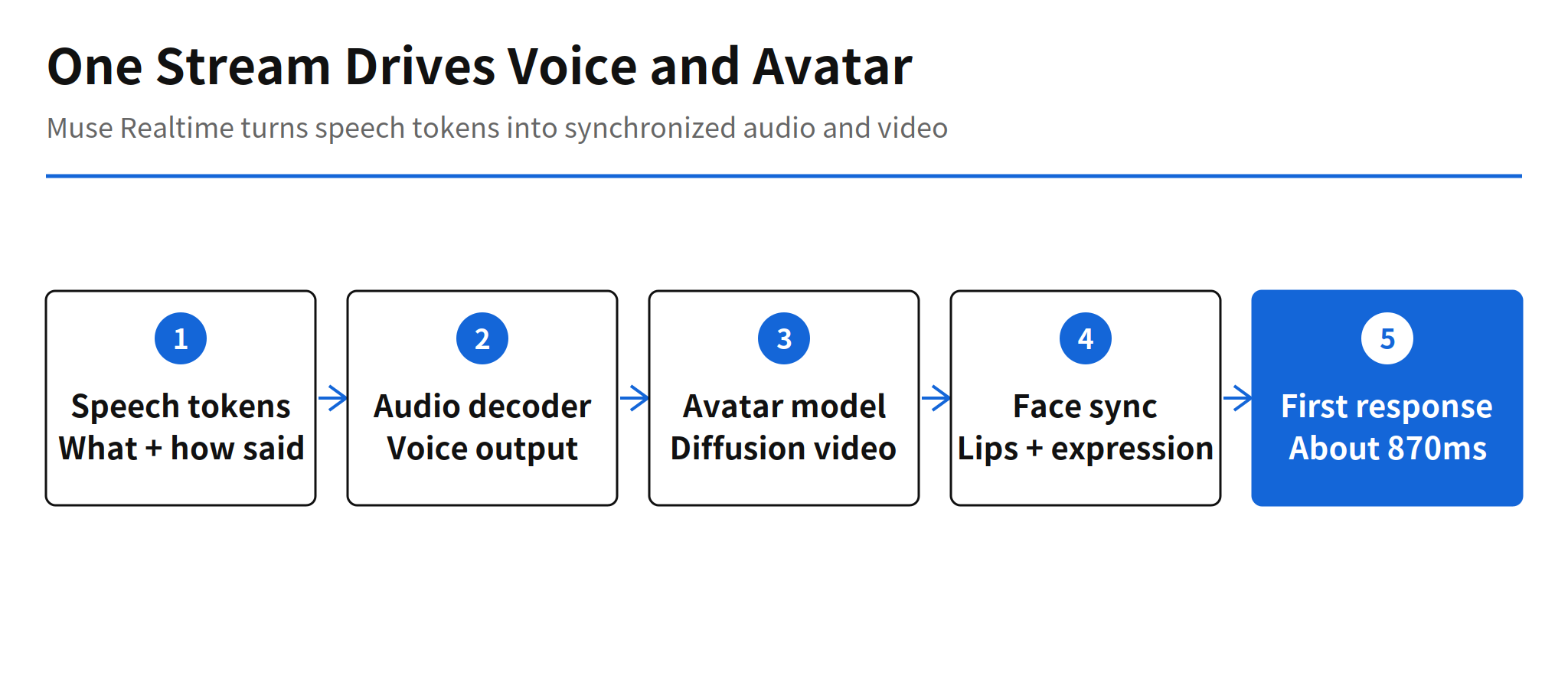
The avatar model is an audio driven Diffusion Transformer. It generates short video chunks in sequence, conditioned on the token stream, reference media such as a portrait or an illustration, and a rolling window of recent video latents. That rolling window is the continuity mechanism. Each new chunk sees what the face just did, which is how a long conversation avoids the resets and jumps that stitched clips usually show.
Serving Numbers and the Cost Picture
Meta used distillation to cut the cost of that generation. Per chunk, guided teacher evaluations dropped from 120 to 2 unguided student evaluations, a 60x reduction, with quality Meta describes as close to the teacher. After optimization, serving capacity rose 8x against a two step BF16 baseline, and one GB200 handles 12 concurrent realtime video generation sessions. The output runs at 448x768 and 25 frames per second, and the first byte of the synchronized response arrives about 870ms after the user finishes speaking.
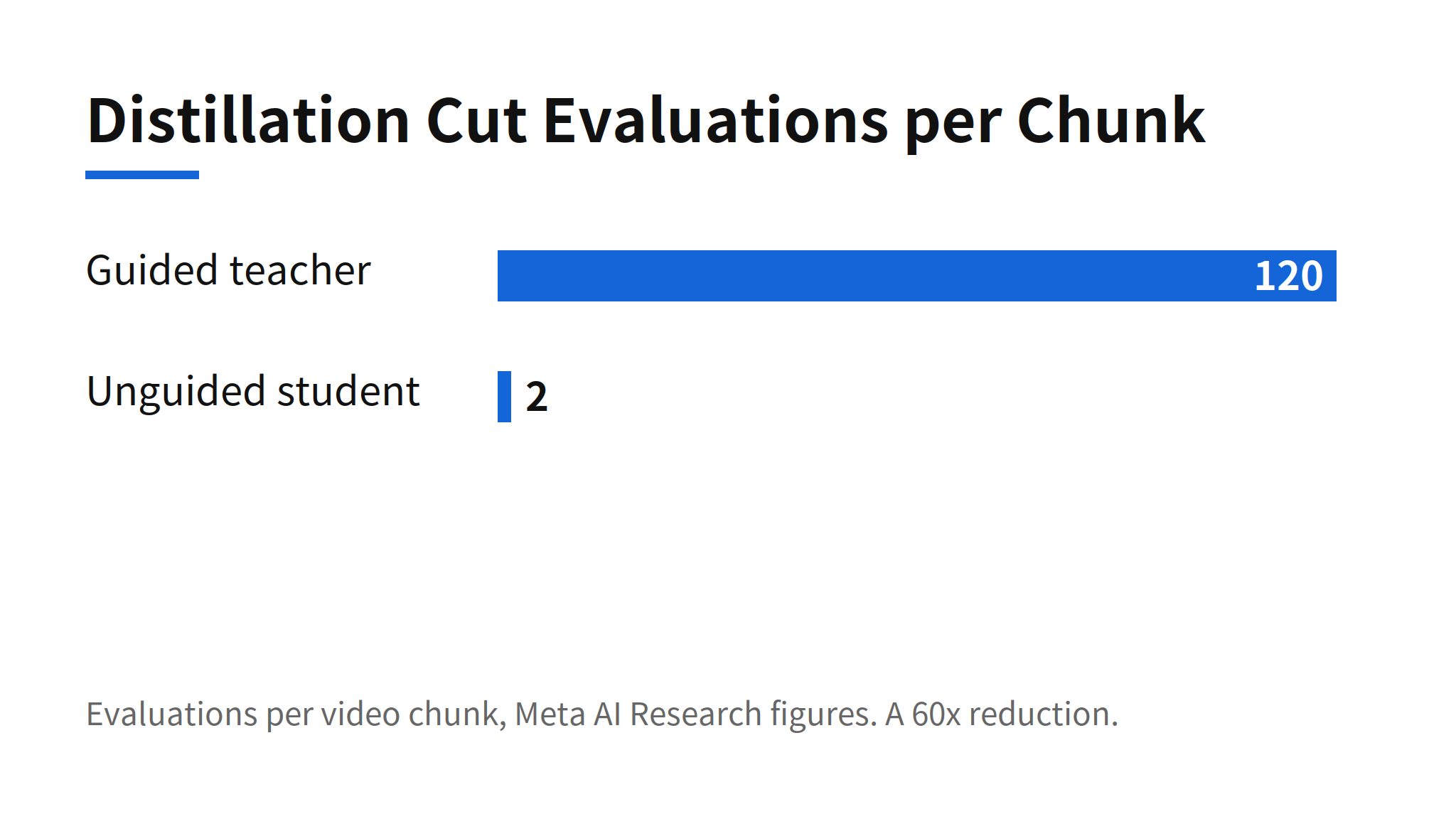
These numbers are the real product story for anyone building realtime agents. A video avatar is a serving economics problem before it is a design problem, because every concurrent call burns accelerator time for as long as the conversation lasts. Twelve sessions per GB200 and an 870ms first response give competitors and builders a concrete reference point for what a production realtime avatar costs to run, even while the figures remain Meta measurements. The September 8, 2026 launch of Muse as a personal agent, followed by the September 23 Connect preview, reached a full US rollout in about six weeks, which suggests Meta judged the serving cost ready for consumer scale rather than a limited demo.
Limits and Unconfirmed Details
The rollout stops at the US border for now. Meta gives the international schedule only as "coming soon" with no date, so availability outside the United States is unconfirmed. Meta also states that the examples in its research post show model capability and do not cover every avatar usable in the Muse app, so the quality range of the shipping avatars is unconfirmed. The 870ms latency and the serving capacity figures are Meta measurements, and no independent measurements exist yet.
For agent builders, the usable takeaway is the interaction pattern. A delegated agent that keeps working while its user talks to it, interrupts it and redirects it by voice is a different product surface from a chat window with a microphone button. Meta shipped that pattern with published latency and capacity numbers, which makes Muse Voice a reference design for realtime agent interfaces even for teams that never use a Meta product.
Related Reading
For persistent agents with a different interaction model, see the report on Perplexity Teammates and persistent agents. For hosted agents sold as a platform, see Kimi Hosted Agents, pricing and skills.
FAQ
What is Muse Voice?
Muse Voice is the voice and video call feature Meta opened to all users in the United States on November 5, 2026. It runs on Muse Realtime Voice and Muse Realtime Avatar, and it works on mobile, the web and Mac through the Muse app.
How fast is the Muse avatar response?
Meta AI Research reports about 870 milliseconds from the end of a user utterance to the first byte of the synchronized voice and video response. The avatar video runs at 448 by 768 resolution and 25 frames per second, and the figures are Meta measurements without independent verification so far.
Can the Muse agent keep working during a call?
Yes. Meta says the agent continues delegated tasks in the background while the conversation runs, and the user can interrupt mid sentence. Conversation and delegated work proceed together inside one session.
When does Muse Voice launch outside the United States?
The date is unconfirmed. Meta describes the international rollout only as coming soon and has not published a schedule. Support for AI Glasses and the Muse Charm wearable is also still at the planned stage.