Meta Muse Ember Release: Agent Pricing and Performance
Meta Superintelligence Labs released Muse Ember on November 9, 2026. It is the smallest and most efficient model in the Muse family, and its job is narrow by design: the work an agent repeats all day. Meta lists tool calling, coding subtasks, routing, extraction and long document parsing as the target tasks.
The headline numbers are price and cost per task. Ember costs $0.10 per million input tokens and $0.50 per million output tokens on the Meta Model API, with cached input at $0.004. Artificial Analysis put the cost at about $0.14 per task, and Meta said Ember matches the top Haiku score at about one third of the cost. For agent systems, that ratio matters more than a small gap at the top of a leaderboard, because most of the spend sits in hundreds of small steps rather than in one hard decision.
Pricing, Context and Availability
Ember carries a 1M token context window and can return up to 512K tokens in one response. The model ID is muse-ember-1.0 and it supports the Responses API. It reads text, image, audio and video natively, so a routing or extraction step does not need a separate model when the input is a screenshot, a recording or a clip.
Availability started on launch day. Ember is usable in Muse Code and through the Meta Model API. That immediate API access is part of the point. A cheap execution model only changes agent economics if a team can route traffic to it today, inside the stack it already runs, rather than waiting for a separate product launch.
Benchmark Scores Against Haiku and GPT-6 Luna
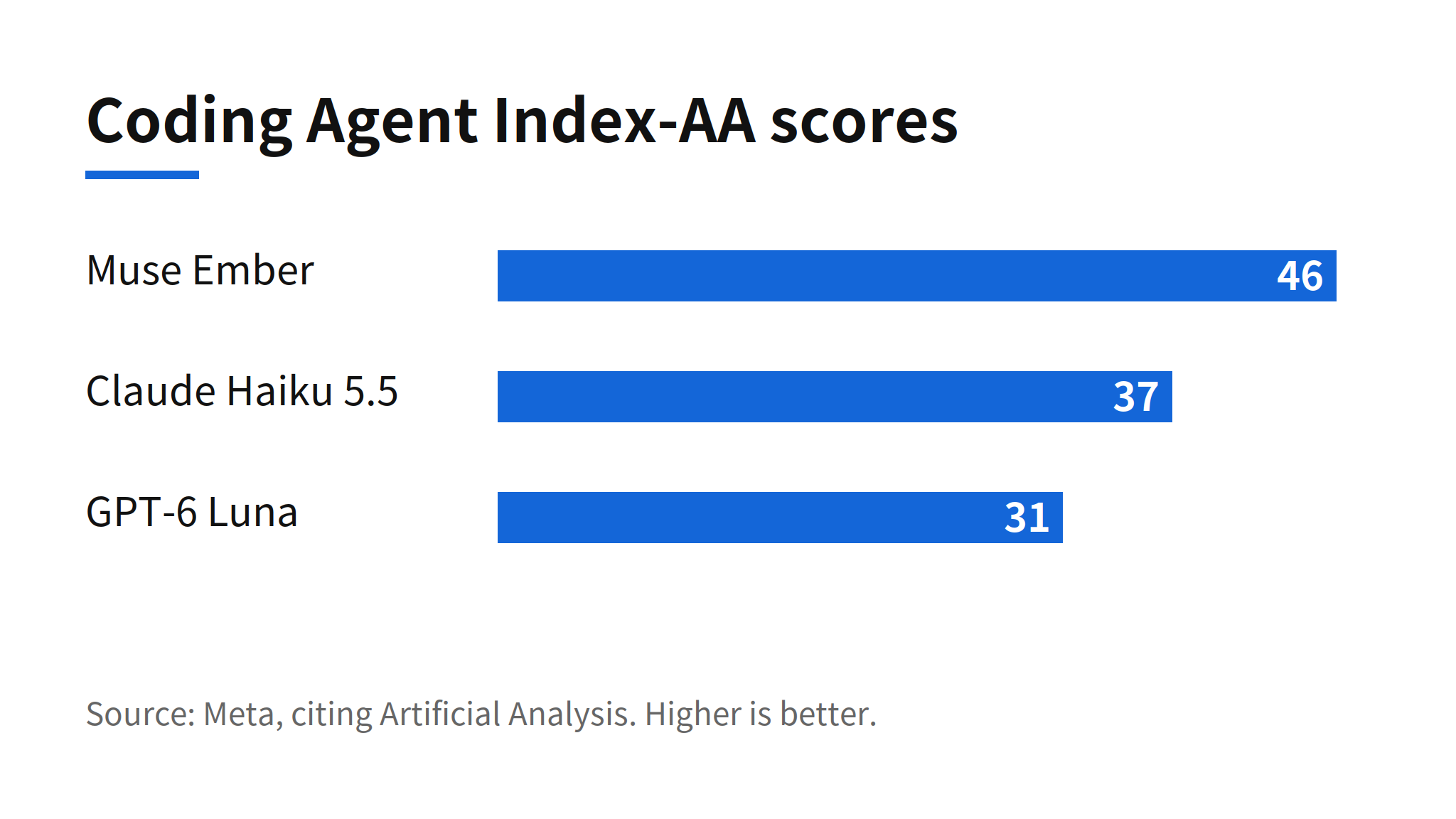
On the Artificial Analysis Intelligence Index, Ember (max) scored 36, the same as Claude Haiku 5.5 (max) at 36. On the Coding Agent Index-AA, Ember scored 46, ahead of Haiku 5.5 at 37 and GPT-6 Luna at 31. Read together, the two results describe a model that is average at the general index level for its class and notably stronger on the agentic coding tasks it was built for.
The counterweight is in the same announcement table. On FrontierCode 2.0-AA, Ember scored 27.2, below Haiku 5.5 at 34.9. Hard coding work still favours the larger model. That split is consistent with the product positioning, and it is also a warning against routing by price alone. Ember looks built to absorb volume, not to replace the model that handles the hardest step in a run.
Place in the Muse Family
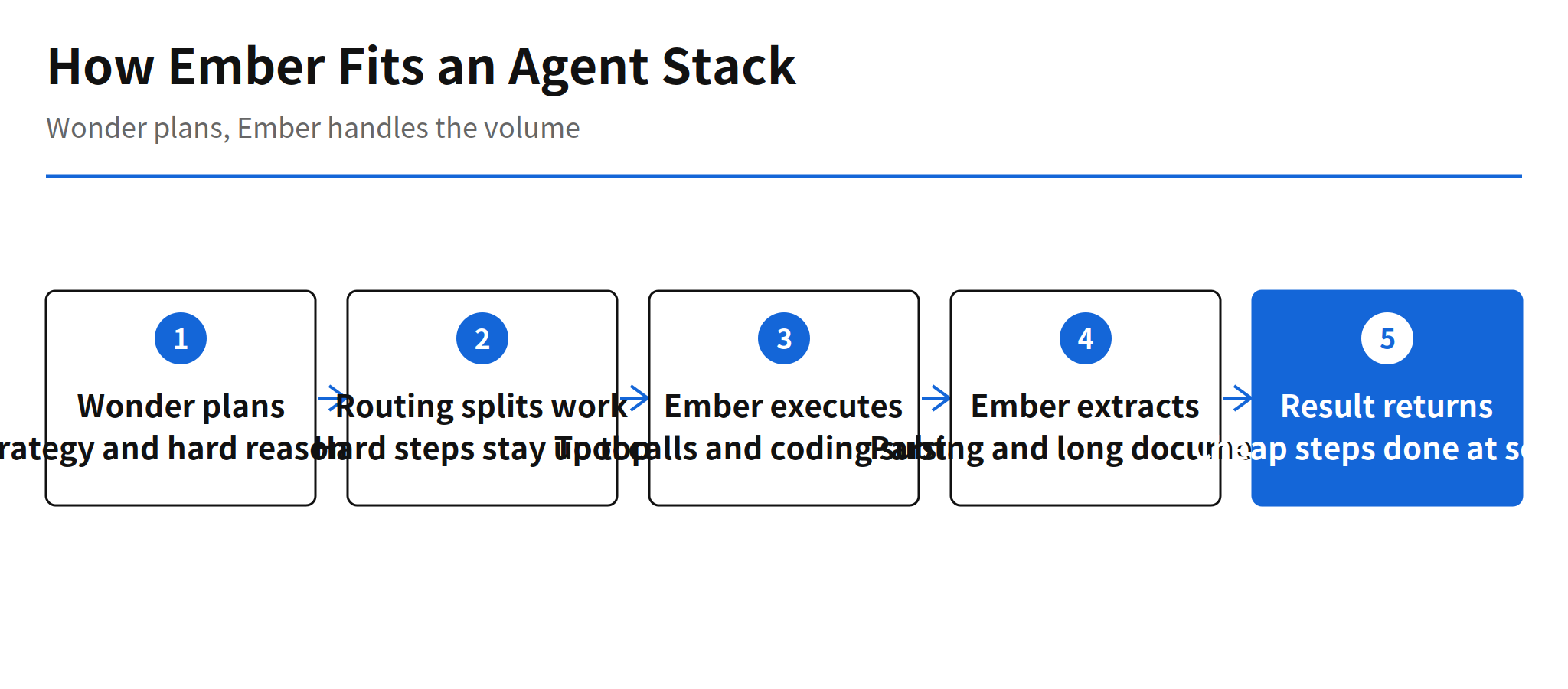
Ember is the first model trained by Muse Wonder Full. In October, Meta released Muse Wonder and Muse Wonder Full and said the top models would be used to create specialised models. Ember is the first result of that plan. The division of labour is explicit in the announcement material: Wonder sets the plan, and Ember processes the volume underneath it.
For a working agent stack, that suggests a two tier pattern rather than a single model choice. Keep planning and the hardest reasoning on a frontier model, then send code reading, test runs, structured extraction and document parsing to a model priced at $0.10 per million input tokens. In Android development, for example, those repeated steps are exactly where a long session burns budget without needing frontier level judgement on every call.
Open Questions and Limits
- No independent remeasurement yet. The benchmark figures come from the Meta announcement and its citations of Artificial Analysis. Independent remeasurement results are not yet available, so the 46 point coding score should be read as a launch claim with a named source, not as a settled ranking.
- Weight release is unconfirmed. The announcement does not state whether weights will be released, and it gives no timeline for a consumer app. Secondary coverage describes the model as closed, but Meta has not confirmed that point, so it stays unconfirmed here.
- Parameter count is undisclosed. Meta did not publish a parameter count for Ember. Smallest in the family is a positioning statement, not a size specification.
- Hard tasks still need a bigger model. The FrontierCode 2.0-AA gap, 27.2 against 34.9 for Haiku 5.5, marks the boundary of the cheap tier. A routing design that sends difficult coding steps to Ember to save money would trade away the quality the saving was meant to protect.
Related Reading
Ember follows the model that trained it. See the earlier report on Meta Muse Wonder and its specialised model plan for the October announcement Ember came from, and the report on Meta Muse Spaces for the collaboration surface around the same family.
FAQ
What is Muse Ember built for?
Muse Ember is the smallest and most efficient model in the Muse family, released by Meta Superintelligence Labs on November 9, 2026. Meta built it for the work agents repeat all day, including tool calling, coding subtasks, routing, extraction and long document parsing.
How much does Muse Ember cost?
On the Meta Model API, Ember costs $0.10 per million input tokens and $0.50 per million output tokens, with cached input at $0.004. Artificial Analysis put the cost at about $0.14 per task, and Meta said Ember matches the top Haiku score at about one third of the cost.
How does Muse Ember perform on benchmarks?
Ember (max) scored 36 on the Artificial Analysis Intelligence Index, the same as Claude Haiku 5.5 (max). On the Coding Agent Index-AA it scored 46, ahead of Haiku 5.5 at 37 and GPT-6 Luna at 31. On FrontierCode 2.0-AA it scored 27.2, below Haiku 5.5 at 34.9.
Where is Muse Ember available?
Ember was available from launch day in Muse Code and through the Meta Model API. Its model ID is muse-ember-1.0 and it supports the Responses API. Meta did not announce open weights or a consumer app timeline in the release.