Gemini 4 Neon Release: Pricing, Coding Scores and Limits
Google released Gemini 4 Neon on November 18, 2026, positioning it as the middle model in the Gemini 4 family, between Carbon for the hardest long-horizon work and Hydrogen for fast everyday execution. The headline number is coding: Neon ranks first overall on the Artificial Analysis Coding Agent Index at 58.6, and Google says it costs 32% less per task than Carbon at its default high thinking level. Pricing is $3 per million input tokens and $15 per million output tokens, with a 1 million-token context window.
The practical question is not whether Neon beats Carbon on raw intelligence. Google itself places Neon third overall on the Artificial Analysis Intelligence Index, at 61 points at the xhigh thinking level, just behind larger and slower models. The claim is narrower and more useful: frontier-level results on complex software engineering, knowledge work and science workflows, delivered faster and at a lower cost per finished task. For teams running long agent sessions, cost per task is the number that decides the monthly bill, not the token rate alone.
Coding Performance and the Harness Gap
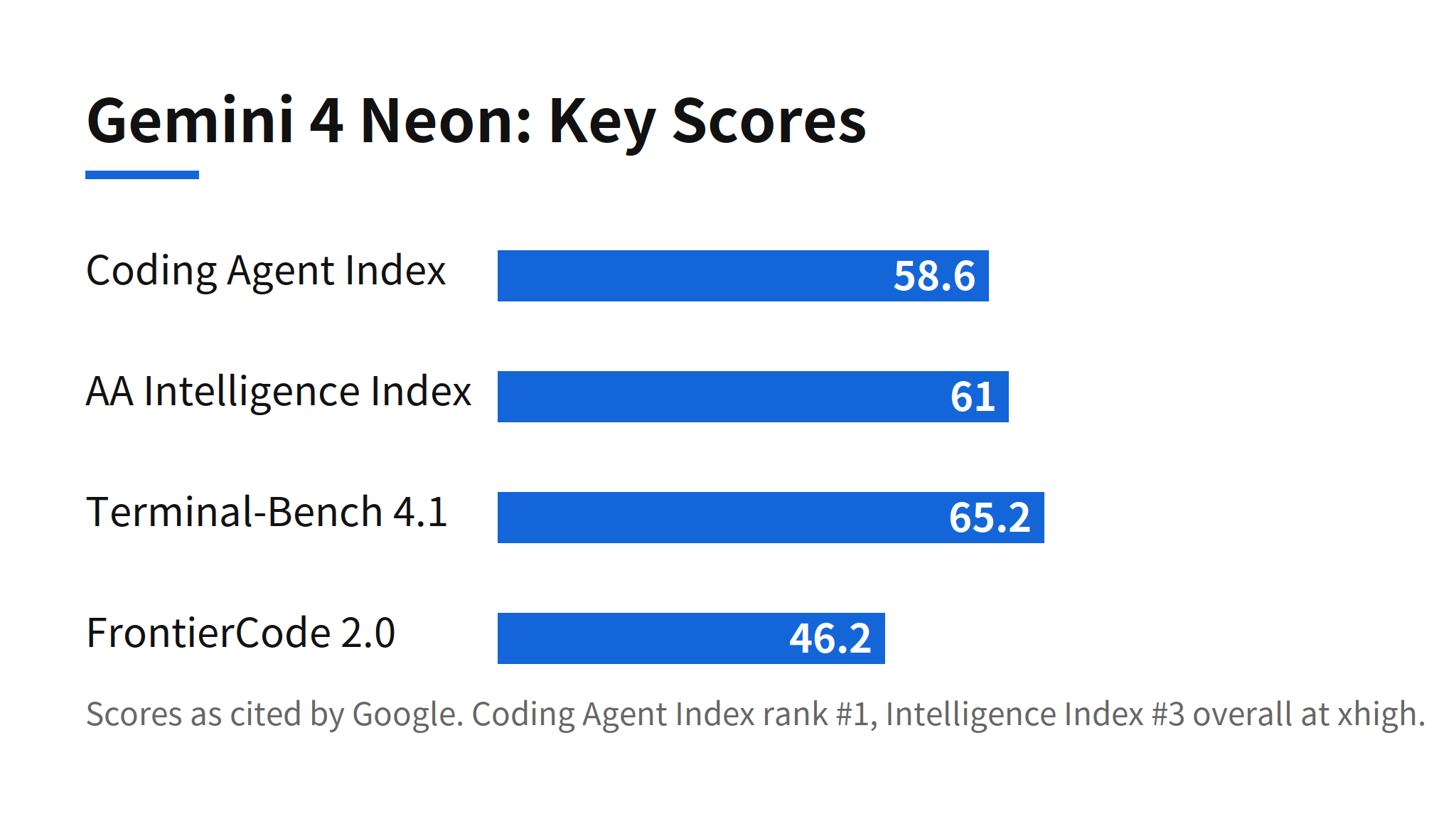
Beyond the Coding Agent Index lead, Google reports 65.2% on Terminal-Bench 4.1 and 46.2% on FrontierCode 2.0 at the default high setting. For production code, the announcement emphasizes multi-file debugging and refactoring across repositories with targeted, surgical edits, plus steadier behavior in long sessions: fewer redundant file reads, progress shared while it works, and reliable context compaction.
The most revealing figure is the SWE-sweep split. Neon scores 12.8% on the mini-SWE harness and 39.0% in Google Antigravity, using the same model. Google presents that gap as evidence of what its harness unlocks, and the implication cuts both ways. A benchmark score for an agent model is now partly a score for the environment around it, so comparing Neon in Antigravity with a rival model in a weaker harness does not isolate the model. It also means Neon can act as an orchestrator in Antigravity, directing parallel Hydrogen subagents, which makes model choice a harness design decision rather than a single-model pick.
Pricing, Thinking Levels and Cost per Task
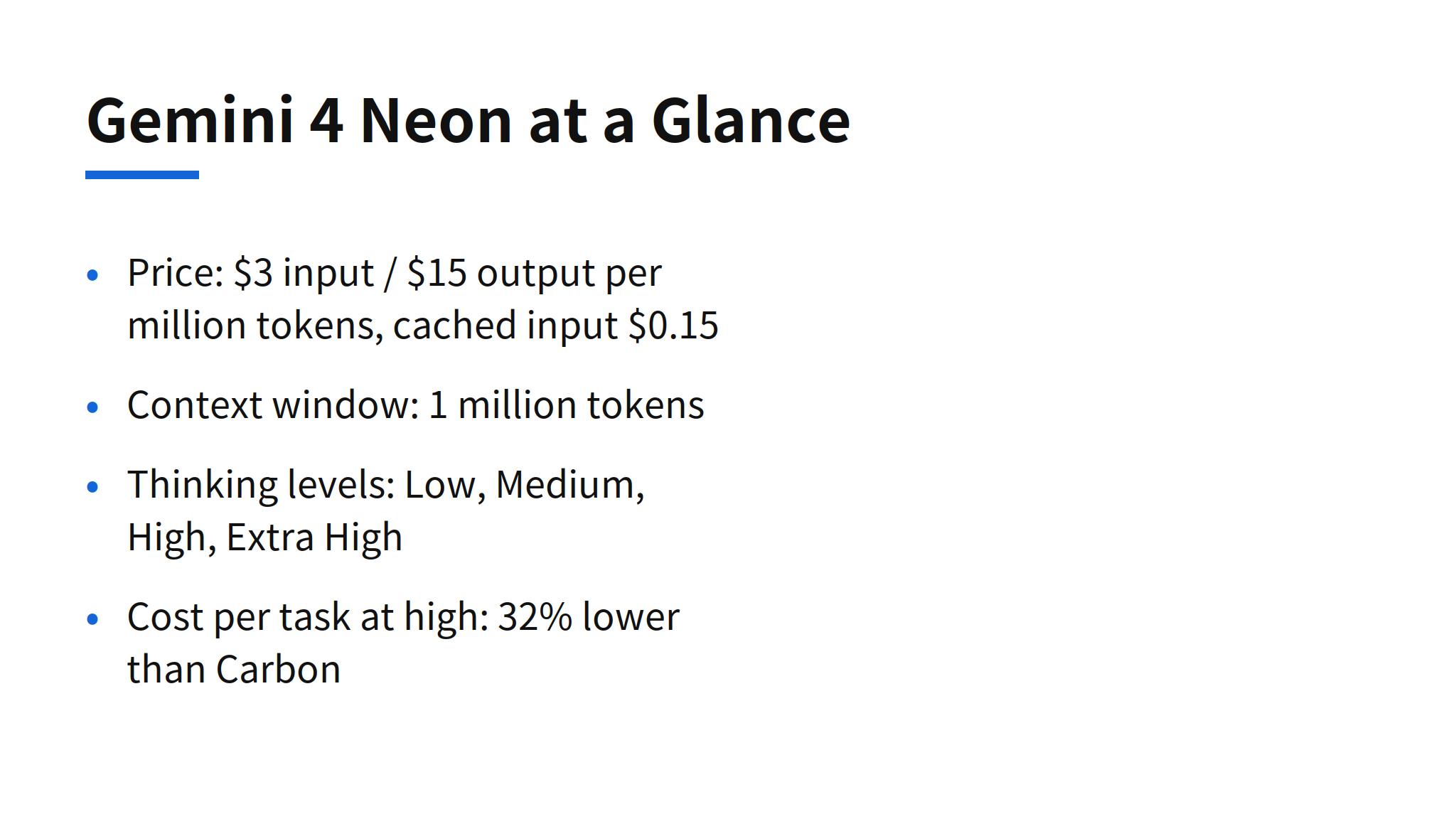
Cached input is priced at $0.15 per million tokens, a 95% discount, which matters for agent loops that resend large contexts repeatedly. Neon offers four thinking levels, Low, Medium, High and Extra High, so teams can trade intelligence against token spend per workload instead of switching models. At high, Google places Neon on the Pareto frontier on both the Vals Index and Agent Arena, with roughly 50% to 80% lower cost per task than top competing frontier models. At xhigh, it still claims 36% or more lower cost per task than competing models at their highest settings.
One pricing caveat belongs in any budget comparison. Carbon launched at an introductory $2/$10 rate that runs until November 30, so the current price relationship between Carbon and Neon is temporary. Google has not published a schedule for Neon price changes, and once Carbon moves off its introductory rate the gap between the two models will widen or narrow depending on a number Google has not announced yet.
Enterprise, Science and Agent Work
Outside coding, Google reports second place on the Vals Index at 70.9%, with first place on both the Legal Research Bench and the Tax Agent Bench. Neon also ranks second on steerability on the new Agent Arena Index, across more than 4,200 real-world agent sessions, and Google reports its lowest fabrication rate yet in internal Antigravity testing. For enterprise inputs, the model synthesizes spreadsheets, PDFs, charts, audio and video inside the single 1 million-token context and returns structured deliverables. It scores 73.5% on Chartography for dense professional charts and 75.8% on Agents' Last Exam v1.1.
On science and mathematics, Google cites best-in-class results on Terminal-Bench Science at 70.5%, RiemannBench at 84.0% and HLE-Diamond at 71.3%. It also ranks first on Zapier AutomationBench at 56.3% and on Andon Labs Vending-Bench 2 at $16,843 in the long-horizon business simulation. These are strong breadth numbers, but they share the same sourcing limit as the coding scores: most were selected and published by Google in its own announcement, so an independent full remeasurement is still pending.
Cyber Variant and Safety Claims
A separate variant, Gemini 4 Neon for cyber, rolls out in the coming days to trusted defenders in the Fairwind Program. Google reports state-of-the-art results across the hardening lifecycle: 90.5% on SEC-bench Pro for finding vulnerabilities at roughly half the cost per challenge, frontier-level ExploitGym performance using half the tokens of Carbon, and 70.7% on CWE-bench v2 for patching, a 3.4% uplift over Carbon. On AutoBaxBench it reaches 76% on the hard tier for secure code generation, and on WebExploitBench v1.2 it scores 51.26% at half the cost of competing large models.
On safety, Google says Neon keeps Carbon-level protections against severe misuse and prompt injection while refusing less legitimate work, including 1.98% of tasks on Terminal-Bench 4.0 and 0% on Terminal-Bench-Science. It reports a 0.09% misaligned action rate on its agentic safety suite, a 99.2% pass rate on its agent honesty evaluation, and a 0.0% attack success rate on the Gray Swan indirect prompt injection benchmark at the highest thinking level with real-time safeguards. These figures are internal Google measurements, and the announcement links a model card for detail, but no external audit of the cyber variant has been published yet.
Availability and Replacement in the Gemini App
Neon is rolling out through the Gemini API in Google AI Studio on the paid tier, in Gemini for business through the API and the model dropdown, for paid Google AI Pro and Ultra subscribers in Google Antigravity, and for Pro and Ultra subscribers in the Gemini app. In the app, Neon replaces Gemini 3.1 Pro, according to 9to5Google coverage of the launch. Android Studio is also listed as a developer entry point for paid subscribers.
The replacement detail matters for existing users. Anyone whose app workflows were tuned around Gemini 3.1 Pro now gets Neon by default, with its different thinking-level behavior and pricing logic behind the subscription. Google frames the app version around higher-quality writing, research that pulls current web detail, and faster completion of multi-step tasks, but it published no latency figures to support the speed claim. Fast completion is described in words only, with no measured response-time numbers in the announcement.
Limits and Unconfirmed Points
- Benchmark sourcing: most scores come from Google's own announcement. Third-party indexes are cited, but Google selected which results to publish, and no independent full remeasurement is available yet.
- No latency data: the speed advantage is asserted without concrete response-time or end-to-end task-time figures.
- Price relationship is temporary: Carbon's introductory $2/$10 pricing ends November 30, and Neon's own future pricing is undisclosed.
- Cyber access is gated: Neon for cyber goes only to trusted Fairwind Program defenders in the coming days, with access requests handled through Cloud account teams.
The durable point is the family structure. Google now sells a three-tier ladder where the middle model, not the flagship, leads the coding agent index and undercuts the flagship on cost per task. If the Antigravity harness gap is real in independent use, the buying decision shifts further from raw model rankings toward the environment the model runs in.
FAQ
What is Gemini 4 Neon and where does it sit in the family?
Gemini 4 Neon is the middle model in the Gemini 4 family, released by Google on November 18, 2026. Carbon handles the hardest long-horizon projects, Hydrogen handles fast everyday execution, and Neon balances depth and efficiency for complex, high-frequency workflows.
How much does Gemini 4 Neon cost?
Neon costs $3 per million input tokens and $15 per million output tokens, with cached input at $0.15 per million tokens, a 95% discount. Its context window is 1 million tokens.
How does Gemini 4 Neon score on coding benchmarks?
Neon ranks first overall on the Artificial Analysis Coding Agent Index at 58.6, scores 65.2% on Terminal-Bench 4.1 and 46.2% on FrontierCode 2.0 at its default high setting. On SWE-sweep it scores 12.8% on the mini-SWE harness and 39.0% in Google Antigravity.
Where can developers and subscribers use Gemini 4 Neon?
Neon is available through the Gemini API in Google AI Studio, in Gemini for business, for paid Google AI Pro and Ultra subscribers in Google Antigravity, and for Pro and Ultra subscribers in the Gemini app, where it replaces Gemini 3.1 Pro.
What is Gemini 4 Neon for cyber?
Gemini 4 Neon for cyber is a cybersecurity variant rolling out to trusted defenders in the Fairwind Program in the coming days. Google reports 90.5% on SEC-bench Pro and 70.7% on CWE-bench v2 for patching.
Related Reading
- Gemini 4 Carbon Release: Pricing, Access and How It Works, the flagship tier above Neon
- Gemini 4 Hydrogen Release: Pricing, Speed and Benchmarks, the fast everyday tier below Neon
- Google Stitch Loop Release: 24/7 Product Agent, Waitlist, another Google agent launch from the same day