Gemini 4 Hydrogen Release: Pricing, Speed and Benchmarks
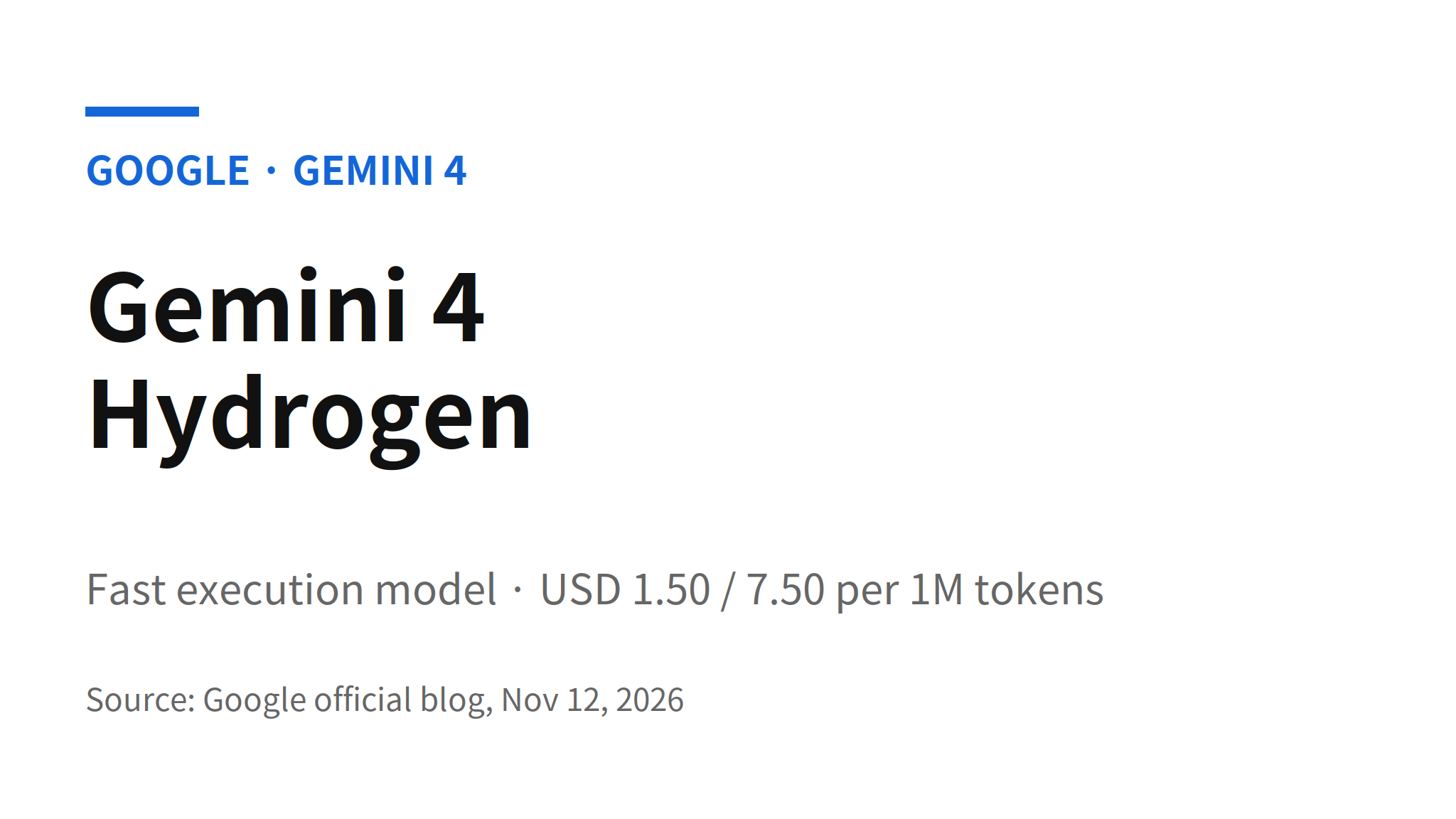
Google released Gemini 4 Hydrogen on November 12, 2026, in a post by Koray Kavukcuoglu, SVP at Google DeepMind. Hydrogen is the fast execution model in the Gemini 4 family, built for everyday coding and agentic workflows. It costs $1.50 per million input tokens and $7.50 per million output tokens, at one flat rate across its full 1 million token context window.
That positioning matters more than the headline score. Carbon and Argon came first as frontier models for deep, long horizon reasoning. Hydrogen takes the work that fills most agent sessions in practice: writing code, running tests, checking a change, and trying again when a tool call fails. A model that does that loop quickly and cheaply changes daily cost far more than a small gain at the reasoning ceiling, and Google priced and distributed Hydrogen as if it knows that.
Pricing and Context Terms
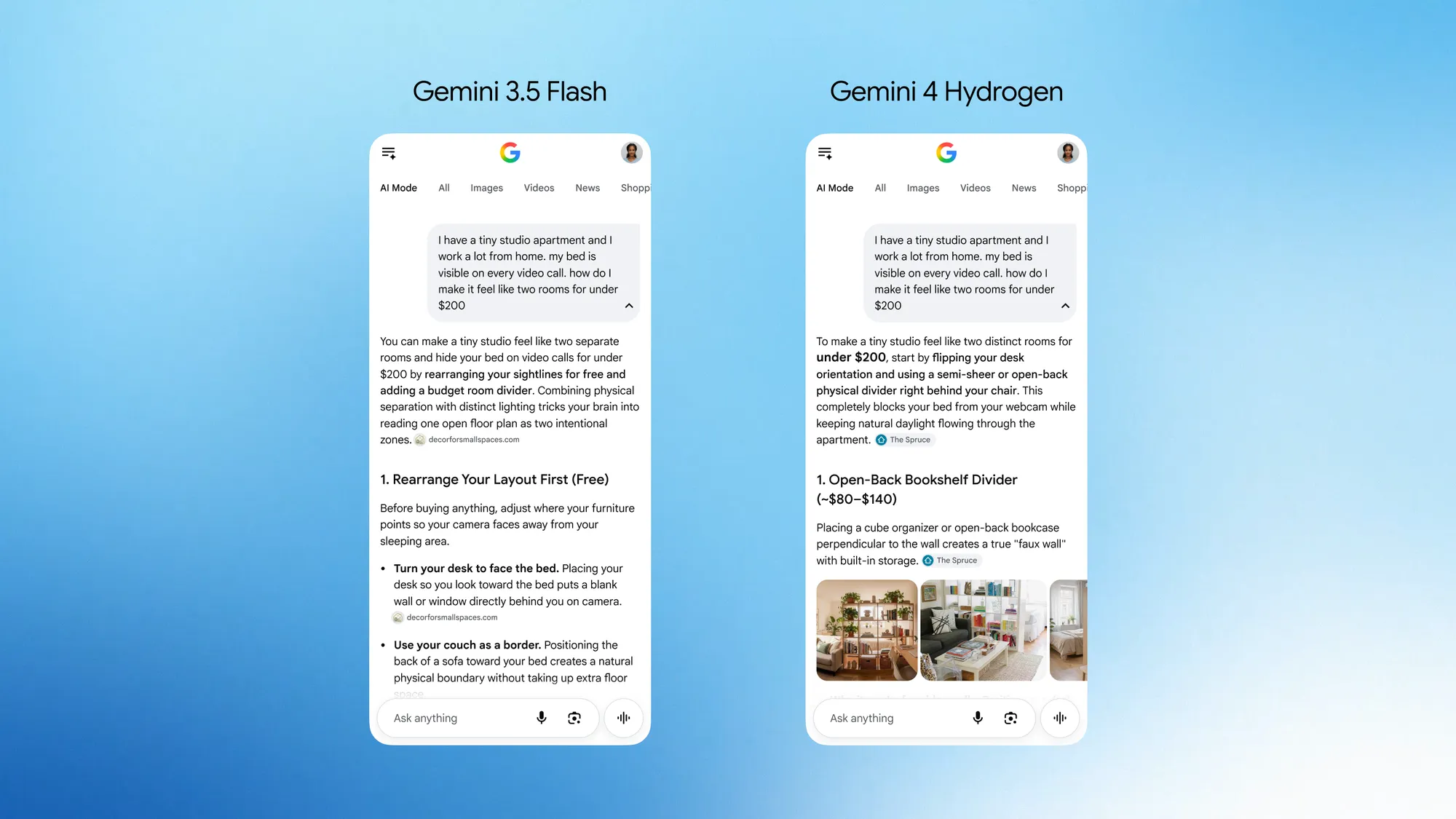
The flat rate is the detail developers should read first. Google states that the $1.50 and $7.50 rates apply across the entire 1 million token context, with no extra charge for long context. Many rival price sheets raise the rate once a prompt passes a threshold, which makes a large codebase hard to budget before the bill arrives. Hydrogen removes that variable: a team can estimate the cost of a full repository session from token counts alone, then compare that estimate against a frontier model session on the same task.
Context support runs in both directions. The launch lists 1 million tokens of input and up to 1 million tokens of output for multimodal knowledge work. That output ceiling is unusually generous for an execution tier model, and it fits long generated artifacts such as migration scripts, test suites and multi file edits, where a truncated answer costs a second session.
Benchmark Scores and the Previous Generation
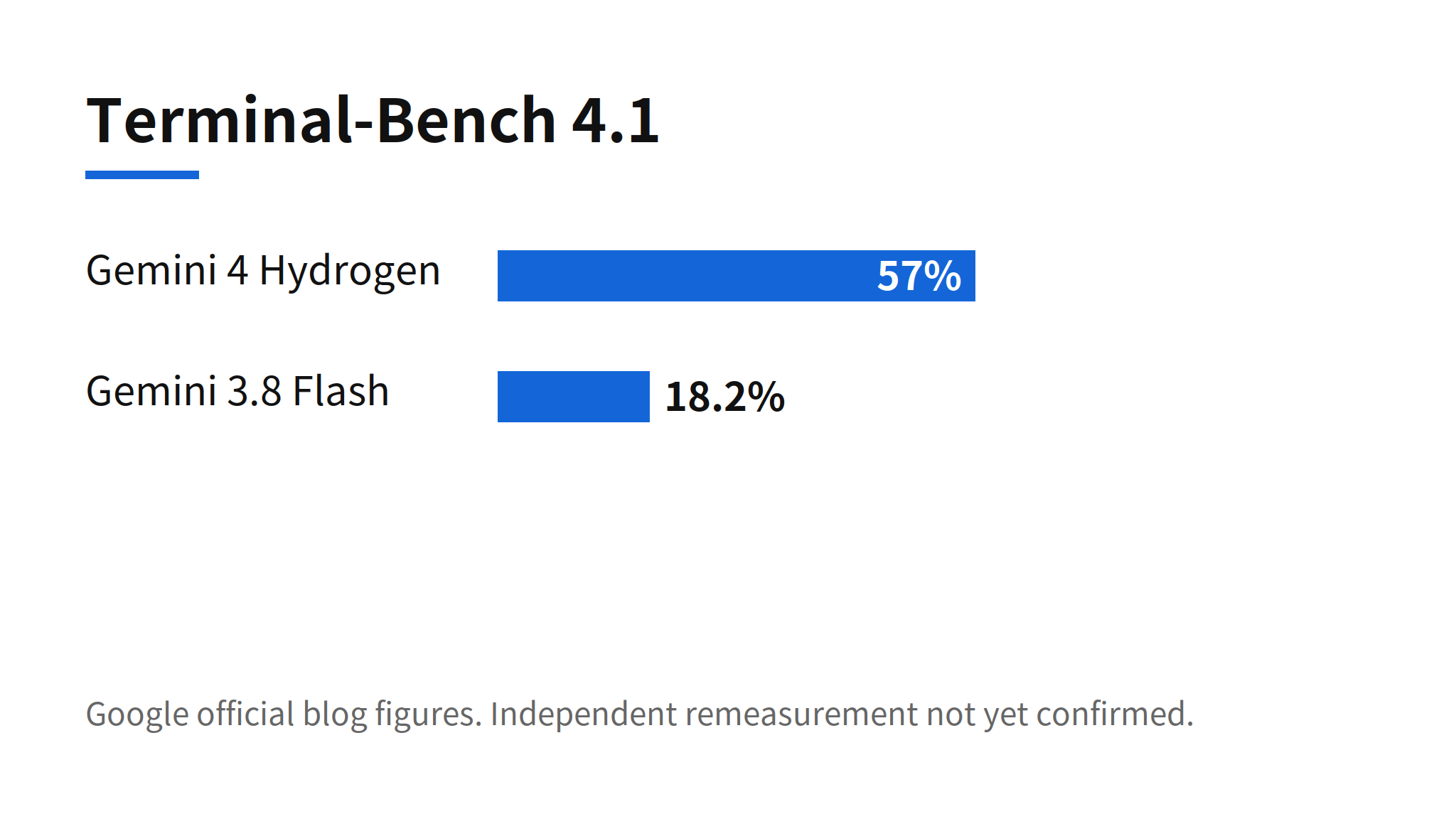
On the Artificial Analysis Intelligence Index, Hydrogen scores 51 at its default high thinking setting, one point above Gemini 4 Argon at 50, and reaches 54 at the new xhigh setting. Against Gemini 3.8 Flash, Google says task completion is 2.5 times faster at the high default, Terminal-Bench 4.1 rises to 57% from 18.2%, and fabricated claims fall by more than 5 times. The Terminal-Bench jump is the strongest claim in the post, because it measures finished terminal work rather than answer quality in isolation, and a threefold gain there, if it holds outside Google testing, would move real coding sessions.
Agent evaluations point the same way. Google lists Hydrogen at 5th place on Agent Arena, first in its class on HLE-Diamond at 58.8%, first overall on the Vals Tax Agent Bench at 52.3%, and joint first on the Vals Legal Research Bench at 55.8%. On multimodal knowledge work it scores 53.4% on the MKA benchmark and 71.6% on Agents' Last Exam v1.1. Read together, the pattern is consistent: the gains concentrate in multi step work with tools and documents, not in short single answers.
Every score in this section comes from the Google launch post. Independent remeasurement had not been confirmed at publication, and Google did not publish parameter counts or open weights for Hydrogen.
Orchestrator in Google Antigravity
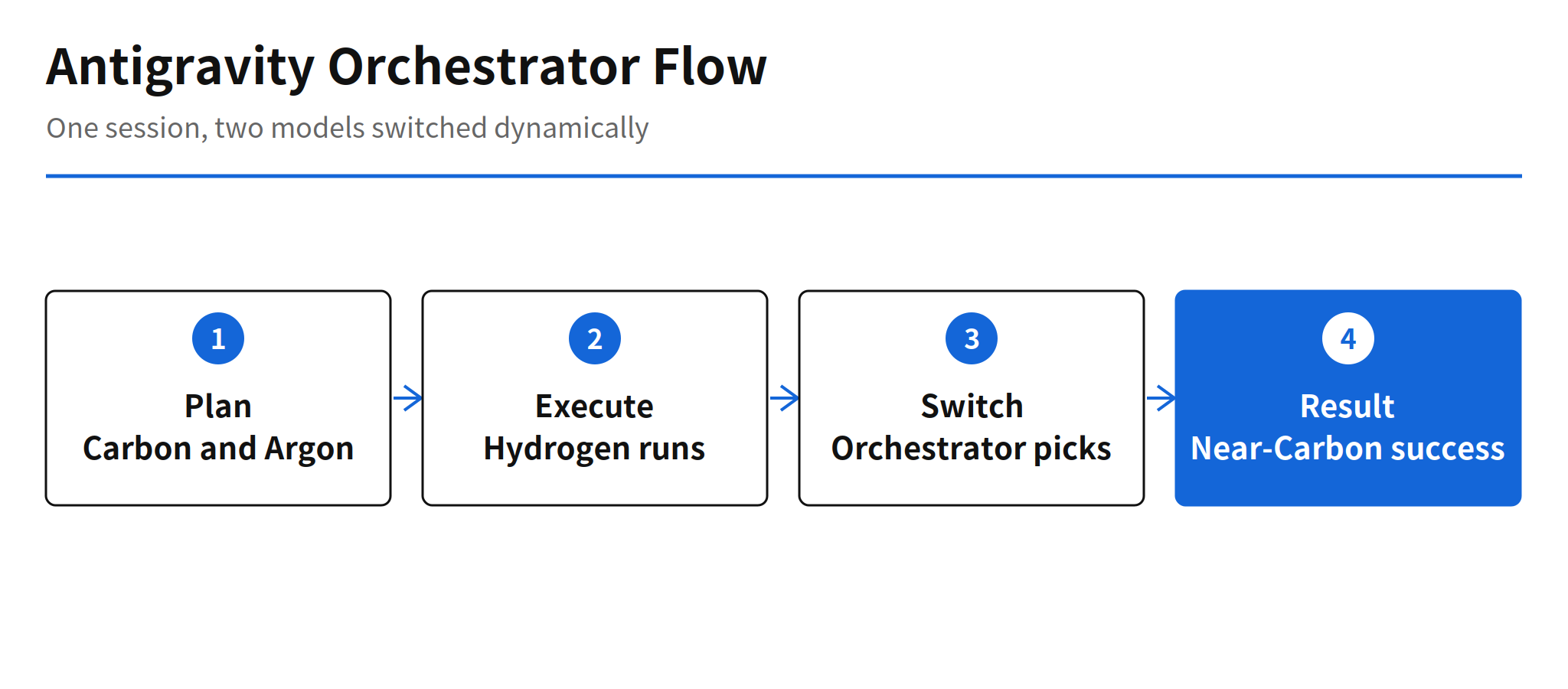
Antigravity gains Orchestrator alongside the model. Instead of running one model from start to finish, Orchestrator switches dynamically between Carbon and Hydrogen inside the same session, so deep reasoning steps and fast execution steps each land on the model built for them. On Terminal-Bench 4.0, Google says Orchestrator kept task success close to Carbon while using 24% less quota on average and finishing 19% faster.
Teams that hand built multi model routing now have a product default to test against. The sensible first step is not to delete that routing code, but to run the same workload through Orchestrator and compare quota, completion time and success rate on their own tasks. If the default matches the hand built version, the routing layer becomes maintenance with no payoff. If it falls short on a specific task type, that gap shows exactly where custom routing still earns its keep.
Availability Across Google Surfaces
Distribution is broad from day one. Google lists all tiers of Google AI Studio, the Gemini API, Gemini for business, the Gemini app and Google Search for all users. Inside Antigravity, Hydrogen is for paid Google AI Pro and Ultra subscribers, and Android Studio offers it on paid tiers. For Android developers, that last point is the practical entry: the model is reachable inside the IDE tier they already pay for, without a separate API integration step.
One consumer caveat stands out. Free Gemini app users do not pick Hydrogen directly. They receive a Hydrogen answer only when automatic model selection judges it suitable, and Google has made no promise to label which model produced a given answer. A user comparing quality across sessions may therefore be comparing different models without knowing it, which limits how much weight free tier impressions should carry.
Safety Figures and Partner Results
Google also reports internal safety and honesty results: agent overreach down by up to 81%, under-service down by up to 79%, and a 96.7% honesty rate on its internal agent honesty evaluation. Early partner testing, again as reported by Google, ran complex graph, SQL and data heavy enterprise workflows 2 to 2.8 times faster than Gemini 3.8 Flash while using 12% to 23% fewer tokens. Both sets of figures are useful as direction, and both carry the same limit: the measuring party is the seller, and the test conditions are not published in full.
My read is that Hydrogen is the Gemini 4 release most teams will actually feel. Carbon set the ceiling story for the family, covered in issue #3905. Hydrogen sets the daily bill and the daily waiting time, and Orchestrator turns the two model split into a default rather than a project. The open question is not whether the launch numbers are large. It is whether they survive independent measurement on workloads Google did not choose.
Limits and Unconfirmed Points
- Google figures only: benchmark, speed, safety and partner results all come from the Google launch post. Independent remeasurement was not confirmed at publication.
- No open weights or size: model weights are not released, and the launch post gives no parameter count.
- Free tier opacity: free Gemini app users get Hydrogen only through automatic selection, with no promised label showing which model answered.
- Thinking settings affect cost: the 54 point xhigh score uses the highest thinking setting. The launch does not state how much slower or more token heavy that setting is in normal use.
FAQ
How much does Gemini 4 Hydrogen cost?
Google prices Gemini 4 Hydrogen at $1.50 per million input tokens and $7.50 per million output tokens. The same rate applies across the full 1 million token context window, with no long context surcharge stated in the launch post.
Where is Gemini 4 Hydrogen available?
Google lists all tiers of Google AI Studio, the Gemini API, Gemini for business, the Gemini app and Google Search for all users. In Google Antigravity it is for paid Google AI Pro and Ultra subscribers, and in Android Studio it is on paid tiers.
What is Orchestrator in Google Antigravity?
Orchestrator switches dynamically between Carbon and Hydrogen inside one Antigravity session. On Terminal-Bench 4.0, Google says it kept task success close to Carbon while using 24% less quota on average and finishing 19% faster.
How does Hydrogen compare with Gemini 3.8 Flash?
Google says Hydrogen finishes tasks 2.5 times faster at its default high setting and scores 57% on Terminal-Bench 4.1 against 18.2% for Gemini 3.8 Flash. Fabricated claims fell by more than 5 times in the same comparison. These are Google figures without independent remeasurement yet.
Related Reading
- Gemini 4 Carbon Release: Pricing, Access and How It Works, the frontier model Hydrogen now pairs with in Antigravity
- Antigravity Remote Agents: Cloud Coding Sessions, Pricing, earlier Antigravity agent features before Orchestrator