Gemini Tasks Goes Free in Six Countries: Calls and Payments
Google started rolling out Tasks in the Gemini app free of charge on November 17, 2026, for what it calls hundreds of millions of people in the US, Japan, Korea, Canada, Australia and India. The work runs on the new Gemini 4 Hydrogen model. A second set of advanced features starts in the US only, and that second set is the bigger story: Gemini can call businesses to book appointments, and it can pay for purchases through the Agent Payments Protocol (AP2).
Tasks is the feature previously known as Spark, an always-on agent that now lives inside the Gemini app. The shift in this launch is scope, not a new demo. Task delegation used to sit behind a subscription, and it mostly produced text. Now the free tier in six countries includes handing off work that ends in the real world, with a booking on a calendar, an analysed bill, or a paid order, and the paid-only boundary has moved to which country you are in rather than whether you subscribe.
Phone Booking and the Dealership Example
The example Google leads with is a minivan with a check-engine light. The owner asked Gemini to call the two nearest dealerships and find an early Friday morning service slot within the next month or so. Gemini knew the car, a 2019 Honda Odyssey, and the home location through Personal Intelligence, found the shops on Google Maps, and called both at once. It sat through the hold music, checked Google Calendar for a free slot, and added the appointment in less than five minutes.
Two details in that story matter more than the speed. Gemini disclosed right away to the business that it is an AI, and businesses can opt out at any time. Google also says Gemini will not hand out payment or private account information on a call unless the user says so. Phone agents fail in public when they misrepresent who is calling, so putting the disclosure and the opt-out in the launch post is a deliberate trust signal, and it is also an admission that businesses, not just users, have to accept this traffic.
Payments Through AP2 and Google Wallet
Shopping tasks end in a real checkout. In Google's holiday trip example, Gemini compared USB-C chargers through the Shopping Graph, asked follow-up questions about wattage and colour, checked out with the new Google Pay integration, and applied a discount code that saved an extra $10. Purchases run on AP2, and Google is working with Mastercard and Visa to secure them with digital tokens on supported cards, while American Express is listed as coming soon, so that part of the network is not live yet.
The controls around the payment are the practical part. Users can set a hard spending cap upfront, and Google says card points, cashback and purchase protections still apply during checkout, because the charge still runs on the user's own card. Receipts and tracking information land in Google Wallet, which expands to iOS starting today. Google also says the Universal Commerce Protocol (UCP) will be integrated next, aimed at a faster path from discovery to checkout. None of that removes the basic risk of an agent spending money, but a cap plus a confirmation step plus a normal card charge is a more auditable design than a stored balance the agent draws from freely.
Bills, Groceries and Email as Task Inputs
The other worked examples show how much of the value comes from data Google already holds. After a surprise $389 electric bill, Gemini was given access to the utility portal through the new Google Password Manager integration, analysed past billing statements from email, and identified the heat pump switching on around 4 p.m., inside peak pricing, as the main culprit. That is an analysis a person could do from PDFs and emails, and almost nobody does, which is exactly the kind of chore delegation is supposed to absorb.
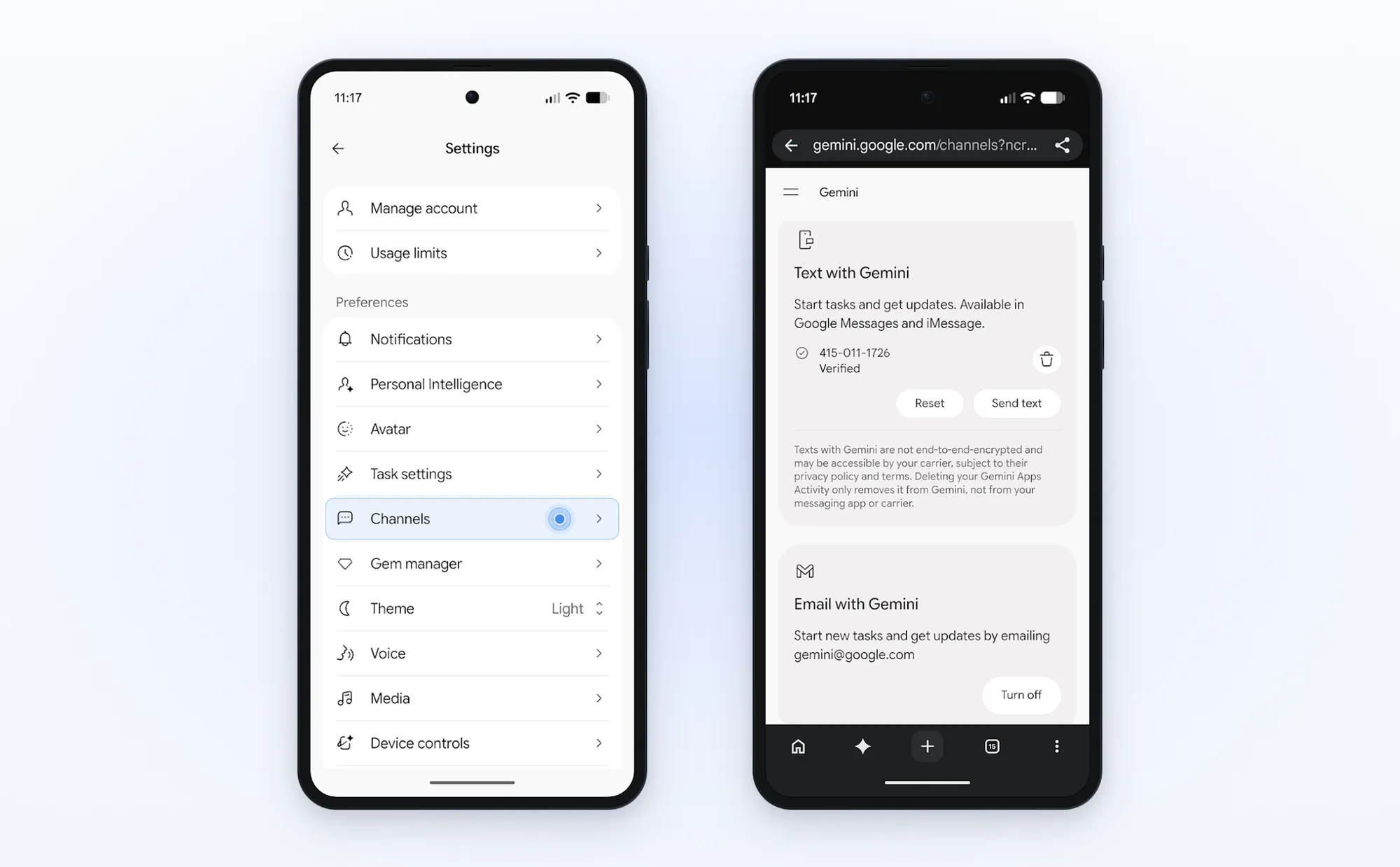
Groceries show the handoff boundary. A lasagna and produce list sent by RCS text, plus a photo of an empty Cheerios box, went onto an Instacart order, and then Gemini handed the user off to Instacart to complete it. Email works as an input channel too: forwarding school emails to gemini@google.com put every date on the calendar, with the spouse invited, in less than a minute, and Gemini flagged a basketball practice conflict and offered to text another parent about a carpool trade. In the US, tasks can also start by RCS text on Android or by iMessage.
My read: the distribution is the moat here. A standalone agent has to ask for your email, calendar, passwords, photos, files and payment cards one permission at a time. Gemini starts with all of that already inside Google, so the free rollout in six countries is really Google converting an existing data position into an execution position. The open question is whether users in Korea and the other launch countries accept that trade once the tasks touch money and phone calls, not just summaries.
How a Task Runs and Where Confirmation Sits
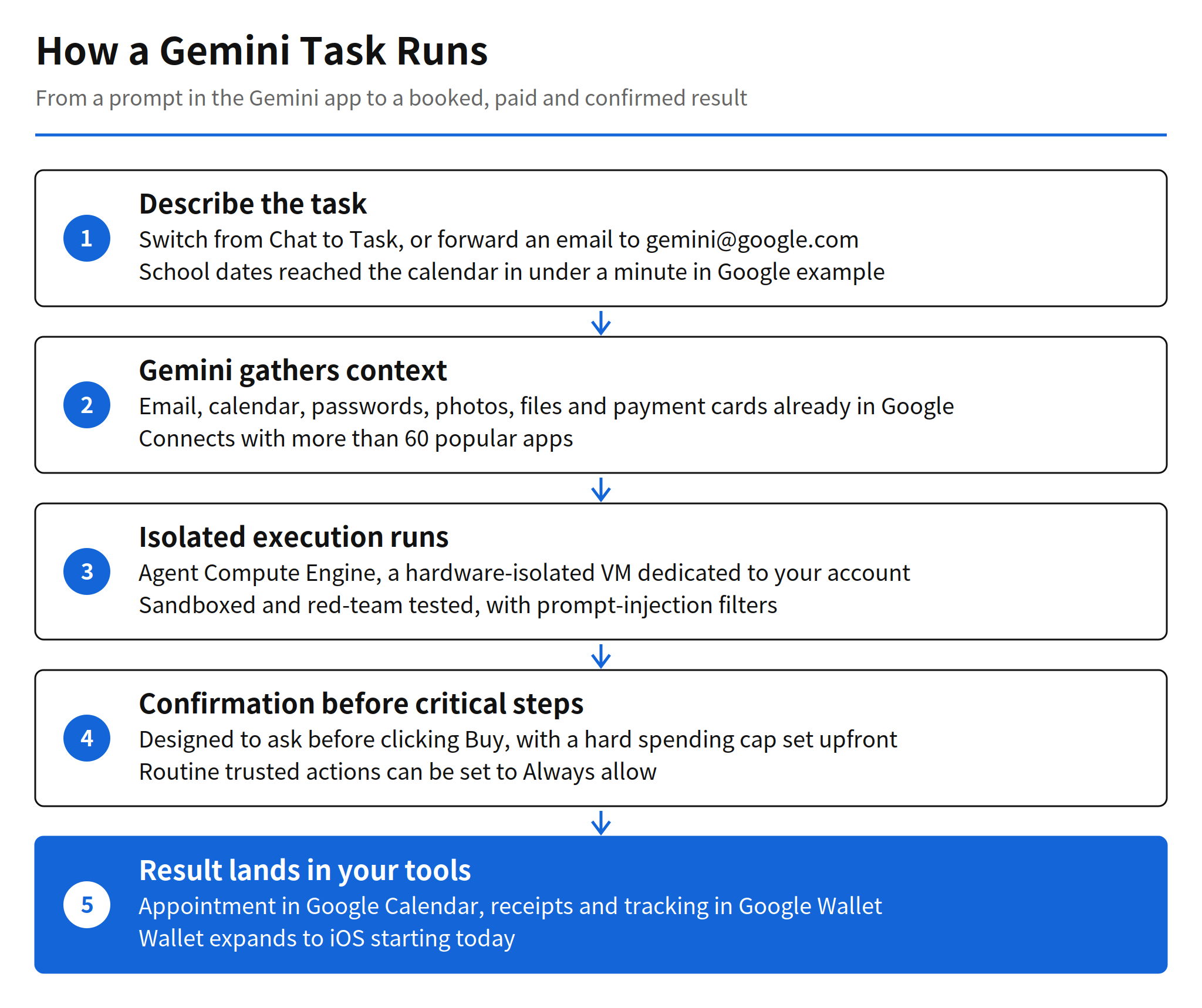
Execution runs on Google Cloud's Agent Compute Engine, in a hardware-isolated virtual machine dedicated to your account and never shared with other users. Google describes the sandbox as one layer among several, alongside prompt-injection filters that scan search results and webpages, and Google Safe Browsing limits on which links Gemini can open. The setup is regularly tested by Google security red teams, and Google points readers to its AI Vulnerability Reward Program for outside testing.
Control stays with the user at defined points. You can add instructions while a task is running. Gemini is designed to pause and ask for confirmation or pre-approval before critical steps, with clicking Buy as the named example, and to ask clarifying questions when an instruction is ambiguous. For routine actions you already trust, such as adding a grocery item, you can set Always allow so it stops asking. Users can also adjust task settings, disconnect Google and third-party apps, or delete chat history at any time. For developers, Google is also opening a Connected Apps Platform that apps can apply to join, on top of the more than 60 popular apps Gemini already connects with.
From Spark to a Free Default
Tasks began as Spark, an ambient agent concept, and this launch folds it into the main Gemini app with a simple Chat and Task toggle. That placement matters. A separate agent product has to win its own installs, while a toggle inside Gemini inherits the app's existing users in six countries at once. The Hydrogen model underneath it was covered here at launch, and the Agent Compute Engine was announced separately in October, so this release is the moment those two pieces meet a consumer surface.
The competitive read is straightforward. Rival assistants can also book and buy in demos, but they tend to start from a chat window and a credit card form. Google starts from the calendar, inbox, password manager and wallet the user already filled in over years. If the free tier proves reliable on ordinary chores, the paid question for competitors stops being model quality and becomes how much personal context they are allowed to hold.
Limits and Unconfirmed Points
- Free tier limits are unpublished: Google does not state daily task counts, or call and order limits for free users, so the real size of the free offer is unconfirmed.
- Advanced features are US first: phone booking and payments start in the US, and Google gives no date for Korea or the other launch countries.
- Some final steps still need the user: Google itself notes that on some sites the last button still has to be pressed by the user.
- American Express is not live: AP2 card support names Mastercard and Visa, with American Express marked coming soon.
- Failure is expected sometimes: Google says testing has minimised mistakes but not eliminated them, and tasks can fail to complete or miss the mark.
FAQ
Where is Gemini Tasks rolling out free?
Google says the free rollout started on November 17, 2026 for hundreds of millions of people in the US, Japan, Korea, Canada, Australia and India, running on the new Gemini 4 Hydrogen model.
What can Gemini Tasks do over the phone and with payments?
Starting in the US, Gemini can call businesses to book appointments and can pay through the Agent Payments Protocol (AP2), with digital tokens from Mastercard and Visa, a hard spending cap set upfront, and receipts and tracking in Google Wallet. American Express support is listed as coming soon.
How do you start a task in Gemini?
Switch the toggle from Chat to Task in the Gemini app, text Gemini through RCS on Android or iMessage in the US, or forward an email to gemini@google.com. Google says forwarded school emails had their dates on the calendar in less than a minute.
How does Google protect data during a task?
Tasks run on Google Cloud Agent Compute Engine in a hardware-isolated virtual machine dedicated to your account. Gemini is designed to ask for confirmation or pre-approval before critical steps such as clicking Buy, and users can disconnect apps or delete chat history.
What are the limits for free users in Korea?
Google has not published daily task, call or order limits for free users, and it has not said when phone booking and payments reach Korea. Those advanced features start in the US only.
Related Reading
- Gemini 4 Hydrogen Release: Pricing, Speed and Benchmarks, the model that now runs Tasks
- Ask Maps Itineraries and Phone Booking, Google putting phone calls to businesses inside Maps
- ChatGPT Wallet: How It Works, Pricing and Who Can Use It, the rival approach to agent payments