ChatGPT Wallet: How It Works, Pricing and Who Can Use It
OpenAI announced ChatGPT Wallet on November 13, 2026, a wallet that lets an agent pay for a purchase without ever seeing the user real card details. The wallet was built with American Express, Mastercard and Visa, and it starts inside dots, OpenAI always-on agent. The user enrols a card once, reviews each purchase, approves it with Face ID or a fingerprint, and the card network then issues a payment token that the merchant charges.
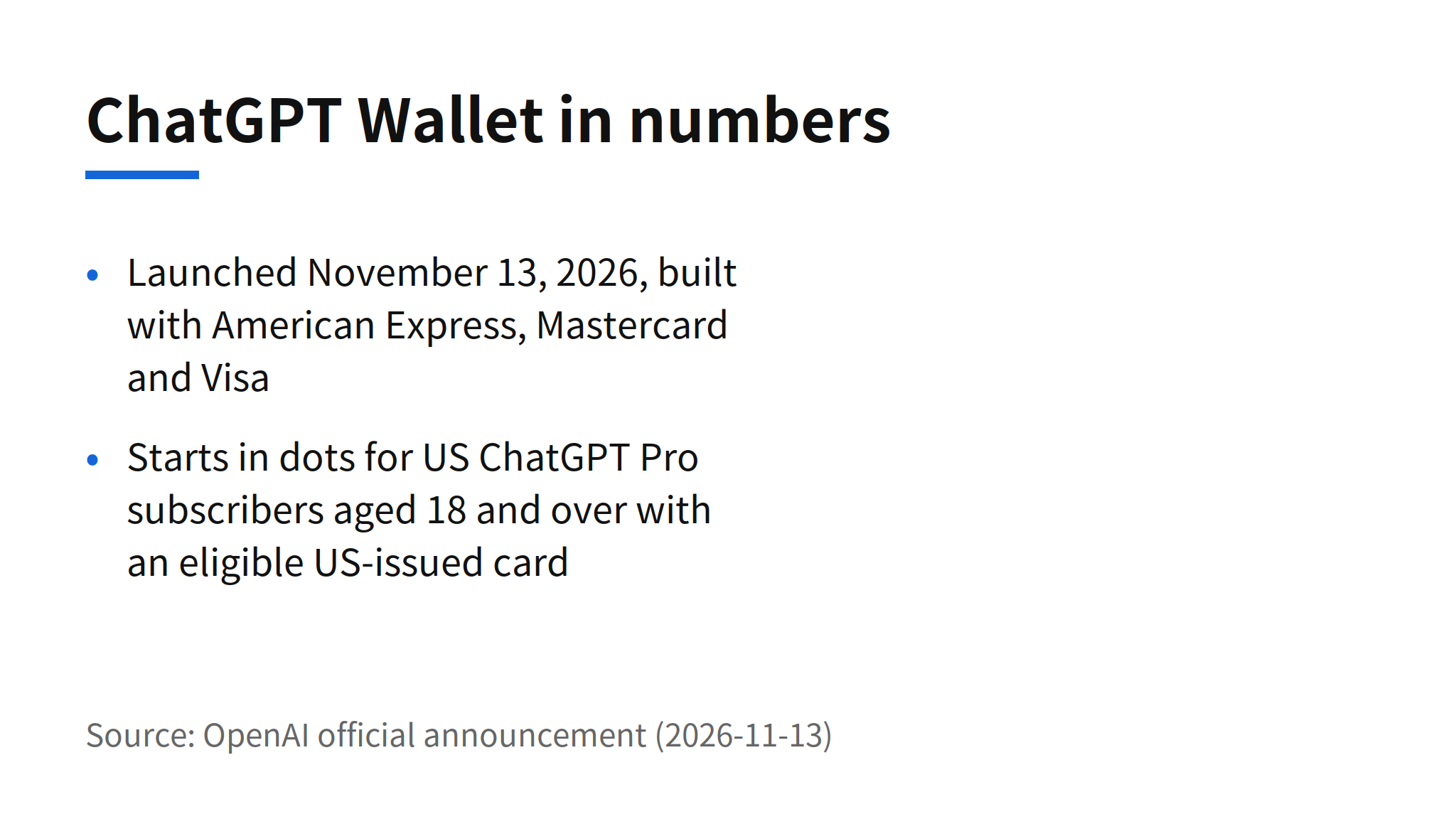
The launch group is deliberately small. Only ChatGPT Pro subscribers who are 18 or older, live in the United States and hold an eligible US-issued card can use the wallet at launch, and OpenAI charges no transaction fee at this stage. That narrow start matters less as a consumer rollout than as a standards test: the product defines how an agent proves a human approved a payment, and how a merchant checkout accepts that proof without handing card numbers to software.
Launch scope and eligibility
Eligibility has four conditions, and all four have to hold at once. The user needs a ChatGPT Pro subscription, has to be at least 18, has to live in the United States, and has to enrol a card that is both eligible and issued in the United States. The full list of eligible cards sits in OpenAI help documentation rather than in the announcement itself, and reporting on the launch noted that virtual cards are not supported at launch. Anyone outside that group, including Free, Go and Plus subscribers, has no published start date.
The Pro-first scope also frames the economics. Pro plans sit in a high price band, so the first wallet users are a small group by design. OpenAI says 1.2 billion people use ChatGPT every week and that many of them already search for and compare products inside ChatGPT. The wallet is the step that turns that existing shopping behaviour into a completed purchase, and starting with the highest paying tier lets OpenAI test the payment rails with users whose spending can cover early support costs while the merchant side is still being built.
How a payment works in practice
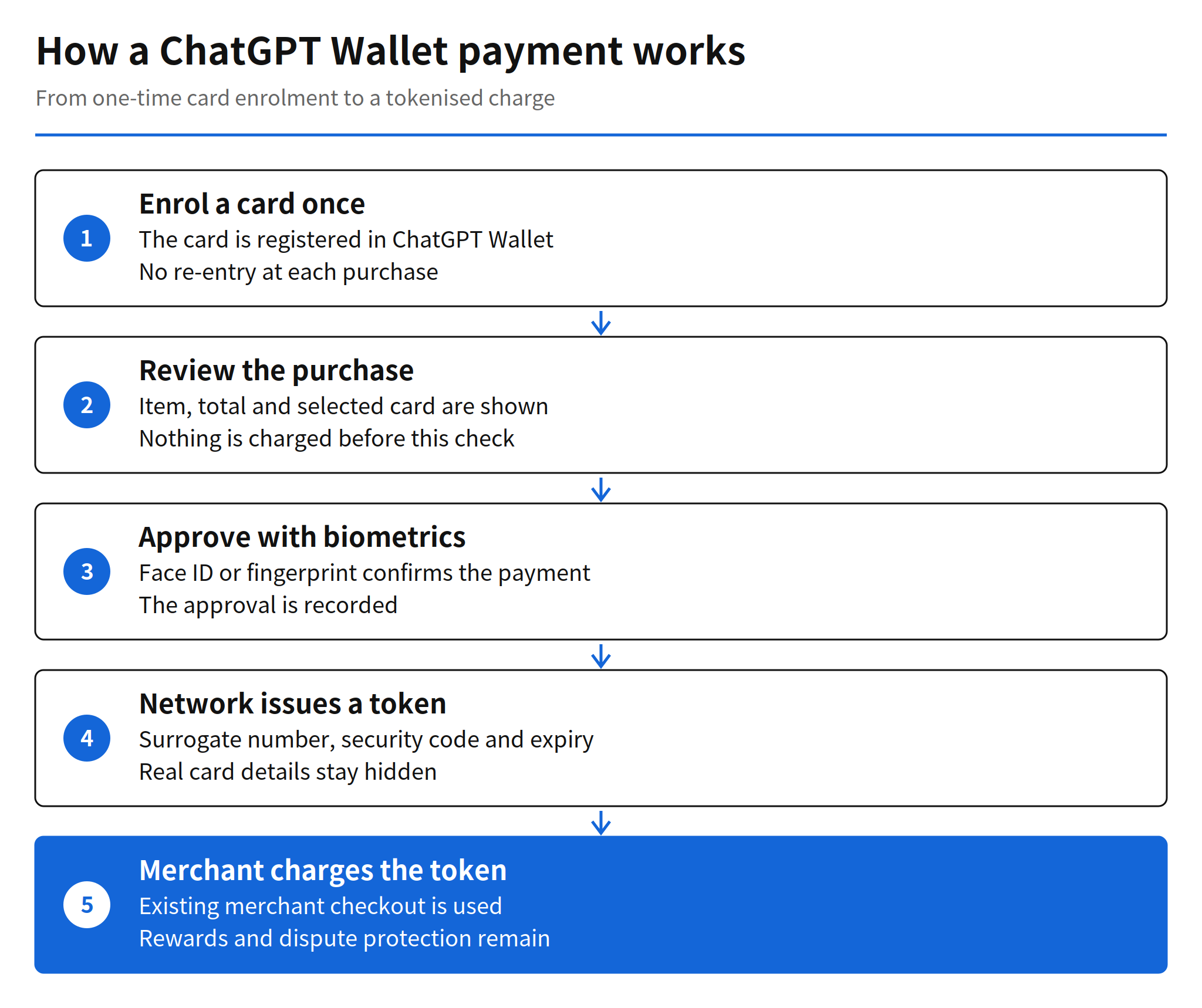
The flow has one setup step and then a repeating approval loop. The user registers a card in the wallet once and does not re-enter card details for later purchases. When the dots agent is ready to buy something, the user first sees the item, the total and the selected card. Approval takes a biometric check, Face ID or a fingerprint, and the approval leaves a record of which purchase was authorised. Only after that approval does the card network issue the payment token.
The token is the core of the design. It carries a surrogate card number, a security code and an expiry date, so a merchant checkout can process it like a normal card payment. The real card number never reaches the merchant or the agent. That split is what separates this design from simply storing a card inside a chatbot: the agent can act on an approved token, but it never holds a credential it could reuse on its own. The user existing card benefits survive the split, because the charge still runs on the underlying card. Rewards and dispute protection stay in place, including disputes over defective goods.
The merchant side and the Commerce Partner Playbook
A wallet only works if merchants can accept what it sends, and OpenAI published a Commerce Partner Playbook alongside the wallet to cover that side. A merchant registers its business with ChatGPT and uploads a product feed. On the network side, the merchant configures its CDN and firewall to recognise signed agent requests through Web Bot Auth, so an agent visit can be told apart from ordinary bot traffic instead of being blocked by default.
The named partner lists show where OpenAI expects the friction to sit. Fraud prevention partners are Forter, Riskified, Sardine and Signifyd, and payment processors are Adyen, Checkout.com and Stripe. In other words, the hard problems are not the chat interface. They are whether a merchant risk system treats an agent payment as a legitimate transaction, and whether its firewall and checkout are configured to let that transaction through at all. A merchant that gets those settings wrong loses the sale before price or product quality enters the picture.
Pricing and the business model at launch
OpenAI takes no transaction fee at launch. Chaya Nayak, who leads revenue and payments products at OpenAI, told CNBC that the company would first build the foundation with merchants and network partners. Read plainly, the wallet is currently an infrastructure land grab rather than a revenue line: OpenAI gives up a cut on early transactions in exchange for merchants wiring up product feeds, Web Bot Auth and risk integrations that later agent commerce will depend on.
That choice also explains the contrast with the earlier attempt. OpenAI first tried in-chat purchasing with Instant Checkout in September 2025, and that programme was folded in March 2026, with a lack of flexibility given as the reason at the time. The wallet takes the opposite approach. It leaves the merchant existing checkout in place and changes only the payment instrument, swapping the card number for a network token. A merchant keeps its own checkout, fraud stack and processor relationship, which lowers the cost of saying yes, and that lower adoption cost is the bet behind the zero fee start.
Limits and unverified points
Four limits should stay attached to this launch. First, the expansion timeline is unpublished: there is no confirmed date for Free, Go or Plus users, or for any country outside the United States. Second, some sites can block agent purchases, a possibility OpenAI states in its own announcement. CNBC reporting added concrete cases, with Amazon blocking agent purchases and United Airlines saying it would block bookings by third party agents. A wallet token does not help at a checkout that refuses agent traffic outright.
Third, approval is still per purchase. OpenAI describes pre-approval by spending limit, category and time window only as a future plan, with no confirmed start date. Until that ships, every agent purchase needs a live biometric approval from the user, which caps how autonomous dots shopping can be. Fourth, the eligibility details are incomplete in the announcement itself: the full eligible card list lives in separate help documentation, and the claim that virtual cards are unsupported at launch comes from launch reporting rather than from the announcement text.
The verified core is still clear. An agent can now complete a purchase on a major card network without holding the user card number, the user keeps rewards and dispute rights, and the merchant keeps its own checkout. Whether that becomes a general payment standard depends on the two things this launch does not control: how many merchants configure their systems for agent traffic, and how many large platforms decide to block it instead.
Related articles
FAQ
What is ChatGPT Wallet and when did it launch?
ChatGPT Wallet is a wallet OpenAI announced on November 13, 2026, built with American Express, Mastercard and Visa. It lets an agent pay for a purchase without seeing the user real card details, because the card network issues a payment token instead.
Who can use ChatGPT Wallet at launch?
At launch the wallet starts inside dots, OpenAI always-on agent, for ChatGPT Pro subscribers aged 18 and over who live in the United States and hold an eligible US-issued card. OpenAI has not published a timeline for Free, Go or Plus users or for users outside the United States.
How does a ChatGPT Wallet payment work step by step?
The user enrols a card once. Before a purchase, the user reviews the item, the total and the selected card, then approves with Face ID or a fingerprint. The card network then issues a token with a surrogate card number, security code and expiry date, and the merchant charges that token while the real card details stay hidden.
Does ChatGPT Wallet charge a transaction fee?
OpenAI charges no transaction fee at launch. Chaya Nayak, who leads revenue and payments products, told CNBC the company would first build the foundation with merchants and network partners.