Brave Search API x402 Payments: $0.005 Per Query, No Key
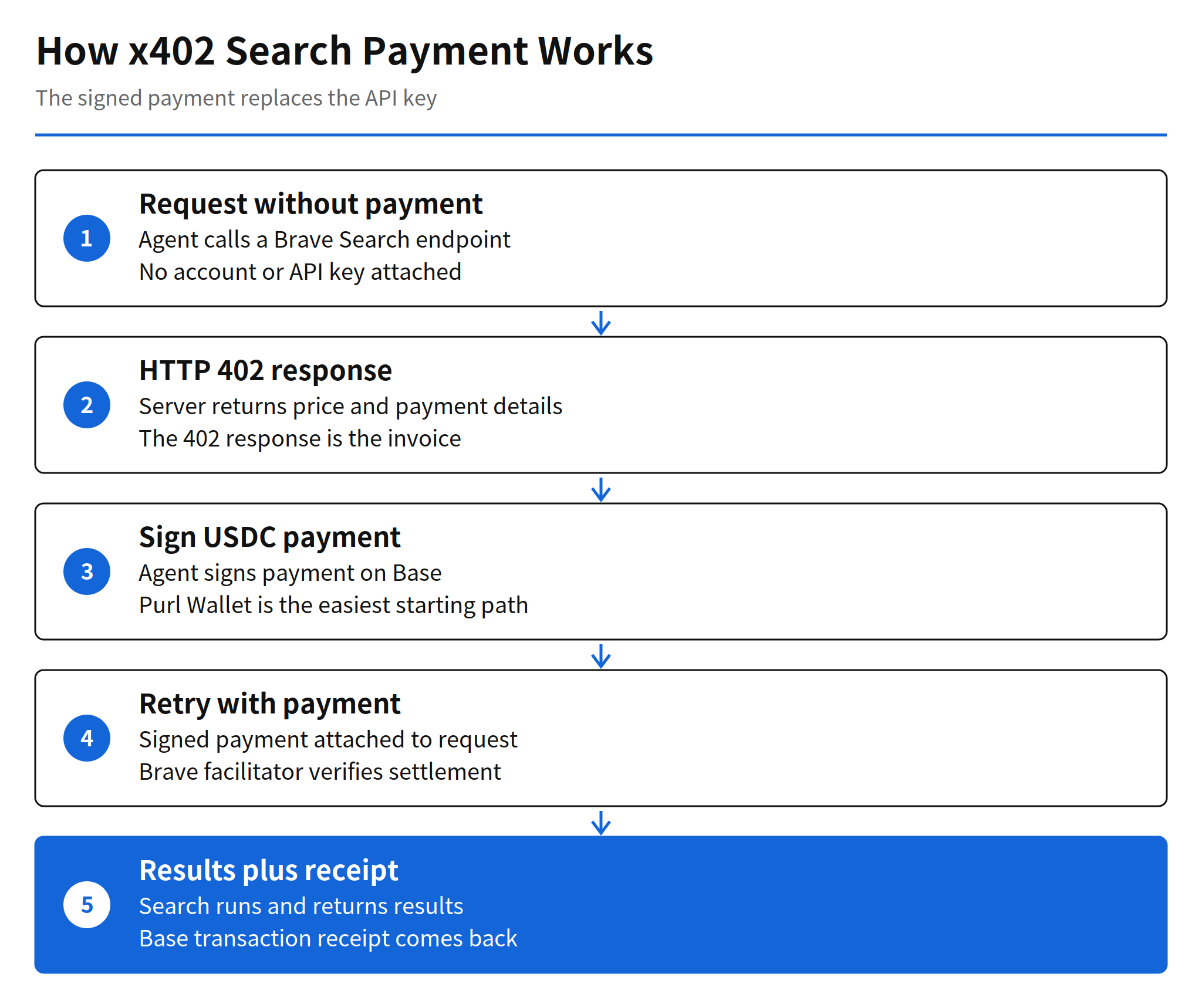
Brave announced on November 12, 2026 that the Brave Search API now accepts agentic payments through the open x402 protocol. An agent no longer needs an account or an API key to buy search. It sends a request, receives an HTTP 402 Payment Required response stating the price, signs a USDC payment on Base, and retries with the payment attached. The price is $0.005 per request, or $5 per 1,000, and the verified result comes back with a Base transaction receipt.
That is a structural change in how a search API is sold, not a new billing page. The traditional model assumes a human who signs up, picks a plan, stores a key, and rotates it later. An autonomous agent has no natural place in that flow unless a person provisions it in advance. With x402, the payment itself is the credential, so a harness can give an agent a funded wallet and let the agent buy grounding data at the moment it needs it.
What Brave Announced on November 12
The announcement, published on the Brave blog under the title "The Brave Search API now accepts agentic payments via the x402 protocol", covers the full search product rather than a single endpoint. LLM Context, the endpoint built to ground agent answers, costs $0.005 per request. The web, news, image, video and local endpoints carry the same price. Settlement runs through a facilitator that Brave operates itself, accepting USDC on Base, and Brave says support for other networks and other stablecoins is coming soon, without a date.
Two details in the announcement matter for cost planning. First, the price follows Brave's published API rates, so the x402 path is not a promotional discount tier with separate economics. Second, Brave covers Base gas fees for a limited time. While that lasts, the $0.005 figure is close to the full marginal cost of a query. Once the coverage ends, each request will also carry network fees, and Brave has not published an end date, so any budget built on today's number should treat the gas subsidy as temporary.
The Pay-Then-Retry Flow
The flow uses a status code that sat mostly unused for decades. Endpoints behind x402 require payment on every request rather than authentication. A request sent without payment receives a 402 response that lists the price of that exact search and the payment details needed to pay it. The agent signs a USDC payment for that amount and retries the request with the signed payment attached. Once the payment is verified, the search runs and the results return with a receipt of the transaction on Base.
The proxy documentation adds the operational specifics. The paid service is served from search.agent.s.brave.app, paths match the ones on api.search.brave.com, and query parameters pass through unchanged. Brave tells agents to read the llms.txt file on that host before paying, because it carries current prices, supported payment rails and clients, the pay-then-retry loop, and error handling. A machine-readable openapi.json on the same host lists every paid path with its price, and Brave states that the 402 response itself is the authoritative price of a request.
Pricing and Covered Endpoints
Coverage is broad but not complete. The documentation lists web search, LLM Context, news, video and image search as available, along with place search, points of interest and descriptions. Answers, Autosuggest and Spellcheck are not sold through the payment proxy yet and still need an API key. A team that builds its whole search layer on the keyless path today therefore has to keep a key for those three services, or design around them.
The flat $0.005 rate also simplifies a calculation that is usually messy. Agent runs are often priced in tokens, which makes search spend hard to forecast because query counts vary by task. A fixed per-query price lets a harness set a hard search budget per run in plain units: 200 queries is $1.00 of search spend before gas, regardless of which covered endpoint served them. My read is that this predictability, more than the absolute price, is what makes the offer usable inside autonomous loops that need spending caps.
Getting Started With Purl Wallet
Brave names one starting path explicitly: Purl Wallet, a CLI wallet developed by Stripe. The documented procedure is short.
- Install an x402 client such as Purl Wallet for the agent.
- Fund the wallet with Base-native USDC.
- Read the llms.txt file on search.agent.s.brave.app for current prices, rails and error handling.
- Send a query to a paid path, for example the LLM Context path, with a payment cap set in the token's base units.
The documentation example caps a payment with --max-amount 10000, where 10000 base units equal $0.01, against the LLM Context endpoint. The cap is a meaningful safety control: it bounds what a single request can spend even if the 402 response quotes more than expected, and it gives harness authors a per-call ceiling in addition to any wallet balance limit.
purl --max-amount 10000 'https://search.agent.s.brave.app/res/v1/llm/context?q=tallest+mountains+in+the+world'Why Keyless Payment Matters for Agent Harnesses
Search is one of the first services an agent needs and one of the hardest to provision for it. API keys tie usage to a person and a plan, they leak, and they need rotation. A fleet of short-lived agents either shares one key, which destroys per-agent accounting, or waits for a human to issue keys, which destroys autonomy. Per-request payment cuts through both problems: spend follows the wallet, each query settles on its own, and the Base receipt gives an audit trail that matches the result it paid for.
The comparison point in this research series is Exa, which launched an agent-focused search API in an earlier issue. That model still sells search as an API product with conventional access. Brave's move is different in kind: it attaches an agent commerce protocol, x402, to a mainstream search index with a published per-query price. Whether other search providers follow will depend on whether agent traffic becomes large enough to justify running a facilitator, but Brave has set the reference price and the reference flow.
My read: the lasting part of this launch is not the wallet. It is the inversion of the credential. When the signed payment is the credential, onboarding an agent becomes a funding problem instead of an identity problem, and funding problems are much easier to automate, cap and audit.
Limits and Open Questions
- Network and asset breadth is still narrow: settlement is USDC on Base through Brave's own facilitator. Other networks and stablecoins are described as coming soon, with no confirmed date.
- The gas subsidy has no published end: Brave covers Base gas fees for a limited time and has not said when that ends, so the true long-run per-query cost is not yet fixed.
- Three services still need a key: Answers, Autosuggest and Spellcheck are not sold through the proxy yet, per the documentation.
- Latency is unmeasured in public: the pay-then-retry loop adds a round trip and a settlement step to every query. There is no independent measurement yet of how much that slows real agent workloads.
- Per-request payment is the current model: the documentation states that today each request carries its own payment. Session or bundle pricing, if it comes, is not documented.
FAQ
How much does a Brave Search query cost through x402?
Each request costs $0.005, which is $5 per 1,000 requests. Brave applies the same price to LLM Context and to the web, news, image, video and local endpoints. Gas fees on Base are covered by Brave for a limited time.
Do I still need a Brave Search API account or API key?
No. On the x402 path the signed payment is the credential. A request without payment receives an HTTP 402 response with the price and payment details, and the agent retries with a signed USDC payment attached.
Which endpoints are not sold through x402 yet?
According to the Brave Search x402 Proxy documentation, Answers, Autosuggest and Spellcheck are not sold through the payment proxy yet and still need an API key. Web search, LLM Context, news, video, image and place search paths are available.
How does an agent start paying for Brave Search?
Brave points to Purl Wallet, a Stripe-developed CLI wallet, as the easiest path. Set up the wallet, fund it with Base-native USDC, and query the payment proxy host. The documentation example caps a payment with --max-amount, where 10000 base units equal $0.01.
Related Reading
- DigUp: On-Device Semantic File Search, EmbeddingGemma 2, a search tool that takes the opposite route and keeps queries on the device
- browser-use 1.0 Release: CDP Direct, 80% Code Deleted, on the browser layer agents use after search returns links