browser-use 1.0 Release: CDP Direct, 80% Code Deleted
browser-use shipped version 1.0.0 on November 10, 2026, closing its long 0.x line with a first stable release titled "browser-use 1.0: CDP is all you need". The rewrite deleted about 136,866 lines, roughly 80% of the codebase, and rebuilt the library from scratch. The core change is architectural: the agent no longer receives a serialized dump of the page DOM and picks the next step from a fixed action list. It writes Python code inside one persistent REPL and executes Chrome DevTools Protocol (CDP) commands directly, and the DOM serializer and the action schema are gone.
The release also changes what a default run means. With no model specified, runs now use the bu-fast model through the Browser Use gateway, and Browser() creates a Browser Use Cloud browser instead of a local one. Local Chromium is an explicit choice, Browser('chromium'). Authentication collapsed from per-provider keys to a single BROWSER_USE_API_KEY, and the default step budget fell from 500 to 100. For a library with 120,525 GitHub stars and 13,464 forks under the MIT license, this is a migration event for every team that built browser automation on the 0.x API, not a routine version bump.
The Execution Model Change: DOM Dump Out, REPL In
The 0.x design put a translation layer between the model and the browser. The library serialized the page DOM into a text form the model could read, the model selected one action from a predefined schema, and the library executed that action and serialized the page again. Every step paid for that round trip, and the action schema bounded what the agent could do to what the library authors had anticipated. Version 1.0 removes the layer entirely. The model writes code, the code talks CDP to Chrome, and one step is defined as a single model request. Anything Chrome exposes through CDP is reachable without waiting for the library to wrap it as a named action.
That trade has a clear direction. A thinner harness means less library code to maintain and fewer serialization costs per step, and it leans on the observation that current models write competent Python. It also moves responsibility: with no action schema validating intent, the constraints that remain are the ones the release adds around the run itself, such as domain restrictions and secret masking through sensitive_data. Teams evaluating 1.0 should read it as a bet that model capability, not harness structure, is now the scarce resource in browser agents.
Benchmark Claims and the BU Bench v2 Caveat
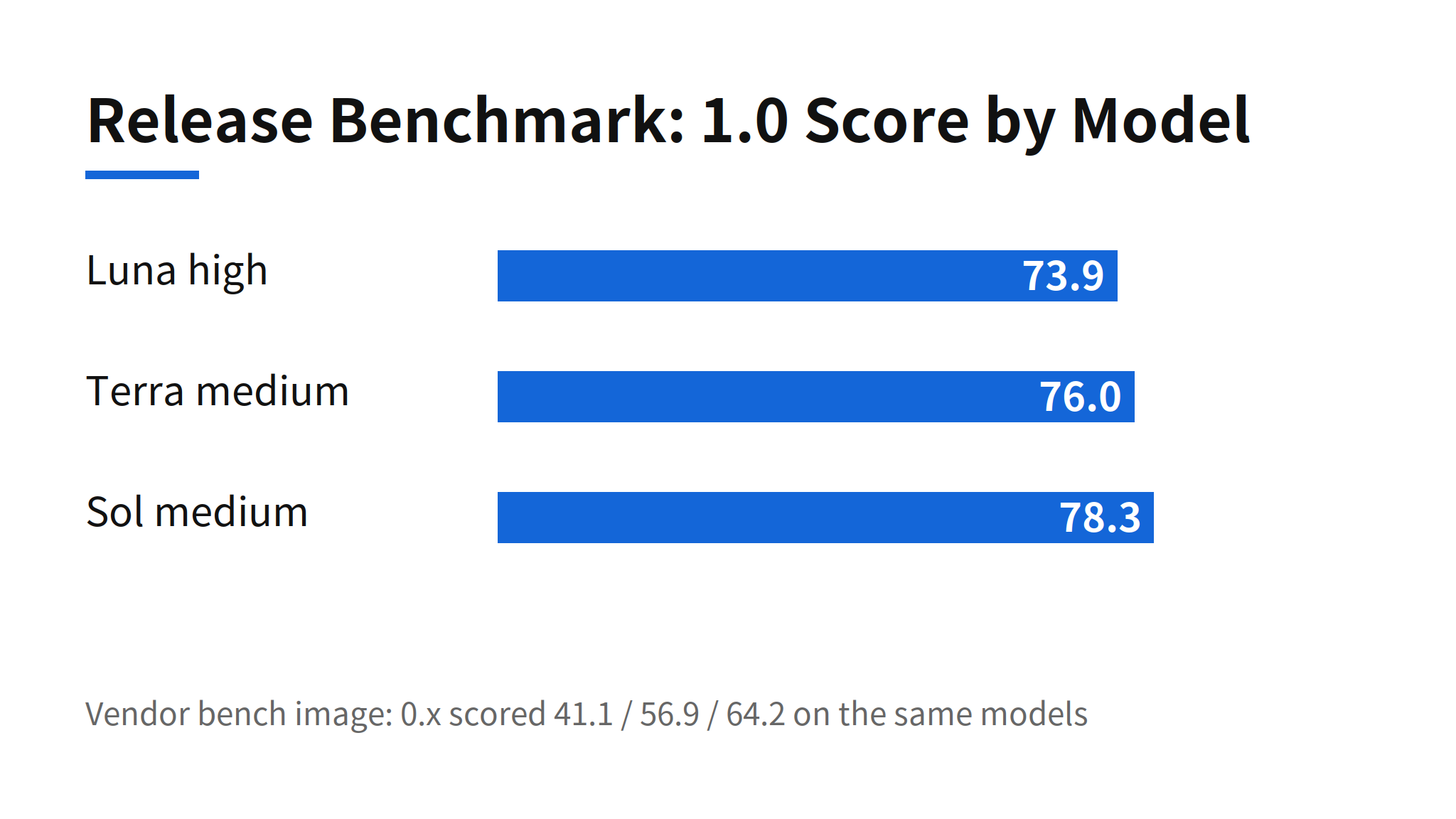
On the same models, the vendor release benchmark reports gains of up to 33 points, cost per task down by a factor of 2.7 to 5.2, and runs 2 to 3 times faster. The chart published with the release shows 1.0 scoring 73.9 on Luna high against 41.1 for 0.x, 76.0 on Terra medium against 56.9, and 78.3 on Sol medium against 64.2, with per-task model cost falling from $3.56 to $0.68 in the Sol medium configuration.
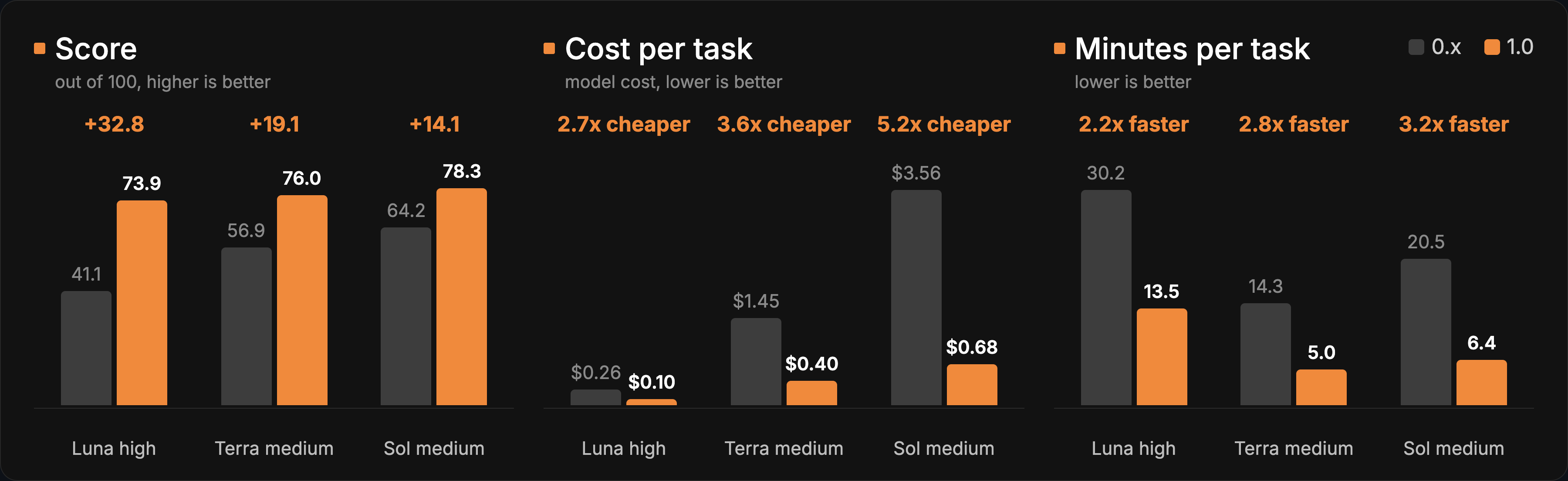
The second benchmark in the same release notes tells a more restrained story. BU Bench v2, run over 60 tasks with 3 repetitions on cloud browsers on November 9, 2026, gave 1.0 a score of 62.5 (95% CI 58.3 to 66.5) at $0.070 per task and 650 seconds per task. In the paired comparison that excludes provider errors, the release notes state plainly that the score difference was not significant and that only cost and time fell. Both statements can be true at once: the harness change reliably cuts cost and latency, while the headline score gains depend on which comparison and which error handling the reader chooses. Independent replication is still missing, so the defensible claim today is cheaper and faster, with score gains unconfirmed.
New Defaults: Cloud Browser, One Key, Tighter Limits
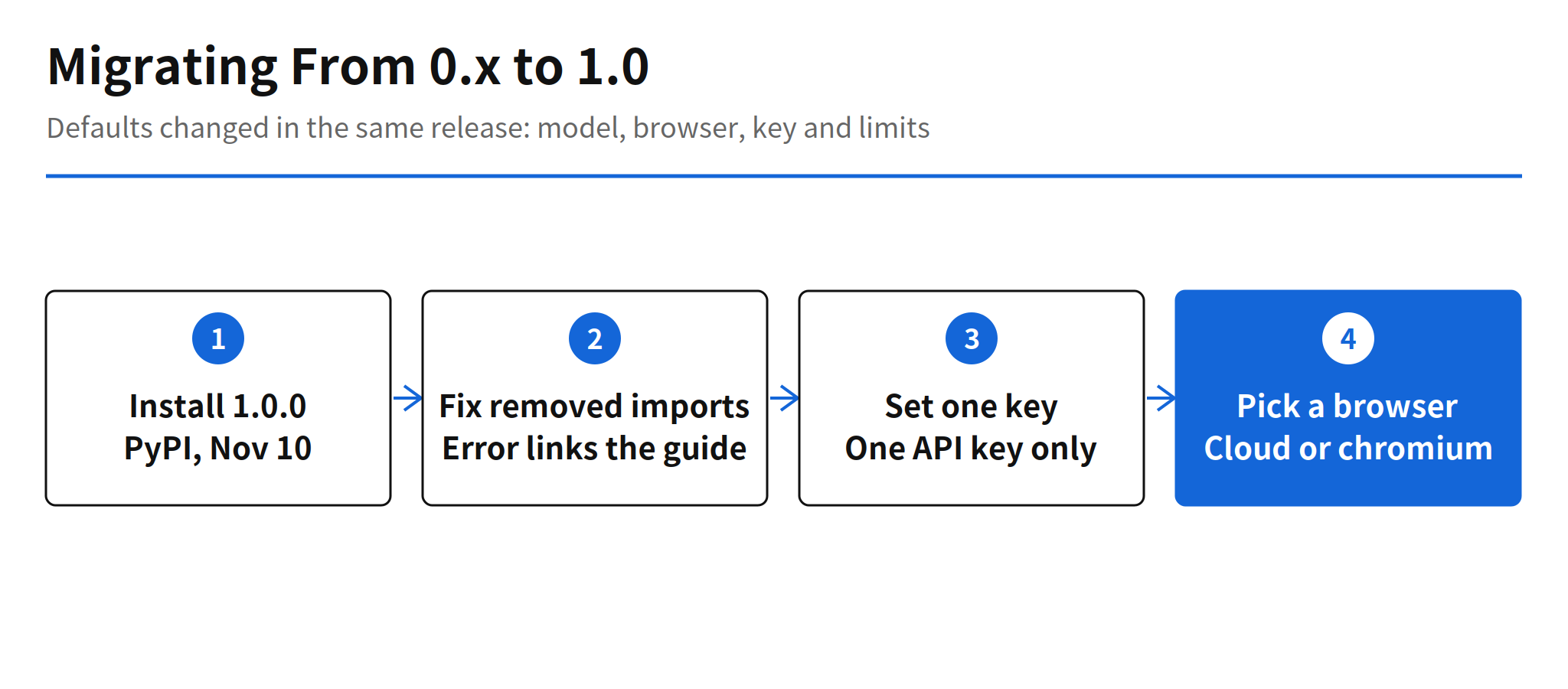
| Setting | 0.x behavior | 1.0 behavior |
|---|---|---|
| Default model | Provider model chosen by the user | bu-fast through the Browser Use gateway |
| Default browser | Local browser | Browser Use Cloud via Browser() |
| Local browser | Default | Browser('chromium') explicitly |
| Authentication | Per-provider API keys | Single BROWSER_USE_API_KEY |
| Run limits | max_steps default 500 | max_steps default 100, timeout 1700 seconds |
The defaults matter more than the new features for most existing users, because they change behavior without any code change on the user side. A script written for 0.x assumed a local browser and local network reachability. Under 1.0 defaults the same script runs against a cloud browser, so tasks that touch localhost or private IP addresses need Browser('chromium') to work at all. The step budget cut from 500 to 100 also turns long exploratory runs into bounded ones by default, which fits the cost story of the release but will silently truncate workflows that relied on the old headroom.
New Capabilities and the Breaking-Change Contract
The feature list is short and practical. Typed results through output_model_schema let a run declare the shape of its answer. File upload and download are supported as first-class operations. Secrets can be masked through sensitive_data, domains can be restricted, and web_search=True adds web search to a run. None of these required the rewrite, but shipping them inside a smaller codebase is the point the release is making: the library now does less translation and more direct control.
The compatibility break is handled as an explicit contract instead of silent failure. A removed import raises an ImportError that names the replacement path and links to MIGRATING.md. An option the new version cannot support raises a TypeError before a browser launches or any billing starts. Projects that cannot migrate yet can pin the old line, since 0.x remains installable as browser-use<1 and its final release is 0.13.14. Version 1.0.0 itself reached PyPI at 02:34 UTC on November 10, thirty minutes after the GitHub release at 02:04 UTC.
Limits and Open Questions
- Score gains are not independently verified. The vendor paired comparison in BU Bench v2 showed no significant score difference once provider errors were excluded, so the up-to-33-point headline and the measured comparison still need an outside replication to reconcile.
- Cloud defaults break local assumptions. Tasks against localhost and private addresses require local Chromium, and scripts written for the 0.x defaults will not behave the same without changes.
- Dependencies are pinned exactly. All dependencies are fixed with exact version specifiers, and the known-issues list notes that a mismatch on core packages such as pydantic can prevent installing 1.0 alongside other tools.
- Viewport emulation is missing in cloud browsers. The release lists it as not yet working in the cloud configuration, which limits device-emulation testing on the new default path.
Related Reading
The harness-thinning move in this release matches a wider pattern in agent infrastructure. See the report on the Cloudflare Codex harness on Durable Objects for another design that pushes state and execution into the platform layer, and the report on phoneuse and iPhone control from Linux for direct device control without a thick intermediary.
FAQ
What changed in browser-use 1.0?
The agent no longer picks steps from a serialized DOM dump and a fixed action list. It writes Python code in one persistent REPL and executes Chrome DevTools Protocol commands directly, and the DOM serializer and action schema were removed.
What are the new defaults in browser-use 1.0?
With no model specified, runs use the bu-fast model through the Browser Use gateway, and Browser() creates a Browser Use Cloud browser. Local Chromium is selected with Browser('chromium'), authentication uses the single BROWSER_USE_API_KEY, and the max_steps default fell from 500 to 100 with a timeout of 1700 seconds.
How much code did browser-use 1.0 delete?
The release notes say the codebase shrank by about 136,866 lines, roughly 80 percent of the previous code, in a rewrite built from scratch for the 1.0 release.
Can existing 0.x projects keep running?
Version 0.x stays installable as browser-use<1, with 0.13.14 as the last 0.x release. Removed imports in 1.0 raise an ImportError that points to the replacement path and the MIGRATING.md guide, and unsupported options raise a TypeError before a browser starts or billing begins.
How strong is the benchmark improvement in browser-use 1.0?
The vendor release benchmark reports gains of up to 33 points, 2.7 to 5.2 times lower cost per task and 2 to 3 times faster runs on the same models. In BU Bench v2 the paired comparison excluding provider errors showed no significant score difference, and the release notes state that only cost and time fell in that comparison.