Google Ask Maps: Itineraries, Route Tips and Phone Booking
Google announced four new Ask Maps features on November 16, 2026. Ask Maps can now build a step by step trip itinerary from a spoken request, show Know before you go tips when a route opens, find local appointments online and call local businesses on the user's behalf, and search saved lists against live availability. The updates started rolling out that day on Android and iOS.
The expansion matters as much as the features. Ask Maps is expanding to 30 countries across Europe, including Spain, Germany and the U.K., which brings it to more than 200 countries and territories globally. Itineraries and list search work everywhere Ask Maps is offered, while route tips and appointment finding launch first in the U.S., with more regions promised later and no date given.
Ask Maps is the Gemini powered conversational search inside Google Maps. Until now its job ended at an answer. This release moves it past answering into doing: drafting a multi day plan, checking conditions before departure, and placing a phone call to a business. That shift, inside an app people already open every day, is the real story for anyone building agent features elsewhere.
Trip Itineraries With Numbered Pins
The itinerary builder covers both ends of trip complexity. Google's examples range from a day trip for holiday shopping to a three day road trip with stops for coastal hikes and oceanfront dining. The result is a day by day schedule where each stop carries insider tips and a numbered map pin, so the plan can be read as a list and followed on the map at the same time.
Once the plan looks right, it can be shared with friends and family, or exported to Google Docs on desktop. The itinerary also stays live after it is created. Reopening it before departure, or finding it through the itinerary badge in chat history, shows real time details: live traffic conditions, whether a place is open, and what Google describes as the vibe at the next stop. Stops can be added on the fly, for example a scenic viewpoint or a lunch place along the way, and directions to the next stop start with a tap from inside the itinerary.
The design choice worth noting is that the plan is not a static document. A generated itinerary that freezes at creation time competes with a notes app. One that rechecks traffic, opening status and conditions at departure time competes with the act of replanning, which is where travellers actually lose time. Google has not published accuracy figures for the recommendations themselves, and its post labels generative AI as experimental, so the quality of the stops and tips remains an open question that usage, not the announcement, will settle.
Know Before You Go Route Tips
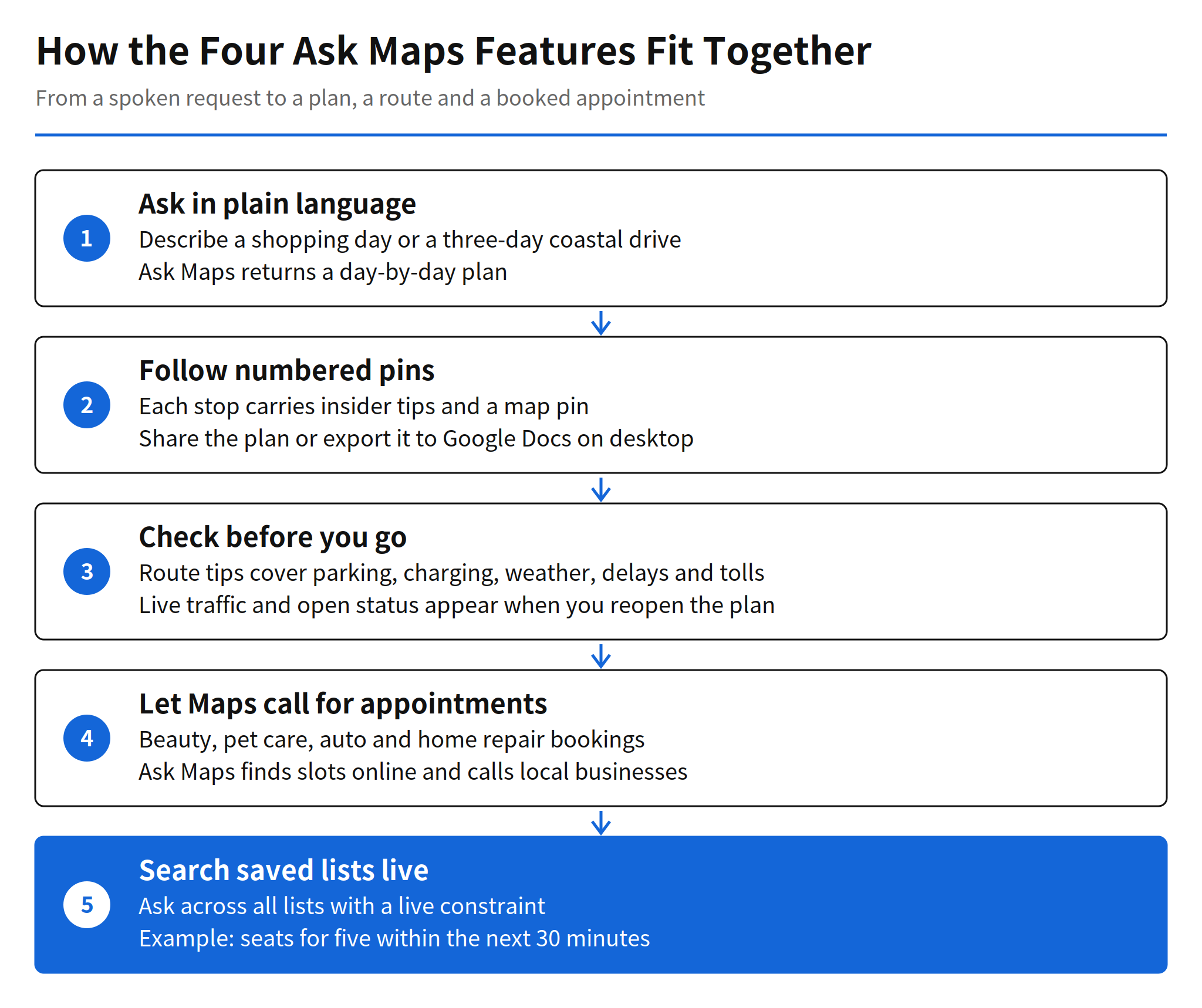
When directions open, Maps now surfaces Know before you go tips about the route. The list is practical rather than conversational: where to park, where to charge a car, real time weather, potential delays and tolls. These are facts drivers normally assemble from several screens or discover too late, and placing them at the moment the route appears is a small change with an outsized effect on whether the information gets used at all.
Route tips are also the most geographically limited part of the release. Together with appointment finding, they launch first in the U.S., and Google gave no schedule for other regions. Travellers in the 30 newly added European countries get itineraries and list search, but not the departure checks, which makes the European expansion a search rollout rather than a full feature rollout.
Appointment Finding That Calls Businesses
The appointment feature is the clearest agent behaviour in the release. A user can ask, "Find me a 4 p.m. nail appointment near me," and Ask Maps will find appointments online and call local businesses directly. It covers four categories at launch: beauty, pet care, auto and home repair. The result is a set of open slots across nearby businesses, presented so the user can decide what to book.
Two limits define how far this agent actually goes. First, the final choice stays with the user: Ask Maps finds and calls, then shows slots, and the person decides. Second, Google did not explain which booking systems the search checks for availability, or how a phone call result is verified before it is shown as an open slot. For a feature whose value depends on the slot being real when the user arrives, that mechanism is the product, and it is currently undisclosed.
My read: the phone call is the strategic move. Online booking platforms own the businesses that adopted them, but a large share of local services still run on phone calls. An agent that can call reaches the businesses platforms could not onboard, and it reaches them through Maps, which those businesses already depend on for discovery. If the calls prove reliable, Maps becomes a booking channel without asking a single salon or repair shop to change its system.
Saved List Search With Live Availability
The fourth feature turns saved lists from storage into a queryable set. Instead of opening each saved place, a user can ask across all lists at once. Google's example is a host with visiting friends: "Which spots saved in my lists have availability for five people in the next 30 minutes?" Ask Maps looks across the lists and checks live availability, so the answer is a place the group can actually go to now.
This is a quiet but telling change in what a list means. Saved places were a personal archive, useful only if the owner remembered what was in it. Searching them with a live constraint, party size and a 30 minute window, makes the archive behave like inventory. It also rewards long time Maps users, because the feature gets better with every place they have saved over the years, which is a retention dynamic a newer competitor cannot copy quickly.
Availability and Rollout
- Platforms: the updates started rolling out on Android and iOS on November 16, 2026.
- Everywhere Ask Maps is offered: travel itineraries and saved list search.
- U.S. first: Know before you go route tips and appointment finding, with more regions coming and no timeline published.
- Expansion: Ask Maps reaches 30 countries across Europe, including Spain, Germany and the U.K., for a total of more than 200 countries and territories.
For Android developers, the competitive implication is direct. A maps app that plans trips, checks routes and books appointments by phone raises the baseline for what users expect an agent to do inside a default app. Standalone agent apps now compete not on whether they can place a call or build an itinerary, but on whether they can do it better than the app already installed, already signed in and already holding the user's saved places.
Limits and Unconfirmed Points
- No expansion timeline: route tips and appointment finding outside the U.S. are promised without dates.
- Booking mechanism undisclosed: Google did not say which reservation systems the appointment search checks, or how phone confirmed slots are verified.
- Partial country list: only Spain, Germany and the U.K. are named out of the 30 European countries.
- No accuracy data: Google labels generative AI as experimental and published no accuracy figures for itineraries or recommendations.
FAQ
What did Google add to Ask Maps on November 16, 2026?
Google added four features: trip itinerary building, Know before you go route tips, appointment finding that can call local businesses, and saved list search with live availability. The updates started rolling out that day on Android and iOS.
How does Ask Maps phone booking work?
A user asks for an appointment, for example a 4 p.m. nail appointment nearby. Ask Maps finds beauty, pet care, auto and home repair appointments online and calls local businesses, then shows open slots across nearby businesses so the user can decide what to book.
Where are the new Ask Maps features available?
Travel itineraries and list search are available everywhere Ask Maps is offered. Know before you go route tips and finding appointments launch first in the U.S. Ask Maps itself is expanding to 30 countries across Europe, bringing it to more than 200 countries and territories globally.
What is still unknown about the Ask Maps update?
Google did not give a timeline for route tips and appointment finding outside the U.S., did not explain which booking systems the appointment search checks, and did not publish the full list of the 30 European countries or any accuracy figures for its recommendations.
Related Reading
- Ask AdMob Release: Agent Skills, MCP Server and How It Works, Google's parallel move to give agents structured skills inside another developer product
- Google Opens Antigravity /teamwork: Proofs and Rust Gains, another Google surface where agent work is being productised