Ask AdMob Release: Agent Skills, MCP Server and How It Works
Google announced Ask AdMob and a set of AdMob agent tools on November 16, 2026, in a post by Naomi Ben-Ayoun, General Manager of AdMob. The announcement splits ad work into three parts. Ask AdMob is a conversational agent built with Gemini that lives inside your AdMob account and works on setup, revenue and brand safety. Agent skills, available today, give a coding agent pre-built playbooks for ad code. An MCP server, still in early testing, will let an agent read account data and write ad units from your development environment. Every recommendation needs your review and approval before it applies.
That split is the useful way to read the release. The skills are the part an Android developer can act on now, because SDK migration and implementation checks are concrete coding tasks with a clear done state. Ask AdMob and the MCP server are staged over the coming months, and their value depends on details Google has not published yet, such as who gets test access and how far the MCP server's account permissions reach. The approval gate runs through all three parts, and it is the design choice that makes the rest plausible.
Ask AdMob Inside the Account
Ask AdMob is trained on AdMob monetization best practices, and Google describes it as working like an AdMob product expert inside the account. Its troubleshooting hub spots setup anomalies and SDK integration issues. Because it can see how ads load in your app, it can point at the problems that are actually costing revenue instead of handing back a generic checklist. That visibility is what separates an in-account agent from a chatbot that only knows the documentation.
The revenue side works from comparison. Ask AdMob uses peer benchmarks to recommend high-value SDK bidders, attaches a predicted revenue uplift to the suggestion, and helps optimize mediation groups. It also checks third-party network configuration automatically and catches typos and floor price discrepancies before they hit yield. Those two error types are mundane, and that is exactly why they matter in practice. A mistyped network setting does not announce itself. It quietly lowers fill or price until someone audits the setup by hand.
Brand safety moves to plain language. Instead of maintaining blocklists by hand, you describe a custom rule in a natural-language prompt inside the AdMob UI. Google does not say how those prompts map to enforcement, or how a publisher can inspect the rule the system derived from a prompt. That gap matters for anyone who needs to audit why a given advertiser was blocked, and it is one of the points to test once access opens.
Agent Skills for Ad Code
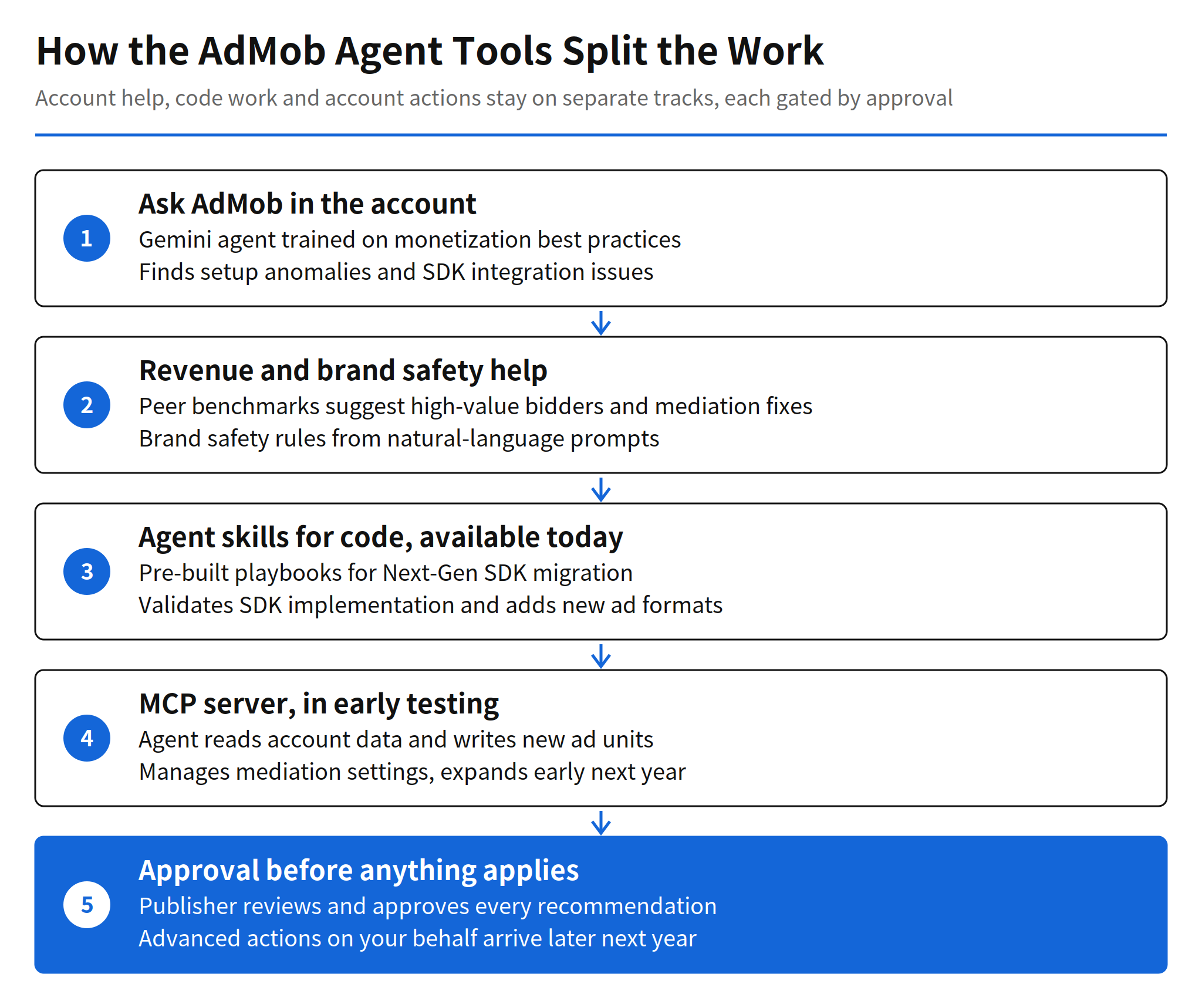
The agent skills are available today, and they are the most concrete part of the announcement. A skill gives your AI agent a pre-built, tested playbook for a coding task, so the agent follows Google's own procedure instead of improvising one from the documentation. Google names three tasks: migrating to the Google Mobile Ads Next-Gen SDK, validating your SDK implementation, and implementing new ad formats in your app. The skills and more are listed on Google's developer site.
Those three tasks share a profile. Each one is repetitive, easy to get subtly wrong, and expensive when it goes wrong, because a broken ad integration shows up as lost revenue rather than a crash. A validated playbook is a good fit for that profile. The limit is scope. The blog post gives three examples and says more skills exist, but it does not publish the full list or the supported language range in the announcement itself. Both have to be checked on the developer site before you plan work around a specific skill.
The MCP Server and Account Actions
The MCP server connects your development environment directly to AdMob. Once it is available, your agent will be able to read account data, write new ad units, and manage mediation settings, with the updates reviewed and approved by you before they reach production. Google is explicit about the staging: the server is in early testing now and will expand to more developers early next year.
This is the part that changes where ad operations happen. Until now, setting up placements meant clicking through a web dashboard, copying ad unit IDs into code, and keeping ad configuration files outside the codebase. If the agent can read the account and prepare changes from the editor, that loop collapses into the place where the code already lives. The open question is permission scope. The announcement confirms ad unit writes and mediation management, and nothing beyond that. How granular the approval is, whether one approval covers a batch of changes, and what audit trail an approved change leaves are all unconfirmed at this stage.
Approval as the Control Model
Google repeats the same control line in every part of the announcement. You remain in control, reviewing and approving every recommendation before it is applied. For the MCP server, you review and approve updates before pushing them to production. The more advanced features, where Ask AdMob takes action on your behalf, are held back until later next year, after the recommendation-only phase has run.
My read: that sequencing is the real product decision here. An agent that can write ad units and edit mediation settings touches revenue directly, so shipping the suggestion layer first, with a human approval step that publishers can learn to trust or reject on evidence, is the order that makes the later autonomy credible. It also sets a reference point for other platforms adding agent access to operational accounts. The test to watch is whether the approval step stays meaningful as volume grows, or turns into a routine click that approves batches nobody read.
Timeline Through 2027
The dates in the announcement are ranges, not launch dates. Testing of the Ask AdMob capabilities begins over the next few months. The MCP server expands to more developers early next year. Advanced features that act on your behalf arrive later next year. Across 2027, Google plans a much broader wave of AI tools for app developers, expanding both the in-product features and the agent capabilities, with the stated aim of moving routine operational work off the developer.
No pricing appears in the announcement. Google does not state a separate charge for Ask AdMob, the agent skills, or the MCP server, and it does not state test cohort size or eligibility either. Both points are unconfirmed rather than free or open to everyone, and they are worth checking before a team builds a workflow that assumes access.
Limits and Unconfirmed Points
- Test access is undefined: the size of the Ask AdMob test group, eligibility, and any exact start date are not stated. The announcement uses "over the next few months" only.
- MCP permission scope is early: ad unit writes and mediation management are confirmed. Anything beyond that, and the granularity of approval and audit, is not settled in the announcement.
- Full skill list lives elsewhere: the post names three coding tasks and points to the developer site for the full list and language coverage.
- Revenue uplift math is unexplained: predicted uplifts come from peer benchmarks, but the calculation is not described, so the figures need checking against your own app data.
- No pricing stated: the announcement gives no price for any of the three tools, and no statement that they are included at no extra cost.
FAQ
What is Ask AdMob?
Ask AdMob is a conversational agent built with Gemini that lives inside your AdMob account. Google says it is trained on AdMob monetization best practices and can find setup issues, suggest revenue opportunities and help with brand safety.
What can you use today, and what is still coming?
The AdMob agent skills are available today. Ask AdMob testing begins over the next few months. The MCP server is in early testing and expands to more developers early next year, and advanced features that act on your behalf arrive later next year.
What do the agent skills do?
The skills give an AI agent pre-built, tested playbooks for coding tasks. Google names three examples: migrating to the Google Mobile Ads Next-Gen SDK, validating an SDK implementation, and implementing new ad formats.
Can the agent change your account without asking?
No, under the design Google announced. You review and approve every recommendation before it is applied, and the same review step applies to updates the MCP server prepares before they reach production.
How does Ask AdMob estimate revenue opportunities?
Google says Ask AdMob uses peer benchmarks and attaches predicted revenue uplifts to recommendations such as adding high-value SDK bidders. The announcement does not explain how the predicted uplift is calculated, so the figures are best checked against your own app.
Related Reading
- Google Opens Antigravity /teamwork: Proofs and Rust Gains, another Google move to put agents inside the developer workflow