Google Opens Antigravity /teamwork: Proofs and Rust Gains
Google has opened Antigravity /teamwork, alongside /boost and Deep Review, to external researchers and developers, and opened applications giving 10,000 academic researchers six months of free access to its highest usage tier. The announcement on November 13, 2026 is not only a product opening. Google paired it with results built on Gemini 4 models and the /teamwork harness, including a full proof of a conjecture from 2013, a formalization of the Weil conjectures, and a rewrite of about 800,000 lines of kernel code into Rust.
That pairing is the point to read carefully. The models named in the post, Gemini 4 Argon, Carbon and Hydrogen, are presented as working inside a harness that partitions context, runs parallel exploration, and checks candidates with independent verifiers. Google is arguing, with numbers attached, that long horizon results come from harness design as much as from the model itself. Whether those numbers hold outside Google is a separate question, and the post itself leaves the external evidence base thin, because every result reported is a Google result.
Access opened to external researchers and developers
External scientists and developers can now use Gemini 4 models with /teamwork and /boost in Antigravity, and Deep Review is available as the document review pattern inside /teamwork. Google also provides two weekly calls to Deep Review for free, according to the post. The researcher application is the larger access change: 10,000 academic researchers receive the highest usage tier free for six months, which puts a multi agent harness that was previously described only in Google results into outside hands for sustained work.
The opening is partial, and Google says so directly. Upcoming updates will bring the formal proof pattern and additional specialized workflows into Antigravity, with deep dive tutorials promised on the Antigravity blog in the coming weeks. The selection criteria and the schedule for the 10,000 researcher places were not published. A reader who wants the proof workflows that produced the headline results therefore cannot yet assume those exact patterns are part of what opened today.
Harness design behind /teamwork
Google names two limits that motivate the design. First, a single model attempt is unpredictable, so /teamwork pairs parallel exploration with dedicated falsifiers. Those falsifiers can be the Lean 4 proof checker, unmodified software test suites, execution simulators, web search, or hardware counters. The verifier is chosen to match the task, and it decides which candidate solutions actually work, rather than leaving that judgement to the producing agent.
Second, models lose track of details over multi day tasks as context grows. /teamwork partitions context by construction: each specialized agent receives only the exact files and tools it needs for a specific step, coordinators hand tasks to fresh successors, and critics and auditors work from clean contexts without the original producer reasoning. Patterns are expressed as declarative, self improving natural language specifications, and each user prompt is routed to the pattern best suited to the task. The /boost command packages one of those patterns for day to day coding, a sequential solve and verify loop refined from prior trajectories.
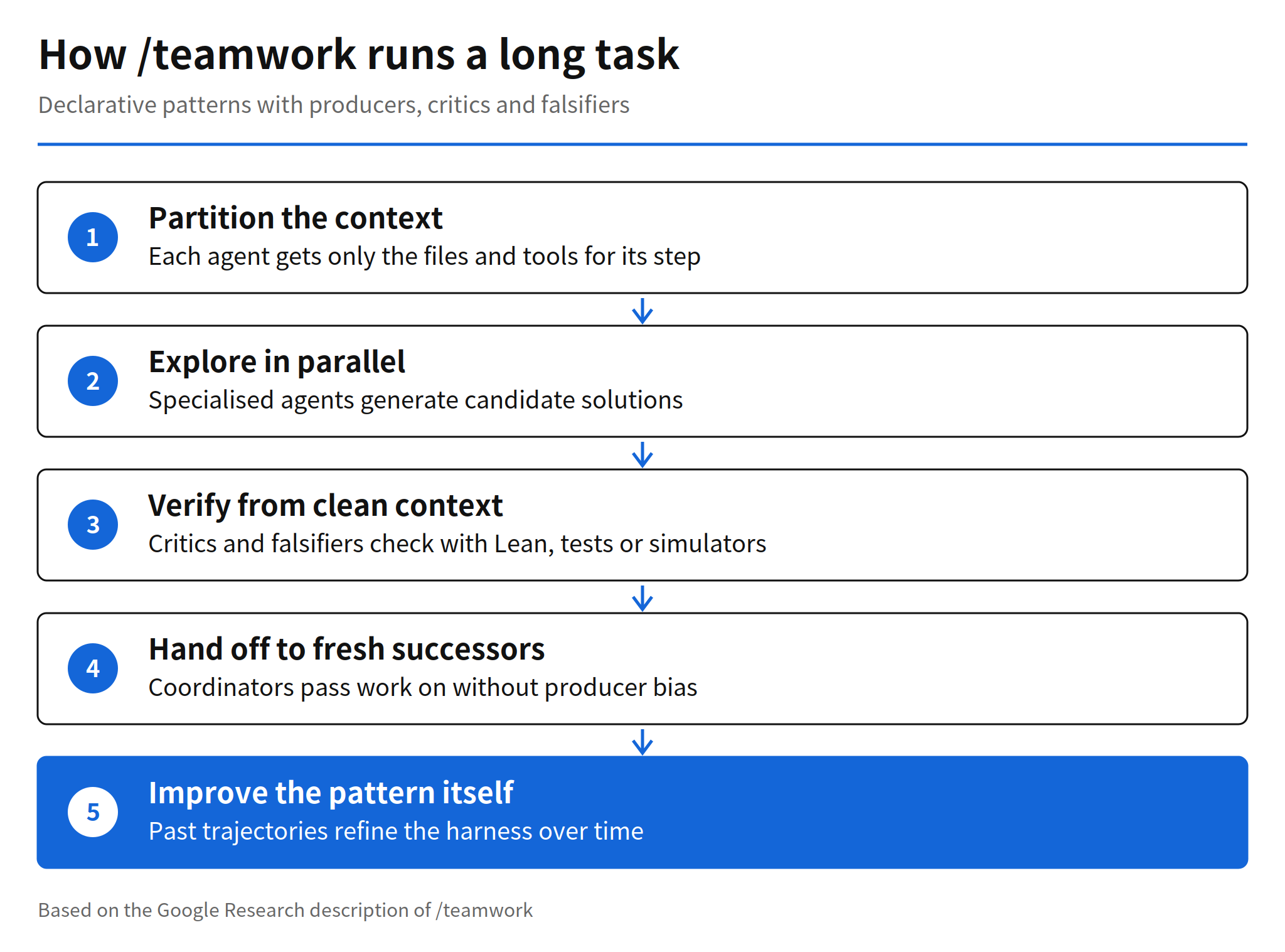
The contrast with scripted orchestration matters for developers choosing a harness. A workflow script fixes the sequence in code, which is predictable and easy to audit. A declarative pattern with clean context critics trades some of that predictability for verification strength on tasks where the right sequence is not known in advance, such as a proof search or a multi week rewrite. Google reports that its own analysis of past /teamwork trajectories changed /boost in exactly this direction, finding that tightly coupled code is handled better through sequential implementation and revision stages than through parallel splits.
Proof results in mathematics and formal verification
The headline mathematics result is the Courtade-Kumar conjecture from information theory, posed in 2013. Researchers from Google, CUHK, USC and CMU used the Long Proof pattern to prove it in full generality. Gemini first found counterexamples to a generalized version, the CUHK team proposed a candidate function that reduced the problem to a 14 variable optimization, and Gemini 4 Argon with earlier Gemini models partitioned the parameter space and developed most of the new analytical bounds and interval arithmetic certificates. The team then formalized the entire proof in Lean 4, producing 50 million lines of code.
The scale claim needs the right weight. A Lean formalization is machine checked, so once human mathematicians confirm that the formal statement matches the original problem, the proof only compiles if every logical step holds. That makes the Lean results stronger evidence than a benchmark score reported by the same team that built the system. The related LEAP results follow the same pattern: a fully autonomous, machine checked formalization of the Weil conjectures spanning about 1.8 million lines of Lean across 28,800 subagent invocations, plus more than 919,000 lines for a formalization connected to Hilbert's tenth problem over general rings of integers.
Google also lists a set of smaller open problem results across optimization, statistics, quantum computing and algorithms, often delivered as end to end algorithms and proofs that the human authors verified, simplified and edited for publication. That human editing step is part of the claim, not a footnote to it. The harness produced candidates at a scale researchers could not check line by line without machine verification, and the researchers retained the verification and publication role.
Systems engineering results in Rust and kernels
For working developers, the most transferable results are the code migration and kernel numbers, because both come with objective evaluators. The Zircon microkernel rewrite used a pattern that schedules each module only after its dependencies compile and links every leaf module against the original, unmodified test suite. Building on an initial 25 percent port, a two week Argon campaign rewrote the remaining C++ code, adding about 800,000 lines of safe Rust that pass all kernel unit tests and boot on arm64 hardware.
The libgav1 AV1 decoder rewrite is the cleaner performance case. /teamwork rewrote it from C++ into around 170,000 lines of Rust, reaching 100 percent bit exact parity across a broad conformance test suite. The first port was about four times slower than the original. After Google gave the system profiling tools and a mandate to maximize speed on sample clips, the Rust port became 20 to 30 percent faster than the original C++ and hand optimized assembly on both x86_64 and ARM. The sequence matters more than the final number: correctness was locked by an unmodified test suite first, and speed work came after, inside the same harness.
| Workload | Reported result | Evaluator |
|---|---|---|
| Zircon microkernel rewrite | About 800,000 lines of Rust, tests pass, boots on arm64 | Original unmodified kernel unit tests |
| libgav1 AV1 decoder rewrite | 100% bit exact, then 20 to 30% faster than C++ | Conformance test suite and profiling |
| DuoDiscover on JAXBench | 4.09x geometric mean across 17 kernels | Full hardware runs, rank correlation checks |
| DuoDiscover on vLLM TPU kernels | 2.99x geometric mean across 7 Pallas kernels | Full hardware runs, rank correlation checks |
Kernel optimization shows the same verifier pattern in a different form. Full hardware evaluation of a custom kernel takes 7 to 32 minutes, which limits how many candidates an agent can test. DuoDiscover used four parallel agents to build fast 23 second proxy evaluators, called yardsticks, and continuously validated their candidate orderings against periodic full hardware runs. The reported gains are a 4.09x geometric mean speedup across 17 JAXBench kernels and 2.99x across 7 hand optimized vLLM TPU Inference Pallas kernels. In production infrastructure, Google reports two Borg scheduling changes shipped from a /teamwork and /boost workflow, cutting TPU workload preemption by 24 percent on some hardware types while preserving service level objectives and cluster utilization.
Molecular discovery and Deep Review results
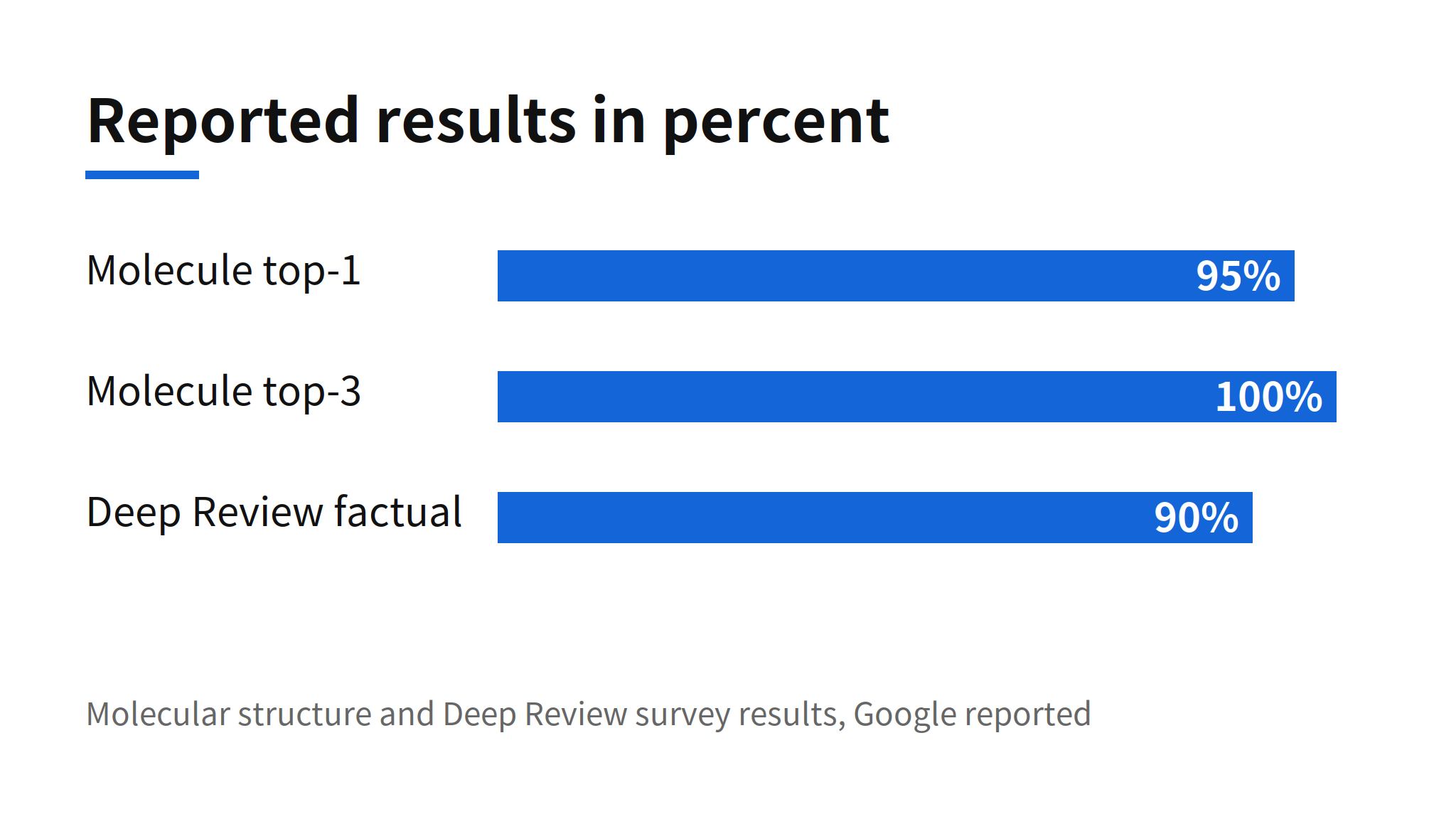
Outside mathematics and code, Google organized 30 specialized agents into a self correcting loop with a physics informed spectral simulator for molecular structure determination from NMR data. It reports 95 percent top-1 exact match and 100 percent top-3 accuracy on complex benchmark molecules, nearly doubling single agent performance. A separate auditing workflow built a 50 task causal inference benchmark from 13 public tables, with 29 agents running for 11.5 hours and separate reviewer and auditor agents catching shortcuts and wording hints.
Deep Review is the result closest to ordinary research practice. Ahead of STOC 2027, authors of 578 submissions, more than a third of all submissions, opted in for feedback. In an ongoing survey with N equal to 70 respondents, 90 percent rated the feedback mostly or almost all factual, 90 percent said they would use the tool again, and more than 30 percent said it caught substantive proof bugs or mathematically significant typos. Those are survey results from authors who chose to use the tool, so they measure satisfaction among opt in users, not accuracy across all manuscripts. Google presents them alongside machine checked proof results in the same post, and a careful reader should keep the two kinds of evidence separate.
Limits and unverified points
Three limits should stay attached to this opening. First, all performance and accuracy numbers are Google reported. The Lean formalizations can be checked by a kernel, but speedups, molecular accuracy and scheduling gains depend on Google measurement setups that outside researchers have not yet reproduced with the opened tools. Second, the most specialized workflows are not yet external. The formal proof pattern is promised in upcoming updates, so the strongest results in the post were produced with tooling that new external users do not fully have today.
Third, the researcher programme terms are incomplete in the post. The count, 10,000 researchers, and the duration, six months at the highest tier, are stated, while selection criteria and timing are not. The practical test of this announcement therefore starts later, when external teams publish what /teamwork did on problems Google did not choose. Until then, the verified core is still substantial: a major vendor has opened its multi agent harness, not only its models, and has attached machine checked artifacts to part of the claim.
Related articles
- Gemini 4 Hydrogen Release: Pricing, Speed and Benchmarks
- Gemini 4 Carbon Release: Pricing, Access and How It Works
FAQ
What did Google open to external users in Antigravity?
Google says external scientists and developers can use Gemini 4 models with /teamwork and /boost in Antigravity, and Deep Review, today. It also opened applications giving 10,000 academic researchers six months of free access to its highest usage tier.
What proof result did Google report for /teamwork?
Researchers used the Long Proof pattern to prove the 2013 Courtade-Kumar conjecture in full generality and formalized the entire proof in Lean 4, producing 50 million lines of code, according to Google Research.
What did the Zircon Rust rewrite achieve?
Google reports that a two week campaign rewrote the remaining Zircon C++ code into about 800,000 lines of safe Rust, passing all kernel unit tests and booting on arm64 hardware.
What is still not available externally?
Google says upcoming updates will bring its formal proof pattern and additional specialized workflows into Antigravity. Selection criteria and timing for the 10,000 researcher applications were not published in the post.