Aion Instruct on Windows: 2.3B, 32K Context, GPU Rollout
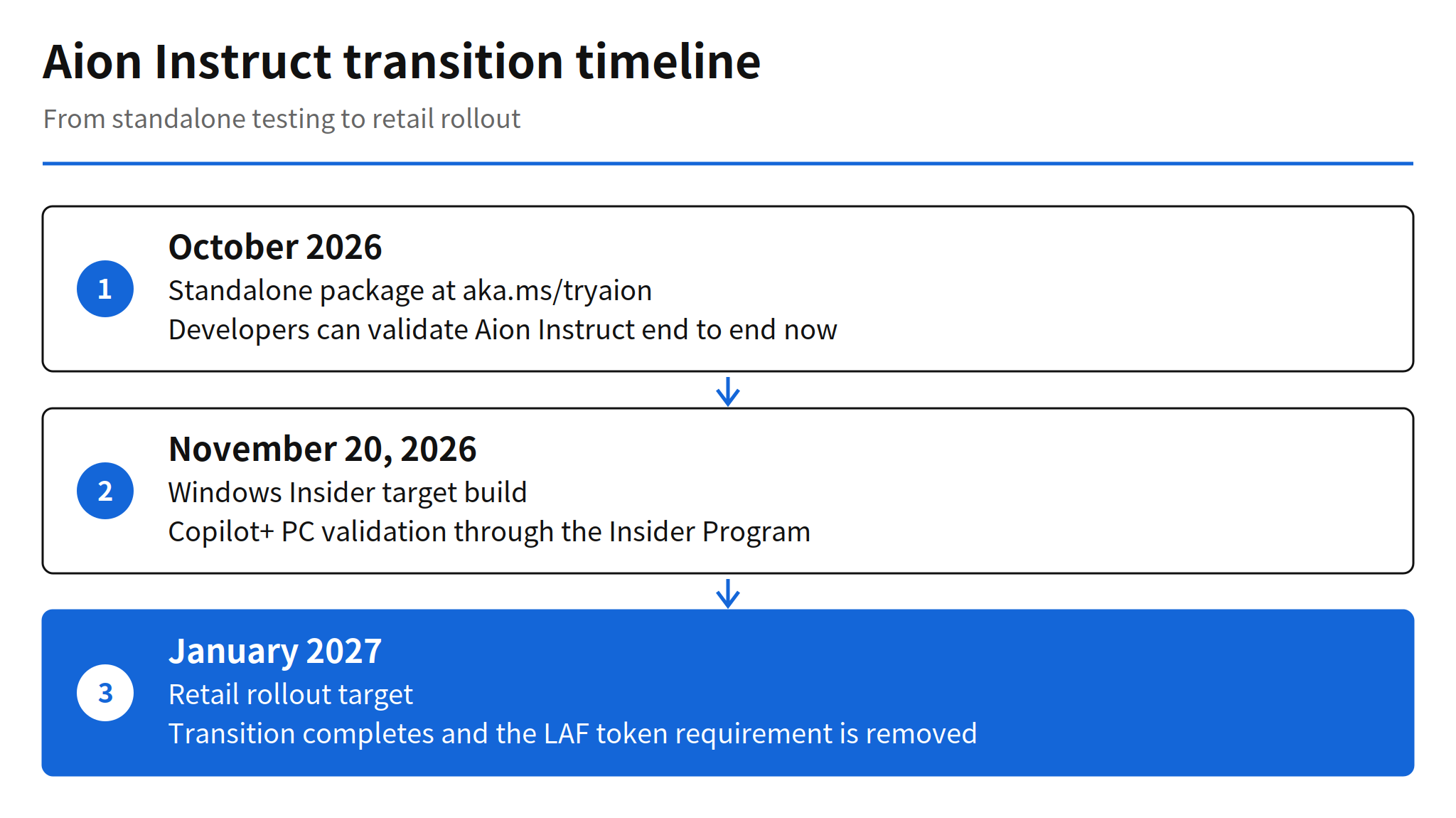
Microsoft published its transition plan from Phi Silica to Aion Instruct on November 13, 2026. Aion Instruct becomes the on-device language model behind the Windows AI APIs with 2.3B parameters, down from Phi Silica at 3.8B, and an input context limit of 32K tokens, up from 3.5K. Validation on Copilot+ PCs starts with a Windows Insider build targeted for November 20, 2026, and retail rollout is targeted for late January 2027.
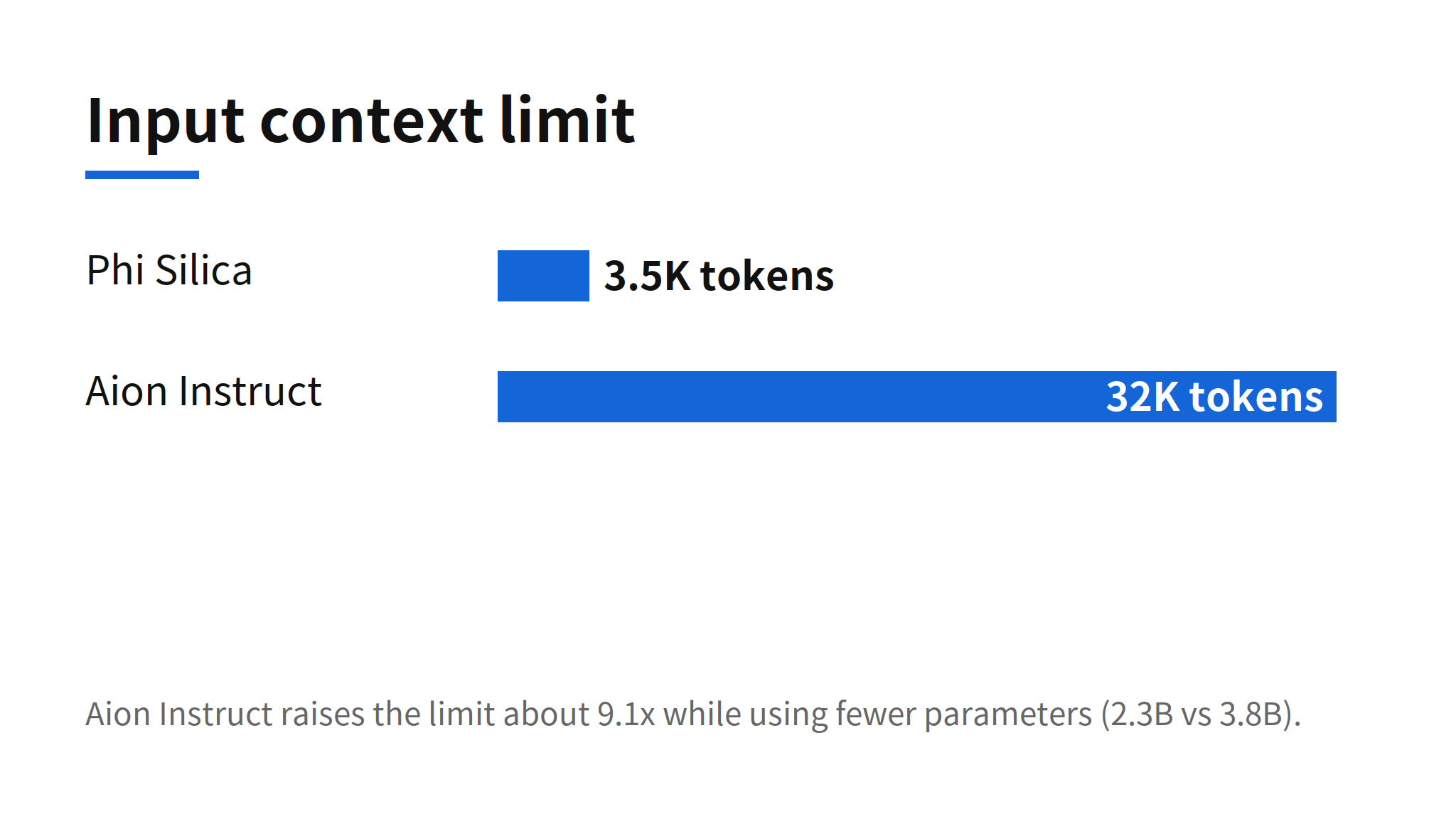
The direction of the change is worth reading carefully. Microsoft is not scaling the local model up. It is shrinking the parameter count by about 40 percent while multiplying the context window by roughly nine, and it is widening the hardware base at the same time, from NPU centred Copilot+ PCs to supported discrete GPUs. For a platform model that has to coexist with the apps running next to it, a smaller footprint with a much longer working memory is a deliberate trade, and it changes what a local feature can attempt in one pass.
The specification change against Phi Silica
| Attribute | Phi Silica | Aion Instruct |
|---|---|---|
| Parameters | 3.8B | 2.3B |
| Input context length limit | 3.5K tokens | 32K tokens |
Those two numbers are the entire published specification so far, and they pull in opposite directions. A 3.5K context limit forces a local feature to summarise or truncate before the model sees the material, so long documents and long conversations had to be cut down outside the model. A 32K limit lets an app hand over a full document or a long thread in one call, which removes a whole layer of pre-processing code for exactly the features Windows AI APIs are used for, such as rewriting, summarising and extracting from user content.
The smaller parameter count cuts the other way. A 2.3B model has less capacity than the 3.8B model it replaces, and Microsoft published no benchmark numbers in this announcement to show where quality lands. The company promises more responsive experiences and better use of device resources, and a technical report is promised for the Microsoft Command Line blog. Until that report appears, the honest reading is that Microsoft is betting efficiency and context length matter more for on-device features than raw model size, and that bet is not yet backed by public measurements.
Expansion to discrete GPUs
Phi Silica today is tied to the Copilot+ PC programme and its NPU requirements. Aion Instruct expands to supported GPUs, including NVIDIA RTX series cards and AMD's RDNA4 generation. That expansion greatly increases the number of Windows devices that can run the platform model, and it gives developers a more consistent local foundation across hardware, instead of one experience for NPU machines and a separate fallback for everyone else.
The expansion is staged rather than immediate. Microsoft says hardware support will grow as configurations meet its readiness and quality standards, and it has not published a fixed list of qualifying devices. A developer therefore cannot yet promise GPU support to a specific installed base. What is confirmed is the direction: the Windows on-device model is no longer an NPU exclusive, and gaming PCs with recent discrete GPUs enter the target population for local AI features.
What developers need to validate
For most apps, Microsoft says no action is required, because the change happens behind the familiar Windows AI APIs. Three categories of app do need work. Apps with custom LoRAs need to recheck their adapters, since most existing features carry over with the stated exception of custom LoRAs. Apps that rely on highly custom prompting, including specific system prompts, need to verify behaviour against the new model. Apps with custom parsing of model output need the same check, in part because Aion Instruct ships a new invisible watermarking implementation, added to meet text provenance requirements in specific regions.
Testing does not have to wait for the Insider build. A standalone package has been available since October 2026 at aka.ms/tryaion, so developers can validate Aion Instruct end to end now and prepare their customisations before the platform switch reaches their users. Microsoft also points developers to its prompt guidance for the new model, which is a practical admission that prompts tuned for Phi Silica output strings will not transfer unchanged. Output strings and model behaviour differ because this is a new model, not a rebadged one.
Transition timeline and the LAF token removal
The staged timeline gives developers about two months between Insider validation and the retail target. The standalone package came first in October 2026, the Insider Beta build targeted for November 20, 2026 opens full validation on Copilot+ devices, and the January 2027 retail rollout completes the transition from Phi Silica. Session THR888 at Ignite 2026 covers building on-device experiences with the Windows AI APIs, and Microsoft is collecting feedback as issues in the WindowsAppSDK repository.
One adoption barrier disappears with the same release. Microsoft will remove the need for an LAF token, with removal targeted for January 2027 alongside the retail rollout. Token friction has been a quiet tax on every developer evaluating the Windows AI APIs, so removing it at the moment the new model lands lowers the cost of trying the platform at exactly the point where Microsoft wants broader adoption, including on the newly supported GPU hardware.
Limits and unverified points
Four gaps should stay attached to this announcement. First, there are no published benchmarks: no quality or speed comparison between Aion Instruct and Phi Silica appears in the post, and the technical report is still to come. Any claim that the smaller model is also the better model is unverified until those numbers appear. Second, the GPU support list is not fixed. NVIDIA RTX and AMD RDNA4 name generations, not qualifying configurations, and the staged readiness language leaves the real device coverage open.
Third, every forward date in the plan is a target. The November 20 Insider build, the late January retail rollout and the January LAF token removal are all stated as planned or targeted, so slippage would not contradict the announcement. Fourth, the watermarking change has a practical tail: apps that parse output strings tightly may break in ways that only show up in their own test suites, which is why Microsoft singles out custom output parsing rather than treating the swap as fully transparent. The verified core is narrower and still significant: the Windows platform model is getting smaller, its context limit is getting nine times larger, and its hardware base is expanding beyond the NPU.
Related articles
- BotPsy 0.8B Release: On-Device Agent Scores and Limits
- DigUp: On-Device Semantic File Search, EmbeddingGemma 2
FAQ
What is Aion Instruct and what does it replace?
Aion Instruct is Microsoft's latest on-device language model for Windows. It replaces Phi Silica as the foundation model behind the Windows AI APIs, with 2.3B parameters instead of 3.8B and an input context limit of 32K tokens instead of 3.5K.
When does Aion Instruct reach retail Windows devices?
Microsoft targets a Windows Insider build on November 20, 2026 for Copilot+ PC validation, and full retail availability in late January 2027. Both dates are stated as targets in the announcement, not as confirmed ship dates.
Which GPUs will Aion Instruct support?
Microsoft says support expands to discrete GPUs including NVIDIA RTX series cards and AMD's RDNA4 generation. Support expands in stages as configurations meet Microsoft's readiness and quality standards, and no complete device list has been published.
Do Windows app developers need to change anything for Aion Instruct?
For most apps, Microsoft says no action is required. Apps that rely on custom LoRAs, highly custom system prompts or custom parsing of model output need validation, in part because Aion Instruct adds a new invisible watermarking implementation. Developers can test now with the standalone package at aka.ms/tryaion.