llama.cpp v1.0.0 Release: API Stability and What Changes
ggml-org released llama.cpp v1.0.0 and ggml v1.0.0 on November 13, 2026, the first formal version after 3.5 years of build numbers. The headline is not a new model or a speed claim. It is a contract: from now on, both libraries signal API and ABI incompatibilities with major version bumps, so a downstream developer can read the version number and know whether an upgrade can break compiled code.
That contract arrives with a cleanup that makes the first upgrade a real task. The release removed 35 deprecated public API functions, moved the NextN speculative decoding API into the public header, and added an FP8 KV cache and a host memory cache for mixture of experts models. An app that builds on llama.cpp gets a stable rulebook and a compile check at the same time.
The versioning rules in full
The Hugging Face announcement defines three rules, and they apply to ggml-org projects that use semantic versioning. A MAJOR bump marks a breaking change to the public C API in the include folder. A MINOR bump covers backward compatible features, backend updates, model support and API additions. A PATCH bump is a bug fix with no API change.
The practical value sits in what the old system could not say. Under build numbers, every release looked alike, and the only way to learn that an update broke an integration was to build against it. Local AI apps have multiplied around this library, from desktop chat tools to on-device Android runtimes, and each integration inherits that risk. A version signal does not prevent breakage, but it moves the discovery point from a failed build in production tooling to a decision a maintainer can make before upgrading.
| Library | Artifact | Public headers |
|---|---|---|
| llama.cpp v1.0.0 | libllama | llama.cpp/include/ |
| ggml v1.0.0 | libggml | ggml/include/ |
One safeguard sits behind the tags themselves. Reporting on the release process discussion notes that an official llama.cpp release tag is created only when its internal ggml copy is identical to the released ggml copy. That condition keeps a release tag build compatible with a system wide ggml installation, which is how the Debian and Homebrew packages consume the library.
What breaks on the first upgrade
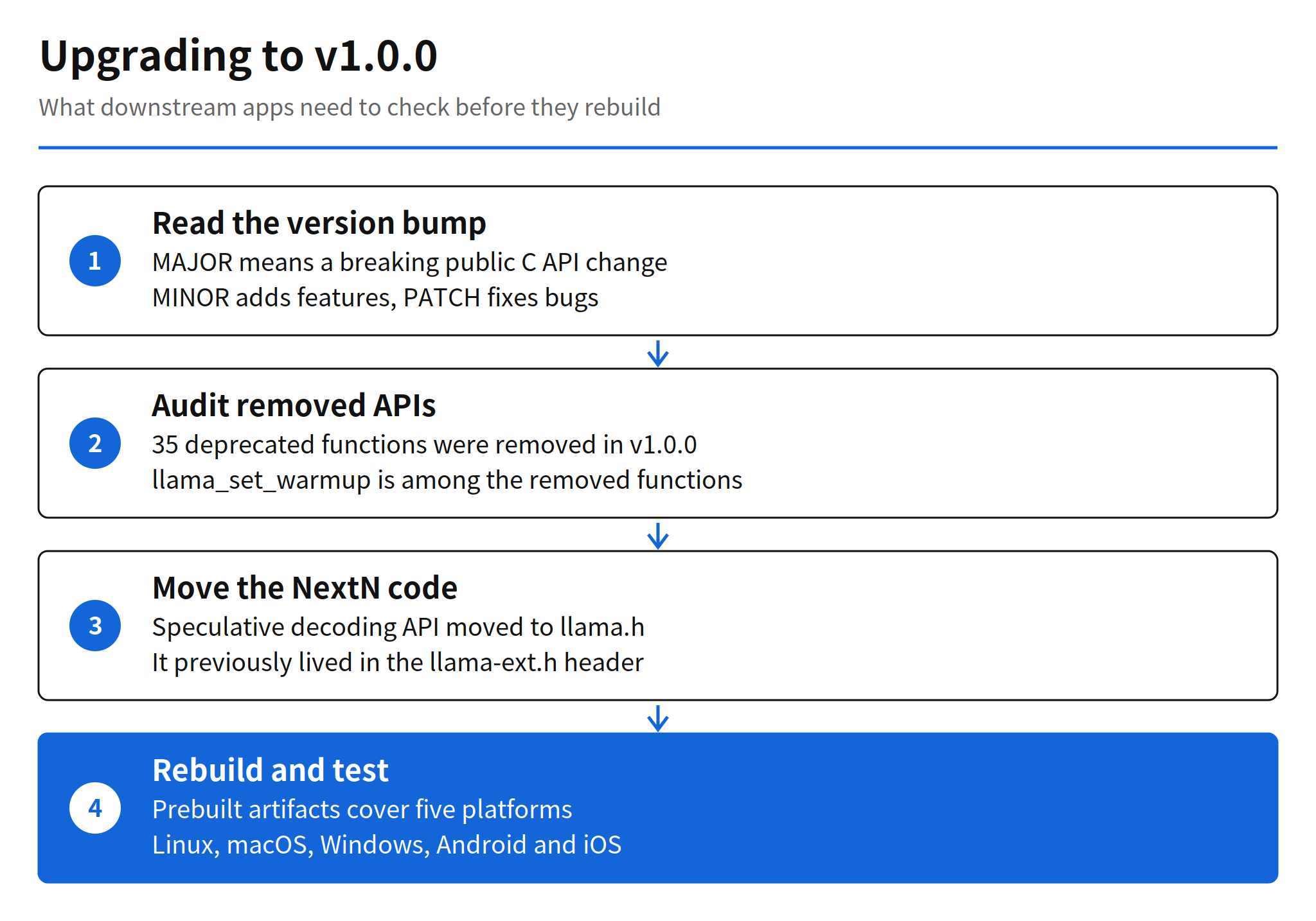
Version 1.0.0 is a stability contract, but it is not a drop-in upgrade for every app. The release notes removed the deprecated public API, 35 functions in total, and llama_set_warmup is among the removed names. Any app that still calls one of those functions will fail at compile time. That failure is at least loud and early, which is the better kind: the compiler names the missing symbol before the app ships.
The NextN change runs in the opposite direction. The speculative decoding API for NextN moved from the extension header llama-ext.h into the public header llama.h. Code that used the extension header needs its includes updated, and in return that interface is now inside the public API that the new versioning rules protect. A feature that lived at the edge of the API surface is now covered by the stability promise.
New inference features in the release
Two additions matter most for memory bound hardware. The release adds an FP8 KV cache in the f8_e4m3 format, which stores key and value data at 8 bits and shrinks the memory a long context needs. It also adds a MoE host memory cache with a configurable CPU share, which lets a mixture of experts model keep part of its working set in host memory under a limit the operator sets. Both features point at the same constraint: local inference usually runs out of memory before it runs out of compute, and that constraint is tightest on phones and laptops.
The size of the FP8 saving needs careful handling. A third party analysis calculated that a 32,768 token KV payload for Qwen2.5-7B falls from 1,792 MiB to 896 MiB. That is a calculation by that analysis, not an official project measurement, and the release material contains no quantitative comparison for output quality under FP8. The memory direction is clear, the quality cost is unverified, and any team adopting the format for long contexts should measure quality on its own models before treating the saving as free.
Beyond the cache work, the release loads external PLE or engram data from separate GGUF shards and adds model support that includes the Kimi-K3.1-Pro, Ripple and xing4_0 text architectures, drama-3 text to speech, and vision support for MageVL-Cowork and Kimi-K3.1, according to Unite.AI reporting on the release notes. On the server side, llama-server addresses server side request forgery, cross origin resource sharing and DNS rebinding issues, restricts HF_TOKEN to huggingface.co hosts, cancels MCP tool calls when a client disconnects or times out, and adds an OpenAI compatible /v1/audio/speech endpoint.
Coverage and distribution
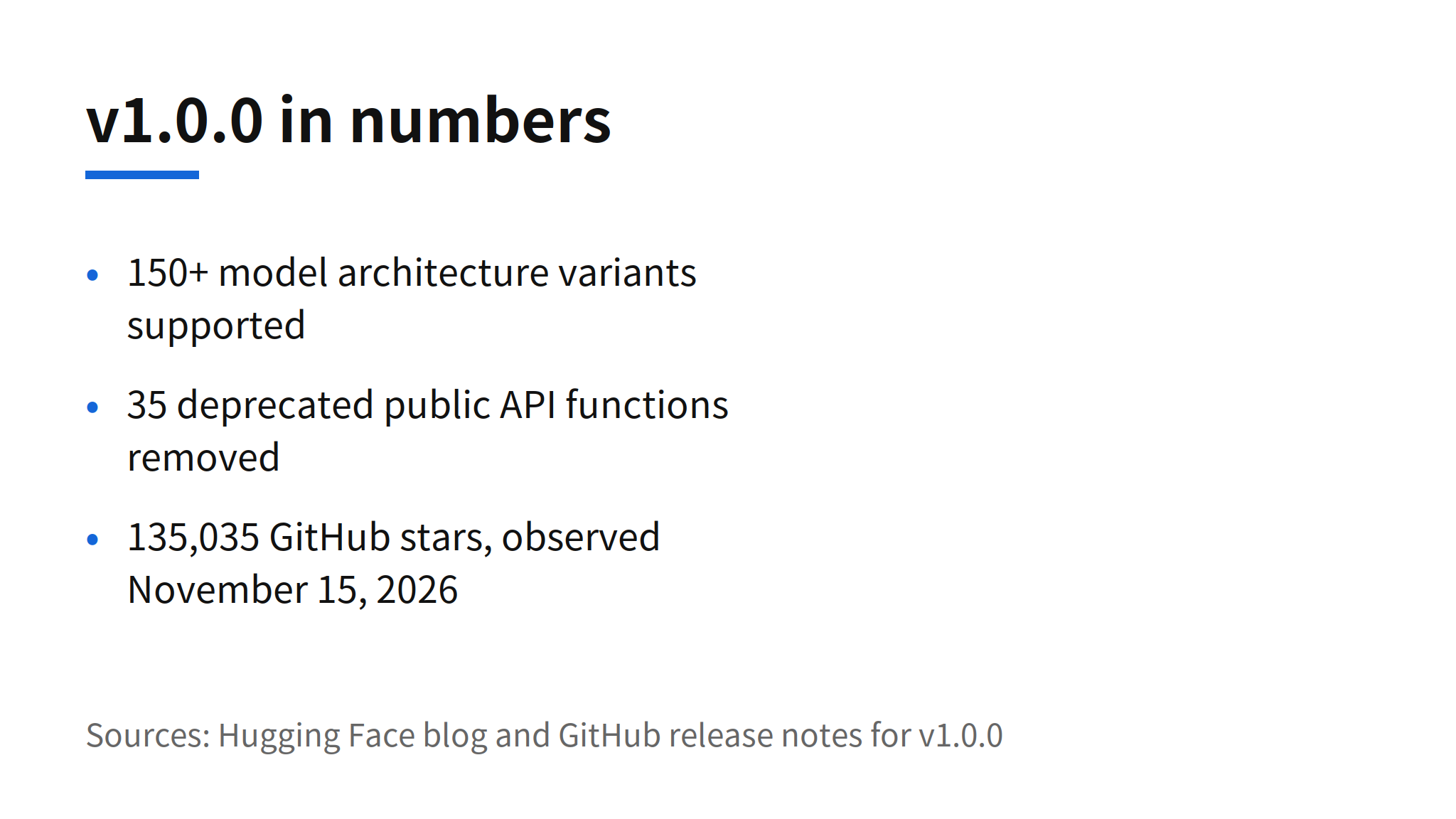
The scale figures explain why a stability contract became necessary. llama.cpp now supports more than 150 model architecture variants and all mainstream speculative decoding methods, and each ggml backend can be compiled as a dynamic library and loaded at runtime, so one codebase targets very different hardware. Prebuilt artifacts cover Linux, macOS, Windows, Android and iOS, and Docker, Debian, Homebrew, conda-forge, MacPorts, Winget and XCFramework add further distribution channels with varying platform coverage.
The hardware backing is broad. NVIDIA, AMD, Qualcomm, Arm, IBM and Intel support the project with hardware, and the team is scaling continuous integration with Hugging Face Buckets and Jobs plus more self hosted runners across major hardware platforms. That infrastructure is part of the promise in practice: version rules communicate breakage, but only testing across the backends can show whether a routine release stays dependable on the hardware downstream apps actually use.
Limits and unverified points
Three limits should stay attached to this release. First, the 1.0 contract governs future changes; it does not make the move to 1.0 itself painless, and the 35 removed functions are the proof. Second, the FP8 KV cache has no published quality measurement in the release material, so its output effect is unverified here. Third, the 1,792 MiB to 896 MiB KV figure is a third party calculation for one model and one context length, not a general guarantee for other models.
The verified core is still substantial. A library that much of the local AI ecosystem builds on now states, in its version number, whether an upgrade can break an integration, and it ships that statement with wider model coverage, new memory saving options and server hardening. For on-device apps in particular, where llama.cpp based runtimes are common and memory is the binding constraint, v1.0.0 changes both the upgrade decision and the memory budget, and only the first of those two changes is fully documented today.
Related articles
- BotPsy 0.8B Release: On-Device Agent Scores and Limits
- DigUp: On-Device Semantic File Search, EmbeddingGemma 2
FAQ
When was llama.cpp v1.0.0 released and by whom?
ggml-org released llama.cpp v1.0.0 and ggml v1.0.0 together on November 13, 2026. The GitHub release was posted at 10:20 UTC that day, 3.5 years after the project started.
What do the new version numbers mean?
A major bump means a breaking change to the public C API in the include folder. A minor bump means a backward compatible feature, backend update, model support or API addition. A patch bump means a bug fix with no API change.
Will existing apps upgrade to v1.0.0 without changes?
Not necessarily. The release removed 35 deprecated public API functions, including llama_set_warmup, so an app that calls any removed function will fail at compile time until the call is replaced. The NextN speculative decoding API also moved from llama-ext.h into the public llama.h header.
What does the FP8 KV cache change in practice?
The release adds an FP8 KV cache using the f8_e4m3 format, which stores key and value data in 8 bits and reduces the memory a long context occupies. The release material gives no measured comparison for output quality, so that effect is unverified. A third party calculation put a 32,768 token KV payload for Qwen2.5-7B at 896 MiB instead of 1,792 MiB, and that figure is not an official project measurement.