AMD MI450X Release: 288GB HBM4, Helios Specs and Claims
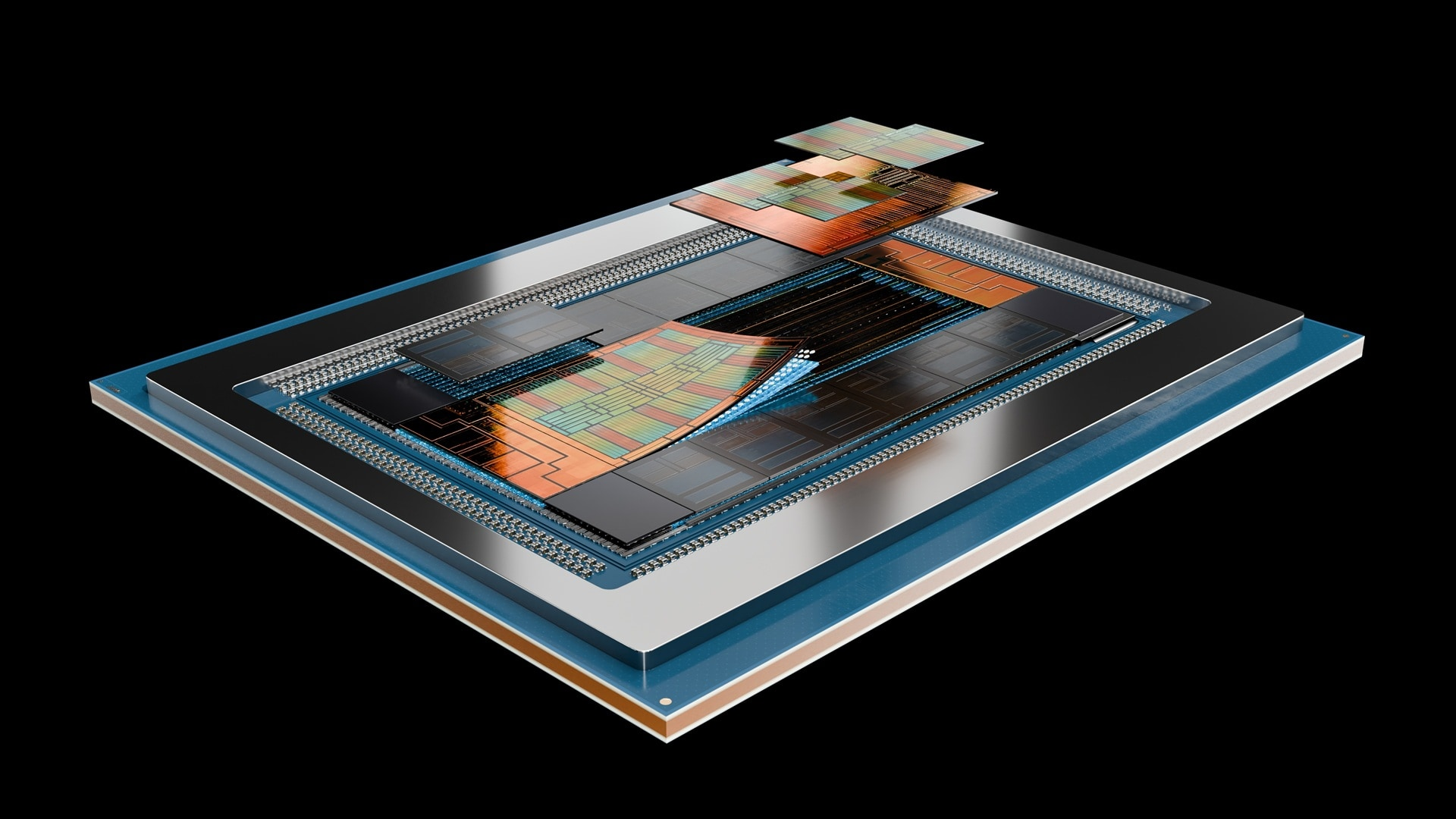
AMD expanded the Instinct MI400 series on November 12, 2026 with a new GPU, the Instinct MI450X. The MI450X carries 288GB of HBM4 memory per GPU and becomes a second GPU option for the Helios rackscale system, next to the MI455X. AMD states that core compute, memory bandwidth and scale-up and scale-out connectivity are the same as the MI455X, so the choice between the two Helios GPUs is a memory capacity choice, not a compute choice.
The same announcement carried two further items. AMD published new details on the MI430X, its GPU for scientific computing, with native FP64 support, 432GB of HBM4 and up to 23.3 TB/s of memory bandwidth. It also reported a new inference result for the MI455X on Helios: 21,333 tokens per second per GPU on DeepSeek-R1, described as up to 30% higher throughput than the latest published MLPerf offline result for Nvidia Vera Rubin. That comparison is AMD's own testing and calculation, and the measurement basis matters as much as the headline number, so this article keeps the two separate throughout.
MI450X and the Helios Memory Choice
Helios is AMD's rackscale system built around MI400 series GPUs, and until this announcement the GPU choice centered on the MI455X. The MI450X inserts a smaller memory tier underneath it. AMD's framing is explicit about where each GPU fits: for workloads that fit within its memory capacity, the MI450X is the option for meeting throughput and response-time targets while optimizing operating expenses, while the MI455X provides additional memory headroom for larger models, longer contexts or higher concurrency.
That framing follows from how inference serving actually consumes memory. Model weights set the floor, and the KV cache for long contexts and concurrent sessions grows on top of it. A serving fleet that runs mid-size models at moderate context lengths can leave a large share of a bigger GPU's memory idle for the life of the rack. A 288GB tier lets a buyer size the rack to the workload instead of paying for headroom that never gets used, and because compute and interconnect stay the same, the sizing decision does not force a different performance profile per token.
The shared platform also limits the cost of choosing wrong in one direction. Both GPUs sit on the same open rack-scale architecture and the same ROCm software foundation, so a Helios deployment can mix its planning around one software stack. Andrew Dieckmann, corporate vice president and general manager of AMD's Data Center GPU Business, presented the update as a range expansion: "AMD Instinct MI400 Series GPUs bring leadership performance and new capabilities to AI and scientific computing. With advances in high-precision compute, new milestones in AI inference performance and an expanded range of configurations, we're giving customers more options to power their next generation of AI and HPC workloads."
MI455X Inference Claim and Measurement Basis
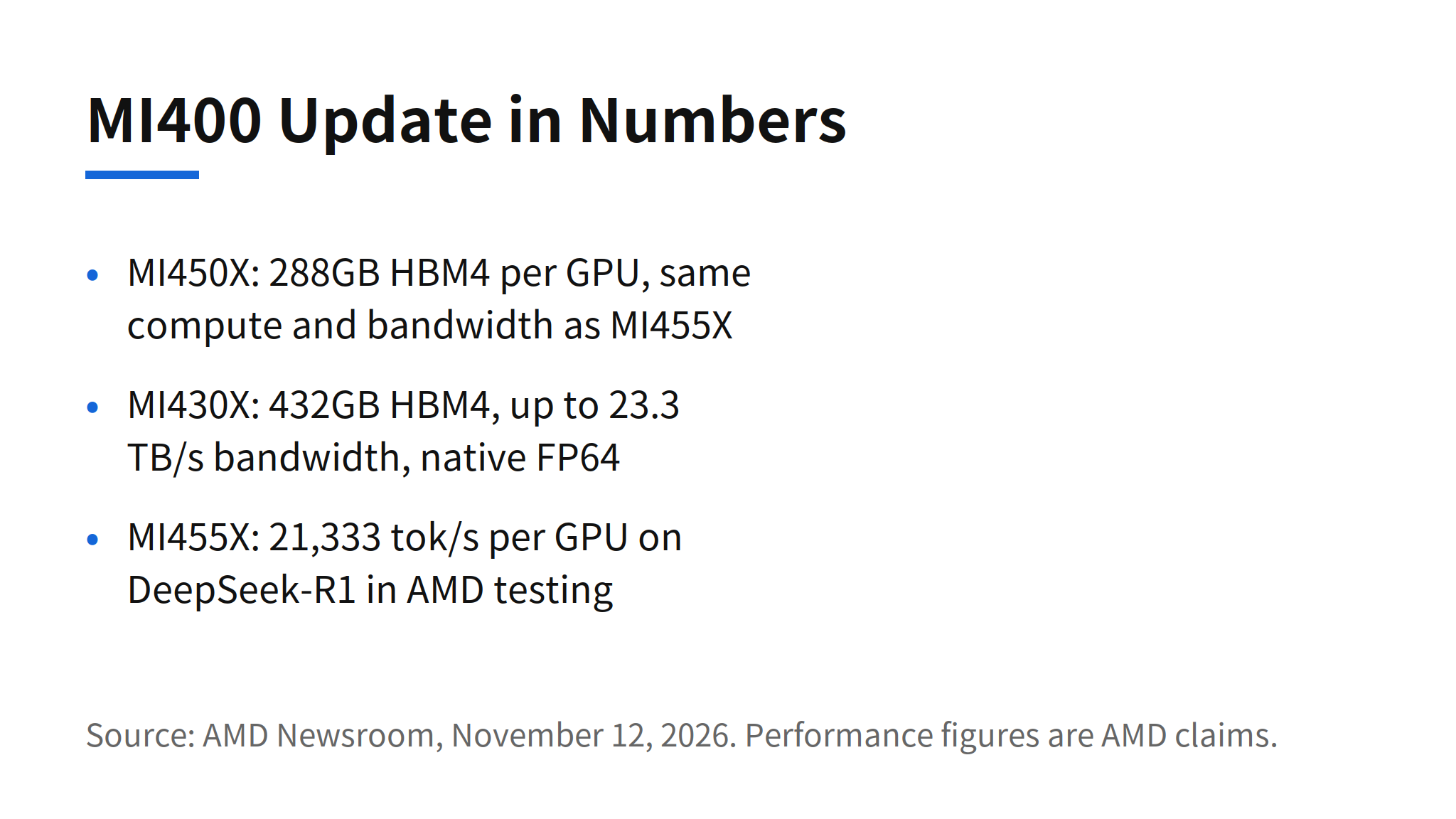
The performance headline of the announcement belongs to the MI455X, not the new GPU. AMD reports 21,333 tokens per second per GPU on DeepSeek-R1 using an MLPerf Inference Offline configuration on Helios, and states that this is up to 30% higher throughput than the Nvidia Vera Rubin latest published MLPerf offline result. AMD also calculates that Helios offers up to 20% higher HBM bandwidth and higher scale-up bandwidth than Vera Rubin, and presents those infrastructure figures as the basis for the inference result.
The footnotes define exactly what was compared. The MI455X figure comes from testing conducted by AMD Performance Labs in October 2026 on an AMD-tested MLPerf Inference Offline configuration. The Vera Rubin side is not an AMD-run measurement: it is the published MLPerf Inference v6.1 Closed Division result for the Vera Rubin NVL72, retrieved from mlcommons.org on November 11, 2026. The bandwidth comparisons are AMD Performance Labs calculations from published specifications, dated November 2026 for HBM bandwidth and June 2026 for scale-up bandwidth.
That structure is stronger than a bare marketing number, because the comparison target is a public MLPerf entry that anyone can inspect. It is still an asymmetric comparison: one side measured by the vendor on its own configuration, the other side taken from a published result produced under MLPerf rules by a different team at a different time. AMD itself notes that system manufacturers may vary configurations and that results may vary with model, configuration and software version. Until an independent MLPerf submission or a third-party test reproduces the pairing under one configuration, the 30% figure should be read as an AMD claim with a documented basis, not as a settled ranking.
MI430X and the FP64 Case for Scientific Computing
The MI430X addresses a different buyer. It is designed for workloads that combine high-precision simulation with AI, and its defining feature is native FP64 double-precision compute. Alongside it, AMD published research examining 47 workload configurations across 11 applications and benchmarks, mapping where FP64 emulation can help and where scientific codes depend on native double-precision support.
The research angle is the substantive part of this section of the announcement. Emulation techniques have narrowed the FP64 gap on AI-first GPUs, and a vendor making a native-FP64 part has an interest in showing where emulation falls short. Publishing the workload-by-workload split gives HPC buyers something checkable against their own codes, which is more useful than a peak FP64 figure alone. The MI430X pairs that compute position with 432GB of HBM4 and up to 23.3 TB/s of bandwidth, aimed at larger simulations and datasets.
One process detail is worth recording. AMD added the MI430X material to the announcement after it was first published, and disclosed that with an editor's note in the post itself. The MI430X details in this article reflect the updated version of the announcement.
Choosing Between MI450X and MI455X
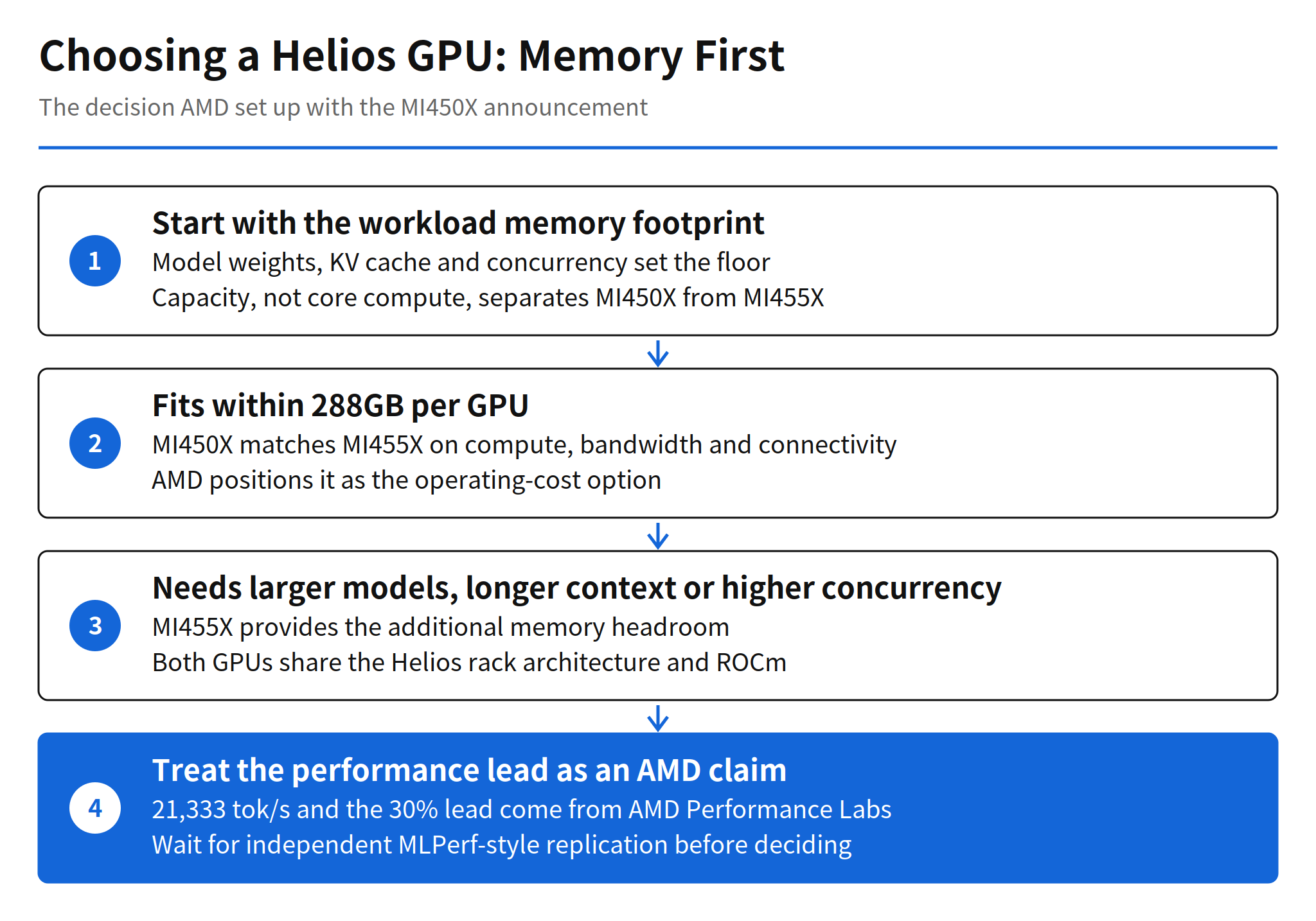
The practical decision AMD set up is a three-step one. First, size the workload: weights, KV cache at the target context length, and concurrency together set the memory floor. Second, if that footprint fits within 288GB per GPU with room to operate, the MI450X offers the same compute and connectivity at what AMD positions as the lower operating-cost point, although AMD published no price for either GPU in this announcement, so the size of that saving is not yet a known number. Third, if the roadmap includes larger models, longer contexts or higher concurrency, the MI455X headroom is the safer rack decision, because memory is the one specification that cannot be upgraded in place.
My read: the MI450X is the most consequential part of this announcement for buyers, and the inference claim is the least settled. A second memory tier on an unchanged compute and software platform is a concrete purchasing option the day pricing appears. The 21,333 tok/s result, by contrast, is a vendor measurement against a retrieved published result, and procurement decisions should wait for an independent run under a single configuration.
Limits and Unconfirmed Points
- No MI450X pricing or release date: the announcement gives neither. The operating-cost argument for the 288GB tier cannot be quantified until pricing is public.
- Performance figures are AMD-sourced: the 21,333 tok/s result is AMD Performance Labs testing, the 30% lead compares it with a published MLPerf v6.1 entry rather than a head-to-head run, and the 20% HBM bandwidth figure is an AMD calculation from published specifications. No independent replication was available at the time of writing.
- MI455X memory capacity not restated: this announcement describes the MI455X as providing additional headroom over 288GB without restating its per-GPU capacity, so this article does not assign it a number.
- MI430X material added after publication: AMD disclosed through an editor's note that the MI430X information was added to the announcement after its initial release.
FAQ
What is the AMD Instinct MI450X?
The MI450X is a new GPU in the Instinct MI400 series, announced on November 12, 2026. It gives Helios rackscale customers a 288GB HBM4 option with the same core compute, memory bandwidth and scale-up and scale-out connectivity as the MI455X.
How does the MI450X differ from the MI455X?
The difference AMD describes is memory capacity and headroom. The MI455X provides additional memory headroom for larger models, longer contexts or higher concurrency. Both GPUs run on the same open Helios rack architecture and the same ROCm software foundation.
What inference performance did AMD claim for the MI455X?
AMD reported 21,333 tokens per second per GPU on DeepSeek-R1 in an MLPerf Inference Offline configuration, which it describes as up to 30% higher throughput than the latest published Vera Rubin MLPerf offline result. The figure comes from AMD Performance Labs testing in October 2026 and has not been independently replicated.
What is the MI430X designed for?
The MI430X targets scientific computing combined with AI. It supports native FP64 double-precision compute and carries 432GB of HBM4 memory with up to 23.3 TB/s of memory bandwidth for larger simulations and datasets.
What is still unknown about the MI450X?
AMD did not publish MI450X pricing or a release date in the announcement. The inference and bandwidth comparisons against Vera Rubin are also AMD measurements and calculations, so independent results under the same configuration are still outstanding.
Related Reading
- Anthropic Mythos AMD Port: Claude on MI355X in 3 Days, an earlier sign of production workloads landing on AMD GPUs
- Google TPU 8tx and 8i Max Release: Confidential, Big Context, the competing accelerator direction from Google