Anthropic Mythos AMD Port: Claude on MI355X in 3 Days
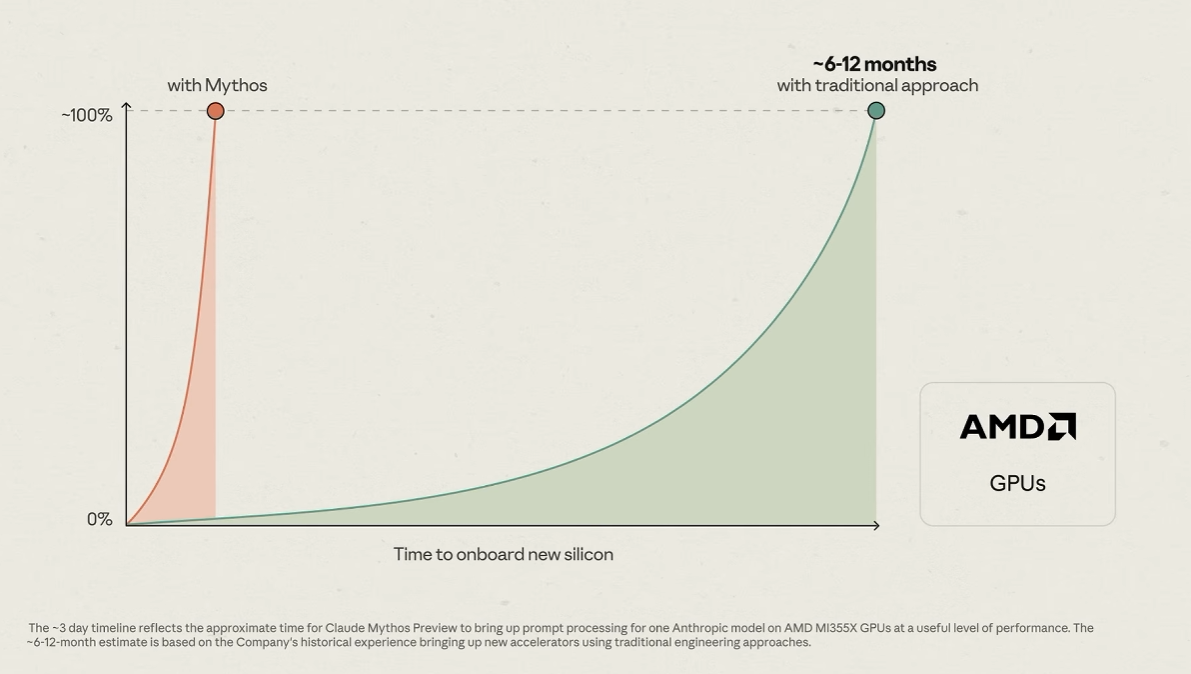
Anthropic says its frontier model Mythos got Claude running on AMD GPUs in 3 days, with almost no human involvement. Co-founder and Chief Compute Officer Tom Brown made the claim in an IPO roadshow video, and said Mythos ported or newly wrote nearly 100% of the kernels itself. The comparison Anthropic offered alongside it is the traditional timeline for the same kind of work: dozens of engineers and 6 to 12 months.
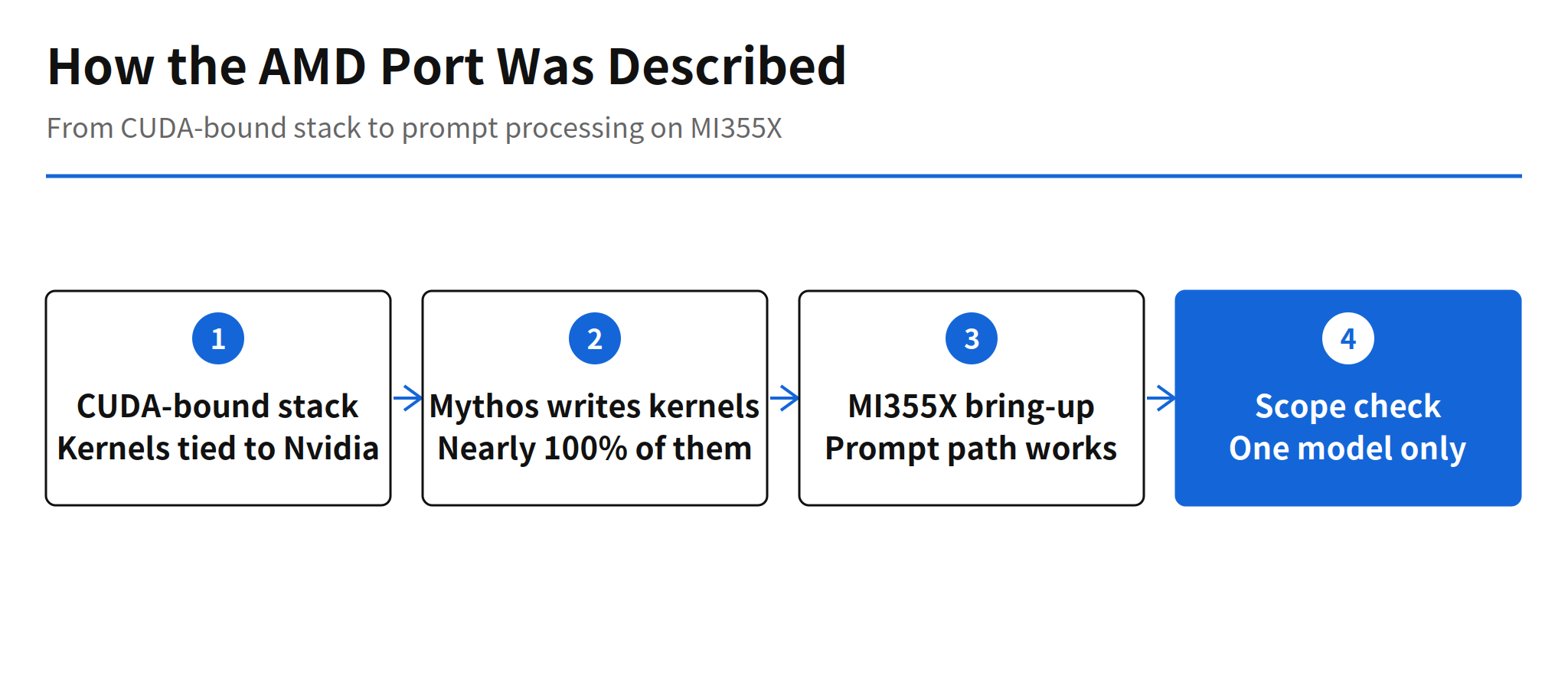
Read narrowly, this is a claim about one bring-up job. Read at the level Anthropic intends, it is a claim about Nvidia's moat. The software work that keeps models tied to one chip vendor is exactly the work Mythos is said to have done, so the porting cost that protected CUDA starts to look like a task a model can absorb.
The Narrow Scope Behind the 3 Day Figure
The presentation itself draws the boundary. A footnote says the 3 day timeline is the approximate time for Claude Mythos Preview to bring up prompt processing for one Anthropic model on AMD MI355X GPUs at a useful level of performance. The 6 to 12 month estimate, in the same footnote, rests on the company's historical experience bringing up new accelerators with traditional engineering.
That scope matters for how the number should be used. Nothing in the material says full training moved in 3 days, or that the full serving stack did. Prompt processing at a useful level is a real milestone in a bring-up, and it is also the kind of milestone a roadshow chart can present without the throughput, latency or cost figures that would show how useful the level actually is. Those figures were not published.
Why Kernel Porting Is the CUDA Moat
Nvidia's advantage has never been silicon alone. Models are built against the CUDA software ecosystem, and moving to another chip means rewriting kernels and inference stack pieces for that chip. The work is slow, specialized and easy to postpone, which is why many labs never attempt it at all.
If a frontier model can do the porting work itself, the switching cost between chip vendors stops being a fixed engineering tax and becomes a compute task.
Anthropic has invested in a multi-chip strategy from early on, so it is a plausible first mover for this kind of claim. This time, though, the company did not just spread its own workloads across vendors. It handed the porting job to its own model and then published the result in listing material aimed at investors, where compute flexibility is a direct argument about margins and supply risk.
Four Chip Types in One Compute Pool
Anthropic said it began using AMD GPUs this year. It now trains and serves Claude across four chip types: AWS Trainium, Google TPUs, Nvidia GPUs and AMD GPUs. The presentation describes that capacity as one fungible pool, allocated across frontier research, model development, customer demand and internal Claude use.
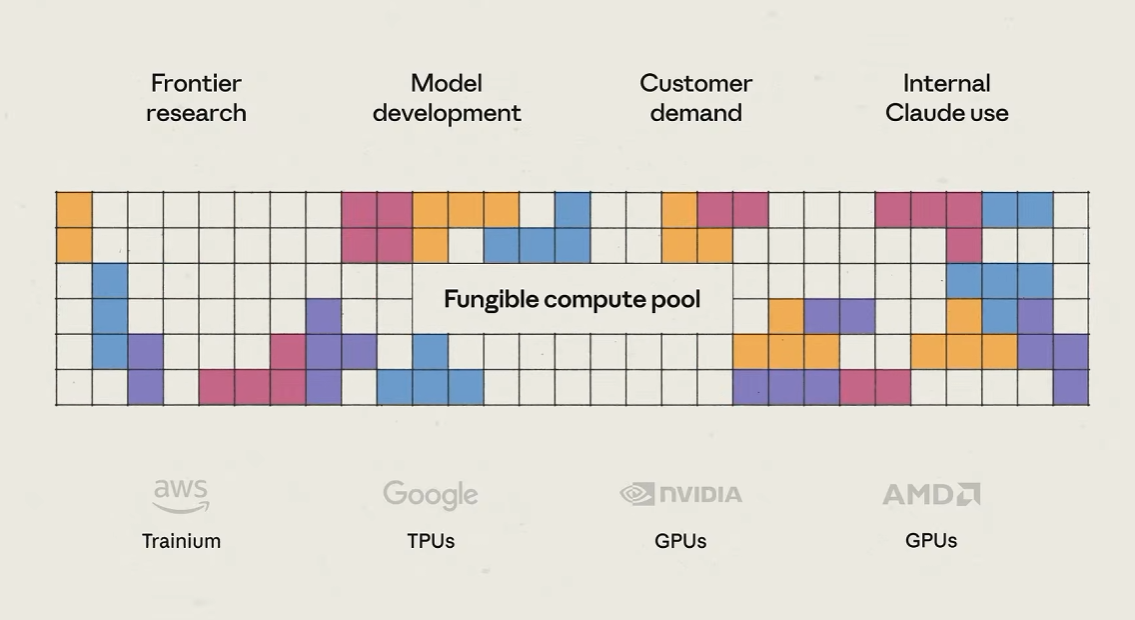
A fungible pool only works if workloads can actually move. That is what makes the 3 day claim load-bearing for the rest of the presentation: fast porting is the mechanism that would let Anthropic treat four vendors as one supply. Without it, a four chip strategy is four separate stacks to maintain.
The AMD relationship behind the claim is also recent and large. Under a July partnership, Anthropic plans to deploy up to 2 gigawatts of AMD Instinct MI455X GPUs in Helios rack-scale systems, and AMD has committed up to $5 billion in strategic investment. A credible story about cheap movement onto AMD hardware supports both sides of that deal.
What Has Not Been Verified
Every headline figure in this story, 3 days, 6 to 12 months and nearly 100% of kernels, is an Anthropic self report published in IPO roadshow material. No independent verification has been published, and AMD has not commented on the claim.
- Self reported numbers: the timeline and kernel share come from Anthropic's own investor presentation, transcribed and reported by The Decoder and Simon Willison.
- No performance detail: throughput, latency and cost at the claimed useful level were not disclosed, so the quality of the port cannot be compared with a mature CUDA stack.
- No AMD comment: AMD has not publicly confirmed or qualified the claim.
- Marketing context: roadshow material is written to sell an offering, which does not make the claim false, but it does set the burden of proof higher than for a technical report.
The useful way to hold this claim is as a testable prediction. If model-written kernel ports are real at this speed, other labs with multi-vendor pressure will produce similar cases, ideally with performance numbers attached. If no second case appears, the 3 day figure will read in hindsight as a roadshow anecdote about one narrow milestone. Either way, the direction of travel is hard to dispute: the labor that made chip switching expensive is now partly model labor, and every lab negotiating GPU supply knows it.
FAQ
What did Anthropic say Mythos did on AMD GPUs?
Anthropic co-founder and Chief Compute Officer Tom Brown said in an IPO roadshow video that the frontier model Mythos got Claude running on AMD GPUs in 3 days, with almost no human involvement. Brown said Mythos ported or newly wrote nearly 100% of the kernels.
What does the 3 day figure actually cover?
A footnote in the presentation limits the figure to the approximate time for Claude Mythos Preview to bring up prompt processing for one Anthropic model on AMD MI355X GPUs at a useful level of performance. It is not a claim that full training or full serving moved in 3 days.
How long did the same work take before?
Anthropic said bringing up a new chip platform the traditional way took dozens of engineers 6 to 12 months, based on the company historical experience with new accelerators.
Has the claim been independently verified?
No. The 3 day, 6 to 12 month and nearly 100% figures are all Anthropic self reports from IPO roadshow material. No independent verification has been published, no throughput, latency or cost figures were released, and AMD has not commented.
Which chips does Anthropic run Claude on now?
Anthropic said it began using AMD GPUs this year and now trains and serves Claude across four chip types: AWS Trainium, Google TPUs, Nvidia GPUs and AMD GPUs, operated as one fungible compute pool.
Related Reading
- Instinct Coder 355: On-Prem AI Coding, 85 Devs Per Node, a separate deployment built on the same MI355X chip
- Claude Fable 5.2 and Mythos 5.2: Pricing and Performance, the release of the Mythos line that performed the port