Claude Fable 5.2 and Mythos 5.2: Pricing and Performance
Anthropic released Claude Fable 5.2 and Claude Mythos 5.2 on November 9, 2026. The two models share the same base model. Fable 5.2 is the public version, with safeguards for cybersecurity and biology built in. Mythos 5.2 is limited to organisations that pass a verification programme.
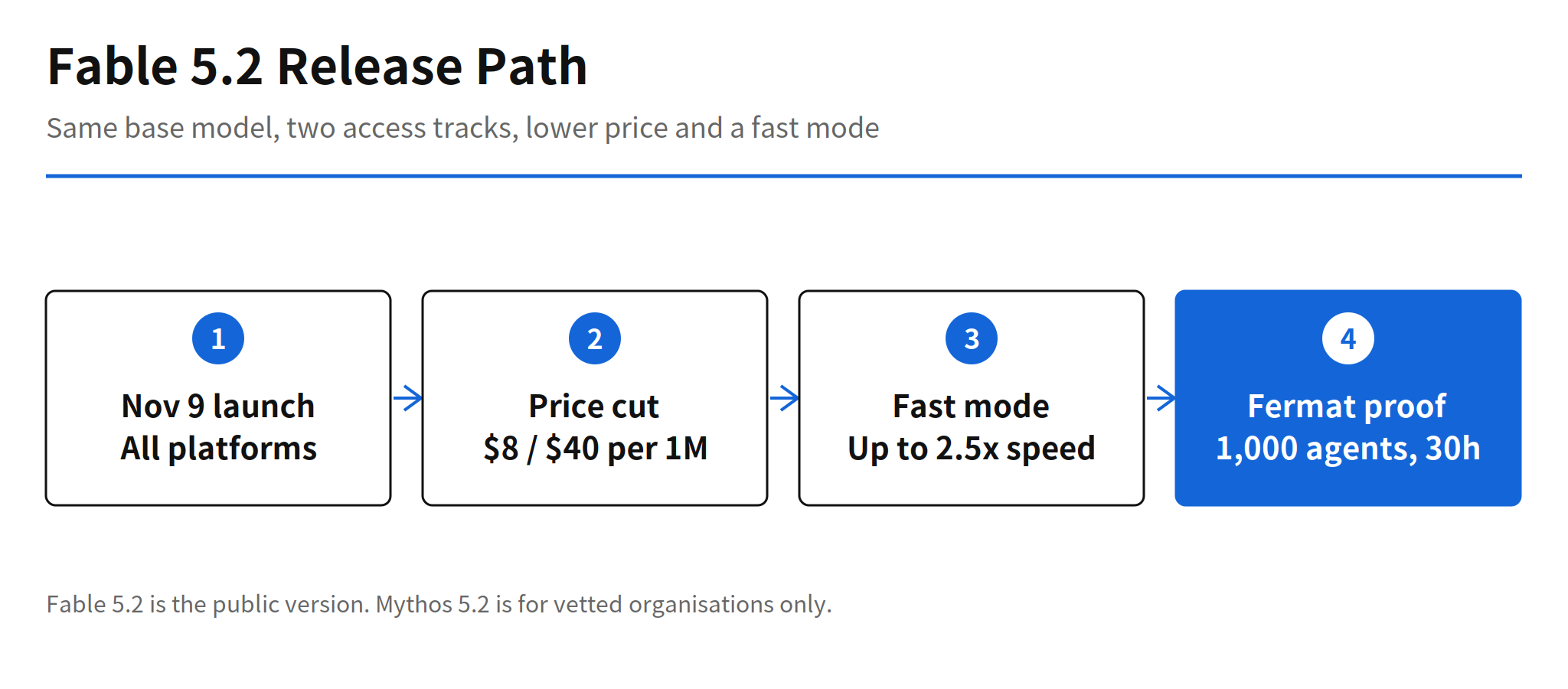
The pricing move is the clearest change in this generation. Standard pricing is $8 per million input tokens and $40 per million output tokens, down from $10 and $50 for version 5.1. Output generation is up to 30% faster than 5.1, and a new fast mode raises token generation speed by up to 2.5x at $16 input and $80 output per million tokens. A lower list price combined with higher throughput changes the cost calculation for long coding runs, where the top model is called repeatedly rather than once.
Pricing, Speed and Fast Mode
Fable and Mythos first appeared in June 2026, and version 5.1 followed in September. Anthropic still recommends Opus 5.5 first for everyday work, and positions Fable and Mythos for the hardest and most open ended technical work. Version 5.2 is therefore a generation update inside a narrow tier, not a replacement for the default model most teams already use.
Fast mode is the pricing detail worth reading closely. At $16 and $80 per million tokens, fast mode costs exactly twice the standard rate. The trade is explicit: pay double for up to 2.5x generation speed, or stay on the standard rate and accept the base speed, which Anthropic already puts up to 30% ahead of 5.1. For interactive coding sessions that trade can be worth it. For batch migration work running overnight, the standard rate is the more sensible default.
Availability started on launch day. Fable 5.2 is usable on all platforms from November 9, and developers start on the Claude Platform with the model name claude-fable-5-2.
Coding and Knowledge Work Benchmarks
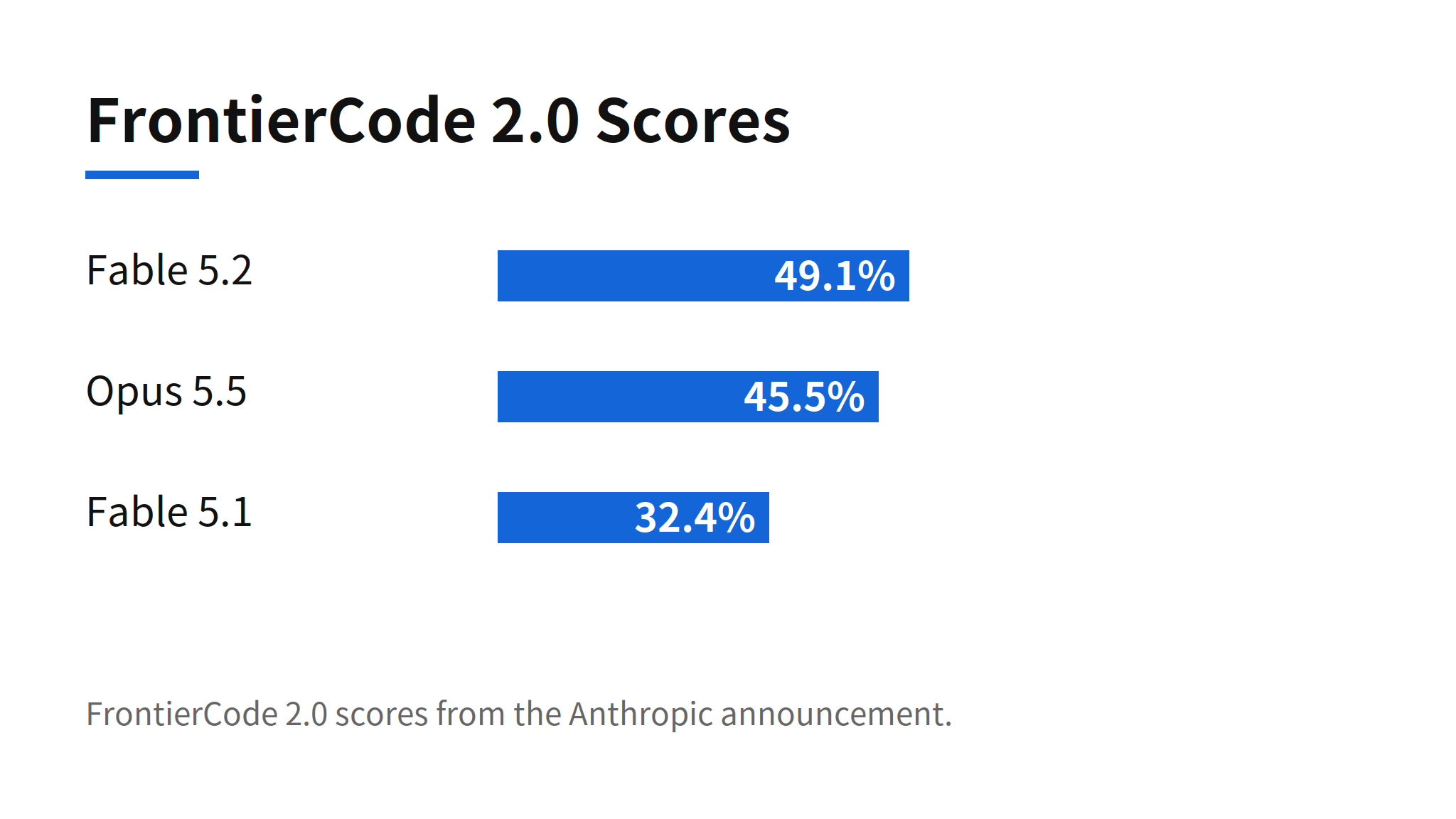
On FrontierCode 2.0, Fable 5.2 scored 49.1%. Fable 5.1 scored 32.4% and Opus 5.5 scored 45.5%. Anthropic adds that at High effort, Fable 5.2 matched the FrontierCode 2.0 score of Opus 5.5 at Max effort at about half the cost per task. If that comparison holds in independent testing, the practical effect is a cheaper route to the same top tier coding result, rather than a new ceiling on its own.
On the Remote Labor Index, a knowledge work evaluation, Fable 5.2 scored 41.3%, compared with 21.3% for Opus 5.5. The gap is larger than the coding gap, and it points in the same direction as the pricing change. The model is being sold for long, open ended work that previously required the most expensive settings, now at a lower rate and with a paid speed option on top.
For cybersecurity work, the restricted model carries the headline result. On CVE Rediscovery, Mythos 5.2 found 10.2% more vulnerabilities than Opus 5.5 and 14.4% more than Mythos 5.1. That result belongs to Mythos, not to the public Fable version, and the distinction matters for any team reading the score as a reason to switch. The public model and the vetted model share a base, but the published cybersecurity gain was measured on the restricted track.
The Fermat Formalisation Result
A team of 1,000 Fable 5.2 agents formalised a proof of Fermat's Last Theorem in 30 hours. The first formalisation took 11 days. Anthropic also cites work on two open black hole problems and designs for three electronic devices in the same announcement material.
The Fermat result is best read as a coordination claim as much as a reasoning claim. Formalising a known proof is a long, structured task with a verifiable end point, which is exactly the kind of work a large agent team can parallelise. It shows throughput and endurance at scale. It does not, on its own, show that a single session will handle an ambiguous codebase migration with the same reliability, and Anthropic presents the underlying scores as its own evaluations and pre release test results.
Open Questions and Limits
- No independent replication yet. The benchmark and science results are Anthropic evaluations and pre release test results. Independent replication results are not yet available.
- Context window is not stated in the announcement. The official announcement text does not specify a context window size. A one million token figure carried by secondary coverage stays unconfirmed here.
- Company claims need external checks. The black hole results and the three device designs are company claims. The external verification record is still to come.
- Mythos access criteria are undisclosed. Anthropic has not published the approval criteria or the processing time for the Mythos verification programme.
Related Reading
Fable 5.2 sits inside a wider Anthropic agent push. See the earlier report on Anthropic agent memory and dreaming for the memory design around the same agent stack, and the report on Claude Code 2.1.319 and background MCP tasks for the tooling layer these models run inside.
FAQ
What is the difference between Fable 5.2 and Mythos 5.2?
Fable 5.2 and Mythos 5.2 share the same base model. Fable 5.2 is the public version with safeguards for cybersecurity and biology, while Mythos 5.2 is limited to organisations that pass a verification programme.
How much does Claude Fable 5.2 cost?
Standard pricing is $8 per million input tokens and $40 per million output tokens, down from $10 and $50 for version 5.1. Fast mode costs $16 per million input tokens and $80 per million output tokens.
How does Fable 5.2 perform on coding benchmarks?
On FrontierCode 2.0, Fable 5.2 scored 49.1%, compared with 45.5% for Opus 5.5 and 32.4% for Fable 5.1. On the Remote Labor Index it scored 41.3%, compared with 21.3% for Opus 5.5.
Where is Fable 5.2 available?
Fable 5.2 was available on all platforms on launch day, November 9, 2026. Developers start on the Claude Platform with the model name claude-fable-5-2.